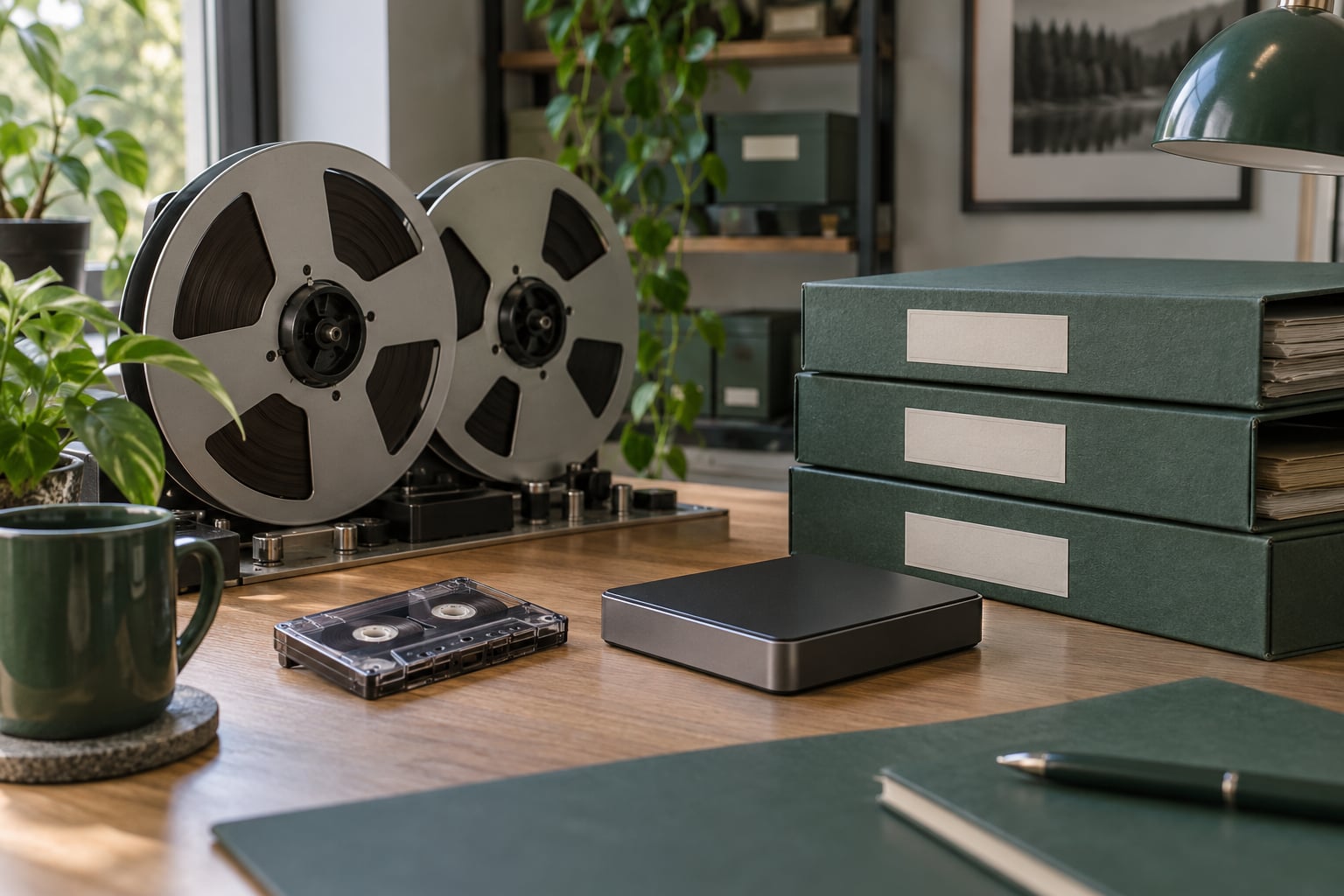
Radio archives are preserved by assessing every recording, stabilising fragile carriers such as reel-to-reel tape and shellac discs, digitising the most at-risk material into high-resolution preservation masters, describing it with proper metadata, and storing copies in several separate places under controlled conditions. Rights are then checked before anything is published. The work is a pipeline, not a single act.
Most listeners assume a station keeps everything it broadcasts. Some do. Many keep a rolling window of a few weeks and quietly delete the rest, which is why so much local broadcast history simply does not exist any more. Understanding the pipeline matters if you want to find old shows, donate tapes you have inherited, or argue for a station to keep its history.
What follows is how the process actually runs, from the moment a reel lands in a box to the moment a researcher or a listener can request it.
Table of Contents
- What Is a Radio Archive?
- Why Radio Broadcasts Need Preservation
- How Radio Archives Are Preserved Step by Step
- What Media Formats Are Used in Radio Archives?
- How Do Archivists Store and Protect Recordings?
- How Are Rights and Access Managed?
- How Can Listeners Find and Support Radio Archives?
- Frequently Asked Questions
- Are old radio broadcasts still available to listen to online?
- How long does it take to preserve a radio station archive?
- Can degraded or damaged tape recordings be restored?
- Can I legally upload old radio broadcasts online?
- What is the 3-3-3 rule for radio?
- What happens to radio archives when a station closes?
- Conclusion
What Is a Radio Archive?
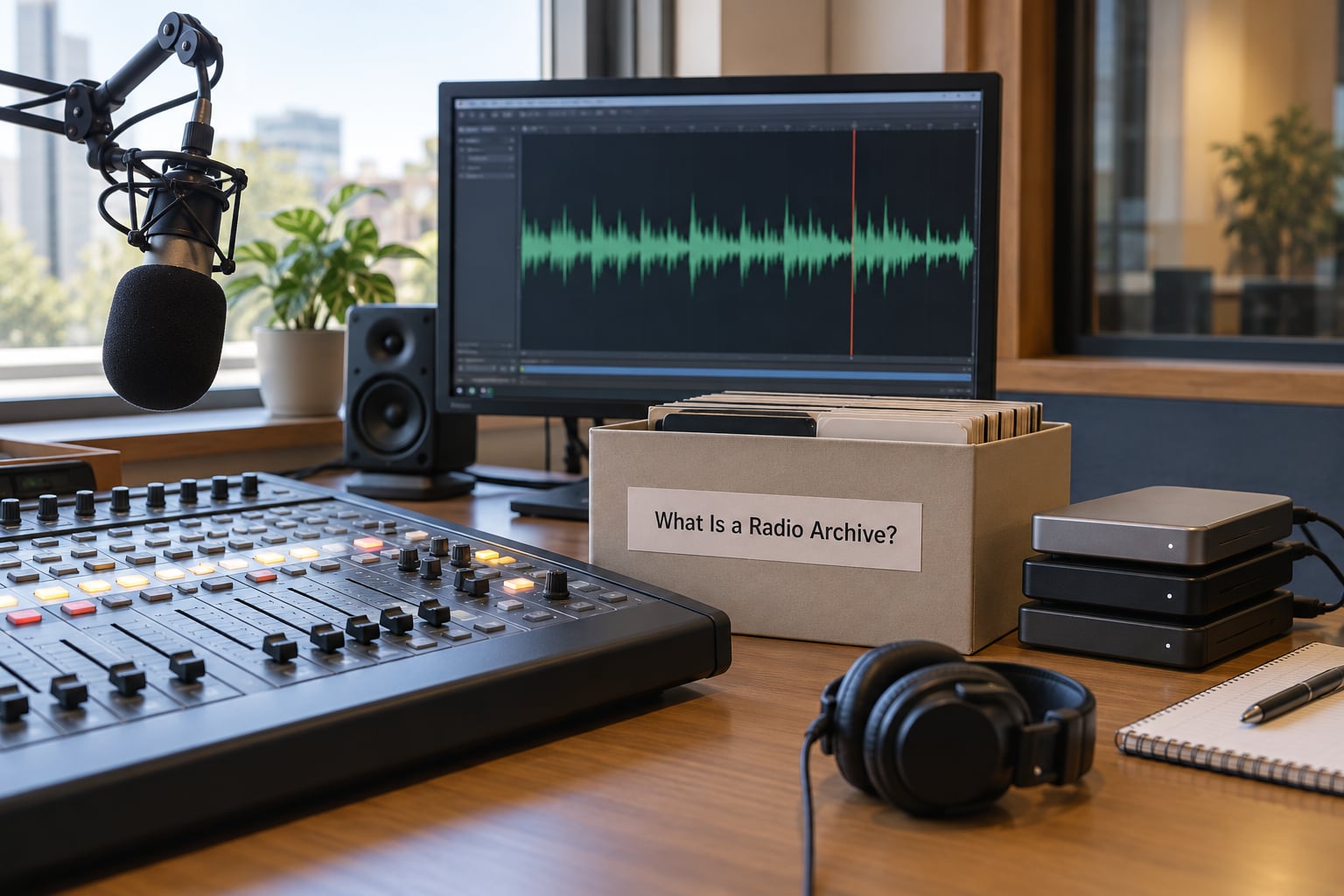
Radio archive preservation is the process of assessing, stabilising, digitising, describing and securely storing recordings, documents and programme materials so they survive decay, obsolescence and ownership change.
A radio archive is any organised collection of broadcast audio and the paperwork that explains it. In practice there are four fairly distinct kinds, and they survive in very different ways.
The first is the live-capture or log system. Commercial stations usually run automated recording systems that log every broadcast to a central server, then wipe the storage on a rolling schedule. These are operational tools, not archives, and what survives depends entirely on how long somebody configured the retention window.
The second is the station library: physical tape, the station’s music and jingle logs, scripts, adverts, contest paperwork, photographs and correspondence. For a small community or student station this is often a few boxes in a cupboard. It is also the most likely material to be thrown out during a move or a budget review.
The third is the public collection. National libraries, the BBC Sound Archives, the British Library Sound Archive and university special collections hold broadcast material with cataloguing standards, stable addresses and a duty to keep it.
The fourth is the online repository: audio streamed or downloaded from a collection rather than played off the original carrier. Useful for listening, but it inherits whatever rights limits the institution had to work around.
Why Radio Broadcasts Need Preservation
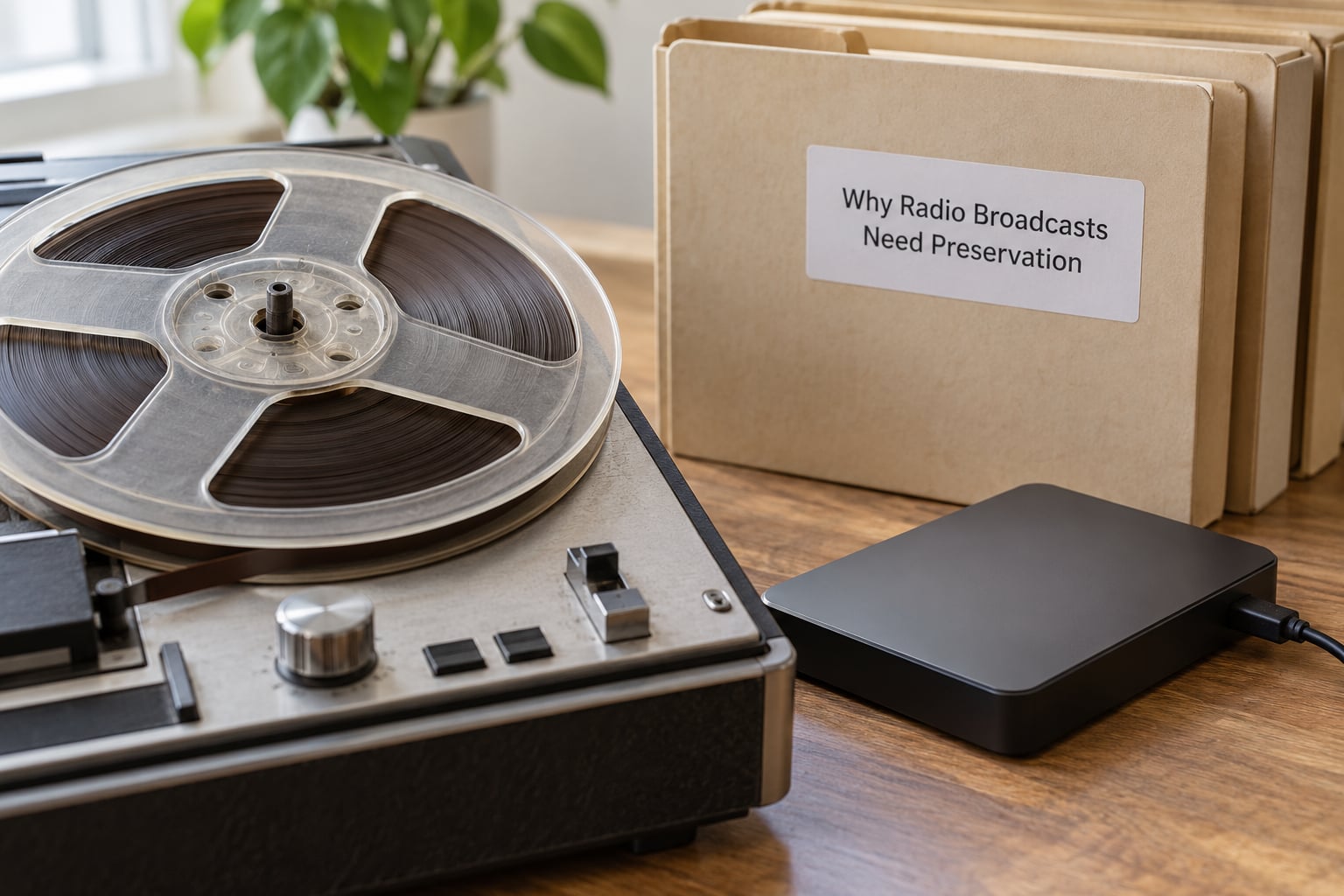
Radio is a live medium, and live media are disposable by default. The reasons archives disappear are boring and predictable, which is exactly why the losses are avoidable.
Retention schedules do the damage first. A station running a 30-day log cycle holds a month of audio and then overwrites it. Nobody decides to destroy a historic recording; the file simply gets replaced.
Physical media decay does the rest. Acetate discs go brittle and then crumble. Magnetic tape suffers binder degradation, where the backing sheds sticky residue onto the head within seconds of playback, or sticky shed syndrome, where oxide transfers to the tape path instead. Open reel stored in a hot attic or a damp cellar will fail regardless of how carefully it was handled.
Ownership change finishes the job. When a station is bought, merged or rebranded, the tapes usually stay in a cupboard nobody has opened in years, until a landlord clears the room. The famous loss cases are blunt: DuMont Television Network kinescopes dumped into the Upper New York Bay for their scrap metal, and a 1938 acetate jazz disc from station WLW rescued from a dumpster in Cincinnati.
Then there is the rights problem. A recording can sit perfectly preserved in a climate-controlled room and still be unusable, because nobody can identify the rights holder. Preservation and access are separate problems with separate answers.
Why cultural history needs it
Local radio is where communities record themselves. Community station interviews, hospital request shows, school broadcast and election-night coverage exist nowhere else. Without archives, researchers writing local history have three sources: newspapers, which usually skipped the radio angle, and memory, which disagrees with itself.
Musically, the practical argument is even simpler. Broadcast recordings are the only surviving evidence of how a performance actually sounded before it was fixed on a label.
How Radio Archives Are Preserved Step by Step
This is the core of the question. Eight stages, in the order a responsible collection moves through them.
1. Assess and triage
Everything is inventoried before anything is moved. Archivists record what the item is, roughly when it was made, what condition the carrier is in and how unique it is. Blank tape, test tones, duplicate press copies and burnt-in monitoring recordings usually fail on uniqueness and get binned. Anything nobody has seen in thirty years and still plays cleanly jumps the queue.
2. Stabilise
Fragile material is made safe before it is handled properly. Dried-out tape is rewound slowly at low tension, sometimes after controlled rehydration. Brittle acetate discs are sleeved in polyester rather than paper. Reels are stored on their edges in archival boxes, not stacked flat, and anything with active mould growth gets separated immediately.
3. Store in controlled conditions
Before digitisation, physical media goes into a cool, dry, stable space. Broadcast tape is happiest around 18 to 22 degrees Celsius at 30 to 50 percent relative humidity, and stability matters as much as the target figures. A room that swings between damp and dry ruins media faster than one that is slightly warm and constant.
4. Digitise
The recording is transferred to a preservation master, normally uncompressed broadcast wave at 96 kHz and 24-bit or better for open reel, with the machine’s azimuth and alignment calibrated first. Transfer is in real time. One 30-minute reel takes half an hour of patient recording, and experienced engineers treat that as normal rather than as failure.
5. Quality-check
Somebody listens to the whole file, not the first minute. Dropouts, wow and flutter, speed error, print-through and clipped levels get logged and, where possible, fixed. Machine-based restoration such as spectral noise repair helps, but it can invent audio that was never there, so a human decides what stays.
6. Describe and catalog
A preservation master with no metadata is a file nobody will find again in twenty years. Cataloguers add date, duration, programme title, presenter names, station, call sign, source of acquisition, provenance, technical details and rights status. Collection-level work produces a finding aid, an inventory of the whole box, series and sub-series.
7. Replicate and store
The digital file goes to at least three copies on at least two kinds of media, with one kept somewhere else geographically. Automated fixity checks compare checksums so silent corruption is caught before anyone tries to play the file.
8. Provide access
Only now does the material become listenable. Rights are assessed, access copies are produced at lower resolution, and a reading or listening room, streaming service or on-request service goes live.
What Media Formats Are Used in Radio Archives?
Radio archives hold anything that carries sound, and the carriers have wildly different survival odds. Lifespans below assume reasonable storage; heat and humidity shorten every one of them.
| Carrier | Likely lifespan | How it fails | Priority |
|---|---|---|---|
| 78 rpm shellac | 50 to 100 years | Becomes brittle, then shatters on handling | Very high |
| Acetate transcription disc | 30 to 80 years | Pigment burns in, shrink crack, powdery surface | Very high |
| Wire recording | Fragile | Wire oxidises, tangles, snaps on the spool | High |
| Wax cylinder | 30 to 80 years | Surface cracks, grooves crumble, warps | High |
| Open reel magnetic tape | 30 to 60 years | Binder degradation, sticky shed, print-through, dropouts | High |
| Cassette tape | 15 to 40 years | Sticky shed, shell warping, dried lubrication | Medium to high |
| Lacquer disc | 60 to 100 years | Mostly stable; lacquer embrittles, wartime discs crumble | Medium |
| Vinyl LP | 60 to 100 years | Warping and vinyl chloride embrittlement | Medium |
| Compact disc | 20 to 50 years | Dye degradation and unreadable areas near the disc edge | Medium |
| Digital audio files | Indefinite if verified | Bit rot, failed drives, lost filenames and formats | Medium to high |
The order matters. When a collection cannot digitise everything, the at-risk analogue carriers go first, because digital files can be copied again tomorrow and a crumbling acetate disc cannot.
Why two copies of every digital file
Preservation master and access copy are different jobs. The master is the archival object: uncompressed, complete, untouched by editing. The access copy is what the public downloads, often MP3 or AAC at a lower sample rate, trimmed and level-matched for listening. Only the master gets the fixity checks and the geographically separate replica.
How Do Archivists Store and Protect Recordings?
Saving a file once is not preservation. Storage is a set of habits that have to keep working for decades without anyone watching.
Layered storage
Institutional archives keep three layers: many terabytes of nearline disk for the working collection, a smaller offline or less connected tier for the preservation masters, and an off-site copy in a different building or region. Smaller collections do the same thing with a desktop drive kept at home and a cloud copy as the off-site tier.
The 3-2-1 rule
Three copies, on two different media types, with one kept somewhere else. Community archive users repeat this constantly and for good reason: a single machine’s hard drive is not a backup, and a backup in the same room is not a backup.
Checksums and fixity checks
A checksum is a fingerprint of the file. Software recomputes it periodically and compares the result, so a hard drive that is quietly losing data gets flagged before anyone tries to broadcast from it. Digital preservation without scheduled fixity checking is just storage with better branding.
Migration
Every few years the data moves onto newer media, because tape drives and disks have service lives. Migration is the boring, expensive part of preservation, and the part most likely to be skipped until it becomes an emergency.
Enclosures and handling
Media lives in acid-free folders and polyester sleeves in boxes stored flat or upright as appropriate. Acidic paper resting against a disc causes irreversible damage. Nobody handles disc surfaces bare-handed, and ordinary sticky tape and masking tape are never used to repair a reel; the adhesives in both damage the tape they touch, and archival splicing filmoplast or a Micron pen is the accepted alternative.
How Are Rights and Access Managed?
Preserving a recording and making it publicly playable are different jobs. An archive can be a perfect steward of an audio file and still be unable to put it online, because the copyright holder has to agree.
Copyright in recorded sound follows the composer, lyricist and performer, and in the UK sound recordings have their own term. For a great deal of twentieth-century broadcast material the label that recorded the session is long gone, which leaves an orphan work. National libraries and the Copyright Licensing Agency operate schemes for licensing use of orphaned material, and archives can apply through them, but the process takes time and does not always succeed.
Other blockers are not copyright at all. Privacy and defamation affect interview recordings, including the interviewee’s voice. Donor agreements often restrict public access for a fixed period. Some stations hold talent or licence agreements that limit where a recording can travel. And a small amount of material is restricted for reasons of sensitivity, sometimes national, sometimes personal.
Takedowns happen too. A rights holder who objects to an item hosted online can have it removed, and archives have to comply even when they preserved it lawfully.
How to tell whether something is clear to use
Start with the archive itself, because it will have recorded the rights position as part of cataloguing. Then search the repertoire databases operated by performing rights organisations, where a work can be checked by title and writer rather than guessed at. Look for works whose rights have reverted to the public domain. Where nothing matches, treat it as in copyright, and where material is clearly orphaned, use a rights-respecting access route rather than uploading it yourself.
It is worth being blunt about one thing: listeners asking whether the Internet Archive is legal are asking a question with no simple yes. The site’s music-preservation work has been contested by rights holders, and access to a given item depends on where you are and what the item is. Treat it as one route to a large and largely careful collection rather than a blanket permission slip.
How Can Listeners Find and Support Radio Archives?
You do not have to be an archivist to keep a piece of broadcast history alive, and most of the useful help is free.
Named collections you can hear today
The Library of Congress National Jukebox holds digitised commercial and broadcast-era recordings from the 1890s to the 1920s. BBC Genome is the BBC’s record of what was scheduled to air on its radio and television services, decade by decade, and it is the fastest way to check whether a show existed and when. BBC Sound Archives and the British Library Sound Archive take listening-room requests. In the United States, radiOM.org publishes community radio archives from stations large and small, PRX hosts public radio documentary back catalogues, and Old Time Radio Downloads aggregates surviving broadcasts of classic US shows.
For local British history, the most useful starting point is usually the county record office or the local studies section of your library. Many hold station records, trade press and correspondence even where the audio went elsewhere.
If your local station is closing
Station closures are the moment of highest risk, so here is the order to work in.
1. Ask for the recordings before anything is decommissioned, in writing, and get the station’s legal position on ownership clear early.
2. Photograph the studio, the log books, the playlist records and any wall of memorabilia on the same visit. Nobody documents a control room before it is stripped.
3. Capture the last broadcasts live if you can, and save the files locally rather than only to a streaming platform.
4. Ask for the physical tapes, discs and cartridge recordings rather than just the digital logs. The old reel-to-reel material is usually the part with no other copy.
5. Contact a repository early, before you move anything. A university special collections department, a national library or a recognised broadcast preservation body will tell you what it can accept. Repositories generally refuse duplicate press copies, blank media and station merchandise, so do not turn up with a box of giveaway mugs.
6. Get the finding aid written as you go. Dates, programme titles, presenter names, durations and the station call sign are the details a researcher will need.
If you have inherited tapes
Do not play suspect reels to see what is on them. A single pass on sticky tape can destroy a recording. Store them upright, cool and dry, and take the assessment to someone with the right deck and the discipline to stop at the first sign of shedding.
Approach a local archive, a university special collection or a national recording preservation programme. Be honest about the condition and about what you do not know, because that is the normal starting point. If no repository will take the collection, a digitisation project by a university or a volunteer group with proper equipment is better than a cupboard.
When you do listen and share, stay inside the rules: use the archive’s own streaming service where one exists, respect any request-only restriction, credit the collection, and do not upload material you cannot clear.
Frequently Asked Questions
Are old radio broadcasts still available to listen to online?
Many are, but not all, and the ones that survive tend to be the famous ones. National libraries, the BBC Sound Archives, community radio archives such as radiOM.org and commercial back catalogues hold tens of thousands of hours. What is missing is usually local material, interviews and anything that was never formally catalogued. Search by station and programme title rather than by show name alone.
How long does it take to preserve a radio station archive?
It depends entirely on volume and condition. A small collection of cassettes can be assessed and digitised in a weekend. A commercial station running back to the 1950s may hold thousands of reels, and transfer runs at real-time speed, so one hour of audio takes an hour. Realistic projects triage first, digitise the unique and at-risk material, then catalogue it over months.
Can degraded or damaged tape recordings be restored?
Often partly, and that is genuinely worth the cost. Speed and level can be corrected, dropouts repaired and some noise reduced. What cannot be recovered is audio that was physically destroyed, or content lost to binder degradation that turned the tape to slime on first playback. Stabilisation before transfer, not restoration afterwards, decides how much survives.
Can I legally upload old radio broadcasts online?
Not automatically. Preserving a recording for an archive and publishing it are different permissions, and copyright in the underlying music, performance and speech still applies. Where the rights holder is unknown, that is an orphan work and national licensing schemes may cover some uses. If no scheme applies, upload at your own risk. Check the rights status the catalogue records before anything goes public.
What is the 3-3-3 rule for radio?
It is not a broadcasting term. It comes from personal data storage advice, meaning three copies, on two types of media, with three copies off site, and it was never designed for audio preservation. Archives use 3-2-1 instead: three copies, two different media, one kept somewhere else geographically. The off-site copy is the part people skip and the part that matters most.
What happens to radio archives when a station closes?
Usually nothing good. Recordings get wiped from the automated logging server when the system is decommissioned, tapes get cleared out with the office move, and ownership questions stall any transfer. Stations have destroyed archives during consolidation simply because nobody claimed them in time. The fix is early contact: claim the material in writing, document the studio, and approach a repository before the equipment is scrapped.
Conclusion
Preserving a radio archive is unglamorous work done in a fixed order: assess, stabilise, store properly, digitise to a preservation master, quality-check, describe, replicate across at least three separate copies, then clear rights and open access. The carriers decay on their own schedule whether anyone is paying attention or not, and the losses that cannot be undone are mostly the ones nobody planned for.
Start with one thing. Find a collection you already trust, whether that is the BBC Genome listing for a show you remember or a library’s local studies collection, and look at how it catalogues and stores its holdings. That tells you what good looks like. If you have tapes of your own, get them assessed before anything touches a playback head.