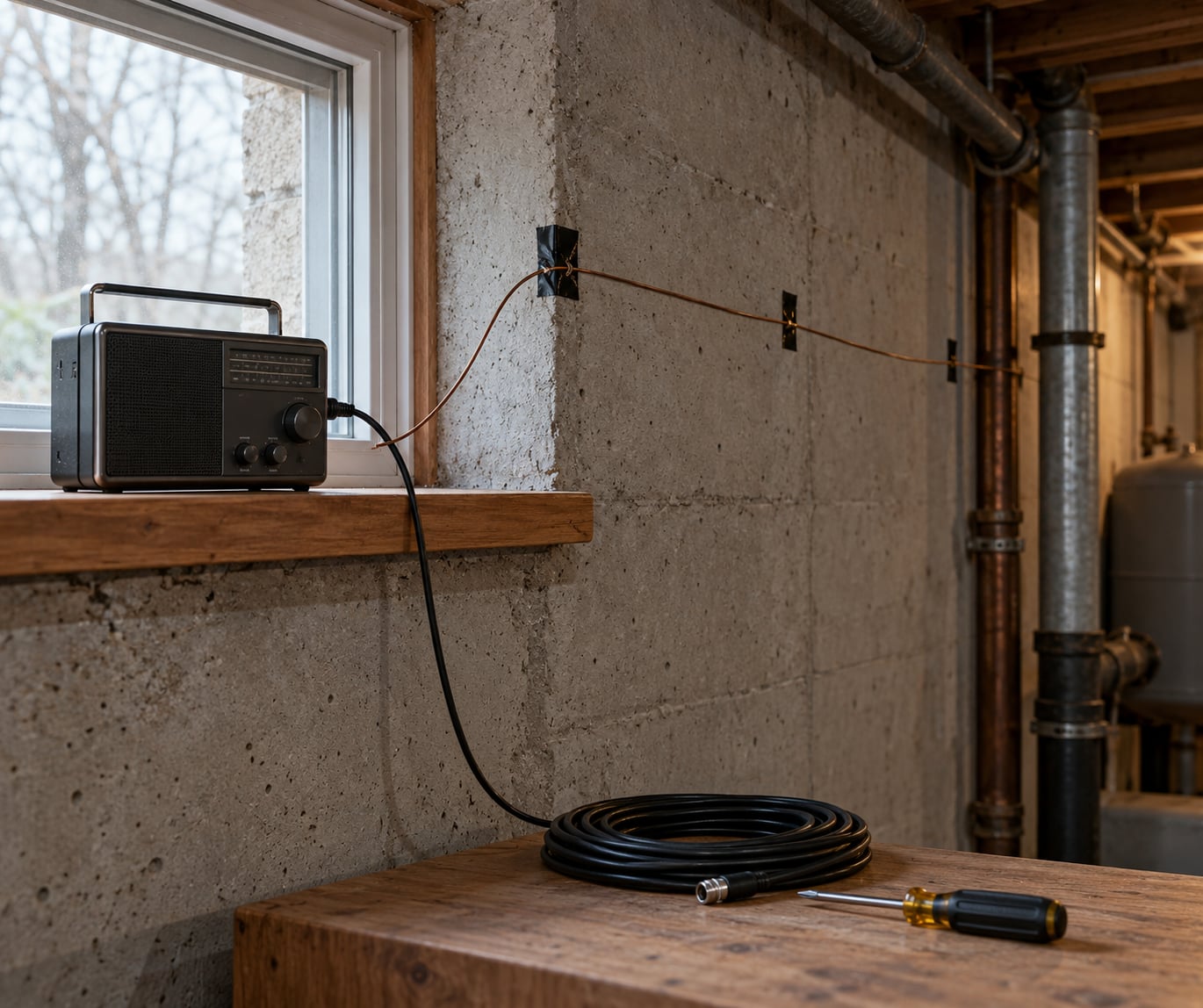
Boosting a radio signal in a basement comes down to three moves: get the set closer to an exterior wall, give it a longer or better antenna, and cut the electrical noise in the room. Start there before you buy anything, because most basement reception problems disappear once you move the radio and change the antenna.
Basements are the hardest rooms in a house for radio. The signal from a local transmitter has to get through a floor slab, damp soil and often a steel frame before it reaches the set, and what gets through arrives weakened and covered in reflections. That is why a station that is perfectly clear upstairs turns into hiss and drop-outs one floor down.
If you want the short version before the detail, these are the eight fixes in the order I would work through them.
- Test the radio upstairs, at a window and outside, to find out whether the problem is the set, the antenna or the building.
- Move the radio away from concrete, metal appliances and buried wiring.
- Try each basement window and point the antenna toward the transmitter.
- Check the antenna connection and the radio’s FM, AM and mono settings.
- Run a longer antenna, a roughly 75 cm wire per side, into the set’s external aerial socket.
- Switch off electrical devices one at a time to find noise sources.
- Add a booster only after the antenna is right, and watch for overload on strong local stations.
- Re-test at different times of day and fix the position that works best.
Table of Contents
- What You Need
- Step-by-Step: How to Boost Radio Signal in a Basement
- 1. Identify whether the problem is the radio, antenna, or location
- 2. Move the radio away from concrete, metal, and wiring
- 3. Find the best window and antenna direction
- 4. Check the antenna connection and radio controls
- 5. Use a longer or external antenna
- 6. Keep the antenna away from electrical interference
- 7. Add a signal amplifier only after testing the antenna
- 8. Confirm the result and document the best setup
- Common Mistakes
- Frequently Asked Questions
- Why does my radio receive fewer stations in the basement?
- Should I use an indoor or outdoor antenna for basement radio reception?
- Does a radio signal amplifier work in a basement?
- Where should I place an FM antenna for the best signal?
- Can metal or concrete in a basement block radio signals?
- How can I reduce static and electrical noise on a basement radio?
What You Need
You can get most of the way with things you already own. A phone with a signal-strength reading for FM, a length of ordinary speaker wire, and an afternoon are enough to diagnose almost every case.
- A phone with an FM or DAB radio for the outdoor and upstairs test. It is the cheapest way to prove the stations are receivable from your property.
- A metre rule if you plan to cut a wire antenna. Length matters more than people expect.
- Speaker wire or thin coaxial cable, roughly 1.5 to 3 metres, for a DIY dipole or an extension to the telescopic whip.
- RG6 coaxial cable and F-type connectors if you intend to run signal from a window or roof aerial into the basement.
- A signal strength meter, if your radio has one. Many sets and most car stereos show signal as a bar count or a number, which turns trial and error into measurement.
- An attenuator or booster only once steps 1 to 6 are done.
You do not need a mast, a rooftop aerial or a power supply to fix most basements. If you are renting, check before you drill anything, because a cable through a basement sill or window frame can breach a tenancy agreement or a building rule.
Step-by-Step: How to Boost Radio Signal in a Basement
1. Identify whether the problem is the radio, antenna, or location
Diagnose before you spend. The single most useful test takes two minutes and tells you where the fault actually lives.
Carry the radio, or your phone, to the top of the stairs, then outside to the driveway or front garden. Tune to a station you struggle with downstairs. If it is clear outside but poor indoors, the transmitter is fine and the building is the obstacle. If it is poor in the open air too, it is coverage, and no antenna in the house will change that.
Forum advice converges on this point. Listeners with dead basements report that their stations play perfectly in the car outside, which points squarely at the structure and its wiring rather than the transmitter.
2. Move the radio away from concrete, metal, and wiring
Concrete, brick, steel framing and rebar act like a mesh around the signal, and damp soil conducts radio waves rather than letting them through. A basement is effectively a partial cage, which is also why a steel-framed or reinforced-concrete building behaves the same way.
Inside the room, keep the set and its antenna clear of radiators, fridges, washing machines, metal shelving, water tanks and any run of electrical conduit. A metre or so of clearance helps. Ceiling-mounted metal hangers and a bundle of extractor or lighting cable can do as much damage as a wall.
Height and air matter too. A set on a high shelf near an exterior wall usually beats the same set on the floor in the middle of the room, and a radio turned on its side can help because many portables use a directional internal loop that also leaks into FM.
3. Find the best window and antenna direction
The best spot is the window on the side of the building facing your local transmitter. Compare every window in the basement and note the bar count for the same station at each one, because small differences in wall thickness matter more than you would expect.
Once you find the strongest window, orient the set. Extend the telescopic whip fully and rotate it slowly in 20-degree steps through a full turn, watching the signal meter. A whip is a directional antenna on the wavelengths it covers, and the strongest position is often broadside to a transmitter rather than pointing straight at it.
Windows that face a neighbouring wall or a busy road often perform worse than an empty one. Glass with metal film, double glazing and mesh screens all cost you signal.
4. Check the antenna connection and radio controls
Most reception complaints are actually connection or setting problems. Start by fully extending any retractable antenna, since a whip at half length is a poor antenna at the low end of the FM band.
Look for an external aerial socket on the back. Small sets use a spring clip or a phono or RCA style socket, while better receivers offer a 75 ohm antenna input, sometimes labelled 75 ohm AM/FM, and sometimes two sets of 75 ohm taps that were meant for an old loop or dipole.
Then check the settings. FM and AM bands behave very differently underground, so a station that will not hold on FM may still come in on AM. Switching a weak stereo signal to mono often removes the hiss entirely, because the receiver is no longer trying to recover a weak subcarrier, and this single switch beats buying an antenna more often than not. An attenuator helps in the opposite situation: if strong local stations distort, squeal or stretch when a nearby transmitter is too powerful, cutting the level back can clear them up.
5. Use a longer or external antenna
A quarter-wave dipole, which is about 75 cm per side near the middle of the FM band, collects noticeably more signal than a short whip and works well taped to a basement wall or hung near a window.
To build one, cut about 1.5 metres of speaker wire, strip the insulation from the middle, and twist the two bare halves together to form a T. Tape or clip it to a wall roughly two metres above floor level, with the crossbar as high and as clear of metal as you can manage, then run the two legs down to the receiver. Connect the two wires to the aerial terminals, which is what a 75 ohm tap pair is for.
Connect one leg to the aerial socket and try a few lengths before committing, since the right length depends on where your stations sit. Keep the whole run short: every metre of thin coax and every poor connector throws away signal you worked hard to collect.
For longer runs, move up to RG6 coaxial cable. Cheap thin cable is a common cause of failed installs, and the loss compounds over distance, so a good cable over a proper run will beat an expensive amplifier on a bad one.
6. Keep the antenna away from electrical interference
Static, crackle and buzz that come and go with appliances are interference, not weak signal, and no antenna will remove them. Common culprits in a basement are LED lighting, dimmer switches, switch-mode power supplies, phone chargers, computers, fluorescent fittings, dehumidifiers and anything with an inverter or motor.
Find the source by elimination. Switch off one circuit at a time at the consumer unit, or unplug devices one by one, and listen for the noise to stop or change. Whole-room lighting on one circuit is the most common finding, and noise from a neighbour’s flat can arrive through the wiring rather than through the air, which is harder to solve.
There is a quicker clue. If the noise appears and disappears on a rhythm, suspect a dimmer or a load switching. If it is a steady hum that shifts pitch when you touch the volume control, suspect a poorly connected shield or a ground loop.
Keep at least half a metre between the antenna and any suspect device, and route the antenna cable away from mains runs rather than parallel to them.
Matching the symptom to the fix saves a lot of guessing. Work down this list before you go shopping:
- Constant hiss on a weak station. The signal is below the noise floor, or stereo recovery is failing. Switch to mono, then improve the antenna and raise the set.
- Rasping buzz or crackle that comes and goes. Electrical interference from LED gear, dimmers or switch-mode supplies. Isolate circuit by circuit, then move the antenna or re-route the cable.
- A station fades out entirely, then returns. Multipath and obstruction as the signal passes through the slab. Move the set to an exterior wall, try another window, lengthen the antenna.
- One station weak while the rest are fine. A distant transmitter, or an antenna cut to the wrong length. Rotate the whip and adjust the length, but accept that a distant station may never arrive.
- Strong stations distort, squeal or stretch. The receiver is overloaded by a nearby powerful transmitter. Fit an attenuator in the aerial lead rather than a booster.
- Everything is poor in every room. This is coverage, not the building. Check reception outdoors, because an aerial cannot create a signal that is not there.
7. Add a signal amplifier only after testing the antenna
An amplifier helps only when the signal already reaches the receiver cleanly and is simply too weak. Amplify a signal you are not receiving and you amplify nothing, while a poor antenna plus a booster usually gives you more noise, not more stations.
That is why the cheap inline boosters people pick up for a few pounds disappoint so often. They add their own noise, and on a strong local station they can overload the receiver and turn a clean signal into a rasp. Forum regulars in weak-signal audio generally advise skipping them until the aerial is sorted.
Choose an indoor amplified antenna only for a specific case: a metal workshop or garden room with no exterior wall. Use RG6 or better with proper connectors rather than thin ribbon cable, keep the run as short as you can, and check whether your radio has a dedicated amplified antenna switch, since some sets apply preamp power to the aerial line and others fight it.
For a real basement with an exterior wall, running coax from a window-mounted or roof aerial beats any booster, and in a rental or a building with community rules it is often the only visible-antenna-free route that works. Pass the cable through an existing sill or window gap rather than a fresh hole, seal the gap with a suitable exterior sealant, and keep the indoor run off the floor where damp is a risk.
8. Confirm the result and document the best setup
Test properly once you think you have it. A weak signal often fades at dusk and in wet weather, so a good result at midday can be useless in February.
Run through the stations you care about, note the signal strength and audio clarity for each, and repeat in the morning and after dark. Mark the position of the set and the antenna on the floor or wall with masking tape, because you will otherwise lose the sweet spot the first time you tidy up.
Write down which antenna, which length and which room worked. That note is what lets you rebuild the same setup after a power cut, a new router or a replacement radio, and it is the difference between a solved problem and a continuing mystery.
Common Mistakes
Almost every basement reception fix is undone by one of these, and each has a straightforward correction.
- Buying a booster first. Amplification cannot rescue a bad antenna or a bad position. Correct the antenna first, then reassess.
- Hiding the antenna behind metal. Pushing a whip behind a shelf or a wall loses more signal than the antenna ever collected. Keep it in open air.
- Using thin, cheap cable for a long run. Loss in poor coax can exceed everything the aerial gained. Use RG6 and decent connectors.
- Ignoring the radio’s own settings. Mono mode and the correct band solve a surprising share of complaints for no cost at all.
- Treating interference as weak signal. A new antenna will not remove buzz from a dimmer. Isolate the circuit instead.
- Drilling without permission. Check your tenancy or building rules first, and seal any pass-through so damp and draughts stay out.
- Testing once and assuming it is fixed. Reception changes with weather, time of day and neighbouring switch-mode loads. Retest before you move the set.
One last piece of advice for metal buildings and workshops, where the same fixes apply. Distance from metal does the work. Keep the antenna about a foot away from sheet metal and steel frames, and if reception is still poor, take the same steps above with a window-mounted aerial and coax rather than a bigger indoor booster.
Frequently Asked Questions
Why does my radio receive fewer stations in the basement?
Because the transmitter signal has to pass through the floor slab, damp soil and often steel framing before it reaches the set, and what arrives is weak and full of reflections. Concrete and rebar act like a mesh, so the receiver is working with a low signal-to-noise ratio. Moving the set to an exterior wall, extending the antenna and switching to mono usually recovers several stations before any equipment is bought.
Should I use an indoor or outdoor antenna for basement radio reception?
Start indoors, because most basements improve with a longer wire antenna taped near a window or exterior wall. Move to an outdoor or window-mounted aerial with RG6 coax when the basement has no exterior wall, when the set is more than a few metres from the window, or when a DIY antenna has already been tried and failed. An outdoor aerial always wins on a genuinely obstructed site, but it needs planning and often permission.
Does a radio signal amplifier work in a basement?
Only when the signal is already reaching the receiver cleanly and is simply too weak, for example in a metal workshop with no exterior wall. Amplifying a signal you do not receive adds nothing, and cheap inline boosters introduce their own noise. They can also overload the receiver on strong local stations, turning a clear signal into a rasp. Fix the antenna and the position before buying one.
Where should I place an FM antenna for the best signal?
High up, in open air, near an exterior wall or window on the side of the building facing your local transmitter. Keep it about half a metre from metal objects, radiators and appliances, and route the cable away from mains wiring. Extend a telescopic whip fully and rotate it in small steps while watching the signal meter, since a whip is directional and broadside often beats pointing straight at the mast.
Can metal or concrete in a basement block radio signals?
Yes. Steel framing, reinforced concrete and rebar form a partial Faraday cage around the room, and damp soil conducts radio waves rather than passing them freely. The same effect is why steel-framed and high-rise buildings struggle with radio and digital broadcast reception. It is also why the signal that does get through arrives with reflections, producing drop-outs and distortion rather than a clean fade.
How can I reduce static and electrical noise on a basement radio?
Switch off circuits or devices one at a time at the consumer unit and listen for the noise to stop, which identifies the source quickly. Common culprits are LED lighting, dimmer switches, switch-mode power supplies, phone chargers and fluorescent fittings. Then keep the antenna clear of those devices and route its cable away from mains runs. A battery-powered set can sound cleaner than the same set on a noisy adapter.
Start with the diagnosis: carry the radio upstairs, then outside, and see where the stations stop being reliable. Then move the set to an exterior wall, extend or replace the antenna, and switch to mono. Only once those are done is it worth thinking about a booster or coax from a window aerial, and by then most basements are already solved.