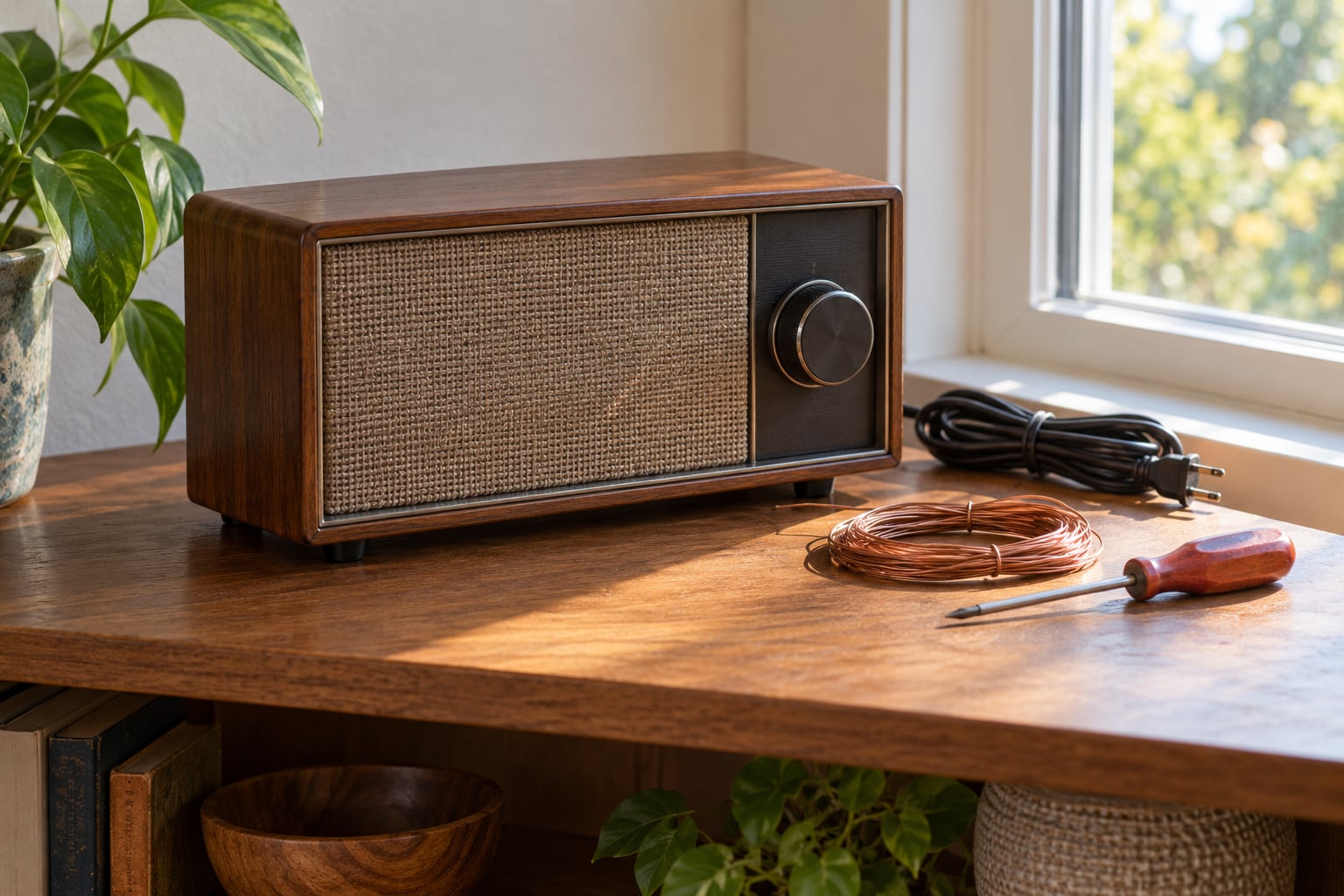
Weak AM at home is almost never a broken radio. It is a weak signal, electrical noise inside the house, or an internal antenna pointing the wrong way, and the first two are usually fixable in minutes with nothing more than a screwdriver. This guide sets out how to improve AM radio reception at home in six ordered steps, from the ten-minute checks through to an external aerial. The first four steps are free; only the last two involve hardware.
Everything here reflects what listeners still report on the hobby forums in 2026, and the short version is worth saying plainly: move the set, turn it 90 degrees, keep it away from chargers and LED lighting, and only then think about wire.
Table of Contents
What You Need
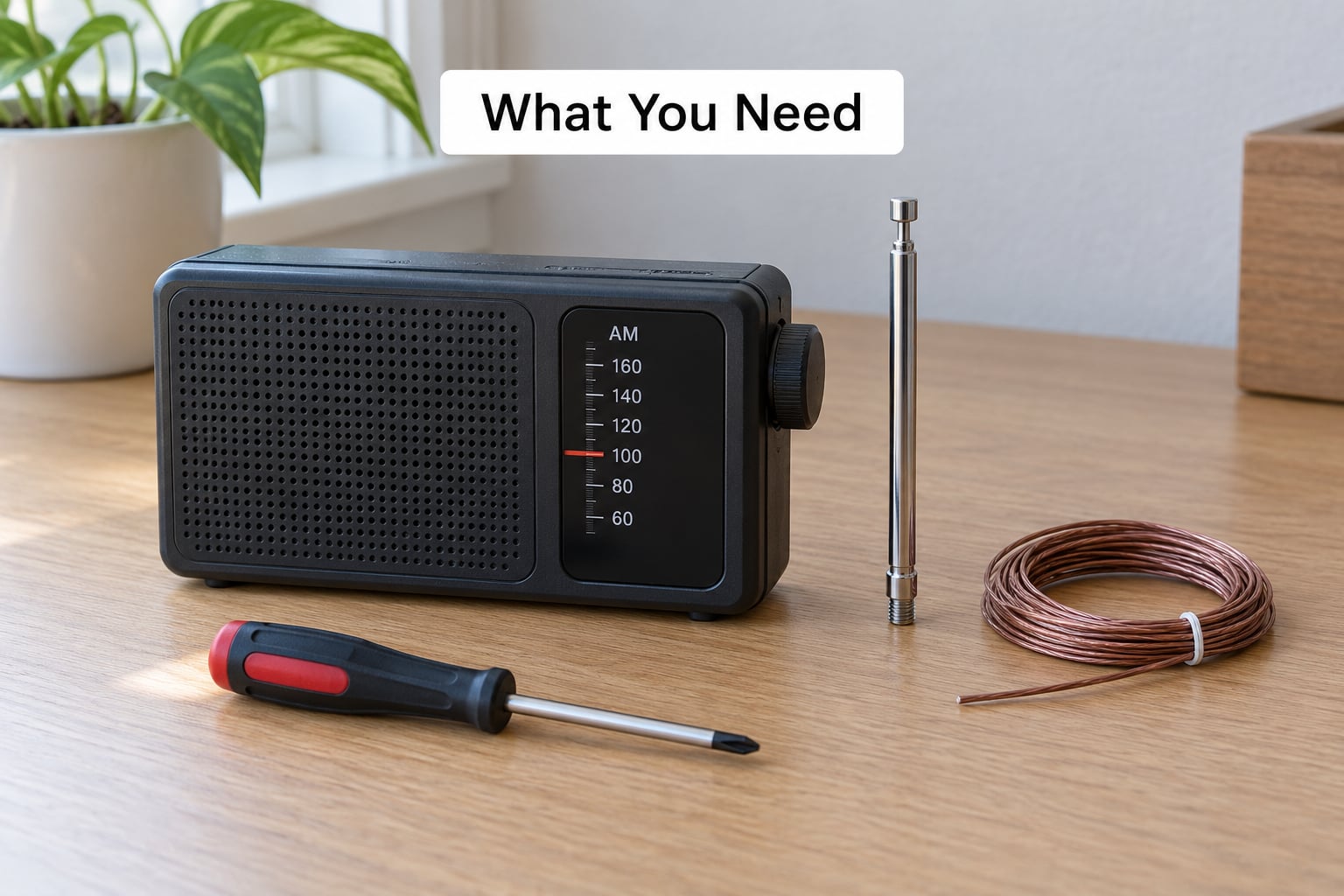
You need the radio, whatever antenna it came with, and ten minutes. Everything else on this list is optional and only matters once the free steps are exhausted.
- The radio itself and its power supply or fresh batteries.
- The supplied antenna — either a detachable telescopic whip, or nothing visible at all because the AM antenna is a ferrite loopstick inside the case.
- A small screwdriver for the battery door, the casing screws and any spring terminal for an external aerial.
- A torch if the set lives on a high shelf or in a cupboard.
- Optional: an AM signal-strength meter, or a cheap SDR dongle with phone software, so you can see signal strength change instead of guessing.
- Optional: a length of lightweight insulated wire, a dedicated AM loop antenna, or a 30–365 pF variable capacitor if you want to build a loop yourself.
Step-by-Step: How to Improve AM Radio Reception at Home
Work down this list in order and stop when the sound is clean. Each step tells you what to do and how to tell whether it actually helped, because half the advice online stops before the second part.
1. Identify where the signal is weak
Start by working out whether you have a signal problem or a noise problem, because the two need opposite fixes. Tune to the same station at different times of day, in different rooms, and near different windows, and note what changes.
Stations that vanish after dark usually point to ionospheric skip rather than a fault at home. Weakness that follows you from room to room points to distance, terrain, or a building that is blocking the signal. Static that gets worse the moment the kettle, a dimmer or a TV comes on is electrical noise, and no antenna will fix it.
How to tell it worked: you can now name the problem. Weak everywhere means antenna. Noisy only when appliances switch on means interference. Both means do both.
2. Move the radio away from interference
AM receivers and household electronics are neighbours in the same part of the spectrum, and the noisy suspects are everywhere. USB and mains charger blocks, laptop power bricks, LED bulbs, dimmer switches, LED strip lighting, smart plugs, plasma or large flat-panel TVs, induction hobs, fluorescent fittings and routers are the usual list.
The test is simple. Turn the volume up so you can hear the noise clearly, then switch off or unplug one device at a time and listen. On a portable set, run it on batteries for ten minutes instead; that isolates the mains adapter in one move.
How to tell it worked: the hiss drops out completely when you switch off the one guilty device, and comes back when you switch it on again. That device is your problem.
3. Optimise the built-in antenna
The antenna doing the work on most sets is a ferrite loopstick inside the case, and it is directional. It receives best broadside and has a null along its length, so rotating the whole radio 90 degrees can change the reception dramatically. That null is useful: turn the set until the noisy source sits in the dead zone, and the station stays.
One thing to clear up, because it costs people hours: on many sets the telescopic whip is an FM antenna only. As a forum moderator put it plainly, the telescopic antenna on your AM/FM radio is not what picks up AM signals. If extending and angling the whip changes nothing on an AM band, that is expected, not a fault.
How to tell it worked: rotate slowly through a full turn while listening. The loudest position, and the quietest, should be roughly opposite each other.
4. Change the radio’s location and orientation
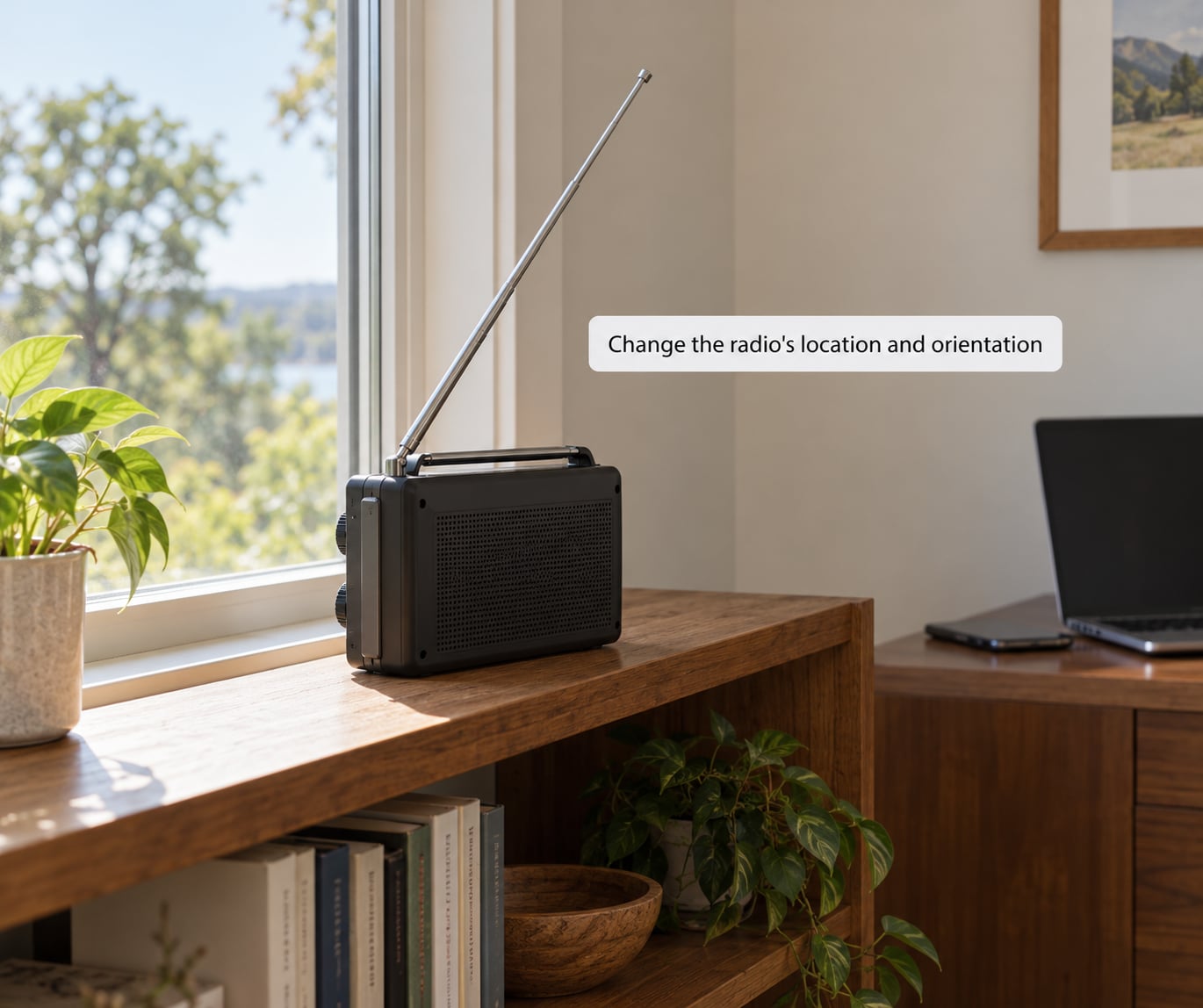
Location beats almost every other adjustment. Put the set near a window rather than in an interior wall, lift it clear of metal objects, and turn the case so the loopstick is broadside to the transmitter. Then walk it around the room and try two or three positions properly, not just a nudge.
If the set sounds worse the moment a metal door closes, your building is the problem. Metal roofs, aluminium siding, metal window frames and foil-backed cavity insulation all behave like a Faraday cage, and a listener in a steel-sided pole barn reported the set effectively stopped working with the doors shut and degraded further whenever the ceiling fans ran. Flats with foil-backed insulation fall into the same category.
How to tell it worked: you find one spot where two or three stations hold cleanly, and you leave the radio there.
5. Try a longer or external AM antenna
This is the step that fixes weak signal rather than noise, and the simplest version costs almost nothing. Clip a length of insulated wire to the radio’s external AM terminal if it has one, usually a spring clip or screw terminal on the back, and drape the wire until reception settles. The most repeated tip on the hobby forums is a straight run of roughly 15 feet, adjusted by moving it rather than by measuring it.
If your set has no external AM terminal, you have two options. Stand a passive AM loop antenna near the radio and let the two couple inductively, with no connection at all, or open the case and clip onto the external AM wire. For a self-built loop, the recipe that keeps reappearing on forums is 18 or 19 turns of insulated wire wound on a box roughly 10 by 16 inches, with a 365 pF variable capacitor for tuning; a single six-inch loop of copper wire plus a 30–365 pF capacitor is the minimal version.
Outdoors beats indoors for noise, because a long wire out in the open avoids picking up your own wiring. The same forums caution that an attic run does the opposite: branch circuits in the ceiling carry noise from every switch-mode supply, LED bulb and fluorescent fitting, and a wire strung up there strongly picks all of it up. Whatever you do outside, fit a lightning arrestor and a proper earth, and check your lease or landlord before running anything past the property boundary.
How to tell it worked: you can walk around the room without the station fading, which means the set is no longer doing the work of the antenna.
6. Check the radio and power system
If the noise is there on every station, in every position, all day, the receiver or its power supply is now the suspect. A failing mains adapter often shows up as hum, buzz or a whine that rises with the volume. Old batteries cause fading and drifting as the set warms up. A set that hisses constantly regardless of station may simply have a noisy internal amplifier, and one that will not hold a station across a short distance may have a tired tuning capacitor or a ferrite rod that has lost sensitivity.
Quick checks: fit known-good batteries, try a different adapter of the same type, and try the same radio in a different room. If it is no better anywhere, a set with a proper ferrite loopstick and a wider selectivity will beat further changes to the aerial.
How to tell it worked: the hum or constant hiss disappears, or the set performs identically everywhere, which tells you the antenna was never the issue.
Common Mistakes
Almost every AM frustration traces back to one of these.
- Fiddling with the telescopic whip. On many sets it handles FM only. The ferrite loopstick inside the case is the AM antenna, and rotating the whole radio is the adjustment that counts.
- Leaving the set next to a charger or a TV. One power brick can be enough to fill the band with noise, and no amount of wire will remove it.
- Turning the volume up to pull a weak station in. Volume amplifies signal and noise together, so a distant station stays just as unintelligible, only louder. Work on the signal-to-noise ratio instead.
- Assuming an attic wire is as good as an outdoor one. Attic runs collect household noise through the branch wiring, so the gain can be cancelled out by added hiss.
- Buying a powered booster first. Amplifying a noisy reception amplifies the noise as well. A passive loop or a length of wire solves more stubborn cases for a fraction of the money.
- Wrapping aluminium foil round the antenna. Foil does nothing useful for a weak signal. It is occasionally handy as screening against interference coupling, not as a reflector.
- Making unsafe connections. Never join an aerial to mains earth or a gas pipe, and never run a wire above a roofline without a lightning arrestor and earth.
Four habits that pay off: tune slowly and watch for the strongest peak rather than the first readable sound, test with the volume low so the noise floor is audible, keep a note of which station and which position works so you can rebuild the setup after a move, and try a second radio to confirm whether the fault is in the set or the room.
Frequently Asked Questions
What is the best antenna for AM radio at home?
For most homes, a passive AM loop antenna gives the best return: it adds gain without adding noise, and because it is directional you can turn it to reject interference. A long wire run outdoors works best for distant stations and fringe areas. Powered amplified antennas are worth considering only when the signal is genuinely weak and quiet, not merely noisy.
Do AM signal boosters actually work?
Sometimes, and the word sometimes matters. A booster raises signal strength, but it also raises whatever noise is already there, so in a noisy home it can leave you with a louder hiss and no extra stations. They help most when the signal is weak and the noise floor is low, which is why a passive loop or a long wire is the better first purchase.
Does aluminium foil boost an antenna signal?
No, not in the way people usually mean. Foil wrapped around a telescopic whip or draped near an internal loopstick does not increase received signal strength. It is occasionally used as a screen to stop interference coupling into a set near noisy equipment, but for a weak signal the answer is a better aerial, a better position or a better building, not foil.
Why do some AM stations only appear after dark?
Because the ionosphere changes. In daylight, the lowest ionospheric layer absorbs much of the medium wave signal, so distant stations fade out. After sunset that absorption drops and the signal reflects back to earth, so distant stations become receivable and interference from other regions often rises at the same time. If the noise also climbs at night, you are hearing both effects together.
What are the disadvantages of loop antennas?
A passive loop is directional, so it must be turned toward the station rather than the set, and small loops couple weakly to the internal ferrite loopstick so results vary. Tuning is another limit: a fixed loop is tuned to one part of the band, so you may need a variable capacitor to cover medium wave properly. In electrically noisy homes, a loop only helps if you can position the null.
How do I connect an external antenna if my radio has no AM antenna socket?
You have two options. The easiest is to place a passive loop antenna near the radio and let the two couple inductively, with no connection and no risk of a wrong wire touching something live. The alternative is to open the case and attach a lead to the internal external-AM wire, which is more invasive and needs a soldering iron. Check the manual first, as many sets have a hidden terminal marked AM or ANT.
Conclusion
Start with the four things that cost nothing: move the radio to a window, turn the case 90 degrees and find the quietest orientation, keep it a metre away from chargers, LED lighting and dimmers, and unplug things one at a time until the hiss drops out. Only once those are done is it worth running wire.
After that, how to improve AM radio reception at home comes down to one thing: a passive loop or a long run of wire, properly earthed and fitted with a lightning arrestor if it goes outside. Set your expectations too. Even a perfect aerial will not make AM sound like FM, and a metal roof will always cost you some signal.