Here is how audio drama podcasts are produced, in stages: someone writes a script built for the ear, a director guides voice actors through it in a controlled recording space, an editor repairs and assembles the dialogue, a sound designer layers ambience, foley and music around it, and a producer masters, publishes and measures the finished episode. Almost everything that feels wrong in a beginner production is wrong at one of those seams rather than in the writing.
This guide walks the whole pipeline in order, from the first season plan to the analytics screen, with the trade-offs explained rather than glossed over. You can read it end to end, or jump straight to the stage you are stuck on.
Table of Contents
- What Is an Audio Drama Podcast?
- How Audio Drama Podcasts Are Produced
- How Audio Drama Podcasts Are Built in the Studio
- Preproduction: Plan the Story and Audio
- Write and Record a Production-Ready Script
- Cast Voices and Record Performances
- Edit Dialogue and Build the Story
- Design Ambience, Foley, and Sound Effects
- Add Music Without Distracting from the Story
- Mix, Master, and Complete a Quality-Control Check
- Publish, Distribute, and Measure the Episode
- What Tools Does an Audio Drama Production Need?
- What Makes an Audio Drama Sound Believable?
- Who Typically Makes an Audio Drama?
- How Long and How Much Does a Production Take?
- What Rights, Safety, and Accessibility Should Producers Consider?
- Frequently Asked Questions
- Can one person produce an audio drama podcast?
- Do I need a studio to make a convincing audio drama?
- How should I record multiple characters in different voices?
- Should dialogue be processed to match effects and music?
- What audio format and loudness settings should I export?
- How do I clear music and sound effects for publication?
- Conclusion: Start With a Small Pilot Episode
What Is an Audio Drama Podcast?
An audio drama is a scripted story told almost entirely through performed dialogue, sound design and music, in the tradition of old-time radio. There is little or no narration carrying the plot, so the sound itself does the work a camera would do on screen.
That is the whole difference from a standard interview or narrative podcast, where one or two real voices talk to you and the recording is close to untouched. In an audio drama the performance is acted, the environment is constructed, and the script is written knowing it will never be read silently.
| Format | Who talks | Production load | Suits |
|---|---|---|---|
| Audio drama | Full cast, acted scenes | High: casting, direction, sound design, score | World-building and ensemble stories |
| Podcast novel | Mostly one narrator | Low to medium | Long-form solo storytelling |
| Dramatized audiobook | Cast reading a novel | Medium: casting plus clean mastering | Existing prose, minimal invented sound |
| Mockumentary or found-footage fiction | Characters in-world | Medium to high, deliberately rough | Horror, comedy, parody of documentary |
| Interview or narrative podcast | Host and guests | Low | Conversation and reported story |
One quick clarification about the broader category: podcasts are usually grouped into interview, narrative, comedy, news and fiction. Audio drama sits inside the fiction group, but it borrows heavily from stage and screen production rather than from the podcast conventions of a single host talking straight to you.
How Audio Drama Podcasts Are Produced
The order below is the order most shows follow, and the order matters because each stage feeds the next. Skipping ahead is how a season ends up with three hours of unusable dialogue.
How Audio Drama Podcasts Are Built in the Studio
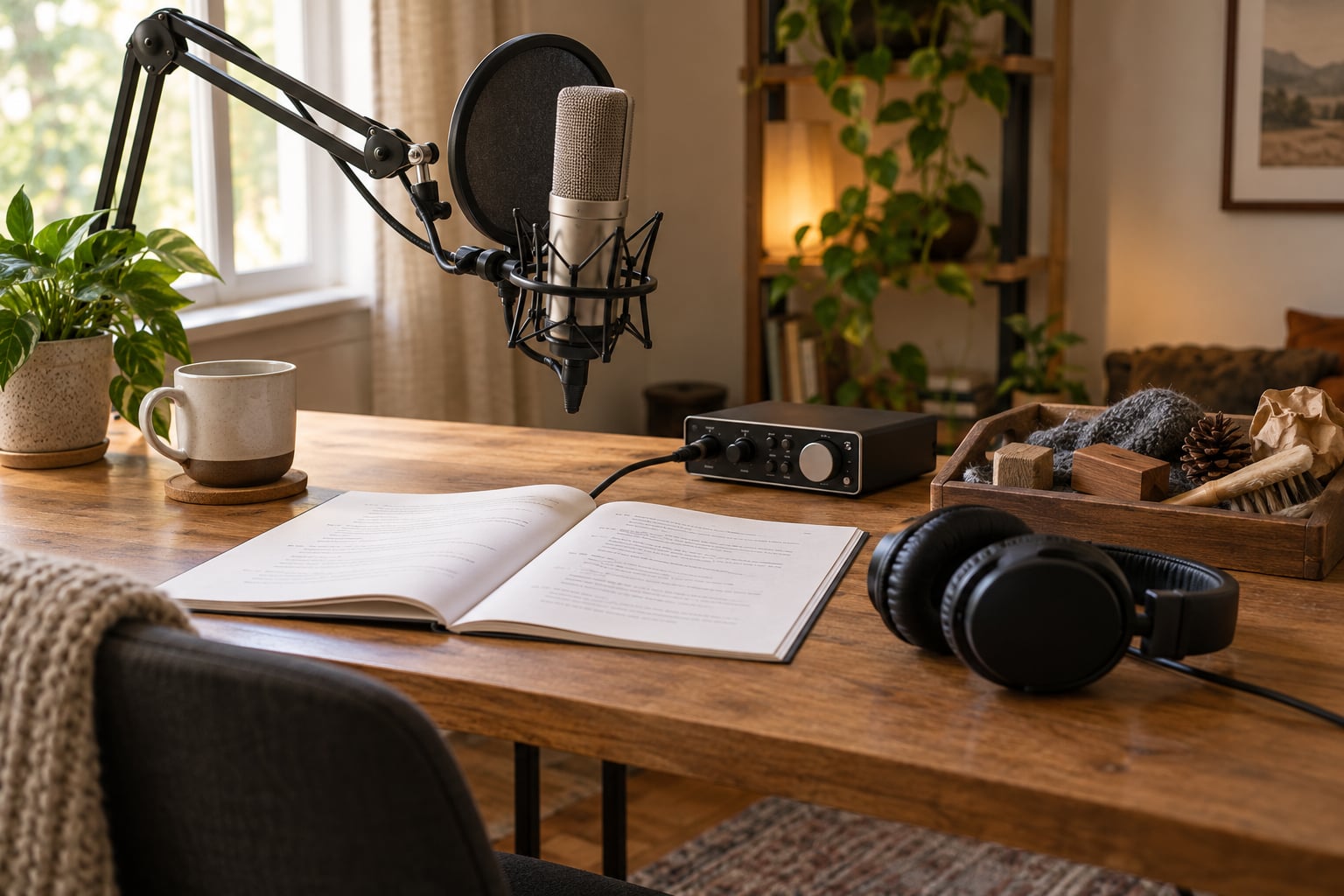
A studio session puts every voice in a treated room with a consistent microphone position, so the editor inherits predictable audio and the director can shape the performance in real time. Actors usually perform line by line, with the engineer capturing each take cleanly.
Between takes the session also records room sound: the empty acoustic of that space, without anyone speaking. Editors layer that room tone under the dialogue later so cuts do not sound like holes, and it anchors the whole scene to one believable place.
The finished mix then rebuilds the listener’s point of view. Dialogue sits in the middle, effects establish near and far, and music carries the emotion, so a scene feels like it is happening around you rather than being narrated at you.
Preproduction: Plan the Story and Audio
Preproduction is where the show decides what it is before anyone opens a microphone. Skim it and the recording days will argue with your intentions.
- Concept and audience. One sentence describing the show, and who listens at 7am on a commute.
- Format and runtime. Single-slot episodes, a serial season, or an anthology. Duration sets how much dialogue fits before attention drifts.
- Script breakdown. Every speaking role, plus narration, plus how many locations and how many effects.
- Era and place. Deciding this is 1978 and coastal before you cast matters, because it changes voices, ambience and props.
- Sound palette. How dense the effects will be. Thriller and comedy need opposite mixes of the same tools.
- Rights and permissions. Clear script ownership, music and library licences, and releases before recording.
- Schedule and budget. Session days, editing weeks, and what you can actually pay.
- Deliverables. Final mix, alternate mix, transcript, artwork, show notes and the episode title.
A useful test: read the concept back to someone who has never heard the idea. If they can describe the kind of sound it should make, the plan is ready for a script.
Write and Record a Production-Ready Script
An audio drama script is not a play with the stage directions stripped out. It carries information a page play would leave visual: what we hear, how far away, and when music enters.
Action lines carry that load, and they need to be playable.
Weak: She opens the door and hears something in the hall.
Workable: She opens the door. Long pause. Footsteps recede down a tiled corridor, hard and getting quieter.
Sound cues belong in the script rather than in the designer’s head later. The same goes for music: mark a cue as theme, underscore or stinger, and say where it enters and leaves.
Three conventions earn their keep. Use a separate line for pronunciation of any name or term an actor might mangle. Keep dialogue short, because an unseen listener has no visual beat to rest on during a long speech. And write silence in, rather than letting an actor fill it, because an unplanned pause in a studio session usually gets narrated over by nervous talent.
Read the script aloud while standing up before it reaches the cast. If a line loses you when spoken, it will lose a listener too.
Cast Voices and Record Performances
Casting chooses voices for character, not just range, and the audition should use real lines from your script rather than a generic monologue. Two actors can both be excellent and still not suit the pairing.
A table read before the record button turns out to be the cheapest insurance in the whole process. It exposes pacing problems, doubled names and missing jokes while the fixes are still free.
On the day, three things matter most:
- Microphone technique. Close-miking at a consistent distance and angle, with a pop filter, gives every actor the same starting point.
- Performance space. Practitioners often favour a room with space to move and gesture over a tight booth, then deal with the extra room tone in post. Constrained actors deliver flat performances that no amount of repair fixes.
- Continuity files. A script supervisor or note-taker logs every take, pickup and wild line, because you will want a different breath three weeks later.
Expect pickups. A line that clashed with a door sound, a reaction that came in too late, a word the actor disliked once they heard the take. Budget for them rather than treating them as failure.
Edit Dialogue and Build the Story
Dialogue editing is assembly and repair in that order. First you choose takes and build the scene so the acting lands. Then you clean what you chose.
The cleanup work is unglamorous and mostly mechanical: trimming mouth clicks, smoothing breaths you never needed, repairing any line that clipped at the top, and cutting light room reflections where they blur a consonant.
Where actors recorded on different days or in different rooms, EQ matching levels the tone and Dialogue De-Reverb tools pull back unwanted reflections. Advanced repair tools can isolate a voice from noise or reduce a stray hum, but they work best on mild problems rather than rescuing a ruined take.
Two habits keep dialogue convincing. Lay a strip of that room tone under the scene so silence between lines has texture, and resist over-editing. Removing every breath and every pause makes a performance sound like it was read to a metronome, which listeners notice even if they cannot name it.
Design Ambience, Foley, and Sound Effects
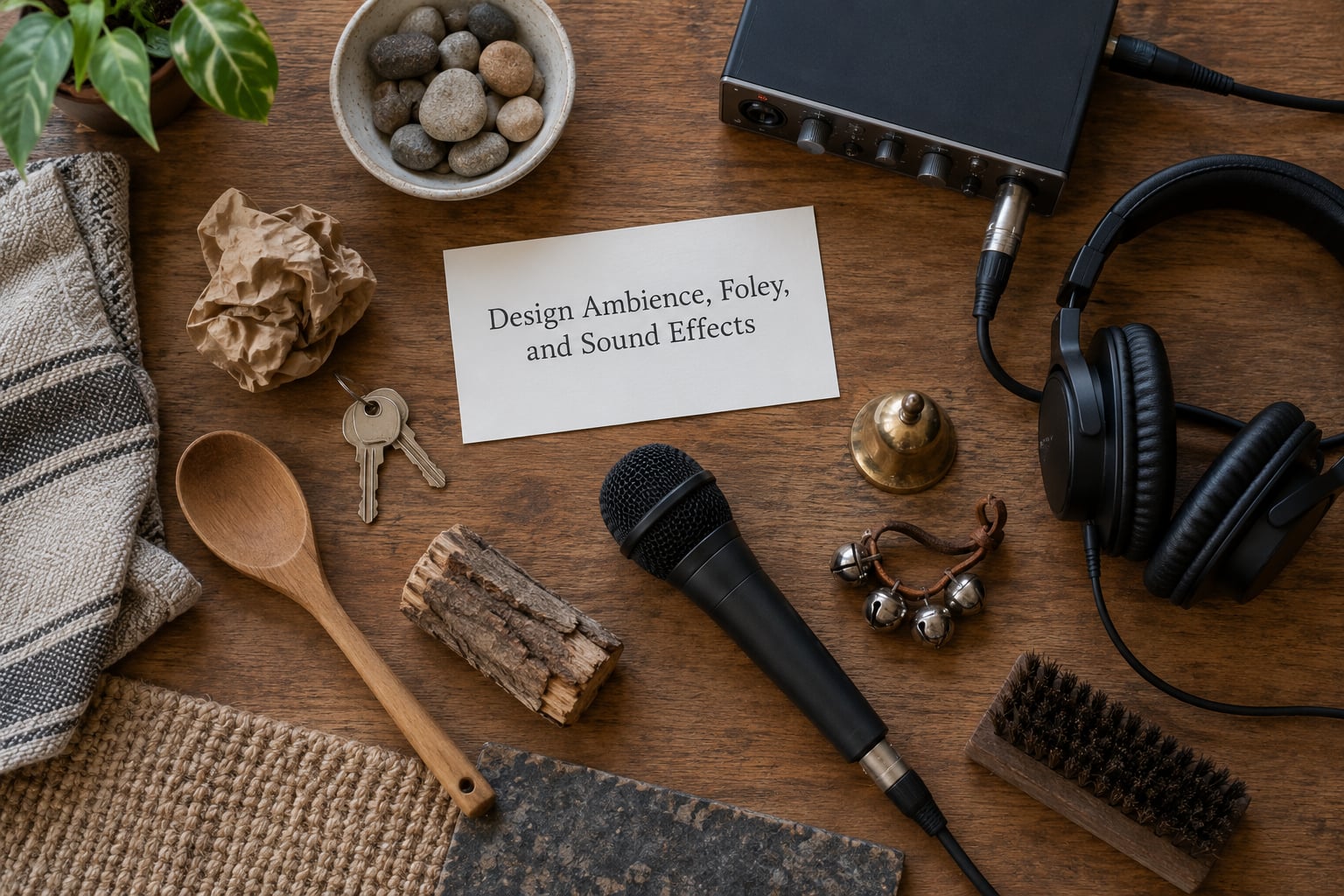
Ambience establishes place, foley supplies physical action, and effects deliver events the listener cannot see. Confused, the three get mixed together and the scene turns muddy.
Ambience comes from libraries, from your own field recordings, or from a short loop built to hide its seam. Record real rooms where you can: a stairwell, a car park, a kitchen at night. Thirty seconds of genuine space beats two minutes of generic library wash.
Foley is performance, not selection. A door closing recorded properly is a hand, a latch and a frame reacting in sequence. Recording your own works well for small physical actions, and it is the standard answer to a sound budget that will not stretch.
Perspective does the storytelling. A door heard from three rooms away tells the listener more about where they are standing than any description of the room. Automate the distance with level and EQ rather than with reverb alone, and use fades, filters and hard cuts to suggest movement and to hide a join.
The common failure is over-designing. When effects compete with the lines, the listener stops following the story and starts noticing the production.
Add Music Without Distracting from the Story
Music carries what dialogue cannot say, and it is the easiest place to lose a listener. The rule of thumb is that a cue should carry emotion, information or a transition, and if it does none of those, it is decoration.
A theme earns its place by telling the listener who made the show. Underscores sit under scenes where silence would feel empty. Stingers are short transition markers, and shorter still, usually a couple of seconds.
Get stems whenever you can. Separate tracks for a cue, split into elements, let you pull one layer down when dialogue needs space, and let you adjust levels across scenes that play at different times.
On licensing, use production music you have rights to and keep the paperwork. Libraries, commissioned composers and properly licensed subscription libraries all work; a track lifted from a streaming service’s catalogue is a rights problem waiting for your next monetisation application.
Silence is a legitimate choice too. Two people talking with no bed under them at all can feel more immediate than the same scene buried in atmosphere.
Mix, Master, and Complete a Quality-Control Check
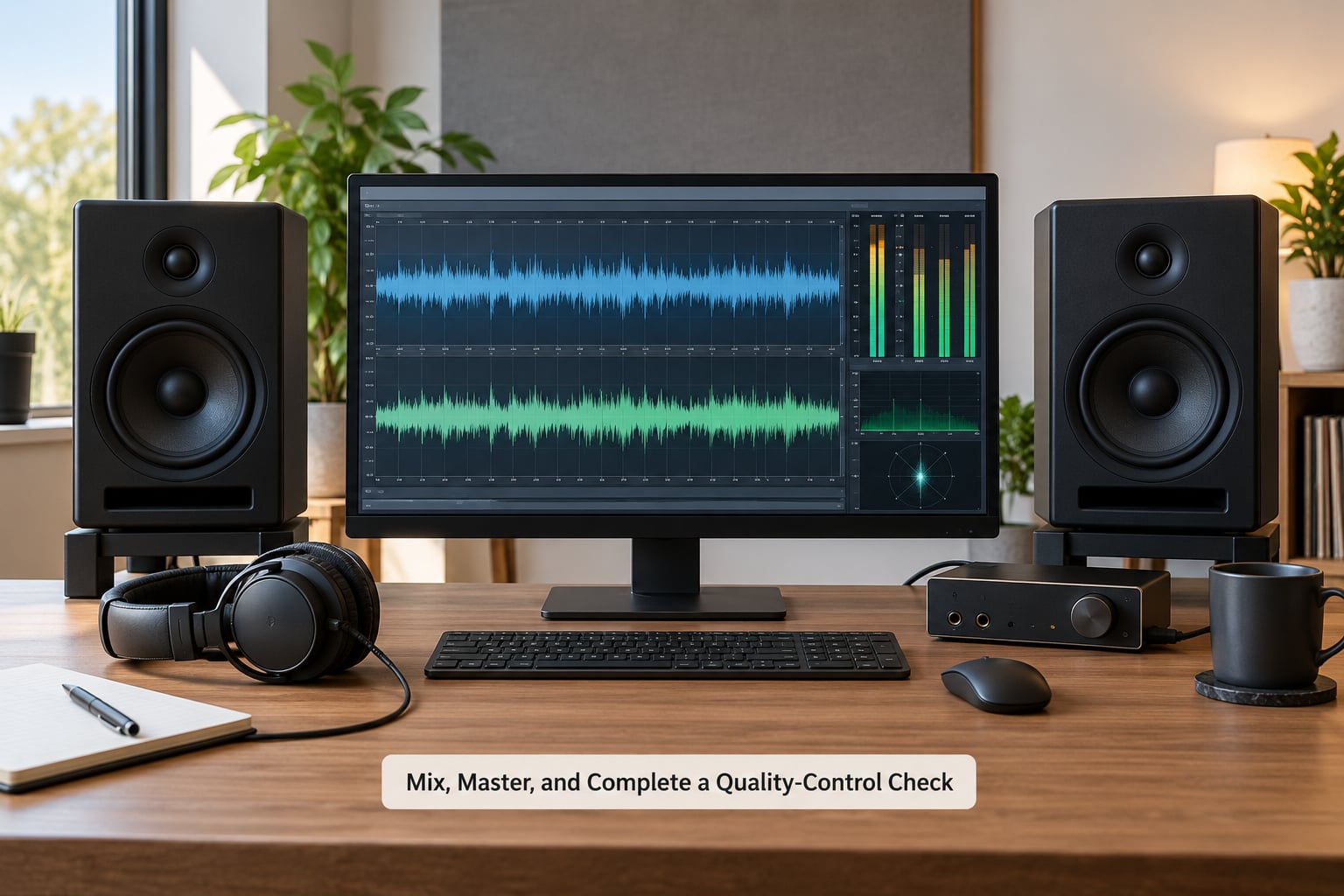
The mix decides what the listener hears first. Dialogue usually sits forward and consistent, effects sit behind it in level and surround it in space, and music sits under both.
- Levels. Set dialogue to a consistent reference, then build everything else relative to it.
- Frequency control. Cut muddy low end from effects and music so words stay clear on earbuds and phone speakers.
- Dynamics. Light compression keeps performance texture intact. Heavy limiting flattens actors into a wall.
- Loudness. Match the platform target for spoken word rather than pushing everything louder than everyone else.
- True peak. Leave a little headroom so ordinary listeners on ordinary systems do not hear distortion.
- Export. Deliver the final mix and a separate high-dynamic version for listeners on good headphones.
Then run the quality-control pass on headphones, on a phone speaker and in a car, because listeners will not all be listening carefully. Check for clipping, missing audio at the head or tail, jumps where an edit landed wrong, a dropouts section where dialogue vanished, and inconsistent volume between episodes. Confirm the file starts where the credits say it starts, because that error is common and easy to miss.
Publish, Distribute, and Measure the Episode
Publishing is more than uploading a file. Name the episode so it survives in a list, write show notes that say what happened and who appears, prepare artwork that stays legible at podcast size, and produce a transcript for listeners who browse in text.
Distribution is where a lot of finished indie shows stall. Host the audio file somewhere reliable, put it behind an RSS feed, and submit that feed to the platforms your listeners already use. Networks can take a finished show to an existing audience, and they take a cut and often a say in your decisions, so read the terms before signing.
Measure what the numbers actually tell you. Completion rate and drop-off points show whether the middle of an episode loses people. Listening platforms have become more privacy-conscious, so treat figures as directional rather than exact, and ask for feedback directly in your community spaces.
One practical loop matters more than the rest: find where listeners leave, write it down, and change that specific thing next season.
What Tools Does an Audio Drama Production Need?
A workable starter setup is short, and spending early in the wrong place is the classic first-season mistake. You can begin with a computer, a digital audio workstation, one microphone, closed-back headphones, a small interface, and a treated corner.
| Item | Starter | Working setup | Why it matters |
|---|---|---|---|
| Digital audio workstation | Free or low-cost editor | Full production DAW with track comping | You will split and edit hundreds of dialogue clips |
| Microphone | One large-diaphragm condenser | Matched condenser plus a dynamic for noisy rooms | Consistency across a cast matters more than top-end detail |
| Audio interface | Two-in two-out with phantom power | Multiple mic preamps, low-latency monitoring | Fewer inputs mean scheduled queueing around the interface |
| Headphones | Closed-back monitoring pair | Closed-back plus an open pair for checking mixes | Closed-back stops bleed into the microphone |
| Treatment | Bass traps and a heavy duvet | Panels, a small booth, gated room | Room sound leaks into every take and every match |
| Storage and backup | External drive with a copy | Two copies plus a project archive | Recorded sessions are unrepeatable |
Free repair and utility plugins are genuinely good and cover most of what beginners need: a noise reduction tool, an EQ for matching voices, a de-esser, a convolution reverb with room impulses, and a spectral repair tool. Spend on the microphone and the room before you spend on plugins.
Monitoring is the piece people get wrong. If you cannot hear sibilance, a level jump or a buried line while mixing, you will not fix it in the final hour.
What Makes an Audio Drama Sound Believable?
Believability is continuity. Listeners rarely notice a clean production, but they notice a scene that changes shape halfway through.
- Consistent voices. A character who sounds different between episodes breaks the illusion faster than anything else.
- Stable room tone. The silent space behind a scene should stay the same across every cut.
- Clear scene geography. The listener should always be able to say who is in the room, how far away, and whether the door is open.
- Synchronised effects. A door that lands a frame late reads as a mistake, not as atmosphere.
- Natural reactions. Listeners expect a breath, a swallow, a half-word when someone is startled.
- Pacing that matches the story. Silence after a line is dramatic only if the editor left it there.
- Restraint with stereo space. Headphones and good speakers reward binaural and stereo work, but phone speakers collapse it, so anchor every key cue in mono.
Test a scene by listening to it with your eyes closed, then with the sound muted. If the story survives only one of those, the writing is doing the work the production should be doing.
Who Typically Makes an Audio Drama?
Established audio dramas run a dozen or more credited roles. Small shows collapse several of them into one pair of tired people.
| Role | Owns | Often combined with |
|---|---|---|
| Writer | Story structure, script, revisions | Showrunner or producer |
| Producer | Schedule, budget, contracts, delivery | Writer or director |
| Director | Performances, tone, cast sessions | Voice director |
| Voice actor | One character per performer | Table read, pickups |
| Recording engineer | Levels, files, mic placement, backups | Editor |
| Dialogue editor | Cleanup, assembly, EQ matching | Sound designer |
| Sound designer | Ambience, foley, effects, perspective | Composer |
| Composer | Theme, score, stems | Licensed music editor |
| Mix and mastering engineer | Loudness, delivery versions, QC | Editor |
| Script supervisor | Take logs, continuity, pickups | Assistant producer |
A solo creator usually writes, directs, edits and designs. What they give up is performance energy, which is why a second voice reading the script back to you catches what silence hides.
On paying contributors, practitioners in the audio drama communities are blunt: exposure is not payment. If a show has budget, budget for the actors first, and credit everyone properly either way.
How Long and How Much Does a Production Take?
Audio drama takes far longer than the recording itself, because the recording is a small share of the hours. Real figures from practitioners give a useful sense of scale: one editor describes more than 300 hours of recorded audio across roughly eighteen months, with about four months of seven-day weeks just to organise files and reach rough cuts.
| Production type | Typical span | Effort | Main cost driver |
|---|---|---|---|
| Solo creator, short pilot episode | A few weeks | 20 to 40 hours | Learning curve on editing and sound |
| Solo creator, serial season | Six to twelve months | 200 to 400 hours | Consistency across episodes |
| Small volunteer team, full cast | One to two years per season | 400 to 800+ hours | Scheduling actors around other jobs |
| Studio production with paid cast and crew | Six months to two years | 1,000+ hours | Studio days, session fees, score |
Four things move the schedule and the cost more than anything else: the number of locations in the script, the size of the cast, how much original sound design the story needs, and how many rounds of revision the script goes through after recording. Lock the script before booking studio time, or you pay for studio time twice.
Whether narrative audio earns money is worth saying plainly. Fiction podcasts generally earn less than interview shows, because listeners subscribe for a person they recognise. The usual paths are patron support, paid bonus episodes, sponsorship, and licensing the show to a network. Expect those to fund a small production slowly rather than pay a crew properly, and budget accordingly.
What Rights, Safety, and Accessibility Should Producers Consider?
Rights are the part that ends shows, and most of it is settled before recording rather than after.
- Script. Confirm in writing who owns the writing, and that you hold the rights to adapt a novel or a game rather than just to read from.
- Music. Keep the licence terms with the project files, and check whether the licence covers monetised distribution.
- Sound effects. Library licences vary; some cover broadcast and podcasts, some do not.
- Voices. Record a release from every performer, defining usage, term and payment, and pay on time.
- Synthetic voices. If you use AI narration or train a voice on someone’s readings, consent has to be documented. Forum discussion in the audio drama communities has moved this from theoretical to practical fast.
- Safety on record. Long sessions in an unventilated room with actors under pressure need breaks, sensible hours and a quiet space.
Accessibility costs little and adds up. Publish a transcript, describe sound that carries meaning, keep any essential cue audible on a phone speaker, avoid heavy stereo-only effects, and check the mix does not fatigue at earbud volume. Listeners who cannot follow a scene quietly simply leave, and you never learn why.
Frequently Asked Questions
Can one person produce an audio drama podcast?
Yes. Plenty of indie shows are made by one person who writes, directs, edits and designs the sound. It works best for a pilot with two or three characters in one location, since every extra voice and location multiplies the editing. Budget for the learning time rather than the studio, record at least one episode before committing to a season, and get a second reader to react to the script while it is still cheap to change.
Do I need a studio to make a convincing audio drama?
No, you need a controlled room. A treated home space, a heavy duvet over a frame and a close-miked condenser can carry a full season, and many acclaimed shows started that way. What matters is the same microphone distance for every actor, steady levels, and room tone you can lay under the cuts. A professional studio helps most when the script demands large spaces, effects or a large cast.
How should I record multiple characters in different voices?
Record each character on a separate track, in separate sessions if needed, and keep the microphone position and gain consistent. Give every actor the same script pages and the same direction on pace and distance from the microphone. Afterwards, match tone and room between takes before adding effects. If you play several characters yourself, leave a full day between them so your voice does not drift.
Should dialogue be processed to match effects and music?
Process the dialogue to sound like one coherent space first, using EQ matching and room tone, then place it. Effects and music should be balanced around the dialogue rather than processed to fit it. If a line sounds wrong, check your levels and your headphones before reaching for more processing, since most perceived problems in dialogue are volume and clarity issues rather than tone.
What audio format and loudness settings should I export?
Export stereo at the standard music sample rate and bit depth your editing software uses, and deliver a high-quality master file to your host rather than an MP3. Set loudness to the spoken-word target the major platforms normalise to, and leave a little true-peak headroom so ordinary listeners hear no distortion. Keep an uncompressed master and a separate high-dynamic version for good headphones.
How do I clear music and sound effects for publication?
Use production music with a licence that covers podcasts and monetised distribution, or commission an original theme and score you own outright. Keep every licence confirmation in the project folder rather than in your inbox. For effects, check the library terms for broadcast use, record your own where possible, and document the source of anything downloaded. A simple spreadsheet of asset, source and licence date prevents most problems.
Conclusion: Start With a Small Pilot Episode
The pipeline is shorter than it looks, and the hard part of how audio drama podcasts are produced is earlier than most people expect: decide the format, write a script for the ear, cast and rehearse, then record into a room you control. Everything after that, editing, ambience, foley, score, mix and publish, is craft you can learn while you work.
So make your first one small. Three characters, one location, under twenty minutes, one ambience bed and one theme cue. Get it in front of five listeners who enjoy fiction podcasts and ask them where they stopped paying attention.
That answer is the most useful thing in the whole production, and it costs you one episode rather than a season.