Most old radio shows are free to stream today, and finding them takes less than a minute once you know which archive to search. Whether you want a specific episode from a serialised detective series or just something good to play while you work, here is the route I use every time.
The catch is that search results for this topic are full of live oldies music stations that play endless 40s and 50s songs rather than the Golden Age dramas you actually want. Knowing how to tell those apart, and how to pin down a show from a half memory, is what separates a two-minute find from an afternoon of clicking.
Table of Contents
- What You Need
- How to Listen to Old Radio Shows Online: Step-by-Step
- Step 1: Identify the show, episode, or broadcast era
- Step 2: Check official station and broadcaster archives first
- Step 3: Search legitimate streaming and podcast services
- Step 4: Use keywords to find surviving copies
- Step 5: Verify the audio before you commit
- Step 6: Choose the playback option that fits
- Step 7: Save, revisit, and share the broadcast responsibly
- Common Mistakes
- Frequently Asked Questions
- Are old radio shows available online?
- Can I find a radio broadcast that never became a podcast?
- What is the safest way to listen to archived radio shows?
- Why can’t I find a specific episode after searching its show name?
- Can I listen to old radio shows on my phone or smart speaker?
- Is it legal to listen to a radio show uploaded by someone else?
- Conclusion
What You Need
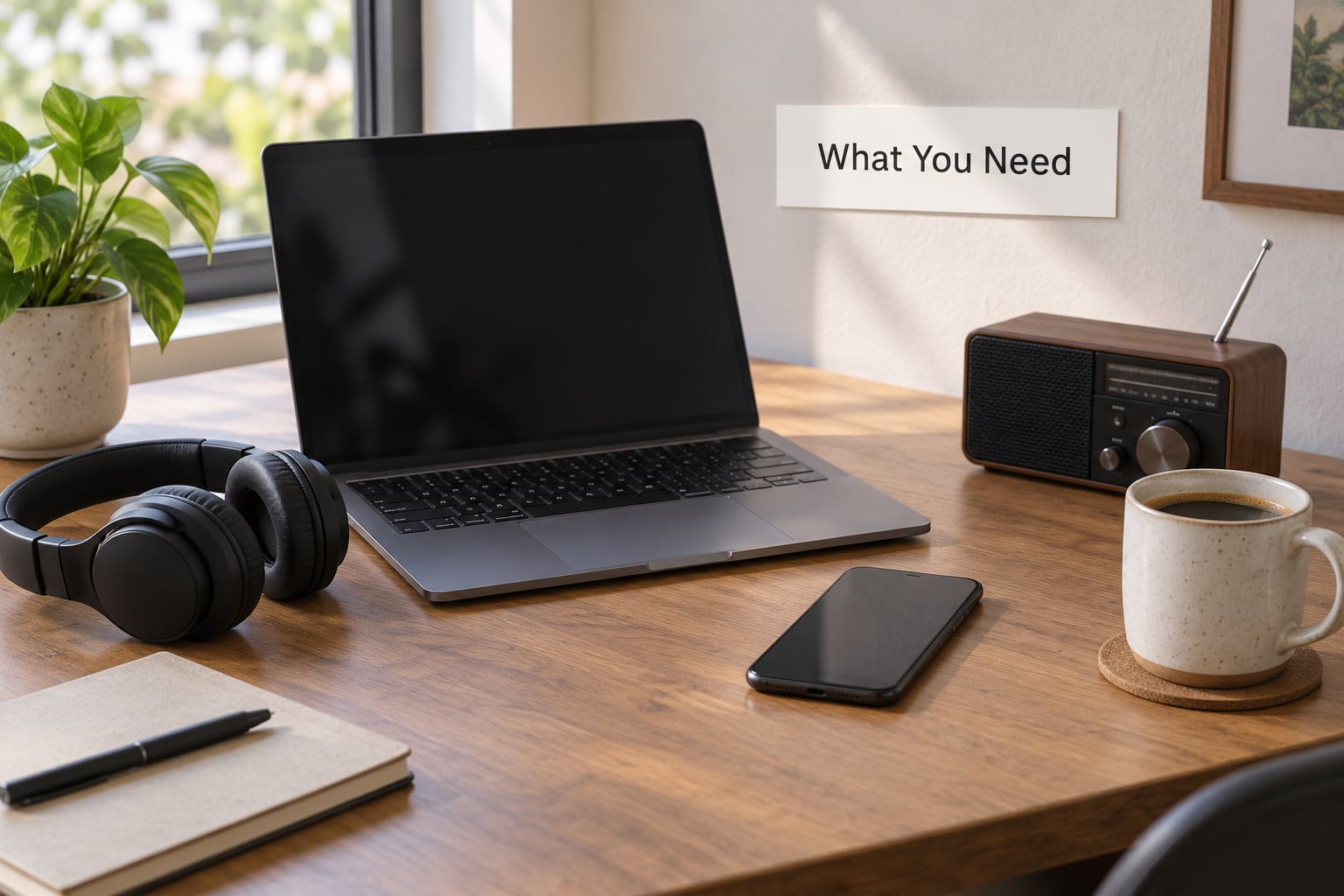
You need very little. A phone or computer with a browser, a steady internet connection, and somewhere to listen from — headphones for dialogue-heavy shows, speakers if you want it filling a room.
A search engine is your main tool, plus accounts with the archive and podcast services you end up using. Most of the large archives do not ask you to register at all, but a free account unlocks downloads, playlists and offline listening.
Worth sorting out the terminology first. Old time radio means scripted drama, comedy and variety from roughly the 1920s to the late 1950s. Oldies radio means a music format playing 40s and 50s records. Plenty of search results are the second thing, and clicking them is the most common wasted minute in this whole process.
If you want the full vintage experience, add one piece of hardware: a Bluetooth receiver that plugs into a restored valve or transistor set. More on that in the playback step.
How to Listen to Old Radio Shows Online: Step-by-Step
Step 1: Identify the show, episode, or broadcast era
Start by writing down everything you actually remember: the title, the announcer’s voice, a lead character, the sponsor, roughly what decade it aired. Precise identifiers produce dramatically better results than a vague one, because archive catalogues are indexed by title, original broadcast date and cast.
A search like Dragnet 1949 episode gives you a playable list. police show heard in California late 1940s gives you a forum thread where someone might recognise it. Search combinations that work well include show plus year, host plus show, episode title, cast member name, and the phrase “original broadcast date”.
Step 2: Check official station and broadcaster archives first
Official sources are where you can listen to old radio shows online with the least risk of a broken or mislabelled file. Look for the network or rights-holder pages of the era: CBS Radio Theatre, NBC Blue and NBC Red, Mutual, and the American national networks are all archived by studios and collector-run libraries.
Dedicated archive sites built by collectors are the next stop. Old Time Radio Researchers and similar libraries index series by episode number with the original air date, originating city and full cast list attached. That metadata is what tells you whether a file is the real broadcast or someone’s edited cut.
Signals of an authentic archive: episode numbering, a broadcast date per entry, a named originating city such as New York or Hollywood, cast listings, and a clear copyright statement. An unverified upload has none of those, and often arrives with three different dates and a generic file name.
Step 3: Search legitimate streaming and podcast services
Many old series are republished as podcasts, which means you can subscribe once and forget about it. Search the podcast directory built into your phone for the show title, then check that the feed carries per-episode metadata and an archive of back episodes rather than only the newest few.
Look for feeds that list a broadcast date and cast for each episode, offer a plain RSS link, and are still publishing. Those three things separate a maintained archive from an abandoned upload. On-demand listening is the one route that reliably works offline, because you can download the episode file to your device.
Live rebroadcast streams are the other half of this step. Some stations run scheduled classic-drama blocks around the clock, and directory sites like Streema or Radio Browser list thousands of them by genre and country. Availability and region licensing change, so if a stream refuses to play, that is the first thing to suspect.
Step 4: Use keywords to find surviving copies
When the official route comes up empty, widen the keywords deliberately instead of clicking through more pages. Pair the show name with terms like archive, complete series, transcript, rebroadcast or MP3, and add a year range to separate the run you want from a later revival.
The Internet Archive is usually the biggest single source, with searchable metadata, embedded players and downloadable files. Filtering by date and by media type, then reading the item description before you press play, saves a lot of dead ends.
For half-remembered shows, community boards are genuinely useful. Search the show description you wrote in Step 1 and post it — listeners on old time radio forums are good at identifying an episode from one remembered line or a sponsor jingle.
Step 5: Verify the audio before you commit
Check four things before an hour of listening: who uploaded it, when, whether the description names a broadcast date, and whether the recording runs to a plausible length. A half-hour file labelled as a full episode is usually a trimmed or damaged copy.
Listen to the first thirty seconds. Genuine transcriptions of Golden Age episodes have a level hiss, a studio audience in suspense shows and full original sponsor announcements. Fan edits often cut the commercials, reorder scenes, or splice a modern intro on the front.
Community threads regularly compare different recordings of the same episode to decide which mastering sounds cleanest, which is a good sign the archive is being maintained by people who care about accuracy.
Step 6: Choose the playback option that fits
A computer gives you the widest choice, with full episode lists, transcript search and easy downloading. A phone suits commutes and short sessions, and podcast apps handle downloads well enough that one episode will not eat your mobile data in a morning.
Smart speakers work if the service is supported on the device, and they suit kitchen listening where touching a screen is inconvenient. In the car, connect your phone over CarPlay or Android Auto and use downloads rather than a live stream, which buffers badly on patchy signal.
For a restored vintage set, plug a Bluetooth receiver into the set’s audio input, pair your phone, select the receiver as the source and set the volume low before switching the valve set on. Warm up gradually and stop if the valves smell hot. This is the route that gets old time radio playing through hardware that looks the part, and it suits anyone who wants the sound in the room rather than in their ears.
Step 7: Save, revisit, and share the broadcast responsibly
Bookmark the page rather than the file, subscribe to the feed if there is one, and add the episode to a playlist so it survives a site redesign. Archives reorganise collections without warning, and a saved link to the series index is far more durable than a link to one upload.
Share links, not audio files. Point friends at the broadcaster or archive page so the creator still gets the credit and the listener gets an accurate copy. If you return to an old series and find episodes have vanished, check the series index again before assuming the audio is gone for good.
Common Mistakes
Searching with too little information. “Old radio shows” returns nothing useful. Add a show name, a host, a character or a year and the same search becomes a working one. Tip: write your memory down before you search, not after.
Assuming everything is on a podcast platform. Plenty of Golden Age episodes predate podcasting and sit only in archives. Fix: treat the podcast app as one route, not the route.
Clicking live oldies stations by mistake. If the page says 40s, 50s or Oldies in its genre tags, it plays music, not drama. Fix: look for a schedule of episode titles instead.
Accepting fan edits as complete episodes. Trimmed commercials and reordered scenes are common. Fix: check the runtime against the typical length for that series before you settle in.
Downloading from unfamiliar download sites. Archive scrapers and bundled installers are the classic route to malware. Fix: download only from the archive itself or a podcast app.
Ignoring the region check. Some official streams are licensed by territory. Fix: if a stream will not play but the page loads, try a different episode or a different source before assuming the file is broken.
Leaving mobile data on for a long episode. An hour of audio can eat a noticeable slice of a monthly allowance. Fix: download on Wi-Fi and set the app to download on Wi-Fi only.
Expecting every episode to survive. Records were reused, tapes were declawed and some series were simply never transferred. Fix: check a series index first, so you know what exists before you plan a listening order.
One habit worth adding: note the original broadcast date whenever you save something. It is the fastest way to order a series correctly later, and it tells you instantly whether a file has been mislabelled.
Frequently Asked Questions
Are old radio shows available online?
Yes. Most surviving Golden Age broadcasts are in the public domain and stream free from archives, podcast feeds and collector libraries, with no account needed for playback. What you will not always find is every episode of every series. Some recordings were reused or lost before they were digitised, and a few shows remain under active copyright.
Can I find a radio broadcast that never became a podcast?
Often, yes, and this is where general archives are stronger than podcast apps. The Internet Archive and dedicated collector libraries hold thousands of series that were never turned into feeds, usually with broadcast dates, cast lists and downloadable files. Search by show title plus original broadcast date, then filter by year to narrow a long-running serialised series.
What is the safest way to listen to archived radio shows?
Play in the browser from the archive or broadcaster page rather than downloading from third-party file sites. Look for items that list an original broadcast date, cast and copyright status. Use a reputable podcast app for feeds so you get updates without visiting unknown download pages.
Why can’t I find a specific episode after searching its show name?
Common reasons: the series was never fully transferred, the episode exists only in a partial series upload, the file is region-locked, or you are searching a service that only holds a handful of episodes. Try the show title plus the original broadcast date, check a series index for the full episode list, and accept that some episodes may simply not survive anywhere.
Can I listen to old radio shows on my phone or smart speaker?
Yes. Podcast apps run the same feeds on iOS and Android with download support for offline listening. Smart speakers can play services they support, which suits listening in the kitchen. In the car, connect your phone over CarPlay or Android Auto and prefer downloaded episodes, since live streams buffer badly on weak signal.
Is it legal to listen to a radio show uploaded by someone else?
In the US, most Golden Age broadcasts are public domain, so copying and online distribution are generally fine. A small number of series remain under copyright, and in the UK and elsewhere the rules differ, with the BBC and other broadcasters holding their own rights. Listening to a public-domain upload is fine; prefer official or archive sources rather than commercial re-uploads.
Conclusion
Start with what you remember, then search official and collector archives rather than live music streams. Widen with specific keywords, check the broadcast date and cast before you press play, and pick the playback route that suits where you are listening.
If you only remember a plot, a sponsor or one line of dialogue, say so in a community post. Someone there has almost certainly identified that show before you.