How to start a music podcast legally comes down to two decisions made before you hit record: what kind of show you are making, and where every piece of music in it comes from. Get those two right and the rest is paperwork you can finish in an afternoon. This guide covers the whole route, from choosing a format to clearing the last track before you publish.
It is also worth saying plainly what this is. It is general information about how copyright and music licensing usually work in the US and the UK, not legal advice for your show. If you are planning a monetised series with sponsored segments, or you want to play full songs from major-label artists, talk to a music lawyer or an experienced music supervisor before you commit.
Last updated: October 2026
Table of Contents
- Do I need a license to play music on my podcast?
- What You Need to Start a Music Podcast Legally
- Step-by-Step: How to Start a Music Podcast Legally
- Common Mistakes That Get Podcasts Taken Down
- Frequently Asked Questions
- Do I need a music license to start a music podcast?
- Can I play songs in a podcast if I only use a small excerpt?
- Is music in the public domain always safe for a podcast?
- Can I use royalty-free music from a streaming service?
- Do I need a music license if my podcast makes no money?
- What should I do if I get a copyright claim on my podcast?
- Conclusion: Your First Five Moves
Do I need a license to play music on my podcast?
Yes, if you publish music you do not own. You need permission covering both the song itself and the specific recording you play, whether or not your show makes money, whether or not it is monetised, and whether it is live or on demand. A purchase, a subscription fee or silence from the streaming host does not replace that permission.
For practical purposes, “permission” means one of these five things, and nothing else counts:
- A synchronisation licence for the composition, obtained from the publisher or their representative, plus a master use licence for the recording, obtained from the label or artist.
- A blanket or one-stop licence covering a whole catalogue or library, usually bought through a subscription music service with podcast terms included.
- Written permission from the rights holder, signed or emailed, naming the track, the episode, your channel and your promotional clips.
- Original music commissioned under a work-for-hire agreement, where you own the composition and the recording outright.
- Material that carries no copyright at all, where the composition is in the public domain in your jurisdiction.
Everything else on this page exists to help you get one of those five, and to prove you have it later.
What You Need to Start a Music Podcast Legally
Before you record anything, gather the paperwork and gear. Think of it as three piles: what you will play, what you will say, and what you will publish.
What you will play
- A written format decision. One page saying whether the show plays full songs, short clips for commentary, or only an original score. This single page decides how much clearing you face.
- A rights folder, shared with anyone who edits the show. One folder per track, holding the licence PDF, the emailed permission, the invoice or receipt, and the terms of use. Name files consistently so a volunteer can find them in seconds.
- Your music source: a subscription library with podcast terms, a per-track purchase, a composer on a work-for-hire agreement, or a direct relationship with independent artists.
- Guest releases for any interview. A short agreement covering recording, editing, publication, archiving and promotion is enough for most cases. Send it before the taping, not after.
What you will say and what you will publish
- A credits template for show notes, so music is credited the same way every episode. Consistency here is what makes a rights dispute take minutes instead of weeks.
- Artwork you own the rights to, or artwork commissioned with a written transfer. Cover art gets borrowed, screenshotted and reused more aggressively than music does.
- A release log: one row per episode listing every track used, its source, its licence terms, and who cleared it.
- A pre-release checklist you actually run through, rather than one you skim.
Technical and financial basics
- Recording kit you understand. A decent USB condenser microphone, a pop filter, closed-back headphones for tracking, and somewhere with predictable background noise. Legal trouble does not come from gear quality, so spend where your recording actually suffers.
- Separate tracks for music and speech. Record music beds on their own track in your editor. This makes stems easy to swap if a licence turns out not to cover your channel.
- A hosting account and RSS feed you own, with a downloadable copy of every episode you publish.
- A realistic budget decision about which route you are taking, made before you fall in love with a track you cannot clear.
Step-by-Step: How to Start a Music Podcast Legally
Six steps, in order. The order matters, because choosing the format first saves you clearing music you will not use.
Step 1: Choose a format and content plan
Pick one of these formats, because each one carries a very different clearance load. Commentating on music you never play is the lightest. Playing full songs as a radio-style show is the heaviest by a wide margin.
| Format | What you play | Clearance load |
|---|---|---|
| Talk and interview show | Your own commissioned score, stingers, beds | Low. One work-for-hire agreement covers the show. |
| Review or critique show | Short clips used to illustrate a point | Low to medium. Clip length and purpose matter, and you should expect the possibility of a claim. |
| Mix or DJ style show | Extended excerpts blended with commentary | Medium. Every track needs both sides cleared for blending. |
| Radio-style full-song show | Whole tracks back to back | High. Per-track sync and master clearances for everything you air. |
How do you tell the step worked? You can write one sentence describing a typical episode, and every piece of music in that sentence falls into a category on this list. If you cannot write that sentence, the format is not decided yet.
Step 2: Identify and document the rights you need
Every song has two copyrights attached to it, held by different parties, and you normally need both. The composition is the written work, controlled by a publisher and collected by performing rights organisations. The master recording is that specific recorded performance, controlled by the label or by the artist.
That split explains why a single track can need two agreements before you can publish it, and it is the source of most of the confusion beginners run into. Podcasters on Reddit describe it constantly: nobody can say which label controls what.
- Synchronisation licence (sync): permission to record the composition in timed relation to your audio. Comes from the publisher or a representative.
- Master use licence: permission to use the existing recording. Comes from the label or artist. It is a separate agreement with a separate owner.
- Mechanical licence: covers reproductions and distribution of the composition itself. Relevant when you distribute sheet music or physical products, less central for a spoken-word show.
- Blanket or one-stop licence: covers a catalogue or library you have subscribed to, provided the subscription includes podcast distribution.
- Term and territory: how long the permission lasts and where it is valid. “In perpetuity, worldwide” is the wording you want for a channel you plan to keep.
The rights bodies differ by country, and getting this wrong erodes trust fast. In the United States, performing rights organisations include ASCAP, BMI and SESAC, and their blanket licences cover public performance, not synchronisation into your episode. In the UK, the equivalent bodies are PRS for Music, MCPS and PPL, and the same gap exists: a broadcast licence from a collecting society does not give you the right to drop a track into a podcast episode.
Documentation is dull and decisive. For each track, store the licence or permission, the date, the term, the territory, the permitted uses including promotional clips, and the name of the person who granted it. Forum users consistently trust a dated PDF or email far more than a verbal yes, and so would anyone reviewing your setup later.
How do you tell the step worked? Pick a track you love, walk through the folder, and see whether both sides are documented with terms that match where and how you publish. If one side is missing, that track is not in the episode.
Step 3: Use music from a legitimate source
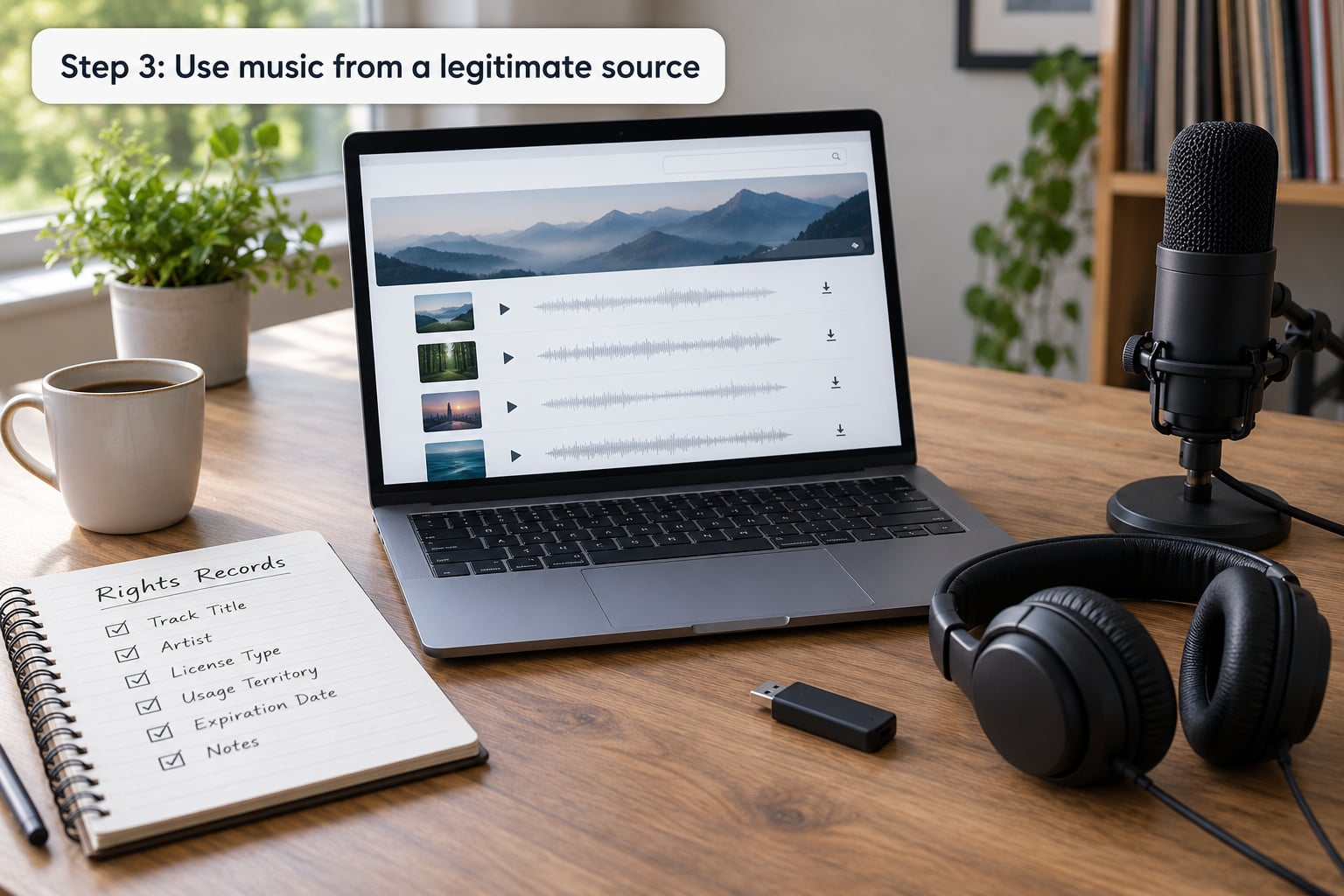
There are five realistic routes, and each has a different shape of cost and paperwork. Free music is not the same as cleared music, and the label on a download page tells you very little about podcast use. Most people searching how to start a music podcast legally land on this step first, and it is the one that decides your paperwork for years.
| Source | Best for | What to check before you commit |
|---|---|---|
| Subscription music library | Theme music, beds, stingers, whole episodes of commentary shows | Does the plan name podcast distribution, monetised shows, video versions and social clips? Does it indemnify, and up to what limit? |
| Pay-per-track or buyout licence | One specific piece you cannot live without | Does the buyout cover your platform only, or the wider web, and does it run in perpetuity? |
| Commissioned original score | A show identity, and anything used across video and social | A work-for-hire agreement assigning the composition and the recording to you, with a clause covering promo use. |
| Direct artist permission | Independent and unsigned artists | Written permission naming the track, episode, channel and clips. Email is fine and is what artists expect. |
| Public domain recordings | Classics and early material, on a no-cost budget | That the composition is genuinely out of copyright in your jurisdiction, and that the recording you found is not a modern protected performance of it. |
The direct route deserves a note. Podcasters running music-heavy interview shows say emailing bands works extremely well for unsigned and independent artists, who often reply within a day and say yes. The same thread points out that this stops working the moment an artist is signed to a major label, where the clearance runs through a business affairs department instead. Plan around that from the start.
On public domain material, one myth gets repeated constantly and it is worth killing early. A composition may be out of copyright while a particular recording of it is very much in copyright, because the performer and the record producer have their own separate rights with their own terms. Check the composition and the recording as two separate facts.
How do you tell the step worked? You can trace any track in your episode back to a document that names it. If a track arrives from memory rather than from a folder, it does not ship.
Step 4: Record and edit with permission
Recording is where good intentions quietly become unusable audio. A few habits fix that.
- Keep music on its own track. Speech on track one, music on track two. Editing, ducking and swapping then take minutes instead of an afternoon.
- Do not alter the music in ways the licence does not cover. Pitch-shifting a track for comedic effect can breach terms that otherwise permitted its use.
- Keep the raw session files. If a claim lands two years later, the unedited original plus your clearance is your evidence.
- Tag your audio properly. Title, artist and copyright fields help platforms and automated systems recognise what they are looking at.
- Log the clearance as you go, not after publishing. The person who presses publish is rarely the person who cleared the music.
For interviews, capture a spoken confirmation at the top of the recording that the guest agrees to be recorded and published. It is not a substitute for a signed release, but it protects you if the release never comes back.
How do you tell the step worked? Any episode can be explained in one sentence without opening a document: here are the tracks, here is where each permission lives, here is who signed it.
Step 5: Publish accurate credits and episode documentation
Credits are not a legal defence, but they are the fastest way to resolve a misunderstanding. A rights holder who can see you credited the artist is a rights holder who is much less likely to send a takedown.
For each episode, list the title and artist of every track, the source or licence reference, and the composer and publisher where you have them. Add a short note stating that the music is used under the licence identified, and link to the artist’s own page where one exists. If a library requires attribution, follow its format exactly rather than improvising.
Do the same job on your other properties. The video version, the vertical clip you post to social, the show notes you paste into a newsletter and the cover art all carry separate risk. A clip cut from your episode and reposted is a new use, and it is where new claims most often originate.
One practical habit: keep a downloadable copy of every published episode, together with its show notes, outside the hosting platform. If an episode is removed, you can prove what you published, when, and under what terms.
How do you tell the step worked? A listener who hears a track can find out what it is and where it came from, without guessing.
Step 6: Review content before each release
This final pass takes a few minutes and catches most problems before anyone else finds them.
- Purpose of each clip. Is it there to illustrate a specific point, or is it standing in for the music itself? Commentary clips and background listening are treated very differently.
- Commercial use. Does the permission cover a monetised show, sponsorship reads, or a video version cut for another platform?
- Territory and term. Worldwide? In perpetuity? Confirm the dates have not lapsed on an older licence.
- Attribution. Credits present, correctly formatted, in show notes and on the video version.
- Third-party material. Any image, clip or table borrowed from a review, a news article or a fan page.
- Platform rules. Your host, your video channel and each social platform have their own automated systems, and they act without notice.
- Takedown readiness. Confirm you know where your raw files and clearances live before you need them at midnight.
How do you tell the step worked? You can answer every one of those questions out loud without checking, because you built the notes as you went.
Common Mistakes That Get Podcasts Taken Down
Almost every problem I have seen in beginner music podcasts comes down to one of these. Each has a straightforward correction.
Assuming a purchase covers podcast use. Buying a track, or owning a subscription to a streaming service, grants you listening rights, not rights to republish. The correction is to find out what the licence actually permits, in writing.
Believing anything under thirty seconds is fair use. There is no such threshold in the law. In the United States, fair use is judged against four statutory factors, and a podcast that plays a song instead of linking to it is the pattern most likely to be treated as a substitute for buying the track. In the UK, the test is similar in spirit: fair dealing for criticism or review has real scope, but it is narrow, and it is a defence you argue afterwards rather than a licence you hold in advance.
Treating commentary as automatic protection. Commenting on a song is a strong position. Commenting while the song plays as your content is not the same thing. Keep the clip serving the point, and keep it as short as the point allows.
Relying on platform silence. An episode can sit unclaimed for months and a claim can still arrive later. The absence of enforcement is not permission.
Failing to credit the music. Credits are your fastest route out of a misunderstanding. Use the same format every episode.
Reusing one track across every platform without checking. A licence for your audio feed often says nothing about a video edit, a story, or a clip reposted by someone else. Check the permitted uses list each time you add a channel.
Borrowing artwork and show images. Cover art is copyright too. Commission it, buy it outright, or make it yourself.
Skipping the paperwork when an answer came over email. A friendly yes in a chat window is hard to prove six months later. Save the thread, and reply confirming the terms so both sides have the same record.
Frequently Asked Questions
Do I need a music license to start a music podcast?
You need permission for every recording you publish unless you own it, commissioned it, or it carries no copyright. In practice that means clearing the composition and the recording separately, or holding a blanket licence from a library whose terms name podcasts. It makes no difference whether your show earns money, is monetised, or sits behind a paywall.
Can I play songs in a podcast if I only use a small excerpt?
A short excerpt is not automatically free to publish. Length matters, but so do purpose, how much of the song you use, and whether your episode could substitute for buying the track. The practical answer for most shows is to clear the clip properly, or to comment on the music without reproducing more than the argument requires.
Is music in the public domain always safe for a podcast?
No, and this is the most common public domain mistake. The underlying composition may be out of copyright while the specific recording you found is protected by the performer and the record producer. Check the composition, the recording, the jurisdiction and the publication history separately, and prefer archive sources that state the rights clearly.
Can I use royalty-free music from a streaming service?
Only if the service’s terms cover your actual use. Check whether the plan permits podcast distribution, monetised shows, video versions, social promotion, edits and perpetual use, and whether it offers indemnification. Royalty-free means no ongoing royalties to a publisher; it does not mean free of charge, and it does not mean cleared for every platform.
Do I need a music license if my podcast makes no money?
Yes. Copyright does not switch off when a show is unpaid. Non-commercial podcasts are routinely targeted by claims, and a rights holder does not have to sue you to cause real damage: an episode can be claimed, blocked or monetised by someone else with no warning at all. Licensing terms also often differ between monetised and non-commercial shows, so read the wording.
What should I do if I get a copyright claim on my podcast?
Work out what it is first. An automated content match, a formal takedown notice and an actual lawsuit are three different things with three different responses. Keep the raw file, the licence or permission and the publication date together, then reply to the claimant with your paperwork. Repeat infringement on a channel you monetise is what turns a claim into a real problem.
Conclusion: Your First Five Moves
Learning how to start a music podcast legally is mostly a matter of sequencing. Write down the format in one sentence, choose a music source whose terms explicitly name podcasts, save the paperwork in a folder you will still find in a year, set up a credits template, and run the pre-release checklist before the first episode goes out.
None of that takes more than a day, and it means you can spend your time on the part people actually subscribe for: the conversation about the music.
Again, this is general information rather than legal advice. If you intend to play full commercial songs, run sponsorship reads, or license music from a major label, get a professional opinion before you publish. The details are general, but the consequences are not.