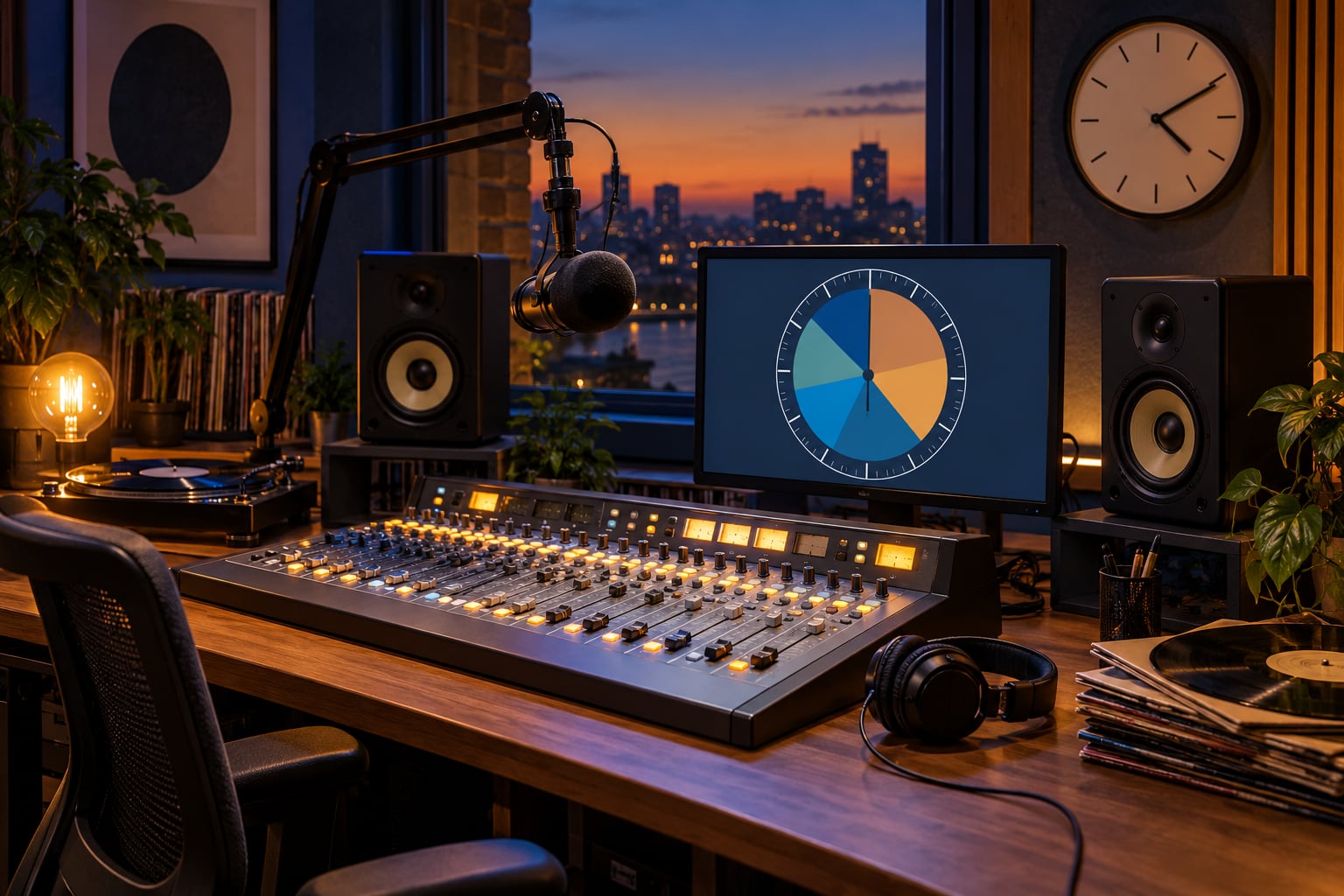
How jazz radio stations are programmed comes down to a music director curating a library, coding every track with rules, and dropping categories into hourly format clocks that a scheduling system turns into the day’s playlist. Public and college stations work differently: the host builds and voices their own show. Everything you hear on a jazz station is the result of those choices, not a jukebox.
That matters more for jazz than for most formats, because jazz tracks run five to eight minutes and often only make sense played in the order the bandleader intended. A jazz clock cannot be built from three-minute singles, so the programming looks denser, longer and more deliberate than a chart-based schedule.
Before the mechanics, one clarification. “Jazz station” covers three fairly different businesses: the commercial mainstream jazz outlet, the smooth jazz and chill-out format, and the public radio or college show where one person picks everything. Search results constantly mix them, which is why listeners get confused about what a station is even promising.
Table of Contents
- What Makes Jazz Radio Programming Work?
- How Jazz Radio Stations Are Programmed
- How Stations Choose and Rotate Jazz Music
- How a Typical Jazz Radio Day Is Structured
- What Roles Do Presenters and Music Directors Play?
- How Do Terrestrial and Streaming Stations Differ?
- How Can Listeners Identify a Station’s Style?
- Frequently Asked Questions
- What to Listen For First
What Makes Jazz Radio Programming Work?
A jazz station works when a small number of promises hold. The music is unmistakably jazz, the day has a shape, and the listener recognises the station’s personality whether the music is being voiced live or sequenced by software.
A handful of terms do most of the work. A music master is the final ordered list of everything the station will air today. A format clock is a one-hour template showing which categories play in which part of that hour. A daypart is a stretch of the day with its own mix, such as morning drive or late night. Rotation is the rule deciding how often a track may come back. Imaging is the station’s sonic identity, the jingles and stings. Traffic is the commercial break schedule laid over the music. A segue is one track blending into the next, and voice tracking means the host records their links in advance rather than live.
Those last two matter more in jazz than in pop, because a long instrumental track can be talked over without either half losing the listener.
How Jazz Radio Stations Are Programmed
The process runs in a fixed order, and most stations repeat it every day for every daypart. Research first, then acquisition, then coding, then clocks, then the schedule, then a listen-through before anything airs.
Audience research. Nielsen audience panels and Edison Research listener studies show when people tune in, how long they stay and what they do afterwards. In-car listening matters enormously for jazz, because the drive hour and the late-night slot behave very differently from midday.
Acquisition. Music arrives from labels and distributors, from promotional services that push new releases to stations, and from artists who send material unsolicited. Public and college stations buy less and barter more, and freeform stations often run entirely on donated or personal library music.
Coding. Every track is tagged with attributes: era, sub-genre, core or non-core artist, vocal or instrumental, energy level, year, and length. A practitioner on r/radio described exactly this, saying their scheduler uses MusicMaster with each song coded by year, sound, whether the artist is core, and a time separation value. Those codes are the raw material of every decision downstream.
Categories and rotation. The director groups tracks into categories, then decides how often each category plays and how long before a given track can repeat.
Clocks. Categories are placed into hourly format clocks per daypart, and ad breaks are fitted around the tracks rather than the other way round. A typical rule of thumb is about 12 minutes of commercial time per hour, with a promo or two folded in.
Scheduling. Software such as MusicMaster, WideOrbit or SAM orders the actual tracks, applying separation rules so the same artist does not appear twice in an hour and the same track does not come back too soon. The result is logged as the music master and shared with the host and the traffic department.
Quality control. Somebody listens to the finished day before it goes out, usually early in the morning. Broken links between tracks, an over-long break, or three consecutive vocal features all get fixed by hand.
One legal layer sits over all of it. Terrestrial stations operate under statutory licences that let them play music in return for reporting and royalty payments, collected through performing rights organisations including ASCAP, BMI and SESAC. Streaming and satellite instead carry a direct per-play fee, administered on the internet side by SoundExchange. A station cannot simply play whatever it likes and walk away; the obligation is real even when the invoice is handled by someone else’s name.
How Jazz Radio Stations Are Programmed in Practice
Here is one hour of a weekday drive show, the busiest clock on a jazz station, and the arithmetic behind it. Long tracks mean fewer spins per hour than a pop station manages.
| Position | What plays | Why it sits there |
|---|---|---|
| 00:00-04:00 | Opening track, often a well-known standard | Cold open, no talk over the first seconds |
| 04:00-05:00 | Host intro and news, voice tracked over the outro | Talk lands where the track thins out |
| 05:00-12:00 | Two modern releases | Heavy rotation, discovery duty |
| 12:00-15:30 | A vocal feature, singer fronting a big band | Vocal tracks take the early slot, not the late one |
| 15:30-19:00 | Commercial break and imaging | Break lands where a listener might still be arriving |
| 19:00-27:00 | Bebop or hard bop, two tracks | The core of the station’s claim |
| 27:00-31:00 | Host segment, an interview clip or history piece | Listeners who want context get it here |
| 31:00-34:00 | Second break and promo | Second commercial pod of the hour |
| 34:00-43:00 | Cool jazz and bossa nova | Lighter energy, good for late-morning drive traffic |
| 43:00-50:00 | Album sequence, two tracks in recorded order | Long runs only work in sequence |
| 50:00-54:00 | Third break, shorter | Keeps the hour from feeling padded |
| 54:00-60:00 | Recurrent standard and a segue into the next hour | Familiar track closes, blend carries over |
Run that hour end to end and you get somewhere between nine and twelve tracks, against the roughly fourteen a pop clock delivers. Programmers have to accept that, and the hour reads as fuller to a listener than the arithmetic suggests.
How Stations Choose and Rotate Jazz Music
Rotation is the answer to the most common listener complaint. When a track comes back every forty minutes, that is not a playlist bug, it is a rule working as designed.
Stations running new music usually rotate a title roughly every four hours. Stations running a deep catalogue of classics can wait as long as eight hours, which sounds generous until you remember the clock repeats all day. Lunar rotation means a track plays once per month, and it is how the rare deep cut stays alive without wearing itself out.
Alongside those sit categories with no set interval at all. Records, birthdays, anniversaries, local artists and listener requests sit in their own pools, pulled when the clock has a gap or a host wants something specific.
The balance question is the real craft. A jazz station has to weigh the standards listeners expect against new releases nobody has heard, and keep vocal and instrumental jazz from clustering into the same hour. Era spread matters too: a station that plays only bebop sounds like a museum, and one that plays only smooth jazz sounds like a spa. Regional scenes get their own slots, and the rising artist of the week feature is a common way to introduce unfamiliar names without committing the whole hour.
Request lines complicate all of it. Public stations take them generously; commercial ones weigh them against the clock and usually say so honestly rather than pretending every request plays.
How a Typical Jazz Radio Day Is Structured
Dayparts are where a station’s personality actually shows, because the same library produces very different broadcasts depending on the hour.
| Daypart | Typical shape | What you should notice |
|---|---|---|
| Early morning, 5-9am | Smooth, mostly instrumental, low talk | Light energy, a short news and weather block |
| Morning drive, 6-10am | Talk-forward with a strong vocal feature | Host personality, frequent requests, longer links |
| Daytime, 9am-4pm | Deeper cuts, album sequences, occasional interviews | The catalogue breathes here |
| Lunchtime feature | A themed block, an artist birthday, a tribute | The one hour that is deliberately off-clocking |
| Afternoon drive, 4-7pm | Upbeat, vocal-heavy, more new releases | Energy climbs toward rush hour |
| Evening, 7-11pm | Hard bop, electric and fusion, retrospective features | Longer tracks, fewer breaks |
| Late night, 11pm-2am | Ambient, modal, sparse, minimal talk | The most adventurous clock of the day |
| Weekend marathon | Era or artist themed, minimal repetition, presenter-led | The best place to hear how broad the library really is |
Listeners on r/minnesota have noticed the flip side of this. A station branded as jazz can drift toward non-jazz or heavily smooth material in certain hours, which feels like format drift even when the licence technically says jazz. Comparing the same station at 2pm and 2am is the fastest way to find out.
What Roles Do Presenters and Music Directors Play?
On a commercial station the music director owns the music, and the host owns the hour. The director sets categories, rotation and clocks; the host narrates, interviews, writes links and decides what to say over a given track. As one engineer’s account puts it, the music director picks a few hours of music and that then plays throughout the day, which is exactly why listeners notice the sameness.
On public stations the split flips. At KALW and KCSM, individual programmers make the programming calls for their own slots, and one host described building rotating 20-minute thematic sets, 20 minutes of jazz then 20 minutes of something else, to keep a night from flattening out.
College and university freeform stations push it furthest. WWUH gives every announcer complete freedom to choose their own music, which its own history describes as presenting listeners with ten unique takes on the same station identity. The trade is obvious: genuine variety, no consistency guarantee, and the listener has to make an effort.
That is also the answer to the most upvoted request on the r/Jazz thread that surfaced in this research: people are not asking for more jazz, they are asking for a host who explains the song, the artist and the style before it plays.
How Do Terrestrial and Streaming Stations Differ?
Streaming changed the mechanics more than the music. A broadcast station is a transmitter with a licence and a geographic signal; an online channel is a playlist with a monthly fee, and the differences cascade from there.
Geography disappears, and with it the local scene slot and the drive-time targeting. A station in one metro area can now compete directly with a specialist channel run from another country.
No transmission window means no missed show. A narrated interview at 8am is there at 8am the next day, which a broadcast audience simply cannot get. A listener can also go back through a whole day of programmes, and stations publish schedules and archives that a broadcast log never offered.
Data gets sharper too. Streaming reports give exact listener counts per track, per hour, per region, which a terrestrial panel only estimates. That measurement changes programming decisions more than listeners expect.
JAZZRADIO.com is the clearest example of the model taken seriously. Rather than one generic jazz feed, it runs more than 45 curated channels spanning early jazz, big band, bebop, smooth, contemporary vocal, Latin, Gypsy and bossa nova, and unlike most internet radio outfits it names its Channel Directors. That is a music director’s job description applied to a stream, one person accountable for one style.
The pressure runs the other way too. A terrestrial jazz station competes with algorithm playlists that already know the listener’s taste and never repeat anything. A scheduled clock, with all its repetition, now has to justify itself as a discovery tool.
How Can Listeners Identify a Station’s Style?
Programmers are not hiding anything, and the practical stuff is mostly published. Read the schedule page before you listen. A station that publishes show names, presenter names and thematic blocks is telling you exactly what it thinks its audience wants.
Sample across the clock rather than judging a station on the drive hour alone. The late-night block and the weekend marathon reveal the library far better than a Tuesday afternoon does, because that is where the director puts what they actually want played.
Check whether the site lists a playlist. When it does, the hours per title tell you the rotation category directly, and you can see whether the catalogue is deep or a loop of the same twenty tracks.
Look for the substream. A main FM signal carrying soft rock with jazz on HD2 or a DAB+ channel is a common arrangement, and it is the reason many listeners wrongly conclude no jazz station exists in their area.
Track repeats for an hour or two if repetition bothers you. If the same track returns inside an hour at the same time of day, that is a clock by design, and it is a different station experience from one that never repeats anything.
For artists trying to reach a playlist, the honest version is that unsolicited material reaches a music director’s inbox, and most of it is never played. A single jazz outlet has reported an average of around 15 spins per week for new music across smooth jazz stations. Send one track, not a full album, and expect a long wait.
Frequently Asked Questions
Do jazz radio stations play only classic jazz?
No. A jazz station’s library usually spans several eras at once, from swing and bebop through cool jazz, fusion and contemporary vocal work, plus new releases added each week. Public and college stations often go wider still, mixing in other genres. The classic material is the familiar part, not the whole picture.
Why do jazz stations repeat the same songs?
Because repetition is a rule, not an accident. A track in heavy rotation returns roughly every four hours, and catalogue titles may wait up to eight. Scheduling software enforces separation rules so the same song never lands twice in a row. The result is familiar music spaced often enough to keep plays high.
How is a jazz radio schedule different from a generic music playlist?
A playlist is a queue of tracks. A radio schedule is built from rules. Categories are assigned to fixed positions in hourly format clocks, rotation governs how often anything repeats, and commercial breaks are fitted around the music. With tracks running five to eight minutes, an hour of jazz fits only nine to twelve songs, far fewer than a pop clock.
Can listeners request songs on jazz radio stations?
Usually yes, though how well it works depends on the station. Public and college outlets are glad to take requests and often build shows around them. Commercial stations log requests and weigh them against the clock, so a request is a wish rather than a promise. Hosts with their own shows can honour far more of them than an automated voice clock.
Are jazz presenters required to be musicians?
No. Plenty of jazz hosts are writers, engineers and broadcasters without a performance background. What they need is deep familiarity with the music and the ability to explain a track in a sentence or two. Musicians often make excellent hosts, but the job is curation and narration rather than playing.
What to Listen For First
Start by sampling three or four jazz stations rather than one, and give each a full week so you hear more than the drive hour. Note the range of eras, how often familiar titles return, and whether the presenters add anything beyond the music.
That comparison is the quickest way to see which station is trading on heritage, which is pushing discovery, and which is really just a software clock with a warm voice. Whichever it turns out to be, you will know why it sounds the way it does, and that is the whole point of how jazz radio stations are programmed.