Short answer: yes, in most US states it is legal to listen to police radio, as long as you do not use what you hear to commit a crime, help someone you know is suspected of a crime escape, or interfere with an emergency transmission. That part is settled nationwide. The messy part is where you listen and what your state adds on top.
This guide walks through the federal rules, the state-by-state picture, scannervox laws, scanner apps and what is actually still audible in 2026. It is general information, not legal advice. If you need an answer for your specific situation, talk to a lawyer in your state.
One thing worth clearing up early: listening at home is almost never the problem. Driving with a scanner is where the legal risk concentrates, and that is the distinction most online advice leaves out.
Table of Contents
- Is It Legal to Listen to Police Scanners in the US?
- What the Federal Communications Commission Rules Cover
- What Is a Police Scanner?
- Is Listening to Police Radio Different From Transmitting
- Do State and Local Laws Matter?
- Scannervox: Why Some States Require It
- Can You Listen to Police Scanners in a Car?
- Are Police Scanner Apps Legal?
- What About Digital, Encrypted, and Private Radio Traffic?
- Can You Record or Share What You Hear?
- How to Listen Responsibly and Avoid Problems
- Frequently Asked Questions
- Conclusion: Check the Rules for Your Location
Is It Legal to Listen to Police Scanners in the US?
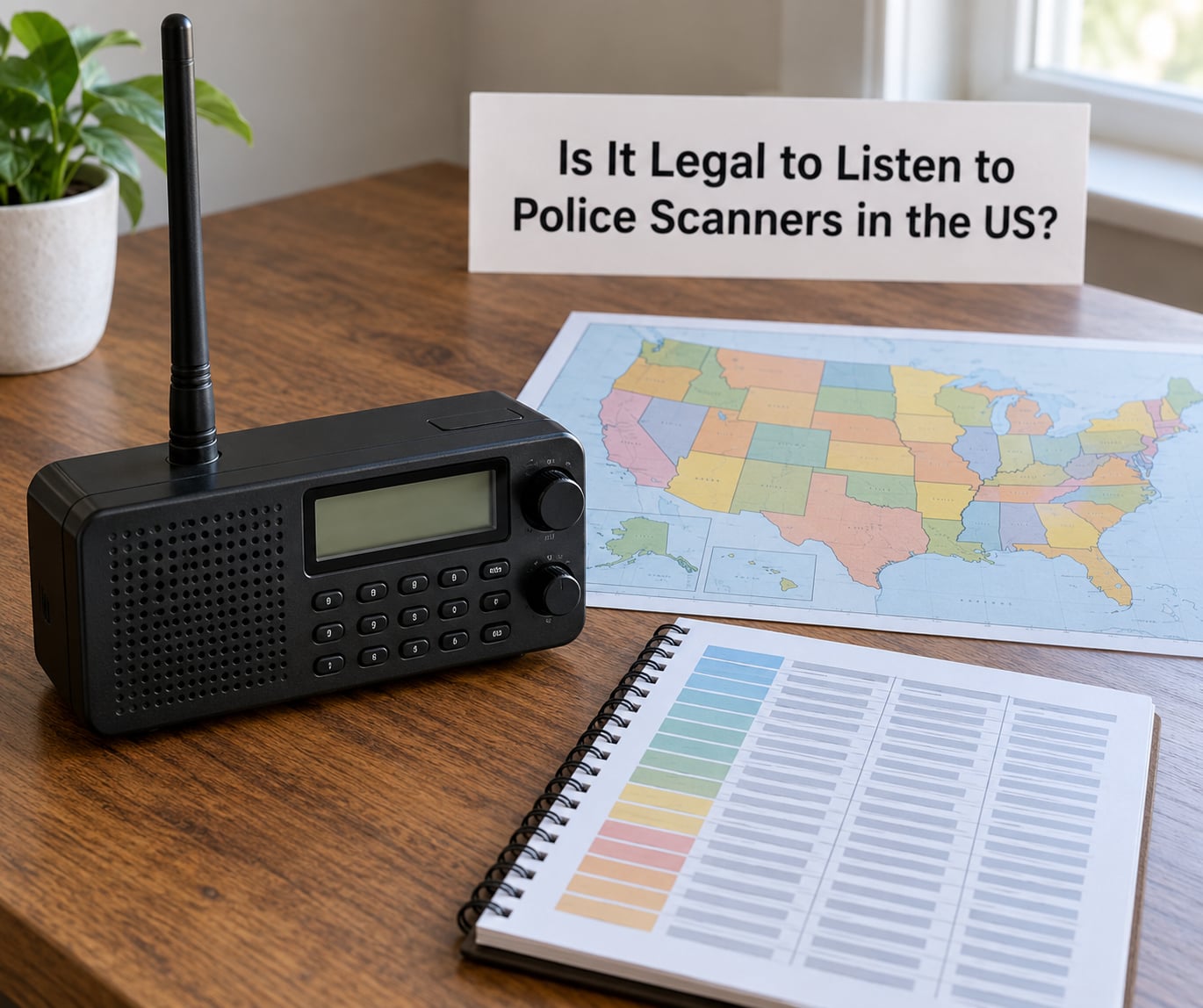
Listening to an unencrypted public safety radio transmission is legal across the United States. Federal law treats ordinary public safety radio as public, and courts have generally held that listening is not eavesdropping.
Three uses are prohibited almost everywhere, and they matter more than anything else on this page:
- Using the traffic to commit a crime, including burglary, robbery or drug offences.
- Using the traffic to help a suspect escape, or to help someone avoid investigation or arrest.
- Interfering with or obstructing a transmission, which also covers jamming, spoofing or repeating traffic over your own transmitter.
Everything else on this page is variation. States regulate where the equipment sits, who may hold it, and whether you need a licence to transmit.
What the Federal Communications Commission Rules Cover
The framework sits in the Communications Act of 1934, which created the authority now exercised by the FCC. Congress gave the Commission power to license radio stations and to write rules for how radio traffic is transmitted and received.
That authority is why licensed stations have to identify themselves and why some radio services are open to the public while others are not. The FCC also publishes rules covering who may operate equipment that can transmit, which is the line between a receive-only scanner and a radio you need a licence for.
Two federal points cause most confusion. First, the FCC licenses transmitters, not listeners. Owning a receiver does not require a federal licence. Second, FCC Privacy Rule 91-36 exists largely because mobile two-way radios kept being used to interfere with emergency services, and it pre-empts some state rules in that narrow area.
So an apparently public broadcast is not automatically unrestricted. Encrypted or access-controlled systems can carry traffic that is not open to the public, and state criminal law on interception still applies underneath the federal framework.
What Is a Police Scanner?
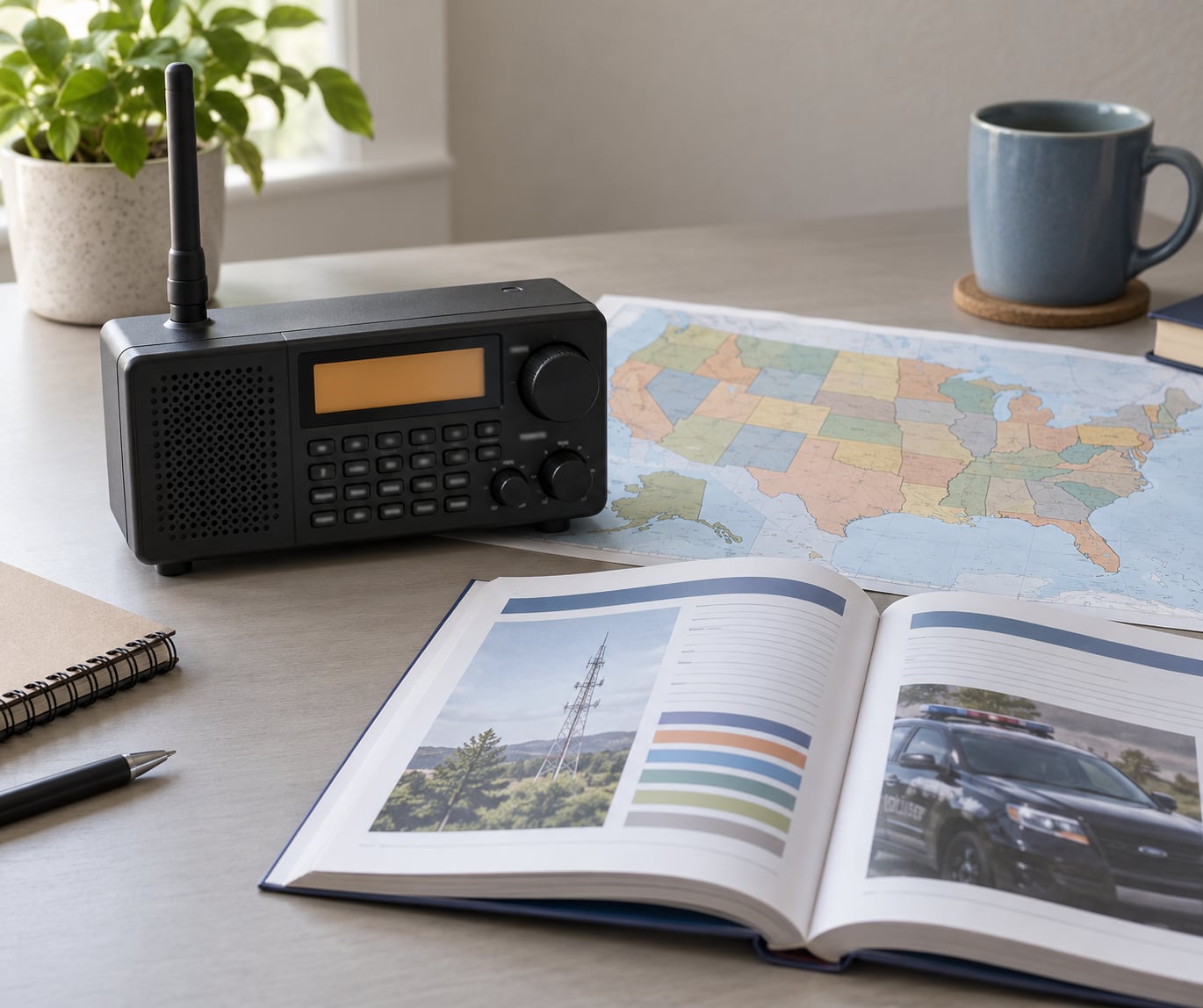
A police scanner is a radio receiver that lets you monitor public safety frequencies used by police, fire and emergency medical agencies. It picks up two-way radio traffic and plays it back as audio. It cannot talk back unless it is built to transmit.
The systems you will meet fall into a few groups:
- Conventional systems where each channel has its own fixed frequency, still common in rural areas and on fire and EMS talkgroups.
- Trunked systems such as EDACS or P25, where many channels are shared and a control channel tells your scanner which one to listen to next. This is why a trunk-following scanner matters.
- Simulcast, where several transmitters rebroadcast the same channel over a wide area to fill dead spots.
- Digital voice such as APCO Project 25, which sounds synthetic and often carries encryption.
- Scanner apps that turn a phone into a receiver using a connected radio or an internet feed.
Dispatch codes are still out there, and decoding them is part of the interest. A few you will hear constantly: a 10-8 means the officer is available, a 10-99 means emergency assistance is needed, a 10-23 means arrival on scene, and a code 67 usually means a pursuit is underway. Code meanings vary by agency, so treat any glossary as a starting point rather than gospel. 10-99 and code 67 show up on people-also-ask boxes more than anything else in this hobby.
Is Listening to Police Radio Different From Transmitting
It is a big difference. Listening is passive. Replying, or being able to reply, is not. Most state scanner laws and nearly every federal licence rule treat a transmit-capable radio as a different animal entirely.
A receive-only scanner cannot interfere with anything, because it has no way to put a signal on the air. That single fact is why enthusiasts keep reminding each other to check the FCC ID on the back of a used transceiver before buying it.
The lines that blur fast are these:
- Replying on the air, which puts you into an operational channel that was not meant for you.
- Repeating or relaying traffic through your own transmitter, which is treated as interference and as an accessory to whatever it disrupts.
- Publishing intercepted traffic in a way that helps a suspect, whether that is a social post, a livestream or a tip-off.
- Using what you hear for any of the three prohibited purposes listed earlier.
Curiosity is not a defence and ignorance is not one either. Officers treat intercepted traffic as live evidence, not gossip.
Do State and Local Laws Matter?
They matter more than most people expect. Nearly every state that regulates scanners does so around the same three levers: whether you may possess one, whether you may have one in a vehicle, and whether you may hold equipment that transmits.
California’s Penal Code 636.5 is a good example of how narrow these laws are. It restricts the uses that make listening a crime and it addresses radio equipment used to obstruct transmissions, without banning civilian ownership. Kentucky’s Revised Statute 432.570 takes the opposite approach to location, concentrating hard on possession inside a personal vehicle while leaving home use alone.
Two named systems cover the rest of the map. States such as Minnesota, South Carolina, New Jersey, Connecticut, New York and Florida regulate mobile or in-vehicle use, sometimes alongside scannervox. Others, including California, Mississippi, Illinois and Wyoming, have no general scanner ban and instead rely on the prohibited-use provisions.
Municipalities add their own layer on top. Some cities restrict where a scanner can be mounted or displayed, some require a permit, and a handful write local rules that are stricter than the state code above them. If you are near a border or crossing between states with different rules, that difference is the thing that catches people.
Can you listen to police scanners in every state?
You can listen in every state. What varies is whether a scanner may be present in your car, whether it must be equipped to pass local enforcement, and whether the traffic you hear is encrypted or plain. Check your state’s code before you drive through it, and treat your city ordinances as the stricter of the two.
Scannervox: Why Some States Require It
A scannervox is a small speaker that replays the audio from your scanner through the vehicle’s own system, so officers hear dispatch traffic rather than static from an external speaker.
Jurisdictions require it for a plain reason: an audible scanner in a quiet cabin is an annoyance that turns into complaints, and complaints turn into ordinances. The requirement usually applies to mobile scanners in vehicles, and it is common in states with in-car restrictions.
For a listener, the effect is small but real. You need the box wired in, mounted out of sight, and switched on before the scanner so dispatch audio never leaks from a speaker. Buying one for a state that does not require it costs you nothing except the installation slot.
Because the list of states and the wording change, verify the current rule for your own location before you buy anything.
Can You Listen to Police Scanners in a Car?
This is where the law tightens, and it is the distinction enthusiasts on the forums keep repeating. At-home listening is essentially never a problem. Driving with a scanner in the passenger seat is where the risk lives, and in several states it is a straight offence to have a working scanner in a personal vehicle at all.
If you drive across states regularly, treat mobile scanning as something to switch off rather than something to configure. One Florida user described the simple habit: never scan while driving, listen from a base station at home instead.
Where scanning in a vehicle is allowed, keep it lawful and unobtrusive. Use a receive-only unit, mount it where it is not visible from outside, use a scannervox where one is required, and never touch the transmit function. Keep every wire out of the way of airbags and pedals.
If you are stopped while a scanner is running, stay calm, do not argue at the roadside, and ask which statute they are applying. A visible receive-only radio is your best defence, which is exactly why the FCC ID sticker on the back matters. Do not reach for it or move it before the officer asks.
Are Police Scanner Apps Legal?
The app itself is almost never the problem. What matters is the state restriction you are sitting in, the technology it uses, and whether you are moving when you use it.
There are two different kinds of app. One connects to the internet and plays a hosted audio feed. The other taps a radio attached to your phone and receives directly, which is much closer to owning a scanner in every way that the law cares about.
That second type is where the grey area bites hardest. In states with in-car scanner restrictions, an app that receives radio traffic while you are driving can be treated as the scanner itself, even though no hardware was bolted to the dash. The safer pattern is the same one enthusiasts recommend: apps and feeds at home, hands off while you are on the road.
Terms of service matter too. Some feeds restrict re-streaming, and an app store listing tells you nothing about whether your use of it is lawful in your state. Installing an app is not a legal opinion.
What About Digital, Encrypted, and Private Radio Traffic?
This is the part that frustrates newcomers most. Listening remains legal even when nothing comes out of the speaker.
The layers you will run into are straightforward. Public digital voice such as unencrypted P25 sounds digital but is open to anyone with the right receiver. Partially encrypted systems leave some channels in the clear, often fire and EMS while police channels stay encrypted. Fully encrypted systems need a key you do not have, so you hear carrier and silence.
Users in Boston and Oakland report major city departments going fully encrypted, leaving fire, EMS and dispatch chatter as the only audible traffic. Colorado discussions show the same pattern statewide, with rural agencies the usual exception.
Private and access-controlled channels are a different category again. Agency repeaters, tactical talkgroups and restricted industrial traffic are not public safety broadcasts, and there is no argument for listening in.
Attempting to defeat encryption is where legal problems turn serious, and it is not worth attempting. Know your system before you buy hardware: RadioReference is the source enthusiasts point to for the system type used by your local agency.
Worth a note for our UK readers. Airwave, the UK emergency network built on TETRA, is a closed system operated for the emergency services, and listening to it without authorisation is a different and much narrower question than scanning US public safety traffic. Do not carry an assumption from one side of the Atlantic to the other.
Can You Record or Share What You Hear?
Curiosity at home is different from publishing. Recording dispatch audio to your own machine for later reference sits in the same legal space as listening.
Publishing is where the exposure rises. Livestreaming a feed, reposting audio to social media or a video platform, or selling access to intercepted traffic can amount to interfering with a transmission, and in some jurisdictions to a separate interception offence of its own.
Two practical rules keep you out of trouble. Do not rebroadcast traffic in a way that reaches anyone near the incident, and do not post anything while the situation is still active. Both can turn an innocent recording into evidence that you interfered or helped someone.
How to Listen Responsibly and Avoid Problems
A short checklist covers most of the risk, and none of it requires giving up the hobby.
- Check your state code and city ordinance before you buy. Look for the words scanner, mobile, vehicle, monitor and scannervox.
- Buy receive-only. Confirm the FCC ID on the back if you buy used, and keep the transmit function disabled.
- Keep mobile use minimal. Home listening is the low-risk default; treat in-vehicle scanning as the exception.
- Use a scannervox where it is required, mount out of sight, and wire it in properly.
- Never transmit, repeat or relay traffic, and never impersonate an agency or officer on any frequency.
- Do not jam or interfere with emergency channels, which is criminal everywhere and treated as serious.
- Protect sensitive detail. Do not share addresses, victim information or anything about an active scene.
- Confirm the current rule with the agency or your local clerk, since these statutes change.
Run that check before any trip into a state you have not scanned in before. Two minutes reading the statute is cheaper than an argument at a traffic stop.
Frequently Asked Questions
Which states require a scannervox or restrict scanners in vehicles?
States such as Minnesota, South Carolina, New Jersey, Connecticut, New York and Florida regulate mobile or in-vehicle scanners, and many of them pair that with a scannervox requirement so dispatch audio comes through the vehicle system instead of an external speaker. California, Mississippi, Illinois and Wyoming have no general ban and rely on prohibited-use rules instead. Verify the current wording for your state and city before buying.
Is it illegal to have a police scanner in my car while driving?
In most states a receive-only scanner in a vehicle is fine. In states with mobile scanner restrictions, having a working scanner in a personal vehicle can itself be the offence, even if you never transmit. Kentucky Revised Statute 432.570 is the clearest example, banning scanners in personal vehicles while leaving home use alone. A scannervox, an out-of-sight mount and disabling mobile scanning on the road reduce risk everywhere.
Is it legal to post police scanner audio online?
Recording traffic privately sits in the same space as listening. Publishing it is different. Livestreaming a feed, reposting dispatch audio to social media or a video platform, or selling access to intercepted traffic can amount to interfering with a transmission, and some states treat it as its own interception offence. The safe rule is not to rebroadcast anything that could reach people near an active scene, and nothing at all while the incident is live.
Can a scanner interfere with police radio or dispatch?
A receive-only scanner cannot, because it has no way to put a signal on the air. Equipment that can transmit is where interference comes from, along with deliberately jamming or spoofing. FCC Privacy Rule 91-36 was created because mobile two-way radios were disrupting emergency services. If your radio has a transmit function, keep it disabled on public safety channels and never retransmit anything you hear.
Can police detect that I am listening to a scanner?
A receive-only radio leaves no trace on the air, so there is nothing for dispatch to detect. What officers can see is a device in plain view, a scannervox that is obviously running, or a mounting setup that looks like a police unit, and that is what leads to questions at a traffic stop. Keep the radio receive-only, mount it out of sight, use a scannervox where one is required, and never reach for the unit before an officer asks for it.
Conclusion: Check the Rules for Your Location
Is it legal to listen to police scanners? Yes, in most US states it is legal to listen to police radio, provided you do not use the traffic to commit a crime, help a suspect escape or interfere with an emergency transmission. Before you buy, install or drive with a scanner, check your state statute and your city ordinance for mobile use and scannervox rules, and confirm you have receive-only equipment.
General information only, last reviewed for 2026. Scanner and interception law changes, so verify the current rules for your location before you rely on them.