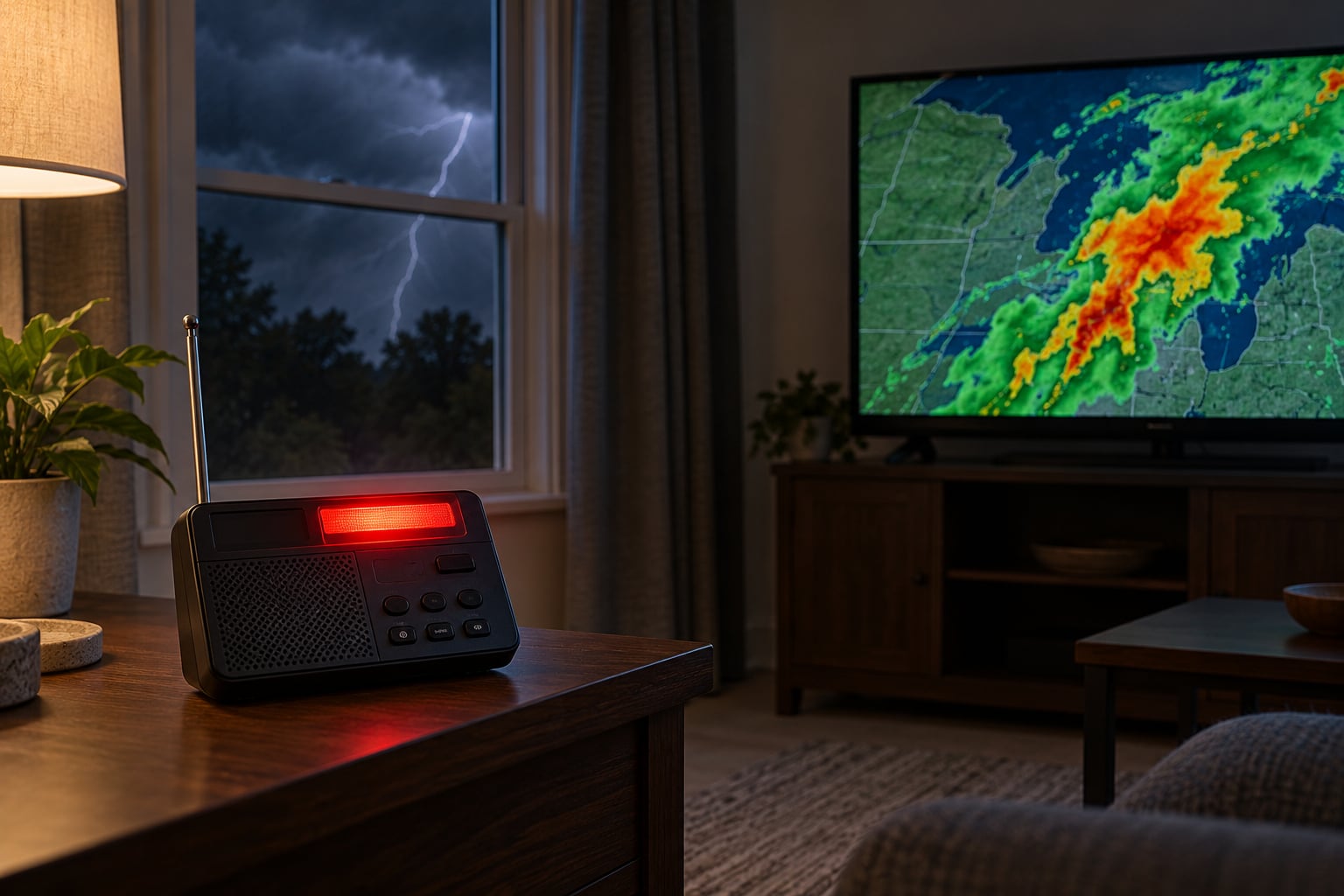
Weather radio alerts are official emergency messages from the National Weather Service, broadcast on VHF radio and sent with a code that tells your receiver what the danger is and where it applies. The receiver decodes that code, sounds a loud attention tone, and reads the alert out loud, even when the storm is nowhere near you.
That last part surprises people. A radio on the kitchen counter can announce a warning for a county two hours up the road, because the transmitter covers a wide area and the receiver decides which alerts are relevant. Understanding how weather radio alerts work takes about five minutes and saves a lot of head-scratching later.
We have put this guide together from the National Weather Service’s own documentation, the FCC rules behind the Emergency Alert System, and the questions that turn up again and again on weather radio forums, where the same handful of confusions cause most of the frustration. No product recommendations, just the system itself.
Table of Contents
- How Weather Radio Alerts Work
- What Is NOAA Weather Radio?
- What Does SAME Mean in Weather Radio Alerts?
- Which Weather Alerts Can You Receive?
- How Do Weather Radio Alert Codes Work?
- What Is the Difference Between NOAA Weather Radio and Wireless Emergency Alerts?
- Why Might You Not Receive a Weather Radio Alert?
- How to Set Up and Test Your Weather Radio
- What Should You Do When a Weather Radio Alert Sounds?
- Frequently Asked Questions
- Do all weather radios receive NOAA Weather Radio alerts?
- Why does my weather radio sound the weekly test alert?
- Can I rely on weather radio alerts instead of wireless emergency alerts?
- What does it mean when a weather radio warning was not issued for my county?
- How often should I test my NOAA Weather Radio?
- Conclusion: Prepare Before an Alert Sounds
How Weather Radio Alerts Work
Two separate things come out of a NOAA weather radio. One is continuous voice programming: forecasts, hourly conditions, climate discussions, river and fire weather information, spoken by rotating forecasters around the clock. The other is an alert activation, where the normal programming is interrupted and a coded emergency message is pushed out instead.
The distinction matters because the second one is rare and deliberate. A radio sitting on a table can run for weeks saying nothing but forecasts, then cut straight into a tornado warning at 2am. Nothing about the device changed. The National Weather Service issued the alert, and the transmitter carried it.
How Weather Radio Alerts Work Behind the Scenes
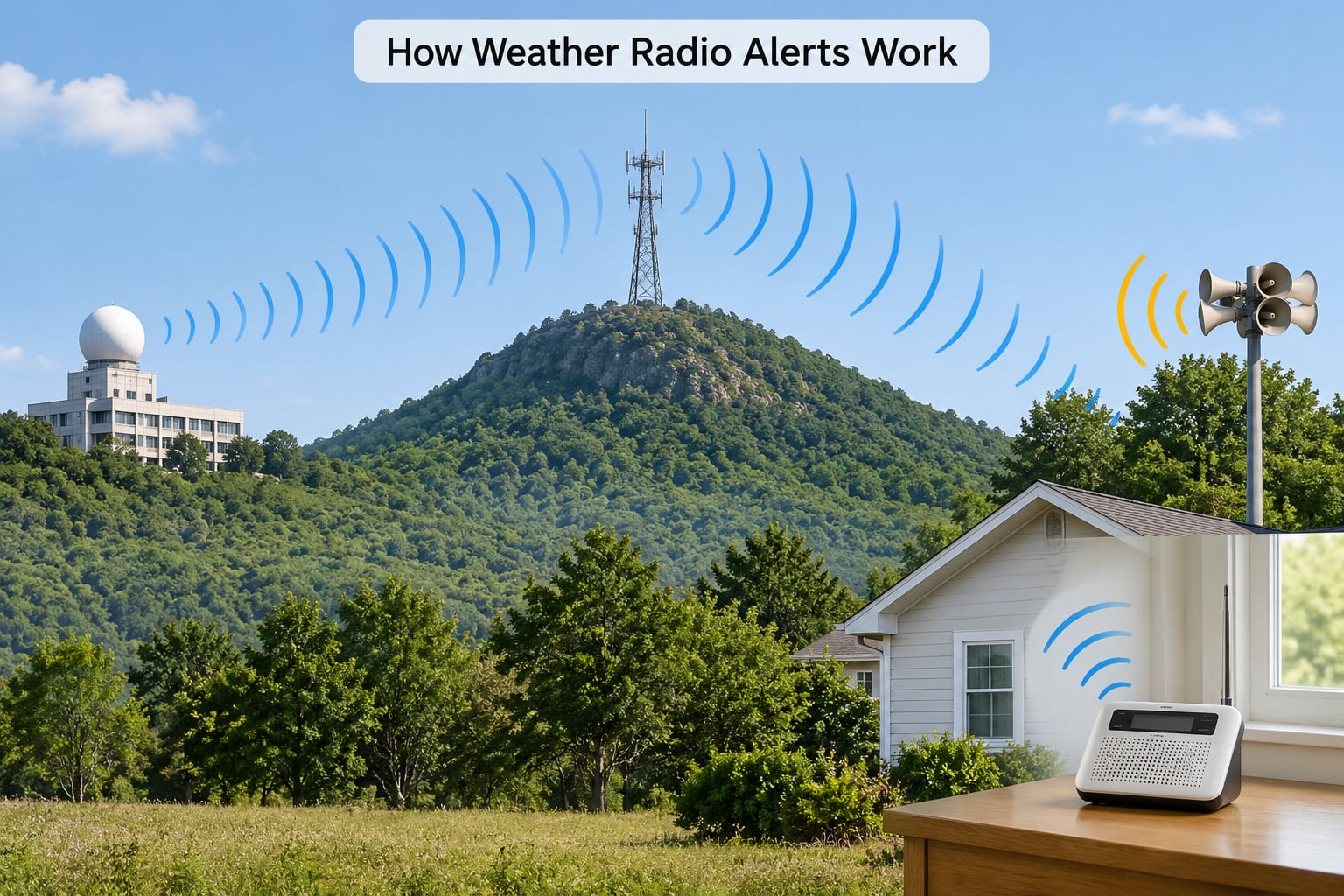
The chain from a forecaster’s decision to a tone in your kitchen runs through six steps.
- A forecaster issues the alert. A meteorologist at a local National Weather Service office determines that conditions meet the criteria for a watch, warning or advisory over a defined area, and issues it for specific counties.
- The alert goes to IPAWS. The message is sent into the Integrated Public Alert and Warning System, the federal infrastructure that collects official alerts and pushes them out to every delivery channel at once.
- IPAWS feeds the EAS. Local Emergency Alert System equipment, operated under rules set by the FCC and FEMA, takes the message and prepares it for broadcast. The same message is what produces a Wireless Emergency Alert on a phone, a crawl on a local television screen, and a siren activation.
- The local transmitter broadcasts it. A NOAA Weather Radio transmitter sitting on a mast somewhere in your region sends the alert on a VHF frequency between 162.400 and 162.550 MHz. Transmitters are sited to cover large areas rather than individual towns, which is why one station can reach hundreds of thousands of homes.
- A SAME code travels with the message. Alongside the audio, the transmitter sends a Specific Area Message Encoding header: a fixed-length digital burst that names the originator, the event type, the affected area and how long the alert runs.
- Your receiver decodes and decides. The radio reads the header, compares the affected area against the location you programmed into it, and if there is a match it sounds the attention tone and plays the voice broadcast. If there is no match, it stays quiet.
That sixth step is where most missed alerts come from. A receiver that has never been programmed does not know where you are, so it cannot filter anything, and listeners often end up ignoring a device that seems to react to every storm in the region.
What Is NOAA Weather Radio?
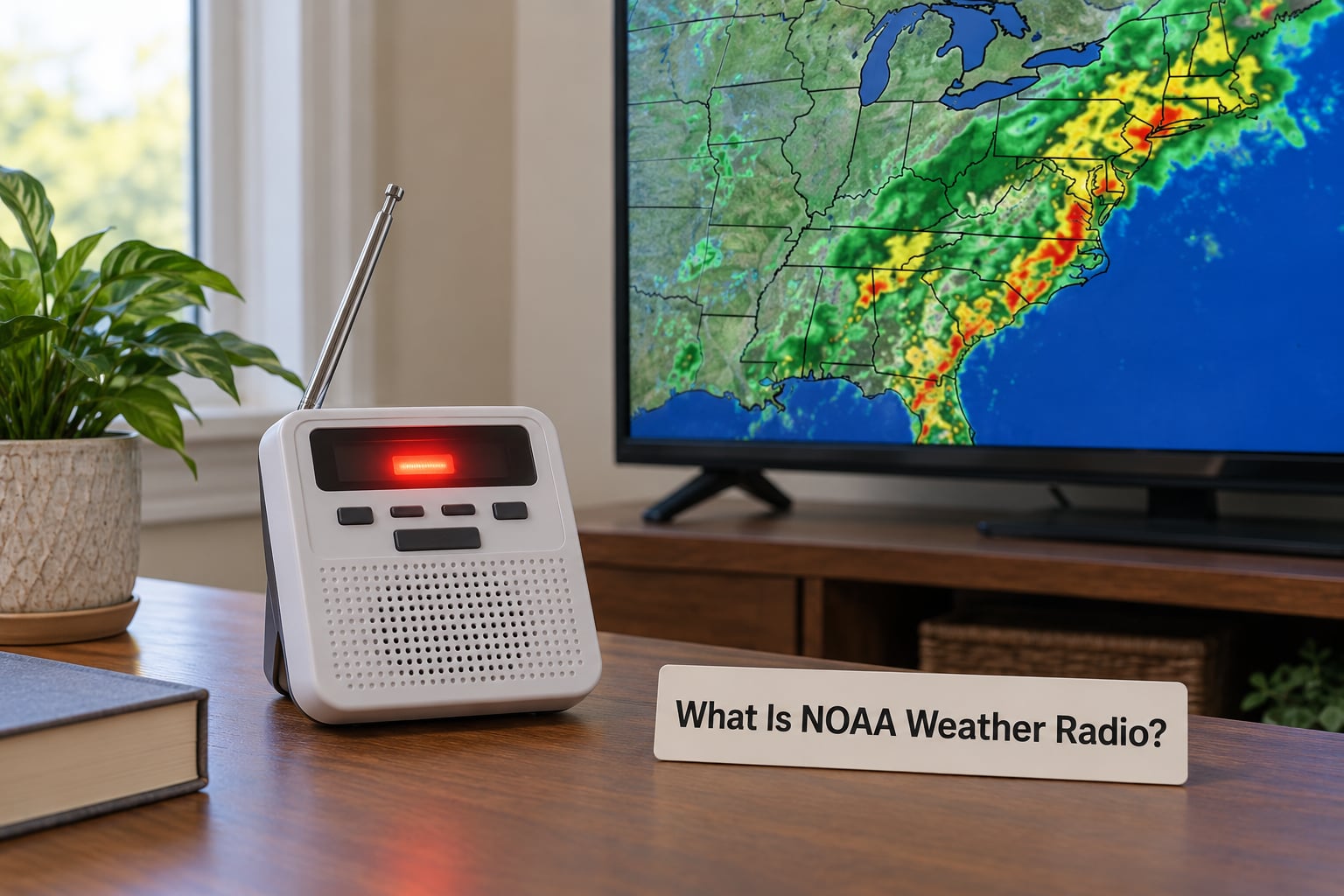
NOAA Weather Radio is a continuous public service run by the National Oceanic and Atmospheric Administration, a branch of the US Department of Commerce. It exists so that a warning reaches people who are asleep, in a basement, in a vehicle, or somewhere with no working television, no data connection and no charged phone.
It carries three distinct kinds of content, and it is worth keeping them apart in your head:
- Continuous programming. Hourly and forecast information, plus scheduled segments such as the NOAA Weather Radio Weather Information Service, river flood information, fire weather and climate outlooks. This is why you can leave it on all day and hear a voice.
- Watch, warning and advisory alerts. Urgent messages that interrupt whatever is playing and carry a specific event code and area.
- Non-weather emergency messages. The same network carries civil emergency messages, AMBER alerts, hazardous material notices, nuclear power plant and radiological warnings, and evacuation messages.
The frequencies involved are VHF, not the AM or FM band a normal radio uses. That single fact is why a kitchen radio that picks up local talk stations perfectly will never produce a tornado warning, and why a weather radio is a separate purchase rather than a feature of an existing set.
What Does SAME Mean in Weather Radio Alerts?
SAME stands for Specific Area Message Encoding. It is the digital header that tells a receiver what it is about to play, and it is the reason a warning for one county does not wake up the whole region.
Every SAME message carries four pieces of information:
- Originator. Who issued it, such as the National Weather Service, a state emergency management agency, or a local authority.
- Event code. The type of alert, for example a tornado warning, a flash flood warning or a civil emergency message.
- Area. The originators, state and county or marine zones the alert applies to. This is what your radio matches against your own programmed location.
- Duration. How long the alert remains valid, and the time it was issued.
Before any of that information is spoken, the receiver sounds a ten-second attention signal at 1050 Hz. That tone is the alarm, and it is identical whether the message is a genuine warning or a routine weekly test, which is one of the reasons people get nervous about their radios.
Not every receiver decodes every event code. A basic model will sound for a tornado warning and a civil emergency message; it will not necessarily sound for a lesser event you did not select. More capable models let you choose which event types interrupt, which is worth doing so the radio is not announcing every minor advisory.
Which Weather Alerts Can You Receive?
This is the part people want a straight answer on, so here it is without the jargon. The category tells you how much time you have and what you are expected to do.
| Alert | Severity | What it means | What to do now |
|---|---|---|---|
| Tornado warning | Highest | A tornado is confirmed or strongly indicated near your location | Move to a basement, interior room or shelter immediately |
| Flash flood warning | Highest | Flooding is occurring or about to occur in the warned area | Move to higher ground and stay out of water and vehicles |
| Severe thunderstorm warning | High | Wind, hail or a confirmed tornado is possible in the next few minutes | Move indoors, away from windows |
| Winter storm warning | High | Significant, life-threatening winter conditions expected | Delay travel, prepare a kit for power loss |
| Tornado watch | Elevated | Conditions favor tornadoes across a wide area | Charge devices, know your shelter, stay reachable |
| Severe thunderstorm watch | Elevated | Widespread damaging wind or hail is possible | Bring in loose outdoor objects, stay alert |
| Flash flood watch | Elevated | Flooding is possible in the area | Check low-lying roads before you travel |
| Winter weather advisory | Moderate | Accumulating snow or ice, travel may be difficult | Allow extra travel time, clear driveways later |
| Advisory | Low | Conditions are worth knowing about but no action is urgent | Note it and carry on |
| Special weather statement | Low | Something unusual is happening in a small area | No action needed |
The rule of thumb is simple and it holds: a warning means act now, a watch means be ready, an advisory means take notice. Most weather injuries happen because people treat a watch as a warning, or ignore a warning because the sky looks calm where they are standing.
How Do Weather Radio Alert Codes Work?
The code itself is not a secret and not complicated. It is a fixed-length burst of digital data that opens each alert, and its job is to let thousands of identical radios make the same decision at the same moment.
Here is the sequence in practice. The transmitter sends the SAME header, then the audio message, and it repeats the whole thing. Repetition is normal and deliberate: the EAS rules call for an alert message to be repeated, because a receiver in a basement or a vehicle may have caught only part of the first cycle. The message also carries an audio time limit, generally two minutes per cycle, so a long message is trimmed rather than left running.
Your radio compares the area in the header against the county and, in some areas, the partial-county or marine zone you entered during setup. Match, and it interrupts programming with the attention tone. No match, and it stays as it is. If the alert does not name your location but is close enough that the weather is likely to reach you, most listeners in that situation want to program the neighboring county as well.
Older systems worked differently. The Emergency Broadcast System, introduced in the 1960s, used a pair of steady tones to get attention and had no area targeting at all, so a warning meant every receiver in range went off. EAS replaced that in the late 1990s, and phone-based Wireless Emergency Alerts arrived in 2012. Modern radios are EAS receivers and will not decode the old system.
What Is the Difference Between NOAA Weather Radio and Wireless Emergency Alerts?
Wireless Emergency Alerts are the pop-up messages on your phone that come with a loud vibration and sometimes a full-screen warning. They are genuinely useful, and they are not a replacement for a radio, because they depend on a phone being powered, charged and in contact with a cell tower.
| Method | Reaches you when | What it needs | Weak point |
|---|---|---|---|
| NOAA weather radio | Day or night, asleep or awake | Batteries or mains power, correct county programming | An unprogrammed radio misses area filtering |
| Wireless Emergency Alert on a phone | You are awake and holding or near the phone | Charged battery, cell coverage, enabled location services | Silent if the phone is off, dead or off network |
| Local TV or radio station | You are watching or listening to that station | Power, a tuned device, a station that relays EAS | Useless if you are not listening to that station |
| Outdoor warning siren | You are outside or near a window | Local system, often limited to a municipality | Coverage is local and indoor volume is poor |
| Commercial weather app | You open it or allow background push | Data plan, phone, coverage, battery | Data usage and the same power dependency |
Storms take out power and cell coverage in the same places and at the same time. That is the gap the radio fills, and it is why preparedness guidance treats phone alerts and a battery-powered receiver as two layers rather than a choice. It also explains why a radio that has sat switched off on a shelf since it was unpacked has missed events: a dead battery, a detached aerial or an unplugged power lead all fail quietly.
For readers listening in the UK and Ireland, the equivalent arrangements work differently. The Met Office issues UK weather warnings, flood warnings and flood alerts, which reach the public through broadcast media, mobile alerting, and in some cases local warning sirens. Across the island of Ireland, emergency alerting is coordinated between the Irish and Northern Ireland authorities and covers both jurisdictions. Neither country runs a nationwide network of VHF weather radio transmitters equivalent to NOAA Weather Radio, so local broadcast and mobile channels do the work a dedicated receiver would do in the United States.
Why Might You Not Receive a Weather Radio Alert?
Most complaints about weather radios fall into a small number of buckets. The frustrating part is that several of them look like a hardware fault and are not.
- The weekly test. Transmitters run a routine test on the same channel each week, typically at a set time midweek, using the 1050 Hz attention tone. It sounds exactly like a real alert. This is the single most common reason people report a radio beeping for no reason.
- Reception loss on the wrong channel. Each transmitter serves one channel, and a county may be served by a different one. If the radio is on a channel that does not cover your location, you will hear the local forecast perfectly and miss every alert.
- Never programmed. Without a county code the radio has no area information to filter on, so its behaviour is unpredictable in both directions.
- Event types switched off. Most radios let you choose which alert categories interrupt programming, and some people quietly turn off watches and advisories to save the interruptions. If the radio went silent during a storm you were watching on television, check which event types are enabled before you assume the set is broken.
- Power, batteries or aerial. A unit running on mains with no backup cells, or an aerial that was moved when the furniture was rearranged, both fail quietly.
- Scheduled system maintenance. Transmitters and the equipment behind them are periodically reset or updated. During that window alerts are not broadcast, and the silence is genuine rather than a fault at your end.
If your radio is flashing rather than sounding, check the same list first, then look for a low battery indicator or a signal strength reading. A blinking light with no tone and no voice usually points at power or reception rather than an alert that has been issued for you.
How to Set Up and Test Your Weather Radio
Set-up takes about ten minutes and then needs almost no attention. The important part is doing it once rather than never.
- Confirm it is a NOAA-capable receiver. Look for SAME or EAS support and a VHF weather channel. A radio that only handles AM and FM cannot receive these alerts at all.
- Find your SAME county code. The National Weather Service publishes a county lookup, and the code is printed on the packaging or the back of many units. Note the code for your home county.
- Add the counties you actually need. Program your own county, plus a neighbor if you sit near a boundary or travel often. Listeners on the edge of a coverage area have been caught out by a warning issued just over the line.
- Choose your alert types. Leave warnings and civil emergency messages on. Decide deliberately about watches and advisories, because switching every minor event on is a fast route to muting the radio.
- Set the mode and volume. Put the radio in alert mode, and set the alert volume high enough to wake an adult in a bedroom. Test it with someone else in the house before you need it to work.
- Power it properly. Fit fresh cells even if it runs on mains, keep the supplied aerial attached and extended, and if the unit has a hand crank, check that it charges.
- Place it where it can be heard. A kitchen counter is fine. A room behind a wall with a metal door is not.
- Run the monthly test. Most receivers have a test button that sounds the attention tone and cycles the display. Use it monthly, replace the cells on the same schedule, and do not ignore the weekly broadcast test as a sign of failure.
Worth knowing: older broadcast voices have largely been replaced by a single synthetic voice on automated segments, which owners sometimes assume is a fault. It is not. That change happened as the network modernised, and the alerts are unaffected.
What Should You Do When a Weather Radio Alert Sounds?
Stay calm and treat the first alert as real, because the odds strongly favor that. Then work through it in order.
- Read the event, not the tone. The type of hazard decides your response, and a tornado warning and a winter storm advisory call for completely different things.
- Check the area. The broadcast names the counties affected. If it does not include yours, you still want to know, but you do not need to evacuate a neighborhood that is not in the warned area.
- Move to safety if the hazard is immediate. For a tornado warning, go to a basement, an interior room on the lowest floor, or a designated shelter. For a flash flood warning, move to higher ground and never cross water.
- Get the detail from an official source. The radio broadcast is a summary. Follow it with the National Weather Service site, your local TV station or your local radio station for the full forecast, timing and instructions.
- Protect people who cannot hear it. If you are responsible for children, older relatives, guests or anyone using hearing adaptors, knock on doors and tell them directly.
- Prepare for the aftermath. Have a kit ready with lights, spare cells, water, medication and a battery-powered radio, and keep it somewhere you can reach it without going outside.
What you should not do is treat an alert for a distant county as a reason to drive towards it or take unnecessary action. Watches and warnings are geographically specific for a reason, and the correct response to a warning that does not include you is to check on neighbors and wait.
Frequently Asked Questions
Do all weather radios receive NOAA Weather Radio alerts?
No. Only receivers that cover the NOAA Weather Radio VHF band between 162.400 and 162.550 MHz can receive these alerts, and only models with SAME decoding filter them by county. A standard AM or FM radio cannot, because it listens on completely different frequencies. Check that the box mentions NOAA, NWR and SAME before buying.
Why does my weather radio sound the weekly test alert?
Because every NOAA Weather Radio transmitter runs a scheduled test, usually in the middle of the week, and it uses the same 1050 Hz attention tone and the same kind of message as a real alert. That is intentional: it proves the path from the transmitter to your speaker is working. There is no way to switch the weekly test off on most receivers.
Can I rely on weather radio alerts instead of wireless emergency alerts?
Keep both. Wireless Emergency Alerts on a phone depend on battery, cell coverage and data, and a storm severe enough to produce a tornado warning is exactly the kind that takes power and towers down with it. A weather radio with fresh cells keeps receiving from a local transmitter, and it will wake you overnight when a phone notification never will.
What does it mean when a weather radio warning was not issued for my county?
It means the alert applies to other counties, and your radio filtered it out because your programmed area did not match. That filtering is the system working correctly. If you live near a county boundary or travel regularly, program the neighboring county too, and never assume a warning for a nearby area is harmless without checking the details.
How often should I test my NOAA Weather Radio?
Run the built-in test monthly, replace the batteries on the same schedule, and note the weekly broadcast test as a free secondary check. Also test after any storm, power cut or antenna move. Ask someone else to confirm they can hear the alert volume from another room, since a radio that is audible only at the desk is no help overnight.
Conclusion: Prepare Before an Alert Sounds
Weather radio alerts work because a single federal infrastructure pushes the same official message down several paths at once, and the NOAA Weather Radio path is the one that does not need electricity, a charged battery or a cell tower. A coded header tells your receiver what the event is, where it applies and how long it lasts, and the receiver decides whether that is your problem. The technology is old, well tested and free to receive.
The first thing to do takes ten minutes: check that your radio is NOAA Weather Radio and SAME capable, program your county code, and run the test function. Do that now, while the sky is clear. The second thing is to fit fresh batteries and put it somewhere you will hear it overnight, because the whole value of the system is the alert that arrives at three in the morning.