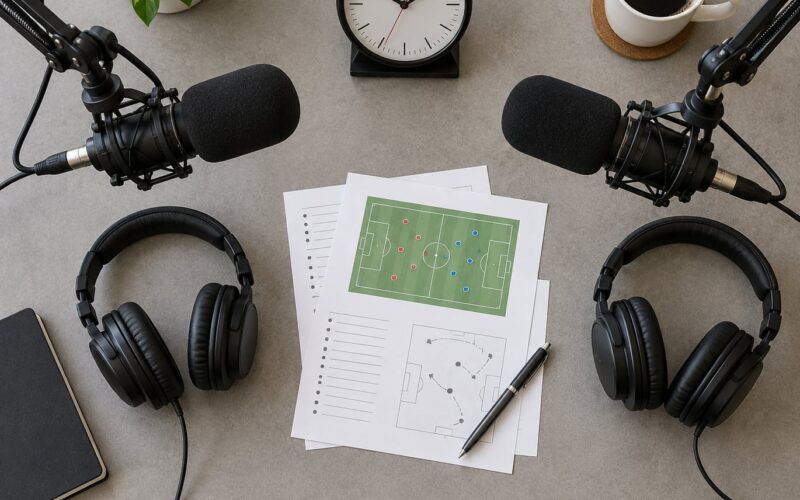
Radio commentary feels faster than TV because there is no picture to sync against. On radio a commentator has to describe everything, so the words come thick and fast; on television the screen already shows the action, so the same commentator pauses, points and waits. The result is denser speech with no visual reference clock, and your sense of elapsed time tightens up.
If you have switched between the local radio feed and the televised version of the same fixture and wondered why one seemed to sprint while the other crawled, you are not being fussy. Almost every listener notices the gap. Very few can say where it comes from, because the difference is not really about speed of words at all. It is about what each commentator is required to say, and what each medium leaves your brain to do.
Table of Contents
- Why Radio Commentary Feels Faster Than TV
- How Audio-Only Attention Changes Perceived Speed
- The Role of Live Context and Real-Time Sound
- Why Concise Commentary Creates a Faster Rhythm
- What Production Differences Add to the Feeling
- When TV Commentary Can Feel Faster Than Radio
- Frequently Asked Questions
- Conclusion
Why Radio Commentary Feels Faster Than TV
Two things create the effect. The first is job description. Radio commentators describe everything because listeners cannot see anything, and TV commentators describe less because the audience already has the picture. The second is attention. A radio listener spends all their processing power on the voice, which makes every pause and every change in tone land harder than it does when the same moment arrives with a camera angle attached.
Here is the same broadcast translated into the terms broadcasters actually use.
| Factor | Radio commentary | TV commentary |
|---|---|---|
| Job of the voice | Describe everything, including what the camera would show | Analyse and fill, letting the picture carry the action |
| Typical delivery | Continuous, high word density, descriptive colour | Short bursts between replay packages and stats |
| Use of pauses | Rare, and used for effect rather than sync | Regular, so commentary lands with the action on screen |
| Attention directed at | Sound alone, including crowd and stadium noise | Picture, graphics, stats and commentary together |
| Perceived duration of the same 90 minutes | Feels quicker, more continuous | Feels slower, more fragmented |
That last row is the one listeners argue about, and it is the one that matters.
Radio has to describe everything
A radio commentator is the only witness the audience has. When a winger goes down injured on the far side of the pitch, the radio caller has to say who it is, roughly where, and what the mood in the stadium is, because nobody can see any of it. That requirement produces longer sentences, more modifiers and a running commentary on the shape of the game rather than on the ball alone.
Adam Acone, a former NFL senior director of media operations, put it plainly when he discussed the craft side of broadcast work: on radio you have to describe everything, whereas TV leans more on analytical talk. It is a description of a craft constraint, and craft constraints show up directly in pace.
TV has to leave room for the picture
The reverse applies on television. A TV commentator who talks continuously over a shot will be shouted at by the producer, because the audience can already see what is happening. The commentator talks through the buildup, drops out at the moment of contact, and comes back afterwards. Those gaps are deliberate, and they are the biggest single reason the televised version feels more relaxed.
SportscasterLife describes the same adjustment when broadcasters move from radio to TV: the biggest change is cadence, because on radio you are the only storyteller and on TV your voice has to stay out of the visuals’ way.
How Audio-Only Attention Changes Perceived Speed
Your brain times an event partly against whatever is in front of you. Watch a replay twice and it feels like it takes about as long as it took. Listen to the same ninety minutes of commentary with your eyes on a spreadsheet and it disappears. That is not radio being fast. It is the visual channel being free.
No picture means no clock to check
Television gives you an ongoing visual reference: a match clock, a scoreboard, a running graphic, a replay you can see repeating. Every few seconds your brain gets a small confirmation of where you are in the event and how far through it you are. Radio has none of that, so the voice becomes the only source of orientation, and the broadcast runs on the assumption that you are following it continuously.
There is a second, more technical effect underneath. Simple reaction times to an auditory cue are reliably faster than reactions to a visual one, a difference Shelton and Kumar measured in their perception research and one of the more robust findings in the field. When everything you need arrives through one sense, the processing chain is shorter. In practice that means audio-first listeners tend to register an event a fraction sooner, which compounds across a long match.
Falk’s work on journalists speaking on air points the same way from a different angle: rhythm, sometimes paired with gesture, measurably improves a speaker’s timing and time estimation. Broadcasters build a house rhythm for exactly this reason. On television, some of that rhythm is carried by body language and camera work. On radio, all of it has to come through the voice.
The Role of Live Context and Real-Time Sound
Sound is a better carrier of immediacy than image. A crowd that suddenly gets loud, a train arriving at a platform, a studio telephone ringing on air, a commentator’s sharp intake of breath before a pass, a colleague muttering off-mic after a chance goes begging, none of it is scripted, and all of it signals that something is happening right now rather than having happened.
Radio feeds also carry more incidental information than the televised cut of the same event. You hear the ground staff, the substitution board, the delay in the stadium before the whistle, the walk back from a corner. The feed is technically behind the picture in most cases, yet it often feels more immediate because it is less edited.
The delay nobody thinks about
Live television usually runs several seconds behind the action, often around ten to thirty for major live events, because the broadcast chain has to encode, route and decode the signal. Radio covers the same event with a much smaller delay. So the version that reaches you first is usually the audio one, and the version that arrives with a picture is the one that is already out of date.
That in itself changes perceived pace. The televised feed is constantly reminding you, subtly, that what you are seeing has already happened. It is worth knowing when you start thinking the picture is the slow one.
It also explains a complaint that shows up constantly in football fan forums, where people report the TV feed lagging the commentary or the crowd noise arriving late. It is not a fault; it is the delay doing its job.
And plenty of listeners now run both at once. Listening to the radio while the match is on in the background, or vice versa, has become an ordinary habit, mostly because the radio call fills in what the TV cut leaves out.
Why Concise Commentary Creates a Faster Rhythm
Short sentences sound fast. Long ones sound considered. Radio commentary leans on short, active constructions, rising intonation at the end of a run, and carefully placed gaps that signal something is about to happen. A pause in front of a television audience means the commentators are waiting for the picture. A pause on radio is a held breath, and it makes the listener lean in.
What radio commentary sounds like on the page
Compare a televised call with a radio call of the same attack.
Television: “He’s got it here, and he can certainly cross, but the defender has got to go, and the keeper’s coming off his line, and he… what a save!”
Radio: “He’s got the ball, wide right, cut it back, the keeper’s coming, he saves it, he spills it, he’s beaten, he’s in the open net, he’s scored, the crowd is on its feet.”
Same action, same second. The radio version gives you nine beats of new information in a few seconds, and almost none of them are filler. The television version gives you five, and spends the rest waiting for the shot to arrive. That gap is the whole effect in miniature.
Prosody, the rhythm, stress and intonation pattern of speech, is doing more of the work here than most listeners realise. Broadcast speech has a recognisable house rhythm, and the difference between a commentator who sounds urgent and one who sounds flat is usually phrasing rather than vocabulary.
What Production Differences Add to the Feeling
Beyond the commentator’s craft, the two feeds are built differently. Radio gives you one voice, a crowd, an effects microphone and very little else. Television adds a multi-camera crew, a graphics operator, a replay package, virtual advertising, studio segments and a producer making live decisions about what you see next.
Every one of those elements is something your brain has to notice and then put aside before you get back to the match. It is a low-level tax on attention, and you feel it as a slow drift rather than as a specific distraction.
The measurable evidence for the speech-rate difference is worth putting in one place. Trouvain’s study of live football commentaries in radio and TV is the closest thing to hard numbers on this question, and its headline finding cuts against the intuition some listeners have.
| Source | Year | Finding | What it explains |
|---|---|---|---|
| Trouvain, Live Football Commentaries in Radio vs. TV | 2011 | TV commentaries produced fewer syllables and less articulation time; TV commentators articulate faster than radio commentators | Radio covers more ground in words, TV spends its time pointing at things you can see |
| Shelton and Kumar, auditory and visual simple reaction times | 2010 | Auditory simple reaction times are faster than visual ones | Audio-first listeners register the action a little sooner |
| Falk, communicative functions of rhythm in spoken discourse | 2013 | Speech rhythm, sometimes with gesture, improves timing and time estimation for journalists speaking on air | Rhythm carries time information when there is no visual clock to do it |
Read the Trouvain finding carefully. It does not say radio speech is faster. It says television commentators articulate more quickly because they are dealing with less to describe, while radio commentators produce more syllables over a longer stretch. The radio call feels faster because there is more happening in it, not because the voice is travelling quicker.
When TV Commentary Can Feel Faster Than Radio
It is not a one-way rule, and pretending otherwise loses the trust of anyone who has followed a game on both feeds.
Radio feels slower whenever nobody is describing anything. A quiet passage of a cricket innings, a dead period in a tennis game, a few minutes of a football match with no chances, all of these stretch badly on radio because there is nothing to report and no crowd noise to fill the gap. Replays work the same way. A missed chance replayed twenty times is rich on television and thin on air, where you hear the same whistle and the same sigh again.
Television also feels faster in sports with natural lulls, where the broadcaster can use a change of angle or a graphics wipe to reset the scene. Tennis and golf have built-in breaks; a tennis commentator can summarise a set while the players change over, and that summary delivers more information per second than a live radio call ever could.
Then there is analysis. A television half-time segment can carry two commentators, a tactical diagram, a replay and a debate inside ninety seconds. The radio equivalent is a phone interview with a manager, and it takes a different shape entirely.
The rule of thumb is simple. When the action is dense and continuous, radio wins on information density and loses you nothing. When the action is sparse or retrospective, television wins because it can show you context in the time it would take a radio commentator to describe it.
Frequently Asked Questions
Is radio commentary actually faster than TV commentary?
Not in the way most people assume. Research on matched football commentary found television commentators articulate more quickly, but produce fewer syllables and less articulation time overall. Radio commentators have more to describe, so they pack more content into the same passage of play. The feeling of speed comes from density of new information, not from a faster voice.
Why does audio-only commentary make an event feel more immediate?
Sound carries immediacy better than image. An unscripted crowd reaction, a commentator’s sharp intake of breath or the roar arriving before the shot that caused it all signal that something is happening right now. Television smooths that out with editing and replay packages, and adds a delay of several seconds so the picture is already out of date by the time it reaches you.
Does radio commentary have fewer distractions than television?
Usually, yes. Television adds score graphics, replay packages, statistics, camera changes, virtual advertising and studio segments, each of which takes a slice of attention before you can get back to the action. Radio offers one voice, a crowd and an effects microphone. Some listeners multitask while listening, and some run the television picture and the radio call at the same time on purpose.
What makes a radio commentator sound fast?
Short clauses, active verbs, rising intonation on a run of description, and gaps placed just before the moment you care about. Continuous explanation tends to sound slower, because you are listening for the point. The rhythm matters as much as the word count, and the same evidence in a flatter delivery sounds noticeably slower.
Why is there a delay on live TV?
The broadcast signal has to be captured, encoded, routed through the production chain and decoded at your set, and that takes several seconds. For large live events networks commonly run around ten to thirty seconds behind. Radio follows the same event with far less delay, so the audio version usually reaches you first, which is part of why television can feel like the slower feed.
Why do songs sound faster on the radio?
The same perceptual effect, applied to music. On radio you get the sound alone with no visual reference for how long the track has been running or how much is left, and your sense of elapsed time drifts. Add a screen, a progress bar or even a static image and the perception shifts again. It is less about the recording and more about what your brain has to orient itself against.
Conclusion
Radio commentary feels faster than TV for three reasons that stack up. Radio commentators have to describe everything, so they deliver more syllables and more information per second. Listeners with no picture to anchor against register events sooner and lose fewer moments to graphics, replays and studio filler. And live sound, with its crowd noise and unscripted reactions, keeps the whole thing feeling like it is happening to you rather than being shown to you.
If you want to check the effect yourself, listen to the same fixture on both feeds and track where the extra time goes on television. Almost all of it is in the gaps and the interruptions, not in the game itself.