If you are wondering how radio station ownership consolidation changed programming, the short answer is this: the decisions about what plays, when it plays, and who says the news moved out of local studios and into the offices of large station groups. Fewer owners meant shared music libraries, shared format clocks, shared news budgets, and far more of the day handed to syndicated shows and automation.
Turn the dial in most US markets today and you will notice it. Two or three stations in the same city run the same format, the same imaging package, the same voice-tracked breaks, and the same syndicated host. Ten years earlier, those slots were often held by owners with different names, different ideas, and different local shows.
This is a history story that is still running. Consolidation was not one dramatic night when everything changed. It was a slow transfer of authority, followed by a wave of station sales, followed by a wave of sales again. Understanding how radio station ownership consolidation changed programming is the fastest way to explain the modern sound of American radio, and the thing to understand first is that the ownership rules changed before the programming did.
Table of Contents
- What ownership consolidation means
- How US radio stations are owned and operated
- How playlists became more standardised
- What happened to local personalities and community coverage
- How music formats and specialist shows changed
- How news, talk and public-interest programming changed
- Why consolidation changed the economics of radio
- What consolidation gained and what listeners lost
- Why the effects vary by market and station
- What radio station ownership consolidation did not cause
- What listeners can do now
- Frequently Asked Questions
- Does radio station consolidation always mean all the stations have the same owner?
- Why do radio stations owned by the same company often play similar music?
- Did radio station ownership consolidation eliminate all local programming?
- How does ownership consolidation affect a station’s online and streaming service?
- Who owns the majority of radio stations in the US, and how do I check a station’s owner?
- Conclusion
What ownership consolidation means
Consolidation means fewer separate owners hold many more stations. A single company might operate a dozen licenses across one metro area, several markets in one region, or a national portfolio. The stations keep separate call letters and separate frequencies, but the money, the playlist rules and often the schedule come from the same place.
It is worth separating this from two other things people mean by the same phrase. Audience decline is a ratings problem: fewer listeners overall, whatever owns the stations. Streaming competition is a business-model problem: money moving to apps, podcasts and smart speakers. Consolidation is a control problem: who is allowed to decide.
Chain those three together and you get the pattern we have now. Fewer listeners means tighter budgets. Tighter budgets favour overheads shared across a cluster. Shared overheads favour companies that can spread cost across many stations. Larger companies can buy distressed stations cheaply because the same efficiencies are already in place.
how radio station ownership consolidation changed programming
Consolidation changed programming by standardising it. Playlists moved from individual station discretion to group rules, music added to a central library instead of a local one, rotation philosophy became a written format document, and local live hours got replaced first by syndicated shows and then by recorded, centrally produced segments. The result is a dial where a handful of formats dominate every market, and where a station is far more likely to sound like its owner than like its city.
Before consolidation, a station licence in a mid-sized market came with an obligation attached to it. The FCC’s localism policy expected broadcasters to serve the community where the signal reached. The practical version of that expectation was a person in the studio, a newsroom down the hall, and a willingness to lose money on public affairs shows. Ownership rules were designed to keep one company from taking over a whole market, so no group had the power to make every station the same.
After consolidation, programming became a line item. Groups run programming departments that decide the format, the clock, the playlist rules and the budget, and the individual station manager works within those decisions. That is a genuinely different business, and it explains nearly everything that listeners complain about today.
How US radio stations are owned and operated
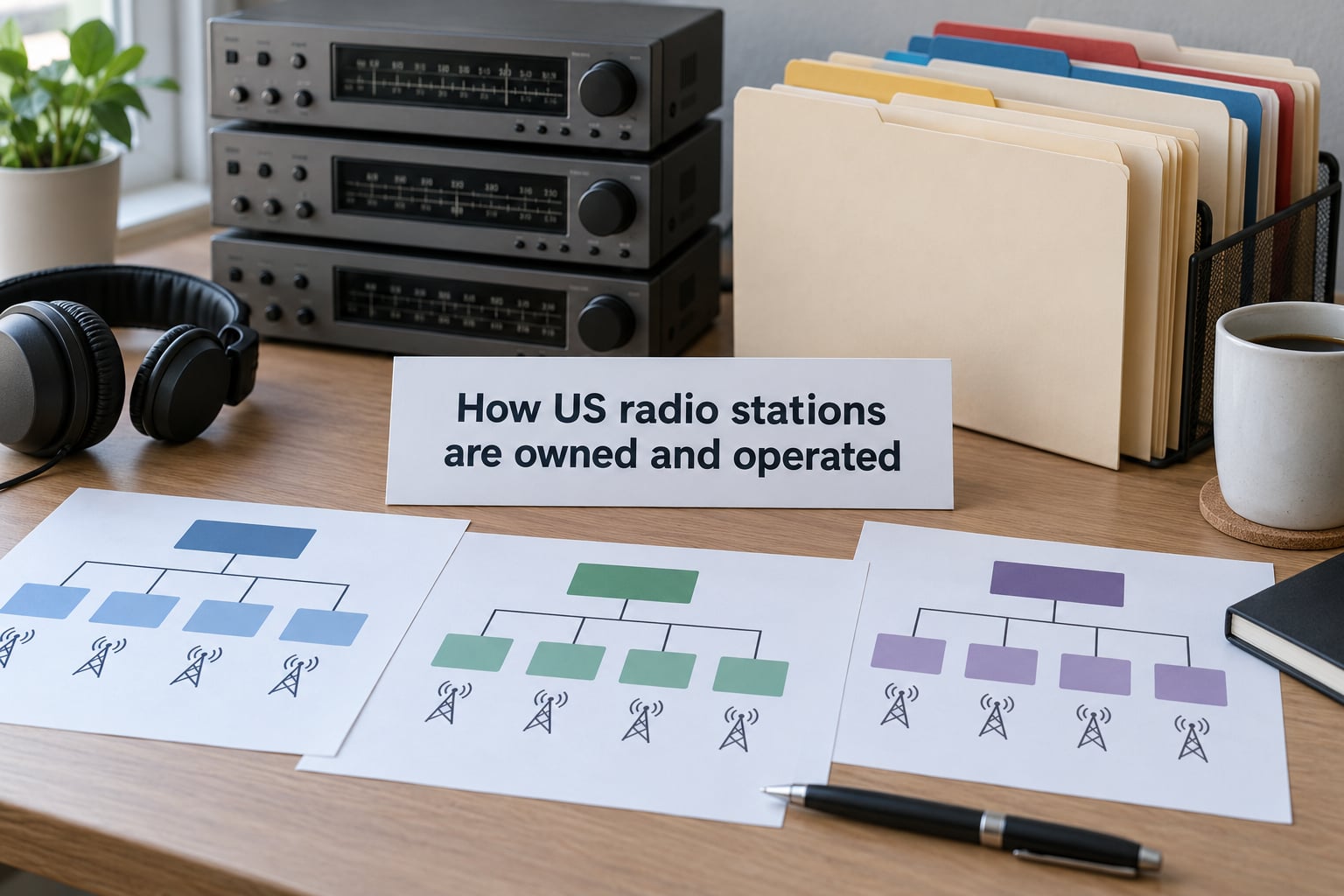
In the US there are roughly four arrangements, and a single market can contain all of them at once. A station can be owned outright, operated by a company that does not own it, run as a noncommercial service with no conventional ad sales, or held by a family or small group that never sold.
| Ownership model | Who decides the programming | What it looks like to a listener |
|---|---|---|
| Group-owned cluster | A central programming department, often working from format guidelines written at group level | Several formats, similar imaging, shared hosts, little local voice between songs |
| Operated under a local marketing agreement | The operator, not the licence holder | A station with one owner on paper and a different company running the studio and sales desk |
| Independent or family owner | The owner, with a small staff and usually a format niche | More distinct personality, more local content, a narrower but more committed audience |
| Noncommercial, public or community station | A board, a staff and often volunteers, with underwriting instead of spot advertising | Long blocks of specialist music, community programming and listener-supported material |
Group branding can mislead here. A station can carry a group name on the air and in the app store while the licence is held by a separate company under an agreement that can run for years. If you want to know who actually operates a station, the public licence record and the station’s own disclosures are more reliable than the logo on its website.
The consolidation wave came in two main bursts, and both are worth dating. The Telecommunications Act of 1996 relaxed the FCC’s ownership caps, including the rule that limited an owner to one AM and one FM station in the same market, and it introduced national audience reach caps instead. A 2001 analysis in Salon described the first wave as roughly 10,000 transactions worth about $100 billion, alongside the loss of an estimated 10,000 radio jobs.
A 2003 FCC order narrowed the national reach rules further after court challenges, and the buying continued. In 2014, Clear Channel Communications rebranded as iHeartMedia, which made the scale of the largest group impossible to miss. Since the early 2020s, several large owners have been selling stations again under financial pressure, which is something listeners noticed: on r/radio, people describe groups that lobbied hard for looser ownership rules now trimming their own portfolios because the debt from those deals is hard to service.
How playlists became more standardised
The clearest change you can hear is the playlist. Before consolidation, a music director at each station picked records, decided the rotation length and chose the hours. Now the music is generally selected in a central music department, added to a shared library, and released to every station in the group under a written format document.
That document is the format clock: a fixed hourly template that says how many songs, how many stops for news, where the commercials sit, and what the station sounds like during the drive. Once a clock is written down and applied consistently, two stations running the same format in the same group can be almost interchangeable, and listeners often switch between them without noticing.
| Programming element | Typical before consolidation | Typical after consolidation |
|---|---|---|
| Music selection | Local music director chose records and set rotation length | Group music department maintains a shared library and format rules |
| Research | Station-level audience and call-in research on its own market | Group-level research, often national, applied to a local market |
| Live hours | Local announcers covering local events and callers | Reduced live hours, replaced by syndicated or recorded segments |
| Scheduling | Built in the local studio, adjusted by the program director | Built centrally, replicated across stations in a cluster |
Recurrence is the part that irritates listeners most. In a tight format, a small group of high-recognition songs is played with defined frequency caps, so you hear the same handful of tracks on every drive for months. That is not laziness, it is a system: narrow playlists reduce the risk of playing something a station’s research says will lose an audience, and with a shared library, one test in one market shapes what plays in a dozen others.
The phrase people use on radio-discussions.com and other industry boards is voice tracking, which means pre-recorded announcer segments produced centrally and played with little or no local input. Nothing in the rules requires it, but it is a direct money-saving response to owning several stations in one market. Where there used to be a person whose voice changed with the town, there is now a recording that could run in any of a dozen cities.
What happened to local personalities and community coverage
Local personalities were usually the first thing to go, because they are the most expensive and least sellable part of the schedule. A morning host who has lived in the market for twenty years costs a salary and generates no direct advertising premium; a syndicated show delivered by satellite costs a flat rate per market. When a group buys several stations in one market, moving live local hours to a network feed is a straightforward saving.
Community coverage went with them. Local interviews, charity event remotes, school sports, play-by-play on local teams and live appearances at local fundraisers were the visible proof that a station belonged to its city. Radio industry Facebook group members have long acknowledged that voice tracking across several stations in a market was already producing sameness, even where the stations had not technically changed hands.
Plenty of owners still fund local content, and the honest answer is that they do it where it earns its keep. A station that carries a high school football championship or a hospital fundraiser keeps an audience that national programmers cannot supply for free. The market test is straightforward: local content survives where it moves ratings or advertising, and disappears where it does not.
How music formats and specialist shows changed
Consolidation narrowed the number of distinct formats in a typical market. A city that once carried a progressive rock station, a jazz outlet, a blues show and three different flavours of contemporary hit radio now tends to have fewer musical points of view, because a group that runs six stations in one market has no incentive to fund six different experiments.
Emerging artists felt this first. Local and unsigned music is hard to sell to advertisers and easy to replace with a known record, so stations under central music policies rely more heavily on research-driven national categories. Bands that broke in by getting regular airplay at a local station or by a local host taking a chance have a harder path when the playlist is chosen in a different state.
Specialist shows, the two-hour deep cuts or blues or regional Mexican programme, became the escape valve. Because they are cheap to schedule and loyal listeners love them, groups allow them as long as they sit in a defined slot and do not disturb the paid parts of the day. That is why so much specialist radio now lives online or on weekend windows rather than across the full broadcast day.
Talk programming shows the same pattern in a different medium. The economically attractive show has a defined audience that advertisers can buy in advance, a host who can sell nationally, and a format that runs identically in every market. That is exactly what a group can replicate; exactly what a local host with strong local politics is not.
How news, talk and public-interest programming changed
Local news is the sharpest measure of what consolidation changed, because news is where the money and the mission point in opposite directions. A group can cut a local newsroom in a secondary market and still have a nightly newscast in the biggest market, which means a licence in a town of 40,000 might lose its only local reporting.
That affects listeners directly, not just in civic terms. Traffic, weather and school closures have historically been broadcast by the station that serves the community, and a network feed simply will not know about a road closure on a specific street. Emergency information and school delays were the practical localism test, and in markets where local newscasts have been cut, that test is harder to pass.
AM, FM and noncommercial stations sit under different pressures. AM stations face falling listenership and ageing equipment, which makes them cheap to acquire and easy to run with syndicated programming and automation. FM stations carry the advertising money but carry more local expectation. Noncommercial stations depend on underwriting and member drives, so their risk is not consolidation in the usual sense but shrinking community support, though several have been sold or merged into larger noncommercial networks.
Syndicated commentary expanded for the same reason as syndicated music. A host who delivers the same opinion to two hundred stations costs the group one fee, and audiences are sold in bulk. The public interest standard has not changed on paper; what changed is how often a licence holder has the budget to meet it.
Why consolidation changed the economics of radio
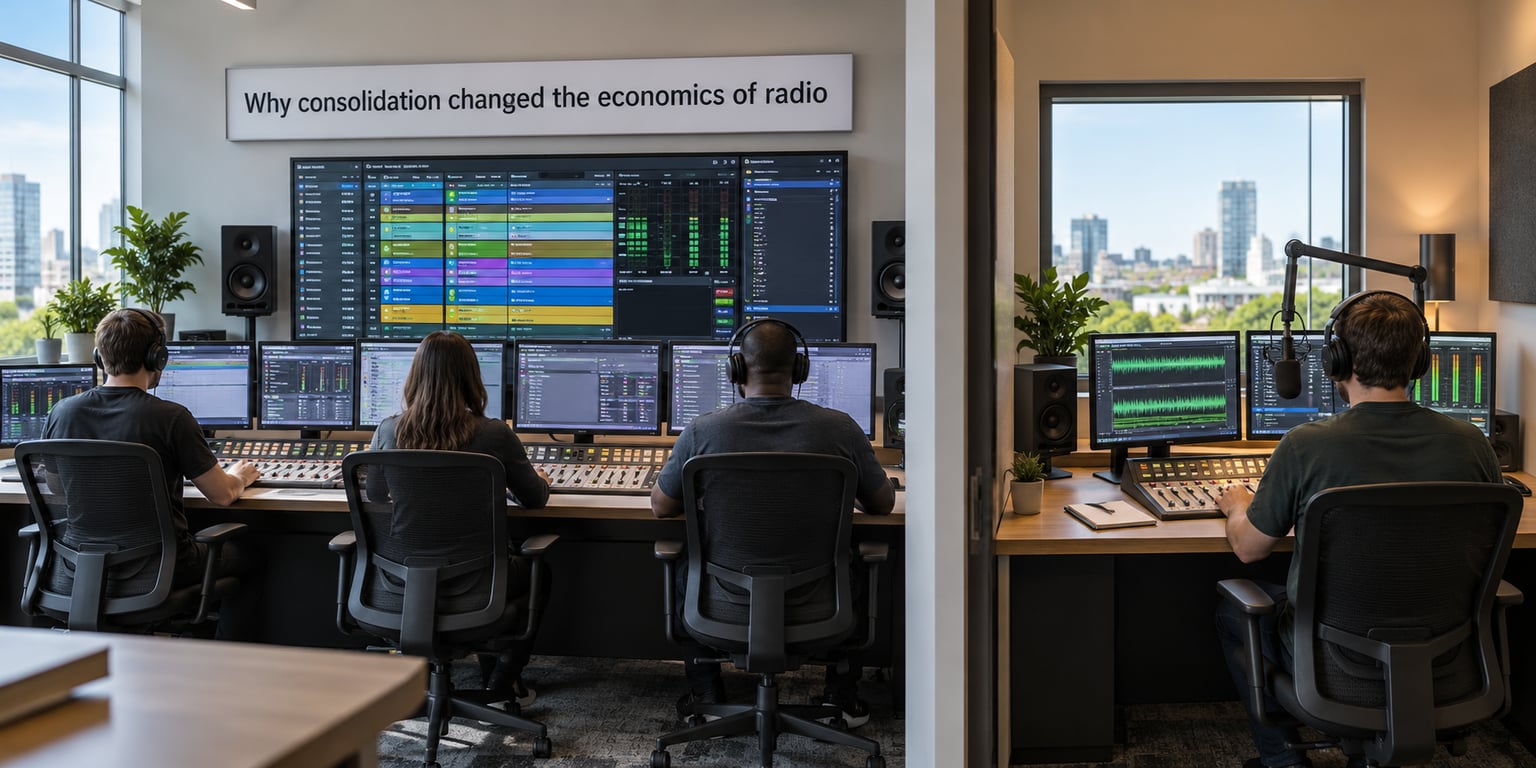
It is tempting to say a group set out to strip local content. Usually it did not. The economics made it the sensible option, and the programming followed the economics. A group running eight stations in a market pays for one programming department, one music licensing team, one traffic and billing system, one engineering team and one sales staff, and it splits that cost across eight signals.
The advertising side rewards this just as much. A buyer who wants reach in a metro area can buy a package across a cluster from one contact, and the group can price it knowing the competition is other clusters rather than a single independent. That pricing power is why independent stations say they cannot match rates, and it is a real business problem, not a complaint about taste.
Technology made the central model practical. Automation systems can build and voice a playlist overnight, satellite delivery pushes a show or a format clock to hundreds of stations at once, and remote control means a group can run a secondary market station from a regional hub. None of that was invented after 1996, but the scale of station ownership after 1996 made all of it worth using.
The counter-argument deserves a hearing. Some of the stations that groups bought in the 1990s were losing money and would plausibly have closed. Consolidation preserved stations in markets where nobody else wanted to invest, and in several cases it also restored technical investment that a struggling independent owner could not fund. Both things are true at once, which is why the argument never ends.
What consolidation gained and what listeners lost
The gains are real but uneven. Professional production, reliable technical infrastructure, apps and streaming distribution, and in some cases the survival of a station that was heading for closure are all downstream of groups with resources. A group can also sustain a specialist show or a public affairs series at one station that no single owner could fund alone.
The losses are felt daily. Fewer distinct formats per market, less local information, fewer opportunities for an experimental or local voice, playlists that repeat, and advertising sold by a handful of sellers with pricing power. The choice between one generic national format and five local ones is a choice a group is never going to make, because the group does not carry the risk of losing the other four.
What most people describe as a bad trade is really a trade that works for owners and works unevenly for listeners. Broadcasting always paid for itself with advertising, and the group model optimises advertising. The public service part of the licence was always a cost, so it is the part that gets trimmed first when a market has a choice of owner.
Why the effects vary by market and station
Ownership does not determine programming by itself. In a market with three strong independent owners and little overlap, groups have to compete on distinctiveness, and you will hear more variety. In a market where one group holds most of the licences, the group sets the menu and listeners choose within it.
Market size matters too. Big metros can support several CHR or Country outlets because the audience is large. Small markets usually support one station per format, so when a group acquires the station that held the only jazz or blues or regional language programme, that genre is simply gone from broadcast radio in that town unless a new owner or a noncommercial licence appears.
Format type, licence class and revenue mix all shift the outcome. A station in a tourism market, a university market or a border region has a defensible local identity that survives ownership changes. A station whose revenue is almost entirely national spot advertising has much less reason to be local. A noncommercial station answers to listeners and donors rather than advertisers, so it follows a completely different logic.
Local history and timing matter as much as the current owner. A station that changed hands in 1999 and again in 2014 experienced two different programming philosophies. Reading a station’s schedule and history tells you more than the ownership badge on its logo.
What radio station ownership consolidation did not cause
It is easy to blame consolidation for everything wrong with radio, and most of those complaints have other causes. Format change is a separate industry with its own cycle, and a station can abandon its format for ratings reasons with no ownership change at all. Ratings pressure pushed stations toward safe, demonstrable formats long before a single group dominated a market.
Chart and label relationships shape playlists as much as ownership does. Record promotion, playlist reporting and pay-for-play concerns affect what a station adds regardless of who signs the licence, and many independent stations run the same research-driven music as groups do.
Playlist software is a tool, not a decision. Automation makes a format easy to execute, but it also lets a small station in a college town run a tight, professional clock. Satellite delivery put syndicated shows on thousands of stations at once long before the largest group existed, which means syndication is a distribution fact, not a consolidation invention.
Podcasts and streaming are the biggest force on radio today, and they are a separate story. They compete for the same hours, but they also give listeners an answer: a host with a specific point of view can build an audience without a licence, an advertiser’s approval, or a format clock. That is the more interesting parallel with the 1990s, not another instance of the same thing.
What listeners can do now
If you want radio that is not just a rerun of the same format, start with ownership. The FCC public file for a broadcast licence is a public record and it tells you who holds the licence, whether an agreement exists, and often who employs the staff. A station website tells you the format and the schedule. Two minutes of that is more than most listeners ever do.
Next, look past the terrestrial signal. Most groups now offer a single app with several of their stations inside it, which means a station you thought was independent may simply be channel 6 of the same company. Independent and college stations, community and low-power stations, and noncommercial stations in your area often stream with no cluster relationship at all.
Then browse the schedule like a menu rather than a channel. Specialist shows, local sports, public affairs programmes and weekend music blocks are usually where the interesting programming sits in a consolidated market, and they are often buried in a weekly PDF. A morning show that is recorded elsewhere will still tell you something, but a live caller segment from your own county will not be.
Finally, spend your attention and your money where you want it to go. Local advertising on a station is a direct vote for that station staying local, and a membership or underwriting contribution to a noncommercial station is what keeps specialist programming on air. Online, individual creators and independent audio producers compete with the consolidated model every single day, and choosing to listen to them is a small but real vote.
Frequently Asked Questions
Does radio station consolidation always mean all the stations have the same owner?
No. A company may own a station outright, operate it under a local marketing agreement, or share services with other stations in the same group. Some independent stations also receive programming or sales support from a larger operator. Always check the licence record, because the name on the air and the holder of the licence are often not the same company.
Why do radio stations owned by the same company often play similar music?
Shared ownership gives stations access to one music library, one research team, one software system and one set of format guidelines. Coordinated schedules also make it easy to promote a song across several signals at once, and a group that tests a record in one market can extend it everywhere. The result is that stations in one group often feel interchangeable.
Did radio station ownership consolidation eliminate all local programming?
No. Many group owners still fund local news, personalities, sports and community events. How much local content survives depends on the market, the station’s role inside the cluster, its format and its revenue. Localism survives where it earns ratings or advertising, and it is the first thing cut where it does not.
How does ownership consolidation affect a station’s online and streaming service?
It shapes streaming as well. A group may publish several stations inside one app instead of separate services, share playlists and schedules, and control programming centrally from the same hub. That makes listening easier, but it also means a station that changes hands can lose its own app identity, its local archives and its independent online brand.
Who owns the majority of radio stations in the US, and how do I check a station’s owner?
A handful of large national and regional groups hold a large share of US commercial stations, with most of the rest spread among regional groups, independents and noncommercial operators. To check any single station, look up its call sign in the FCC public inspection file, which lists the licence holder, any local marketing agreement and the public file contacts.
Conclusion
Radio station ownership consolidation changed programming by moving creative control from local studios to group headquarters. What followed was narrower formats, shared music libraries, tighter rotations, more syndicated hours, less local news and heavier reliance on automation. None of it was inevitable, and none of it was the stated goal of the 1996 law, which was passed to let struggling stations survive.
What to do first is small and takes five minutes. Pick the three stations in your area you actually listen to, check the licence holder and operator of each, compare their formats and schedules, and then look at what the noncommercial and independent options in your market are streaming. You will find more variety than the FM band suggests, and you will know which stations you are actually choosing between.