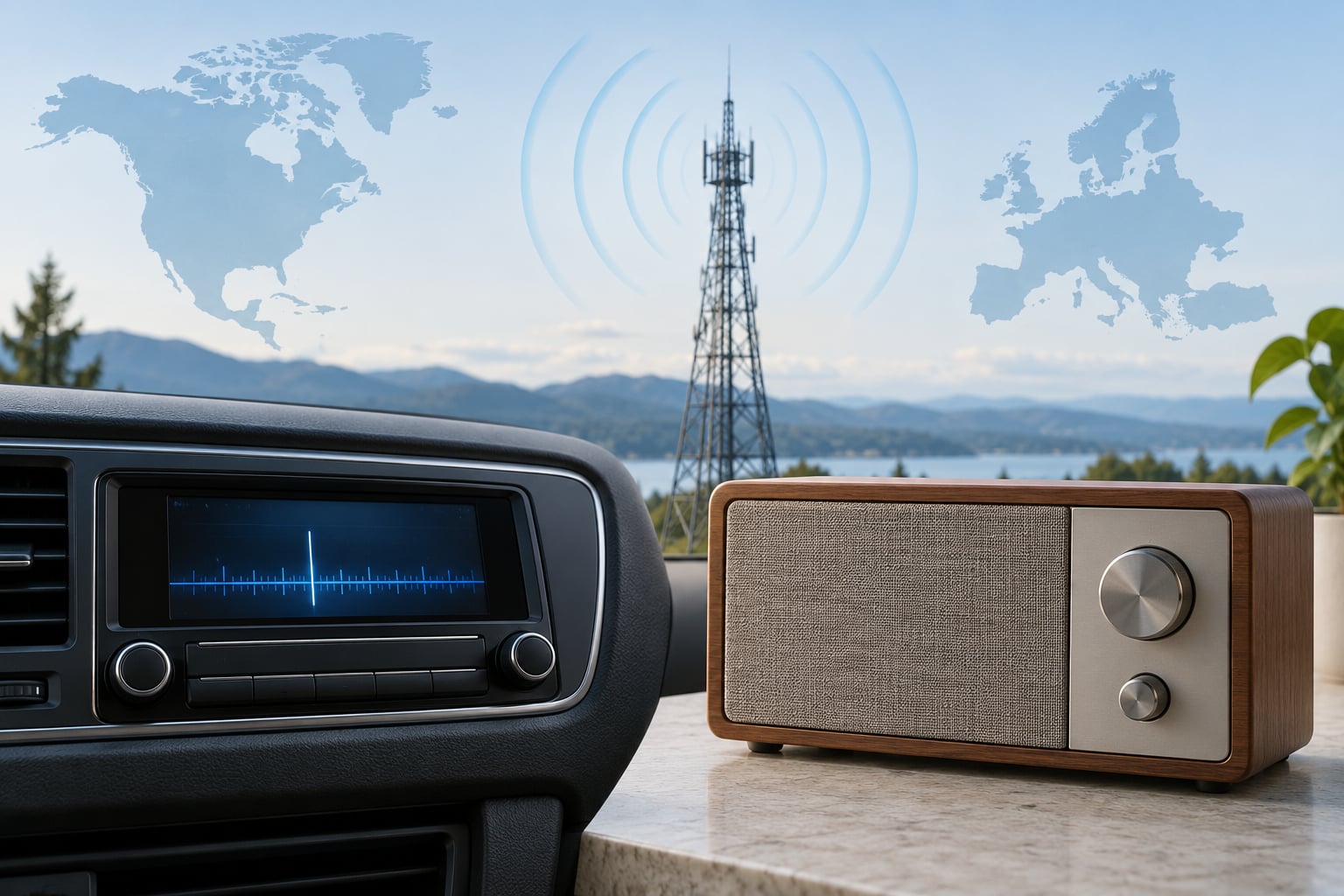
DAB radio is Digital Audio Broadcasting, a digital terrestrial radio standard that sends audio as compressed digital data from a coordinated network of transmitters. It runs across roughly 55 countries, almost all of them in Europe plus Australia. The United States never adopted it, and instead standardised on a rival proprietary system called HD Radio.
That single choice explains most of the confusion. If you have seen a DAB badge on a rental car in Frankfurt, wondered why your bedside radio has no station names, or wondered why American cars never got a digital upgrade, the answer sits in a spectrum decision and a licensing decision the US made a long time ago.
I have written this one without a product to sell you, because the interesting part is not the hardware. It is the map of who chose what, and why.
Last updated: October 2026
Table of Contents
- What DAB Radio Is and Why the US Does Not Use It
- How DAB Radio Works
- DAB vs FM: What Each System Does Better
- Why the US Does Not Use DAB for Everyday Radio
- Can You Listen to DAB Radio in the US?
- DAB, HD Radio, SiriusXM, and Internet Radio Compared
- What DAB Radio Means for US Radio Listeners
- Frequently Asked Questions
- Wrapping Up
What DAB Radio Is and Why the US Does Not Use It
DAB radio is the world’s most common digital broadcast radio standard, and it is effectively absent from the United States. Europe built it as a public, open standard through the European Telecommunications Standards Institute and the Eureka-147 research project, starting with the first broadcast from Norway in 1995.
The American market took the opposite route. The FCC cleared HD Radio, a licensed proprietary technology from iBiquity (now Xperi), which lets digital sidebands sit either side of an existing FM channel. That has been the US digital broadcast system ever since.
So when someone asks what dab radio is and why the us does not use it, the honest answer is two-part: it is a very successful regional standard with no domestic US market, because the US had already picked a different system and never faced pressure to change again.
DAB Radio Basics: What DAB Radio Is and Why the US Does Not Use It in Simple Terms
A multiplex is the key idea. One DAB transmitter sends not one station but a bundle of stations, called an ensemble, all sharing a single frequency block about 1.4 MHz wide. A transmitter site that could carry a handful of FM channels can carry a dozen or more digital services instead.
Your receiver scans the band, finds every multiplex it can hear, lists the services inside each one, and then pulls out the single stream you picked. That is digital broadcast, not internet streaming: nothing is downloaded, no connection is required, and there is no data charge.
The confusing part for newcomers is that DAB and DAB+ are not the same thing. Original DAB used MPEG-1 Audio Layer II at 128 kbit/s. DAB+ uses HE-AAC at roughly 80 to 96 kbit/s and squeezes more stations into the same space. A DAB+ receiver will decode original DAB, but not the other way round, which is why early DAB sets became obsolete so quickly.
How DAB Radio Works
Four steps, and none of them involve a data connection.
- Compression. The station’s audio is encoded as digital data, using MP2 at 128 kbit/s on original DAB or HE-AAC at around 80 to 96 kbit/s on DAB+. Higher bitrate means more audio detail per second, which is exactly why heavily packed multiplexes get criticised.
- Multiplexing. Several stations are combined into one continuous bitstream, the multiplex, occupying one frequency block. Roughly 1.4 MHz wide in Band III, which is the band used across most of Europe.
- Transmitting on a single frequency. Many towers across a whole country broadcast that identical multiplex on the same frequency and are time-synchronised to the microsecond. This is called a single-frequency network, and it is why a national service arrives from twenty transmitters without the receiver hearing twenty separate stations or any of them fading between each other.
- Decoding on the receiver. The set decodes every multiplex in range, reads the service list, and reconstructs the audio for whichever service you selected. On DAB+ many receivers will hold a different multiplex as you drive and keep playing the same station, a feature usually called service following.
The modulation underneath is OFDM, which handles the reflections you get bouncing off buildings and hills far better than a conventional single-carrier system. What that buys you is a cleaner signal in a moving car. What it costs you is the digital cliff: once reception degrades past what the error correction can hide, DAB does not fade gradually into hiss like FM, it drops to silence or to a gurgling artefact that listeners often describe as bubbling.
DAB vs FM: What Each System Does Better
FM is not old technology so much as a different set of trade-offs. Here is where each one wins.
| Criterion | DAB / DAB+ | FM |
|---|---|---|
| Sound on a well-run service | Clean, consistent, no hiss | Hiss that opens up with distance |
| Stations per transmitter site | 10 to 40 services on one multiplex | A handful of channels |
| Tuning | Auto band scan, no manual tuning | Manual dial or presets |
| On-screen data | Station name, song title, album art, traffic alerts | RDS on some stations only |
| Signal loss behaviour | Digital cliff, then drop to silence | Fades gradually into hiss |
| Indoor reception | Often poor, especially on small portable sets | Forgiving, penetration is excellent |
| Audio delay | Typically 1 to 4 seconds behind live | Effectively instant |
| Cost to listen | Free to air, no data charge | Free to air |
The honest read: DAB wins on station count, on-screen information and on silence between stations when the signal is strong. FM wins on forgiveness, on penetration into buildings, and on immediacy, because a live sport commentary on DAB arrives noticeably behind the television.
Plenty of drivers in the UK still switch back to FM on motorways, which is a recurring point in enthusiast forums. Reliability in motion, not raw audio fidelity, is where the digital system most often gets criticised.
Why the US Does Not Use DAB for Everyday Radio
Four reasons, and they compound each other.
1. The spectrum DAB wants in the US is largely reserved. DAB is designed to run either in Band III (174 to 240 MHz), Band II alongside FM (87.5 to 108 MHz), or in L-band (1.452 to 1.492 GHz). In the United States, much of L-band is reserved for military radar, aeronautical and satellite systems. The US also reached an agreement with Canada restricting L-band DAB to terrestrial broadcast use so as not to cause interference across the border. The cleanest European allocation is effectively closed off.
2. HD Radio got there first. iBiquity demonstrated hybrid IBOC in the late 1990s, the FCC authorised it in 2002, and stations began converting. The clever part was that HD Radio’s digital sidebands fit around the existing FM channel, so a broadcaster could keep its frequency and its call sign and simply add digital capability. By the time DAB was a serious proposal in America, the upgrade path had already been spent.
3. Nobody was ever forced to switch. This is the reason that matters most. Across Europe, governments and regulators set FM switch-off deadlines, and the EU has required DAB+ capability in every new car since 2021. In the US there was no mandate, no deadline, and no consumer-replacement driver. Working FM sets were everywhere and perfectly adequate, so a digital upgrade had to be sold on merit alone, and awareness stayed low.
4. US broadcaster economics point the other way. A station upgrading to HD Radio keeps its existing transmitter infrastructure, its frequency and its advertising relationships. Building a DAB multiplex means a new transmitter network, a new spectrum licence, and recurring multiplex carriage fees for every service on it. For a market that was not already required to move, that is a hard sell.
Add one more factor that is less about technology and more about timing. US spectrum policy in the 1990s auctioned off bands that European regulators used differently, so American broadcasters never faced the same pressure to consolidate FM capacity that drove Europe toward digital. Canada reached almost exactly the same conclusion as the US, trying DAB in the early 2000s and dropping it in favour of HD Radio. That is about as close a precedent as you can get.
The result is an unusual situation: the US owns one of the two major digital broadcast standards, while European visitors arrive expecting DAB and find an FM-only dashboard. SiriusXM fills the gap for US listeners who want digital audio, and it does so by satellite, on a subscription, rather than by broadcast.
Can You Listen to DAB Radio in the US?
Not as a normal listening option. There are no commercial DAB or DAB+ broadcast services in the United States, so there is nothing for a normal receiver to tune into. Near the Canadian border you may occasionally pick up DAB multiplexes leaking from a Canadian transmitter, which reception forums occasionally mention, but that is an accident of geography rather than a service.
What you can do instead is listen to the same stations online. Most European national and commercial services run public internet streams or apps, and those work anywhere with a connection. SiriusXM is the US subscription alternative for broadcast-style audio on the road.
If you specifically want to decode a DAB signal yourself, a software-defined radio dongle with a DAB-capable program can do it, though in the US there is almost nothing to point it at. Imported European DAB radios do work on other bands, so they are functional as general receivers, just not as a DAB platform.
DAB, HD Radio, SiriusXM, and Internet Radio Compared
Four ways of getting digital audio into a car, and they are not remotely equivalent.
| System | How it arrives | Coverage | Subscription | Station choice |
|---|---|---|---|---|
| DAB+ | Terrestrial broadcast multiplex | National and regional, from one frequency | None | Typically 30 to 60 national services plus local |
| HD Radio | Sidebands around an FM channel | Same as the FM signal it accompanies | None | A handful of extra channels per station |
| SiriusXM | Satellite | Continental North America, including cities and deserts | Yes, paid monthly after trial | Hundreds of channels, curated |
| Internet radio | Mobile data or WiFi | Anywhere with a signal, anywhere on earth | Varies, often free with ads | Tens of thousands worldwide |
The practical difference comes down to what you need audio for. Broadcast radio wins when you are driving out of coverage, on a boat, or in a rural area with no bars of signal, and it costs nothing to keep listening. Internet radio wins on choice and on fidelity, and it works in a country where DAB does not exist at all.
What DAB Radio Means for US Radio Listeners
Short version: nothing changes for you. FM remains the dominant US broadcast band, there is no switch-off plan on the table, and HD Radio is still there as the digital option, though with low public awareness and patchy inclusion in standalone radios.
What changes is the gear. If you buy a car in Europe, you will get DAB+ as standard and you may not get an FM-only dashboard. If you import or travel with a European radio, expect DAB+ and DAB services rather than US ones. And if you are buying a portable radio for travel, check the band support, because a US-only set will simply find nothing in Europe.
Frequently Asked Questions
Is DAB radio used in the United States?
No. There are no commercial DAB or DAB+ broadcast services in the US. The country uses HD Radio instead, a proprietary system from iBiquity (now Xperi) that sends digital sidebands around an existing FM channel. Canada tried DAB in the early 2000s and dropped it for the same reason the US never adopted it.
Is DAB radio better than FM?
It depends on the service. A well-run DAB+ multiplex sounds cleaner than FM with no hiss between stations and adds station names and song titles on screen. FM is more forgiving, penetrates buildings better and keeps working when DAB hits its digital cliff. Many drivers still choose FM on motorways for reliability.
Do you need internet to listen to DAB radio?
No. DAB is a broadcast signal received from transmitters, exactly like FM, so no connection, app or data plan is involved. It also costs nothing per month. Internet radio is the one that needs WiFi or mobile data, and it is a completely separate thing despite the shared name.
Can I listen to DAB radio stations in the US?
Not through normal broadcast reception, because no US station transmits DAB. Near the Canadian border you may pick up a leaked signal, and a software-defined radio can decode it, but there is little to listen to. Most people use the stations’ internet streams or apps, or a US satellite radio subscription.
What is the difference between DAB and HD Radio?
They are incompatible systems. DAB is an open ETSI standard running on its own spectrum, usually Band III, carrying many stations on one multiplex. HD Radio is a licensed proprietary technology that wraps digital sidebands around an existing FM channel, so each station gets a few extra channels rather than sharing a bundle.
Why do some US radios support DAB?
Usually because of travel and imported equipment rather than domestic US broadcasting. Radios sold for Europe and Australia support DAB+, and multi-band sets built for those markets sometimes reach US buyers. Some phones and car units support regional radio standards for the markets they are sold in, even where the service itself does not exist.
Wrapping Up
DAB radio is Digital Audio Broadcasting, an open European standard that bundles dozens of stations onto one multiplex and dominates broadcast radio outside North America. The US skipped it because the spectrum was partly reserved, HD Radio arrived first, no deadline ever forced a switch, and broadcasters had no financial reason to build a second network.
If you are in the US and want digital audio in the car, look at SiriusXM and internet streams rather than hunting for DAB hardware. If you are heading to Europe, check that the radio you pack supports DAB + as well as FM.