What is a radio drama and why is it coming back? A radio drama is a story performed entirely through sound: actors speak their lines, a Foley artist records footsteps, doors and weather, and music cues mark each scene, so nothing is shown on screen at all. The format is old, and it is currently enjoying its widest audience since the golden age of radio.
Most people meet it under a different name. The same work might be labelled audio drama, audio fiction, audio theatre or a radio play, and all four mean the same thing. Once you know what you are hearing, the rest is easy.
Table of Contents
What Is a Radio Drama and Why Is It Coming Back?
A radio drama, also called an audio drama, audio fiction, audio theatre or a radio play, is a dramatised performance with no visual component. Voice actors play the characters, effects supply the world, and the listener’s imagination fills in everything else. That single design choice is the whole appeal and the whole challenge.
The short answer to why it is coming back: audio became a daily habit in the car and on headphones, podcasting removed the distribution costs that used to kill the format, and fiction podcasts proved that huge audiences will follow invented characters with no pictures. Independent producers now release more of it, and public broadcasters such as the BBC still commission it.
It is worth being honest about one famous story, though. The 1938 broadcast of Orson Welles’ The War of the Worlds is often described as causing mass panic in America. Historians generally treat that account as overstated or apocryphal, even though the broadcast was genuinely unsettling to some listeners and prompted a widely reported newspaper dust-up. Do not expect a modern revival to be as dramatic.
How a Radio Drama Tells a Story
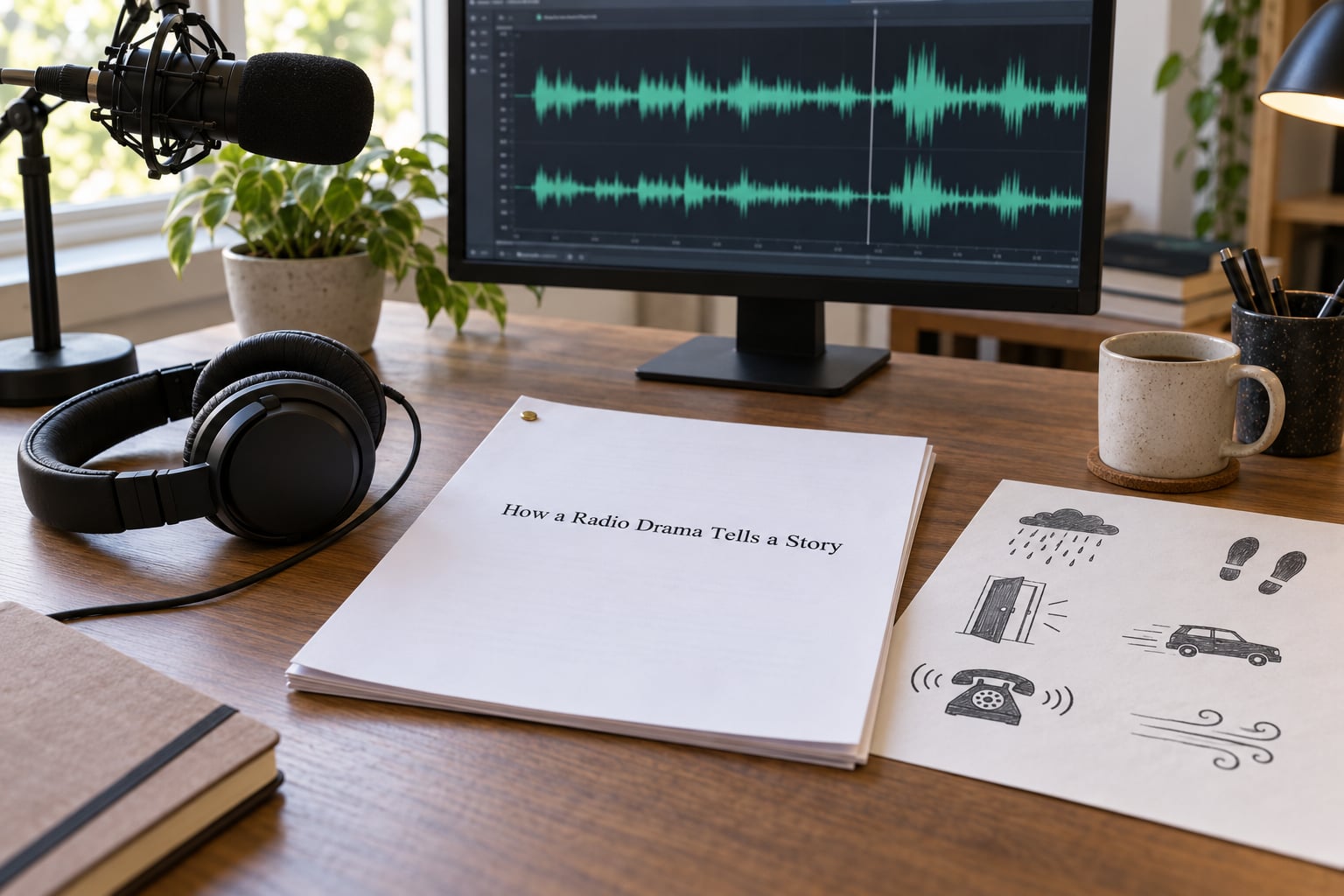
Every radio drama rests on the same four elements. Remove any one of them and you get something different: a podcast, an audiobook, or silence.
- Spoken dialogue performed by a full cast, each actor holding a distinct voice for one character.
- Sound effects and Foley, the everyday sounds recorded live to picture, plus wider atmosphere such as rain, traffic or a ship’s engine.
- Music, either an original score or period cues written for the story, used to signal mood and separate scenes.
- Narration and silence, where a narrator links episodes and the pause between lines carries timing, tension and place.
A short scene shows how it works. A door creaks. Footsteps cross gravel. A character says she left the letter on the table, and music fades out. You know the room, the weather and the hour of the night without being told any of it.
That is why experienced listeners judge a production on its sound design before its plot. Headphones are treated as close to essential, and one of the most repeated pieces of advice in audio drama communities is simply to wear them.
How Radio Drama Differs from Podcasts
Radio drama and podcasts are not rivals, which is where a lot of confusion starts. Some modern audio drama is distributed as a podcast feed, so the two categories overlap heavily.
| Format | Voices | How it sounds | Typical length | Best for |
|---|---|---|---|---|
| Radio drama | Full cast plus narrator | Scripted, effects and score designed around the story | 20 to 30 minutes an episode | Immersion and atmosphere |
| Audiobook | One narrator reading a book | Straight reading, sometimes with light music | Ten hours or more | A single author’s voice |
| Fiction podcast | Usually one host or narrator | Spoken storytelling, often loose and unscripted | Varies widely | Documentary-style stories |
| Film or television | Full cast | Pictures carry the setting and action | Feature length or series | Watching |
The gap that matters most is the third column. An audiobook puts one voice in a room with you. A radio drama builds a room around your head, and that is why it rarely works on a laptop speaker.
Why Radio Drama Is Coming Back
Six forces explain the revival, and they reinforce each other.
- Audio became a daily habit. Commutes, chores and walks used to be dead time. Streaming audio turned them into listening time, and a serial fits a journey perfectly.
- Podcasting killed the distribution problem. Beforehand a production needed a network slot and a sponsor. A self-published episode needs a hosting account and a microphone.
- Fiction podcasts proved the demand. Shows such as Welcome to Night Vale and Serial drew large audiences for invented stories and trained listeners to want them.
- New funding models appeared. Kickstarter campaigns, Patreon pledges and public commission schemes now pay for production directly.
- Archives became free and legal. Large collections of classic old-time radio finally sit online in a stable form, so newcomers can try the golden age for nothing.
- Licensed work found a home. Companies such as Big Finish produce new full-cast audio fiction from established screen franchises, which brings in listeners who would never search for the term.
A widely cited Conversation article in 2016 described more than 200 independent producers and around 10 million BBC radio drama listeners. Those figures are dated now, but the shape of the ecosystem they describe has matured rather than shrunk, and the independent scene is larger than it was.
Where Radio Dramas Come From Today
The format is not a relic of American radio, and it is not all in English either.
- Public broadcasters. BBC Radio 4 commissions new drama regularly and re-runs old serials on the digital station Radio 4 Extra. The Archers has been broadcasting since 1950 and is the longest-running drama serial in the world.
- Independent podcast producers. Small teams release weekly or seasonal audio drama through ordinary podcast feeds, usually funded by listeners.
- Adaptations of classic novels. Public-domain books get re-adapted each generation, and novels by Neil Gaiman and others have been produced as full-cast audio.
- Licensed franchise work. Big Finish publishes audio fiction based on science-fiction and television properties, sold through its own shop.
- International traditions. Germany has a strong Hörspiel tradition, Japan has a very large drama CD market, and South Africa maintains a strong English-language tradition through national public radio.
- Live shows and staged readings. A live radio play is simply a radio drama performed to an audience in a studio or theatre, sometimes recorded and released the same night.
Check current availability before planning around a title. Schedules, feeds and regional access change, so treat listings as a starting point rather than a guarantee.
How to Find and Listen to Radio Dramas
Discovery is the hardest part, and it is where most newcomers stall. A workable route looks like this.
- Start with one episode, not a subscription. Find a production with a full cast and finished sound design, then judge the voice work.
- Search the categories your app already has. Most podcast apps filter by tags, and audio fiction, fiction podcast and drama are separate categories worth checking.
- Try a classic from a free archive. This costs nothing and shows you what the format sounded like in its best years.
- Set up your gear properly. Wired or wireless headphones, a quiet room and a decent app with playback speed control are enough. Background music and podcasts will drown out effects.
- Read the description before you commit. Check whether it is a serial or a standalone, how long the episodes run, and whether the show is still being updated.
On serial versus standalone: a serial rewards starting at episode one, because you learn the voices and relationships gradually. Listeners who drop into episode twenty of a long-running show often describe it as walking into someone else’s family reunion. Standalone episodes, usually anthologies with a new cast each time, need no context at all.
Length is friendlier than people fear. Roughly 20 to 30 minutes covers most journeys and most single chores, which is a very different proposition from a 15-hour audiobook.
How Radio Drama Is Produced
The production chain is shorter than people assume, and each step is understandable.
- Adaptation and script. A writer builds a version of the story that works with sound alone, which means removing anything the ear cannot carry.
- Casting. A director hires actors, often remote, and records everyone for a benchmark episode first so the tone is set before the full script is shot.
- Recording. Performances are captured in a treated studio or at home setups, with the director coaching line by line.
- Foley and sound design. Footsteps, doors, props and atmospheres are recorded and layered until a scene sounds like the place it describes.
- Music. A composer writes a score and themes, sometimes in period style, which become the show’s signature.
- Editing and mix. An engineer balances dialogue against effects and music, because clarity comes first and atmosphere second.
None of that requires a film budget, which is the practical reason the format keeps surviving wherever money is tight.
Frequently Asked Questions
Is radio drama the same as a podcast?
No, and often yes at the same time. Radio drama describes how a story is made: scripted, performed by a full cast, and built with sound effects and music. A podcast describes how it is delivered, usually as an automatic RSS feed. Plenty of excellent audio drama is published as a podcast, so many shows are both at once.
Are radio dramas still broadcast on traditional radio?
Yes, in a reduced but real form. BBC Radio 4 continues to commission new drama and re-run classic serials on Radio 4 Extra, and several countries maintain national public radio drama traditions. In the United States, though, network radio mostly abandoned scripted drama decades ago, so modern production has moved almost entirely to podcasts and paid platforms.
Why is radio drama popular again?
Six reasons usually get cited: audio became a daily habit through smartphones and car listening, podcasting removed distribution costs, fiction podcasts proved large audiences exist, new funding models paid for production, classic archives became free online, and licensed franchise work brought new listeners in. Together they turned a declining broadcast format into a healthy independent scene.
What is the difference between a radio play and an audiobook?
A radio play is a performance. Several actors play different characters, a sound designer supplies effects, a composer supplies music, and a director shapes the timing. An audiobook is a reading, usually by a single narrator, of an existing book with little sound design. Radio drama is written and staged for the ear; audiobooks inherit whatever voice a solo narrator brings.
Can I listen to radio drama on a streaming service?
Some of it, but less than people expect. Public broadcaster fiction usually sits behind the broadcaster’s own app and regional rules, while independent shows arrive through podcast directories or their producers’ own pages. Paid specialist publishers sell their own catalogues directly, and those releases are usually not included in general music subscriptions, so check the specific title rather than assuming.
How do I start listening to modern radio drama?
Start with one finished episode rather than a subscription, and pick something with a full cast and deliberate sound design. Search your podcast app’s drama and fiction categories, try one classic from a free archive to hear how it used to sound, and read the description so you know whether it is a serial or a standalone. Headphones make an immediate difference.
Conclusion
Radio drama is a story told entirely through voices, effects and music, and it is more available in 2026 than at any point since television ended the golden age. Do not start with a hundred-episode serial. Put on headphones, pick one short episode from a production with a real cast and proper sound design, and decide from there.