A radio commercial is built the way a film is built, only with nothing to see. An advertiser writes a brief, a copywriter drafts copy to a hard word limit, voice talent records it in a booth, an engineer lays music and sound effects under it, the whole thing is mastered to a loudness target the station specifies, and the finished file is trafficked out to every station in the campaign. Understanding how radio commercials are made explains almost everything you notice as a listener: why they are short, why some jingles stick for years, and why an ad break can suddenly sound louder than the programme around it.
This guide walks the full chain, from the first brief to the moment the file lands in a station playlist. It is written for anyone curious about the craft, and it is equally useful if you are a small business weighing a first campaign.
Table of Contents
- What Is a Radio Commercial?
- How Radio Commercials Are Made: The Production Process
- How the Whole Process Works
- How the Finished Commercial Gets on the Air
- Different Types of Radio Commercials
- What Makes a Radio Commercial Effective?
- Frequently Asked Questions
- Why are ads louder than the show?
- Why does the volume get louder during commercials?
- How do I stop commercials from being louder than the show?
- How much does it cost to put a commercial on the radio?
- What is the meaning of radio advertising?
- What are the 5 main advertising techniques?
- Why are ads so obnoxious now?
- Are TV commercials louder than their surrounding programs?
- What to Do First If You Are Making a Spot
What Is a Radio Commercial?
A radio commercial is a short audio advertisement, usually 30 or 60 seconds, written to be spoken aloud rather than read silently, recorded in a studio, and played between songs or around programmes.
The form differs depending on who is behind it. A local station ad sells one business, one shop or one service to people within a few miles of the transmitter. A network campaign runs the same script across hundreds of stations, sometimes with cut-down versions, regional tag lines and different voices for different parts of the country. A public-service announcement carries a public message, often recorded free of charge by professional voice talent working under a charity or government scheme. Sponsored content sits in a different category again, blending a host’s own conversation with a paid mention so the ad break does not break the flow of the show.
Two more distinctions are worth holding on to. A radio spot is produced audio, finished and mixed in advance. A live read is the presenter or announcer reading a script off the mic during the break, which is cheaper but less controlled because nothing is recorded and re-edited. Both run in the same break on the same day, and listeners often cannot tell which one they are hearing.
How Radio Commercials Are Made: The Production Process
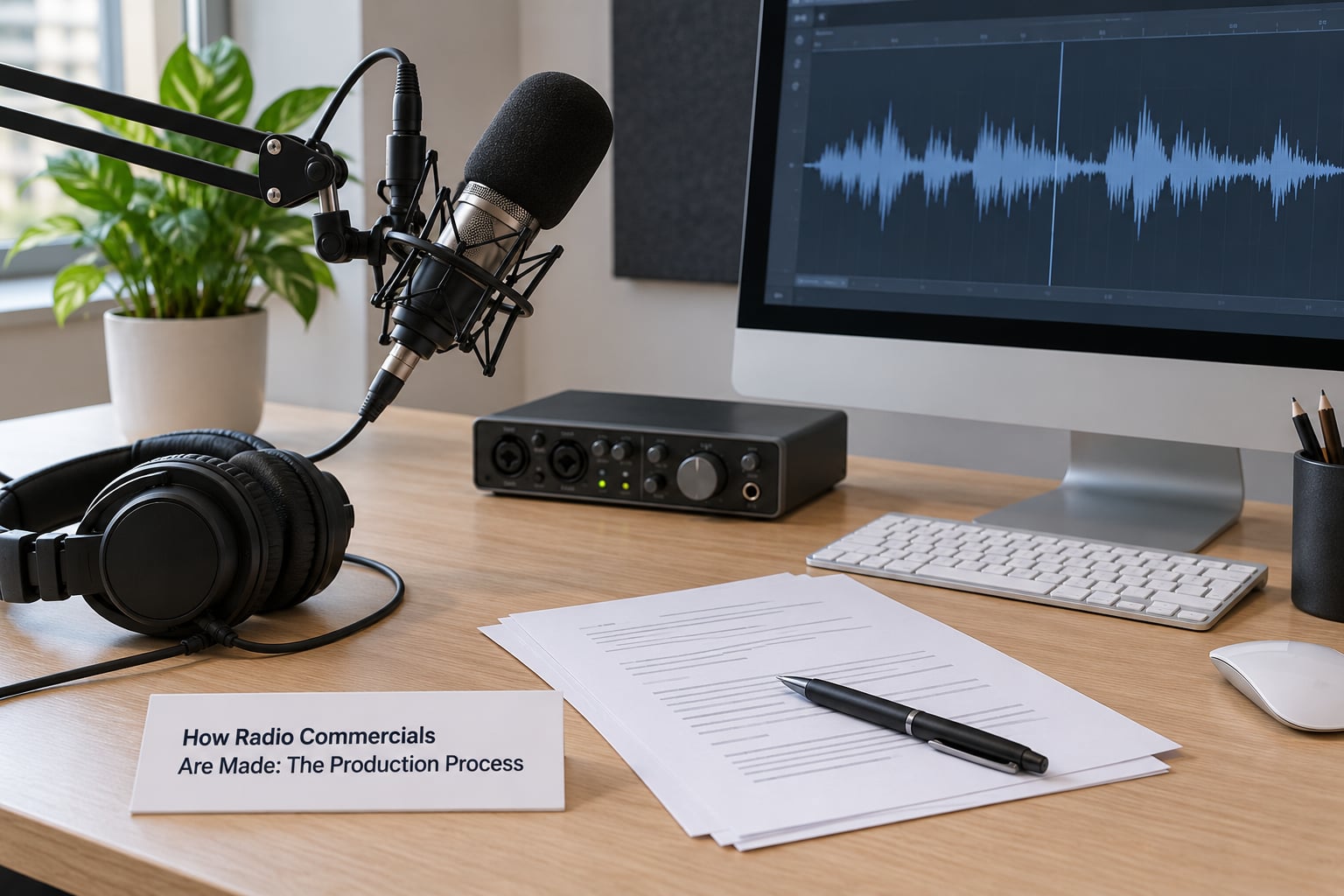
Eight stages, in order. The advertiser sets the brief and audience, the script is written to a word limit, voice talent is cast, the session is recorded, sound design and music are added, the spot is edited and mastered to the station loudness spec, the client approves it, and it is trafficked to stations and scheduled.
- Brief and research. The advertiser sets the objective, the target listener, the stations, the length, the budget and the call to action. Research on audience habits and competing advertising shapes everything that follows.
- Script. A copywriter drafts several versions. A 30-second spot is roughly 75 to 80 words, a 60-second spot about 150 to 160. Every word is read aloud before it is approved.
- Casting. Voice talent is auditioned against a brief describing tone, age, region and accent. National campaigns can audition hundreds of voices for a handful of roles.
- Recording session. Talent works through the script with a producer giving direction, one line at a time. The engineer captures many takes and isolates the best parts.
- Sound design and music. A music bed is licensed or composed, sound effects are selected, and a jingle or sonic logo is dropped in if the campaign has one.
- Editing and mixing. Takes are cut, levels balanced, music ducked under the voice, fades placed, silences trimmed.
- Mastering. The spot is loudness-matched and delivered at the technical specification the station requires, with the correct separation between the channels for FM stereo or mono AM.
- Approval, trafficking and air. The client signs off, the audio is logged and delivered, station schedules and billing are set, and the spot plays in rotation.
The table below shows who owns each stage and how long it usually takes. It is the part of the process most people never see.
| Stage | Who does it | Typical turnaround | Deliverable |
|---|---|---|---|
| Brief and research | Advertiser, agency planner | 3 to 5 days | Creative brief and media plan |
| Script | Copywriter, creative director | 3 to 7 days, plus revisions | Two to three script versions, one approved |
| Casting | Producer, voice agent | 2 to 5 days | Shortlist of talent with auditions |
| Recording session | Talent, producer, engineer | One to four hours in studio | Clean dialogue tracks |
| Sound design | Producer, sound designer | 1 to 3 days | Music bed, effects, stings |
| Edit, mix and master | Engineer, producer | 1 to 2 days per version | Broadcast-ready files |
| Client approval | Advertiser legal and marketing | 1 to 3 days | Signed-off master |
| Trafficking and air | Station traffic, network | Air date set, then rotation | Scheduled spot, verified log report |
For a straightforward local spot, two to three weeks from brief to air is normal. Rush jobs get done in days, at a cost in revisions, because the same compression that shortens the schedule also shortens the room for changing the script.
How the Whole Process Works
Nobody makes a radio commercial alone. The usual team is a copywriter, a creative director who approves the concept, a producer who runs the session and directs the talent, an audio engineer who records and mixes, the voice talent, and a trafficker at the station or network who handles the log report and billing. On a national campaign a planner sits on top of all of that, and a media buyer decides which stations and dayparts get the money.
The reason so many people take part is that radio is a bought medium. A station will not run a spot simply because it is good; it runs it because someone paid for the slot. The creative and the media plan are developed together for that reason, and a change in one usually forces a change in the other.
What Happens Before the Commercial Is Recorded?
It starts with a creative brief, and it is more specific than most people expect. The brief names the target audience in enough detail to be useful: age, where they listen, what they do on the drive to work, which competitors they already hear.
It also fixes the length. Thirty seconds is the industry default and works for almost anything. Sixty seconds buys time for a story, a demonstration or a fuller explanation. Fifteen and twenty seconds exist for very simple offers or for stations with tightly packed breaks.
The brief settles the call to action, usually one action rather than three. Visiting a site, searching a term, quoting a code, calling a number and visiting a shop are all usable; asking a listener to do five of them guarantees none of them happen.
Finally there are constraints. Some markets require local language or bilingual reads for certain classes of advertising, financial and health claims get checked, and certain categories are restricted altogether. Those checks happen now, before anyone buys studio time, because rewriting a script after a session is the most expensive kind of rework.
How the Script and Audio Are Developed
Writing for radio is writing for the ear. A line that looks fine on paper can be a disaster spoken aloud, so the copy is read out loud, usually at the pace it will be delivered, from the first draft onward.
| Spot length | Approximate word count | Typical use |
|---|---|---|
| 10 seconds | 20 to 25 words | Stingers, tag lines, promo IDs |
| 20 seconds | 45 to 55 words | Simple offer, reminder spots |
| 30 seconds | 75 to 80 words | The standard local and regional spot |
| 60 seconds | 150 to 160 words | National campaigns, storytelling, demonstration |
Word count only sets the ceiling. The delivered pace depends on the voice: a conversational read at normal speed fits around 150 words to the minute, a faster promo read more, and every pause, breath and dramatic silence costs words. That is why scripts are timed, not just counted.
The script is also not one column of words. A produced spot is a sequence of cues the producer and engineer follow: sound effects, dialogue, music under and around it, and a final tag for the listener to repeat.
SFX: A car door shuts, keys jangle in a pocket.
VO1 (male, conversational): It’s that time again. The school run, the long drive, the queue at the barrier.
SFX: Engine starts, radio tuning clicks through stations.
VO1: You spend forty minutes a day in the car. Which is forty minutes nobody gets back.
SFX: Music bed fades up, warm and unhurried.
VO2 (brighter): The new station app learns what you like on the first drive. No searching, no static.
SFX: Jingle sting, three notes.
VO2: Yorkshire Radio on the app. Search, download, and take the long way home.
That is roughly 80 words of dialogue for a 30-second read, with the effects and music sitting underneath and around them rather than adding to the count. Writers usually deliver three versions: a straight product read, a story-led version and a short cut-down, because station breaks are not all the same length.
How the Voice, Music, and Effects Are Recorded
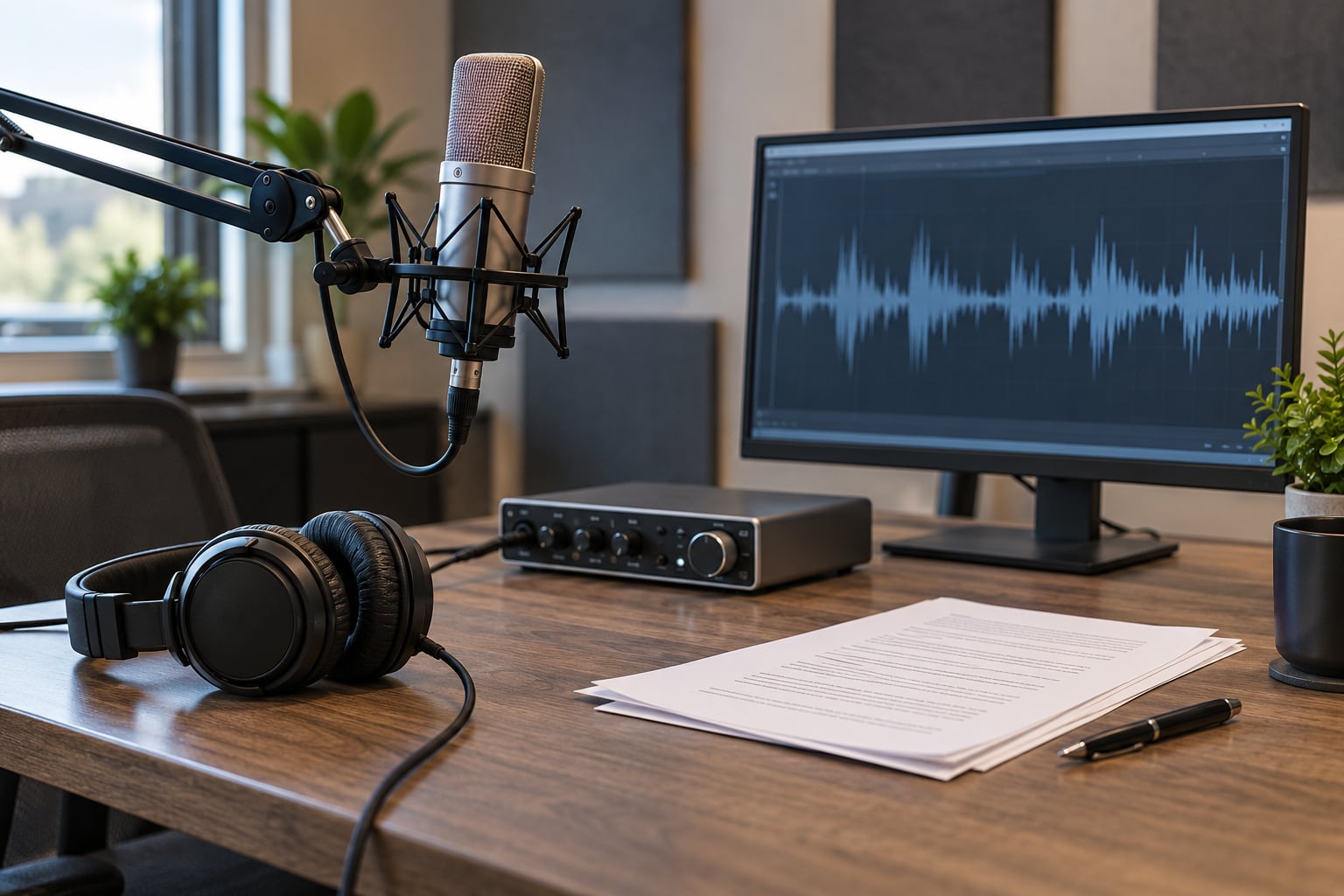
The talent session is the part listeners never see. The producer sits with the talent in the room, and the engineer is behind the glass or just to one side at the desk. The script is broken into small pieces rather than run end to end, so one line can be redone without repeating the whole thing.
Direction is conversational and specific. Producers say things like more relaxed on that line, or let’s try it as if the listener just sat down next to you. They mark which take is preferred while the session is happening, because nobody wants to hunt through three hours of takes afterwards.
Dozens of takes are normal for a few seconds of audio. A single word can be recorded eight times, and the best eight can be stitched into one seamless sentence. It is a normal, unglamorous part of the day for everyone in the booth, and it is where the budget goes.
Music arrives from one of two places. Original music is commissioned or licensed specifically for the campaign, which is the safe route and the expensive one. A production library supplies pre-cleared tracks that come with terms covering broadcast and online use, so nothing has to be cleared spot by spot. What the track must always do is stay behind the voice; a bed that competes with the words is the single most common mixing failure in radio.
Sound effects come from a library too, or they are recorded to order. A car door, a till beep, a doorbell: each one has to sound plausible and has to have a clear licence. Effects also do structural work. A silence after a line tells a listener that something is about to happen, and a hard sting marks the tag.
How Radio Commercials Are Edited for Broadcast
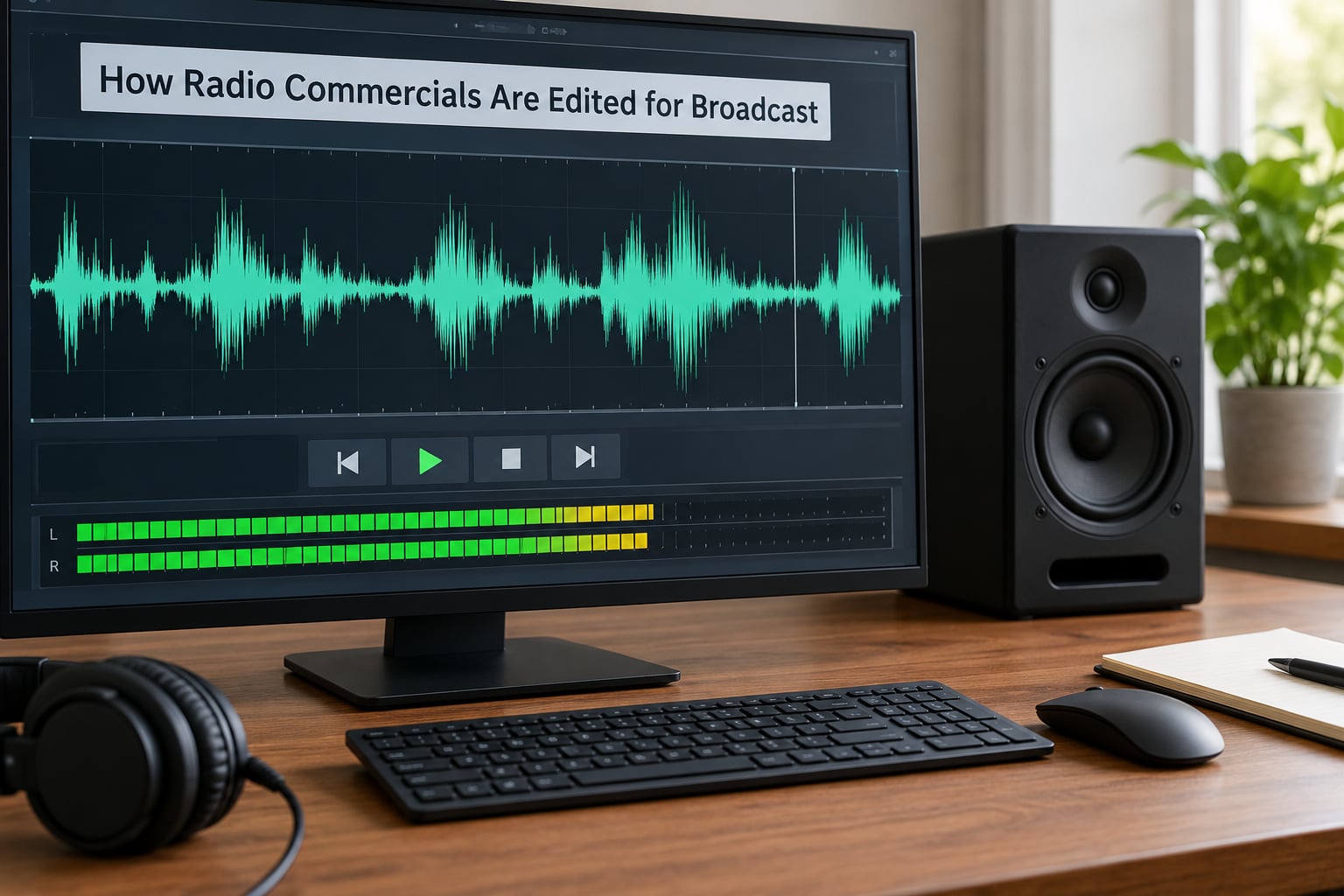
Editing a spot is mostly subtraction. The engineer removes breaths, gaps, mouth clicks, background hum and room noise, then sets the levels so the voice sits consistently. If the read is uneven, small amounts of compression are applied to even it out without flattening the performance.
The music is then ducked under the dialogue, and the whole spot is trimmed to its exact length. A 30-second file that runs 30.4 seconds gets cut in most stations’ systems, so the final edit is usually a little shorter than the script implies.
Mastering is the stage listeners feel without knowing it exists. Stations specify a target loudness, generally in the region of -23 LUFS for broadcast delivery, and the spot is normalised to match it. On FM the transmission process adds its own limiting, which is why a spot delivered slightly quieter is often reproduced slightly louder than it was on file.
This is the direct answer to a question almost every listener asks: why does the volume jump up during commercials? The show and the ad are mastered to different references and played back through different processing, and the ear is far more sensitive to a level change going up than to a level change going down. Quiet talk radio followed by a loud polished ad is the sharpest version of that.
The final technical checks are unglamorous but non-negotiable: correct length, correct loudness, no clipping, mono compatibility so the spot survives on an AM speaker, the legal line present if the category requires one, and the naming and format conventions the station’s traffic system expects.
How the Finished Commercial Gets on the Air
Approval comes before delivery, and it is rarely a single pass. The brand team may want the tagline changed, legal may want a claim qualified, and the media buyer may want a cut-down for shorter breaks. Each request means a new version, and every version is mastered and delivered again.
Trafficking is the administrative step that people rarely know about and would be lost without. The trafficker logs the spot into the station or network system, assigning it a reference, uploading the audio, attaching the copy for the announcer log, booking the schedule against the spots the buyer purchased, and confirming billing. The same process handles makegoods when a spot misses its slot and verification reports showing which spots played on which stations and at what times.
From there the spot plays in rotation, slotted into breaks against music or programmes rather than shown to the listener as a video ad. Stations that take new material daily will run a first-time spot in a good break, then repeat it at lower frequency, usually for several weeks.
Measurement in radio is indirect by nature. Stations report that a spot aired, and listeners respond where the message sends them: visits, searches, calls, code redemptions. That gap between delivery and response is why radio copy usually asks for one specific, memorable action.
Different Types of Radio Commercials
The production route changes with the format, and so does the effort behind it.
| Type | Who makes it | Control over the audio | Typical use |
|---|---|---|---|
| Host-read spot | Station host, sometimes with a producer | Low, tone varies by week | Local businesses, conversational tone |
| Produced spot | Agency or studio | Full | Brand campaigns, product launches |
| Live read | Station announcer at the mic | Minimal | Late-breaking local notices |
| Jingle | Composer and session singers | Full, and expensive | Brands built around a sonic logo |
| Public-service announcement | Charities and public bodies, talent often free | Full | Safety and awareness messages |
| Podcast or streaming ad | Host or a host-read agency script | Medium, hosts often improvise | Niche audiences, longer spots |
Podcast ads are the interesting comparison. A radio spot must be complete and polished because the listener may have no context at all. A host-read podcast ad often works better half-improvised, because the host’s own voice carries the credibility the production would otherwise supply. Podcast hosts and their listeners tend to rate their own read far more warmly than a polished inserted spot, which matches the widespread view that a familiar voice beats a slick one.
What Makes a Radio Commercial Effective?
Recall is the thing that decides whether a spot worked. You cannot remember a phone number, a web address or four product features, so the spot has to carry one idea, one memorable phrase and one action.
A good hook lands in the first three seconds, because a listener who changes station mid-break is gone. The strongest hooks are a scene rather than a claim: a queue at a barrier, a school gate, a phone ringing on a kitchen counter. A weak hook is the brand name spoken slowly over a bed of strings.
Fit matters as much as writing. A spot that sounds like a fashion campaign drops awkwardly into a local news bulletin, and a hard sell placed in a quiet overnight slot reads as an intrusion. Same script, different station, different music bed, sometimes a different read.
Production quality has a ceiling too. Clean audio and a considered music bed signal care, but a spot overloaded with effects and stings reads as noise, and it is the loudness, not the production, that listeners complain about most.
Common Mistakes and What Listeners Say
Scripts written to be read rather than heard. Sentences with clauses nobody can hold in memory at 140 words to the minute.
Two or three calls to action in one spot. The listener remembers none of them.
Music louder than the voice for the first half, then dropping away. It feels like two different advertisements stitched together.
Unlicensed music. Cheap to fix at the planning stage and very expensive to fix after the spot has aired.
Clusters of near-identical spots in one break. Four back-to-back promos with the same structure and the same voice make a break feel twice as long as it is.
The loudness complaint is the one listeners raise most, on radio and on podcasts alike. On forums, people describe it as the single most irritating artefact of audio advertising, and there is a persistent belief that louder ads are against the rules. The honest answer is that stations set and enforce their own loudness targets, the rules are technical rather than legal, and a jarring spot usually means a delivery that missed the station’s specification rather than a station that allowed it.
Frequently Asked Questions
Why are ads louder than the show?
Programmes and commercials are mastered to different loudness references and pass through different processing on the way to your speaker. On FM the transmission adds its own limiting, so a slightly quiet delivery gets reproduced louder. The ear is far more sensitive to a level rising than to one falling, which makes the jump at the top of a break obvious.
Why does the volume get louder during commercials?
Ads are normalised by the station to a target loudness and often start close to full level, while talk radio is mixed to leave wide headroom so a host never clips. The contrast between a compressed, dense commercial and a quiet conversation is what your ears pick up. Turning your volume down during the show makes the jump feel worse.
How do I stop commercials from being louder than the show?
Switch off the automatic volume adjustment your car, television or smart speaker applies, because that correction is what makes a rise feel violent. Set a fixed level with the car radio rather than one that adapts to voice. Keeping playback volume steady all the way through a break removes most of the effect without changing a thing about the advert.
How much does it cost to put a commercial on the radio?
The quote splits into two very different halves. Production covers script, casting, studio time, music licensing, editing and mastering, and it rises steeply with the number of versions, characters and studio hours. Placement is the media spend, which varies hugely by station, daypart and audience size. Local business spots sit at the low end; national campaigns with several cut-downs sit far above.
What is the meaning of radio advertising?
Radio advertising is buying time in a station’s schedule to broadcast a short audio message to people already listening. The broadcaster sells a slot in a break, the advertiser supplies audio that meets the station’s technical specification, and both the delivery and the playing time are verified in a log report. The result is an intimate, one-to-one message with no competing visual layer.
What are the 5 main advertising techniques?
Across audio and outdoor media the recurring techniques are repetition, which builds memory over multiple plays; a memorable hook, which secures the first three seconds; a clear call to action, which asks for one specific step; emotional storytelling, which makes the message stick rather than just register; and placement, which puts the ad where the target audience already spends their time.
Why are ads so obnoxious now?
Most complaints are about delivery rather than content: ads louder than the programme, four or five back to back in one break, and promos for things nobody in that audience will ever buy. The underlying shift is that stations sell a share of a limited commercial break, so the inventory is full. Repetition, clustering and volume all tend to rise together, which is why the break feels worse than it did a decade ago.
Are TV commercials louder than their surrounding programs?
Often yes, for the same technical reasons as radio: dialogue is heavily compressed and normalised so it stays audible over music, effects and audience noise, while a programme mix is left with more headroom. The difference is easier to see on television because you can watch the level meter move as the break starts. The rules are technical specifications set by broadcasters, not laws.
What to Do First If You Are Making a Spot
That is how radio commercials are made in practice, so start with the shortest honest version of the idea. Write one script for 30 seconds at 75 to 80 words, read it aloud, and cut anything the listener has to hold in memory. Get that single version right before you commission a second one, because every extra version multiplies the studio, licensing and traffic work downstream.