Community radio stations in the US are licensed by the Federal Communications Commission, and the route you take depends almost entirely on how much signal you need. Low-power FM applicants file Form 318 and are capped at 100 watts; groups wanting full-power coverage apply for noncommercial educational authority on a reserved-band channel. In both cases a regulator awards the authorisation — not you.
This guide walks through that process in order, using the United States as the worked example because the FCC publishes the clearest rules of any large regulator. Rules differ by country: the UK’s Ofcom, Australia’s ACMA, Canada’s CRTC, Brazil’s Anatel and India’s Ministry of Information and Broadcasting all run separate schemes with their own power limits, licence terms and fee structures. Check your own regulator before you copy any US detail here.
One thing to know before you start: everything you file becomes a public record. Applicant names, organisational structures, site coordinates and technical studies are all publicly inspectable. That surprises a lot of first-time applicants, who then discover the paperwork after their community has already discussed it.
What is a community radio station? A non-commercial radio service owned, operated and shaped by the community it serves, usually run by a nonprofit organisation, school, tribal government or civic body rather than a commercial broadcaster. Broadcasters often describe it as a third model of broadcasting, sitting alongside commercial and public service radio.
A community station is defined by who it serves, not by its wattage. A 100-watt station covering three and a half miles and a full-power station covering forty miles can both be genuine community broadcasters, and the FCC treats them as different applications under different rules.
Table of Contents
- What You Need
- How Community Radio Stations Are Licensed Step by Step
- 1. Confirm That Your Organization Is Eligible
- 2. Choose the Right License and Service Area
- 3. Research Frequency and Location Options
- 4. Build a Public-Facing Service Proposal
- 5. Prepare the Technical and Financial Application
- 6. File Through the Correct FCC Process
- 7. Respond to FCC Review and Public Input
- 8. Receive Authorization and Meet License Conditions
- A Radio Licensing Application Beside FCC Research Materials
- Common Licensing Mistakes and How to Avoid Them
- Assuming streaming permission equals a broadcast licence
- Promising a frequency before authorisation
- Choosing a site for convenience and then fighting the study
- Treating the community record as an afterthought
- Underestimating the budget
- Missing the window or a deadline
- Buying equipment before you have a permit
- Confusing the broadcast licence with music rights
- Frequently Asked Questions
- Does a community radio station in the US have to be a nonprofit?
- Can a community group apply for an LPFM license?
- How do I find an available community radio frequency?
- Are community radio station licensing fees expensive?
- Do I need a license to stream a community station online?
- Can a radio station broadcast before its FCC application is approved?
- Conclusion
What You Need
You need a list of things before you file, and the list is longer than most groups expect. Work through it in this order.
- An FCC authorisation type. Decide whether you are seeking an LPFM construction permit, a full-power noncommercial educational (NCE) construction permit, a translator, or no broadcast authorisation at all. That choice drives everything else.
- An eligible legal entity. A nonprofit educational institution, a government or public safety agency, or an organisation that can document a nonprofit educational purpose. Individuals and commercial businesses generally cannot hold a community licence.
- Governance that will not influence programming improperly. Officers, directors and any controlling interests are disclosed, and the FCC reviews those relationships to make sure funding does not buy editorial control.
- A transmitter site. An address, coordinates, ground elevation, and access rights. A roof, a water tower or a leased land site all work, but each has different interference and safety consequences.
- An engineer of record. Someone who signs off on the technical study. For LPFM this is a routine piece of work; for full-power NCE it is a substantial engineering exhibit.
- A frequency availability study. A long-term frequency search showing what is technically available at your site, including long-spacing and adjacent-channel checks.
- Technical documentation. Antenna type and pattern, effective radiated power, antenna height above average terrain, and a study of predicted interference contours.
- Ownership and financial disclosures. Every holder of a percentage interest, plus a realistic budget for equipment, tower rent, studio, insurance and ongoing operations.
- A community-input plan. Written evidence that you consulted the people you propose to serve, with dates, attendance and what you heard.
- Patience. There is no guaranteed processing time, and the broadcast clock only starts after you have an authorisation in hand.
Skip the site research until after the eligibility check. It is easy to spend months on a channel search for a frequency the FCC will never let you have.
How Community Radio Stations Are Licensed Step by Step
How community radio stations are licensed comes down to one principle: the regulator grants a scarce public resource, and every application is judged against the rules and against the other applicants. The sequence below runs from organisational eligibility to a station you are allowed to operate.
1. Confirm That Your Organization Is Eligible
Eligibility is a gate, not a formality. The FCC expects an entity organised around a nonprofit educational purpose, a government entity, or a public safety agency, with a board or membership structure that is answerable to the community it serves.
There is also a locality test. An applicant normally has to be based within a defined distance of the transmitter, and existing station ownership matters too, because the rules limit how much broadcast interest one party can hold. Groups that already control a nearby station often find they cannot file for the channel they want.
Check your own disqualifiers before anything else. A pending application, an unresolved enforcement action or an unclear governance chain can all stop a filing later, and the window will not wait for you.
2. Choose the Right License and Service Area
Choose the authorisation that matches the coverage you genuinely need. The four common routes differ sharply in power, cost and how much work the application involves.
| Route | Typical power | Coverage | Who can hold it | Main trade-off |
|---|---|---|---|---|
| LPFM (Form 318) | Up to 100 watts ERP, 30 m antenna height above average terrain | Roughly 3.5 miles / 5.6 km from the transmitter | Eligible nonprofit and educational entities | Cheapest and quickest; may not reach the whole target community |
| Full-power NCE (Form 2100) | Varies by band and class, generally far higher than LPFM | Contour-based, often tens of miles | Nonprofit educational institutions and organisations | Reaches further, but contested, expensive and slow |
| FM translator | Rebroadcasts an existing station, no original programming | Shadow or gap-filling area | Existing licensee of the primary station, subject to ownership limits | Not a real option for a new community group starting from scratch |
| Unlicensed / Part 15 | Low power, no protected contour | Room or building level | Anyone, no FCC authorisation | Legal immediately, but interference protection is the operator’s problem |
The honest comparison: LPFM is a neighbourhood service, and many groups discover that a 3.5-mile radius covers the community they actually care about. Full-power NCE is a business plan with a broadcast tower attached, and it attracts competing applicants.
Remember that a translator rebroadcasts someone else’s signal. It is not a licence for a new station with its own programming, so it rarely helps a group that wants to originate its own programmes.
3. Research Frequency and Location Options
Frequency and location research decides whether your project is viable. You are looking for channels that are technically available at your specific site, not simply open on a dial somewhere else.
Start with the FCC’s licensing and technical records, which show existing authorisations, pending applications and construction permits. A channel that looks free on a web-based channel finder can be unavailable once spacing rules, protected contours and pending applications are taken into account.
This is a genuine trap for newcomers. Forum discussions on low-power FM repeatedly describe groups abandoning a project after a free online tool returned nothing, only to find a workable channel later with a proper long-term study. Treat any instant answer as a starting point, not a verdict.
For site selection, weigh ground elevation, the height of the proposed antenna above average terrain, the pattern of the antenna you intend to use, and whether anyone can build and maintain on that structure. A roof mount that works technically can fail on access rights or wind loading.
Do not promise a channel to anyone, including your own board, before you hold an authorisation. Only the FCC assigns the frequency, and it does so as part of granting the permit.
4. Build a Public-Facing Service Proposal
A community licence is judged partly on public value, so the proposal has to describe a service, not an ambition. Define who your community of interest is, what programming you will originate, and what the station does that online audio cannot.
Cover the programming mix by daypart, the languages and groups you will serve, and how you will handle emergency and public safety information. State where the main studio will be, that it is publicly accessible, and how volunteers are trained and supervised.
Then document your outreach: meetings held, who attended, what they asked for, and how that changed your plans. Applicants with a documented paper trail and a realistic budget do better under the FCC’s settlement and point systems than those with a larger but vaguer vision.
Accessibility counts. Plan for captioning where you can, plain-language scheduling, and outreach to people who do not already listen to radio.
5. Prepare the Technical and Financial Application
Preparation is where most applications fail. The technical package and the financial picture have to agree with each other, because an application that promises coverage the study does not support invites a rejection.
For LPFM, file FCC Form 318 during an open filing window. For full-power noncommercial educational FM, the application is Form 2100. Both are filed electronically through the FCC’s Licensing Management System, with older broadcast station data held in CDBS. Attach the engineering study, the community presence certification, the public file commitment and any required ownership disclosures.
The financial exhibit is a real budget, not a wish list: transmitter and antenna, tower or roof rental, studio equipment, electricity, insurance, music licensing, and a realistic reserve for the first two years of operation. Groups that apply and then stall at funding are a familiar pattern, and the FCC expects you to show you can finish.
Budget for obligations that are separate from the broadcast licence. Performance rights for the music you play sit with collecting societies, not the FCC, and streaming an online feed creates further rights questions that a transmitter authorisation does not answer.
6. File Through the Correct FCC Process
Filing happens during announced windows for LPFM, not continuously. Windows are typically announced about 30 days ahead, which is the single most cited reason applicants miss them and have to wait for the next one.
Treat the announcement as your start date for a countdown, not a cue to begin work. An applicant who hears about a window the week before it closes usually cannot produce a compliant engineering study and a finished community record in time.
When you submit, the FCC assigns an application reference number. That number is how you track the file, respond to requests, and check the public notice record. Note the public inspection file location, because the FCC publishes certain applications there and opponents can object to what they find.
Submitting an application changes nothing about your legal position. You may not purchase a transmitter, order a tower or test-broadcast on FM under an application alone.
7. Respond to FCC Review and Public Input
Review and public input are the stages applicants underestimate. The FCC may ask for additional information, and third parties, including existing licensees, can file formal objections against your application.
Answer every request accurately and on time. An unanswered request or a missed amendment deadline can end the application without a second chance, which is why groups describe the process as unforgiving paperwork rather than difficult broadcasting.
Where two or more applications conflict, the FCC handles them through settlement agreements, mutually exclusive designations, and a comparative point system under its selection rules. A mutually exclusive application means only one of you gets the channel, decided on factors such as community presence, local programming commitments and technical merit.
Be honest in responses. A point system is not a negotiation, and a settlement is a real agreement with binding obligations. If your plans change, tell the FCC rather than letting an application drift.
8. Receive Authorization and Meet License Conditions
Authorisation arrives in stages, and confusing the stages is how groups end up with equipment they cannot use. Each document authorises something different.
| Document | What it actually authorises | What it does not authorise |
|---|---|---|
| Application accepted | That your filing entered the queue | Any transmission at all |
| Construction permit (CP) | Building the specified facility at the specified site and power | Broadcasting on air |
| Licence to cover | Operating the facility as built, matching the permit | Any expansion of power, height or site |
| Authorised operation | Continuing broadcast under the licence’s terms | Commercial airtime or programming control by a sponsor |
After a construction permit you have a limited period, generally 18 months, to build and start operating. Some permit holders never complete the build and surrender their permits, so treat the deadline as a funding and engineering milestone rather than a formality.
Ongoing obligations then apply. You must operate for a minimum number of broadcast hours, originate programming locally, keep a publicly accessible main studio, and maintain a public inspection file with the required documents. Noncommercial stations take underwriting announcements rather than commercials, and must follow silent hours and ownership rules.
Licences run on a fixed term, commonly eight years for broadcast stations, and must be renewed. Losing contact with the FCC or letting the station go dark between renewals can put the licence back in play, so treat the schedule as part of the station’s operations rather than an administrative afterthought.
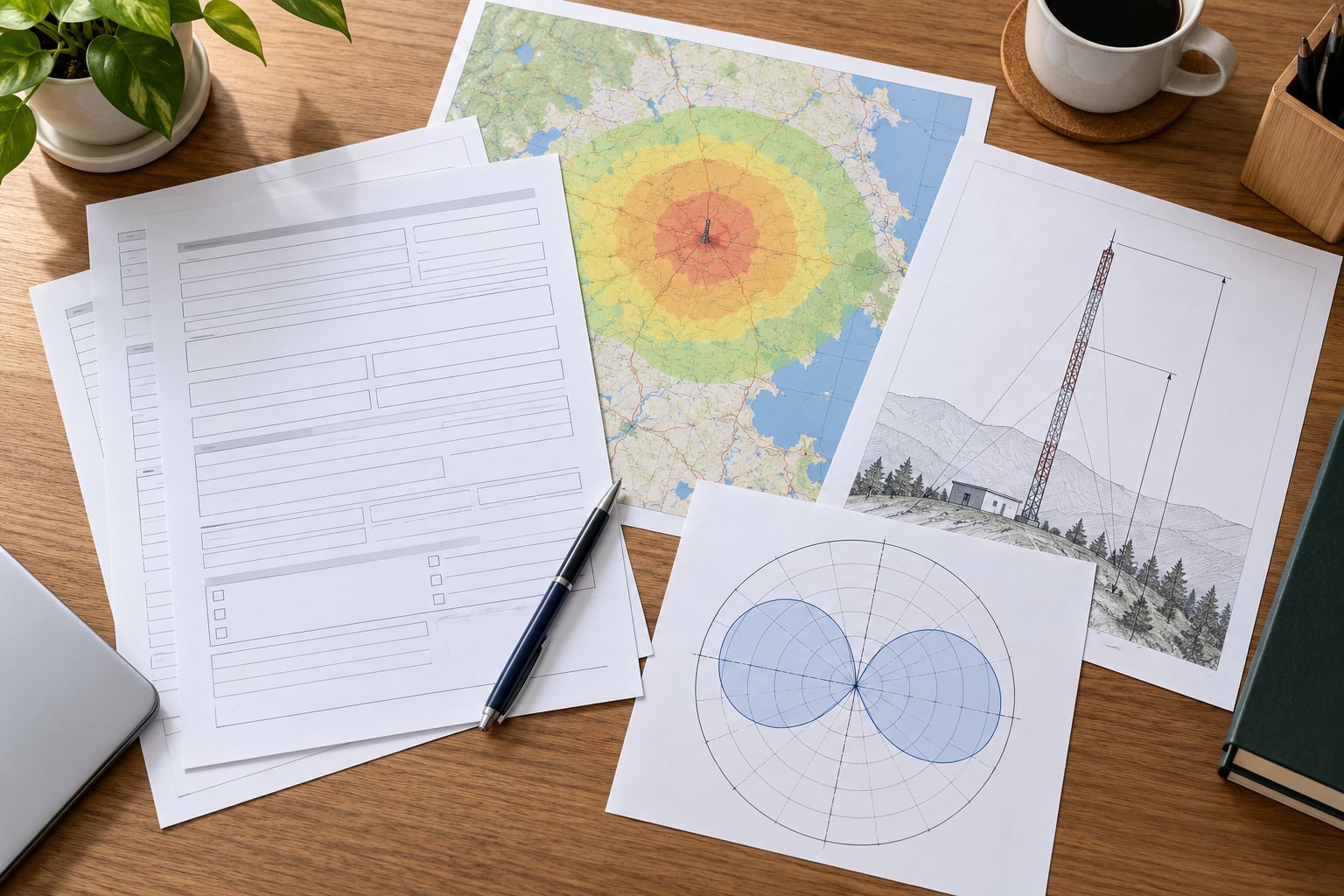
A Radio Licensing Application Beside FCC Research Materials
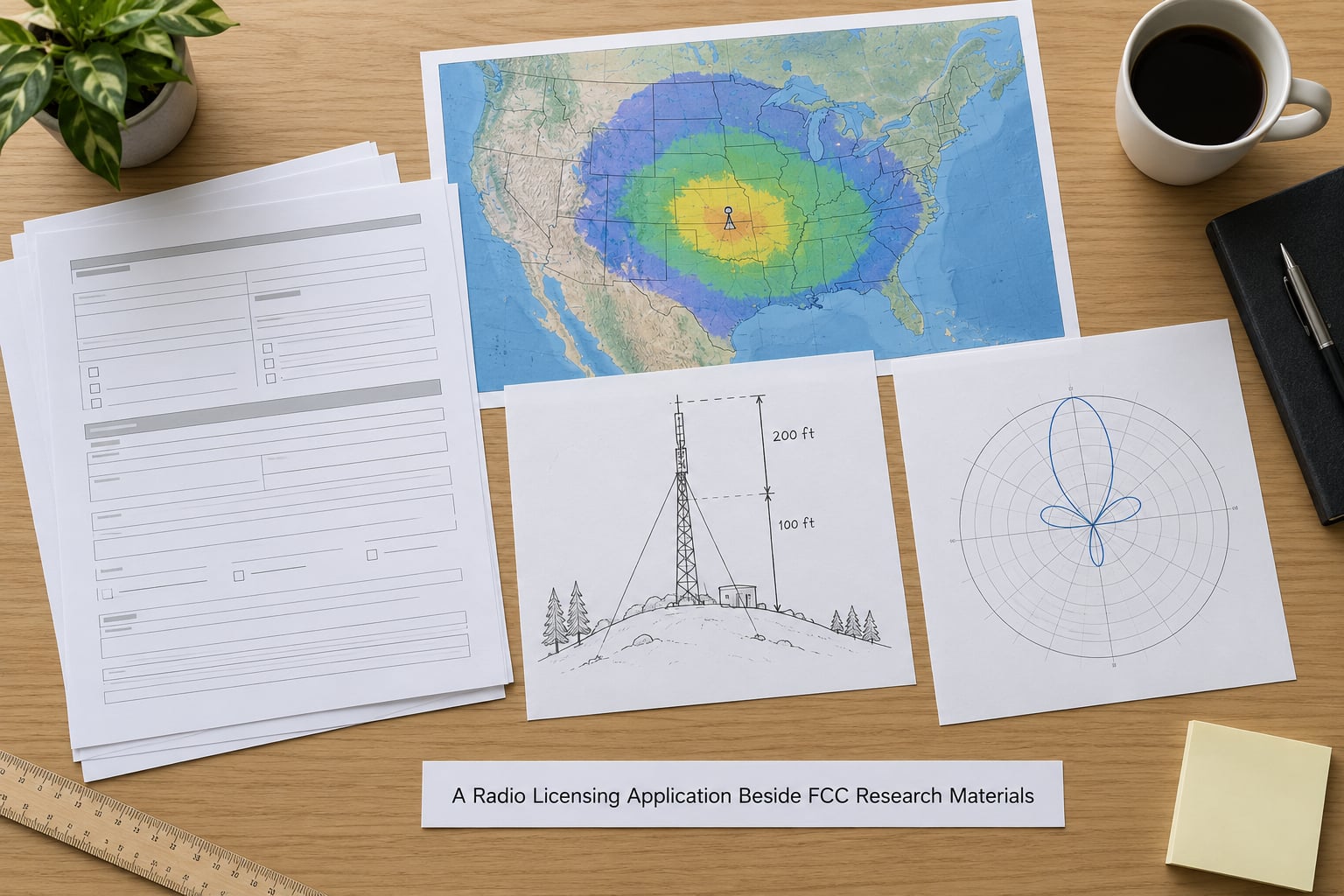
Before choosing a licence path, most applicants sit down with the same working set of documents, and getting them organised early is what separates a smooth filing from a rushed one.
You will need the blank Form 318 and the current Form 2100 for reference, even if you only plan to use one of them. Alongside those, the FCC’s licensing database, a coverage map centred on your candidate site, a site sketch with antenna height noted, and an antenna pattern diagram. A printed copy of the selection and eligibility rules is genuinely useful when a board meeting turns into an argument about who qualifies.
Keep the engineering study, the community record, the budget and the ownership disclosures in one folder, because the FCC often asks for one document while your attention is on another. Applicants who respond faster are usually the ones who had not lost the file.
Common Licensing Mistakes and How to Avoid Them
Almost every stalled community station application fails on paperwork or timing rather than broadcasting. Here are the mistakes that come up repeatedly, with a fix for each.
Assuming streaming permission equals a broadcast licence
Streaming your own audio over the internet needs no FCC broadcast licence, and that is exactly why it is not a substitute. Once you transmit over FM to a community, you are licensed broadcasting. Stream first if you need to start quickly, then apply for a licence on its own timeline.
Promising a frequency before authorisation
Announcing “we will be on 98.3” in a newsletter, a press release or a grant application is a promise the FCC has not made. The regulator assigns channels, and a channel that is open today can be taken by a pending application. Announce the service, not the frequency.
Choosing a site for convenience and then fighting the study
Picking the roof you have access to, then asking an engineer to make the numbers work, reliably produces applications that stall. Get the long-term frequency study and a site feasibility opinion before signing a lease or an access agreement.
Treating the community record as an afterthought
Public outreach written the day before filing reads as an afterthought, and reviewers can tell. Hold the meetings, keep dates and attendance lists, and write a short account of what you changed because of them.
Underestimating the budget
Application and construction permit fees for LPFM are waived, which leads groups to assume the project is free. It is not. Tower or roof rent, engineering, insurance, electricity, music rights and a reserve for unpaid volunteer time are the real numbers, and the FCC wants to see that you can finish.
Missing the window or a deadline
LPFM filing windows are announced roughly 30 days ahead and are periodic, so missing one means waiting. The same discipline applies to amendment requests during review. Put every FCC deadline in a shared calendar that more than one person can see.
Buying equipment before you have a permit
Transmitters, antennas and towers bought on the strength of a pending application are money spent on a site and frequency you may never receive. Wait for the construction permit.
Confusing the broadcast licence with music rights
An FCC licence lets you transmit. It says nothing about the right to play recorded music, which is handled separately through performance rights organisations. Budget and plan for those separately in every country you might operate in.
Two habits cover most of the rest. Track every application reference number and public file location in one place, and get a qualified engineer committed before a window opens rather than during it.
Frequently Asked Questions
Does a community radio station in the US have to be a nonprofit?
Almost always, yes. The FCC expects a nonprofit educational institution, a government or public safety agency, or an organisation with a documented nonprofit educational purpose and accountable governance. Individuals and commercial businesses generally cannot hold a community station licence. You do not have to be tax-exempt to begin, but you need an incorporated entity with a board answerable to the community you plan to serve, because ownership and control are disclosed on the application.
Can a community group apply for an LPFM license?
Yes, and LPFM is usually the right first target for a new community group. You file FCC Form 318 during an announced filing window, and the authorisation is capped at 100 watts effective radiated power with an antenna no more than 30 metres above average terrain, giving roughly a 3.5-mile radius. The catch is coverage: if your community sits beyond that circle, low power will not reach the listeners you need.
How do I find an available community radio frequency?
Search the FCC licensing and technical records for authorisations, construction permits and pending applications near your exact site, then commission a long-term frequency study from an engineer of record. Free online channel finders are a starting point only; applicants regularly report that a tool showed no channel available where an engineer later found one. Remember that only the FCC assigns a frequency, as part of granting a construction permit.
Are community radio station licensing fees expensive?
The regulatory fees are not the expensive part. LPFM application and construction permit fees are waived, and most broadcast fees are modest. The real costs sit elsewhere: engineering studies, transmitter and antenna equipment, tower or roof rental, insurance, electricity, studio build-out, music performance rights, and a reserve to cover the first couple of years while volunteers carry the schedule. Applicants are expected to show a realistic budget, not just a fee receipt.
Do I need a license to stream a community station online?
Streaming audio you produce over the internet does not require an FCC broadcast licence. That makes online-only the fastest way for a group to start publishing and to build an audience while a broadcast application moves through the queue. The line is transmission over the air: putting a signal on FM requires a construction permit and a licence to cover, and playing recorded music raises performance rights questions that a stream or a broadcast licence does not settle for you.
Can a radio station broadcast before its FCC application is approved?
No. An accepted application authorises nothing but the filing itself. A construction permit lets you build the facility at the specified site and power, and only a licence to cover lets you operate it as built. There is no testing period or probationary broadcast on FM for a community applicant, and buying equipment in anticipation of a grant risks spending money on a site and frequency you may never receive.
If you are outside the US, the same eight steps apply in outline, but the regulator, forms, power limits and licence terms all change. Ofcom, ACMA, the CRTC, Anatel and India’s Ministry of Information and Broadcasting each publish their own community and educational broadcasting rules, and several also issue temporary or short-term community licences for events and local projects.
Conclusion
How community radio stations are licensed is a procedural path with a technical spine: confirm your organisation is eligible, choose between LPFM and full-power noncommercial authority based on the coverage you actually need, and have a real frequency study done at your site before you commit to anything.
Start with three things this week. Check your eligibility against the FCC’s rules, ask an engineer what a long-term frequency study at your preferred site would involve, and register for the LPFM window announcements so you hear about the next one early. Everything after that — the forms, the community record, the budget and the post-licence obligations — follows from those three decisions.