If you have heard someone describe a station as LPFM and had no idea what that meant, you are in more company than you would think. LPFM stands for Low Power Frequency Modulation radio: a US FM broadcasting licence limited to 100 watts of effective radiated power and issued only to qualifying non-profit, educational and government organisations. That one sentence covers most of what the label means. The rest is how the licence works, why the range is short, and what you are actually hearing when you tune one in.
Short version for new listeners: if LPFM radio means anything to you, it is a sign that a neighbourhood, campus, church or community group owns a small transmitter and broadcasts to roughly the area it lives in. No adverts, no network feed, no attempt to cover a region.
Table of Contents
- What Does LPFM Radio Mean?
- How Does Low Power FM Radio Work?
- What Frequency Band Does LPFM Use?
- Why Do LPFM Stations Have a Smaller Listening Area?
- What Can You Listen to on LPFM Radio?
- How Do You Find and Listen to LPFM Stations?
- Is LPFM the Same as AM, FM, or Internet Radio?
- Why Does an LPFM Station Sound Clear but Disappear Quickly?
- How Is an LPFM Station Licensed in the United States?
- Frequently Asked Questions
- The Takeaway for New Listeners
What Does LPFM Radio Mean?
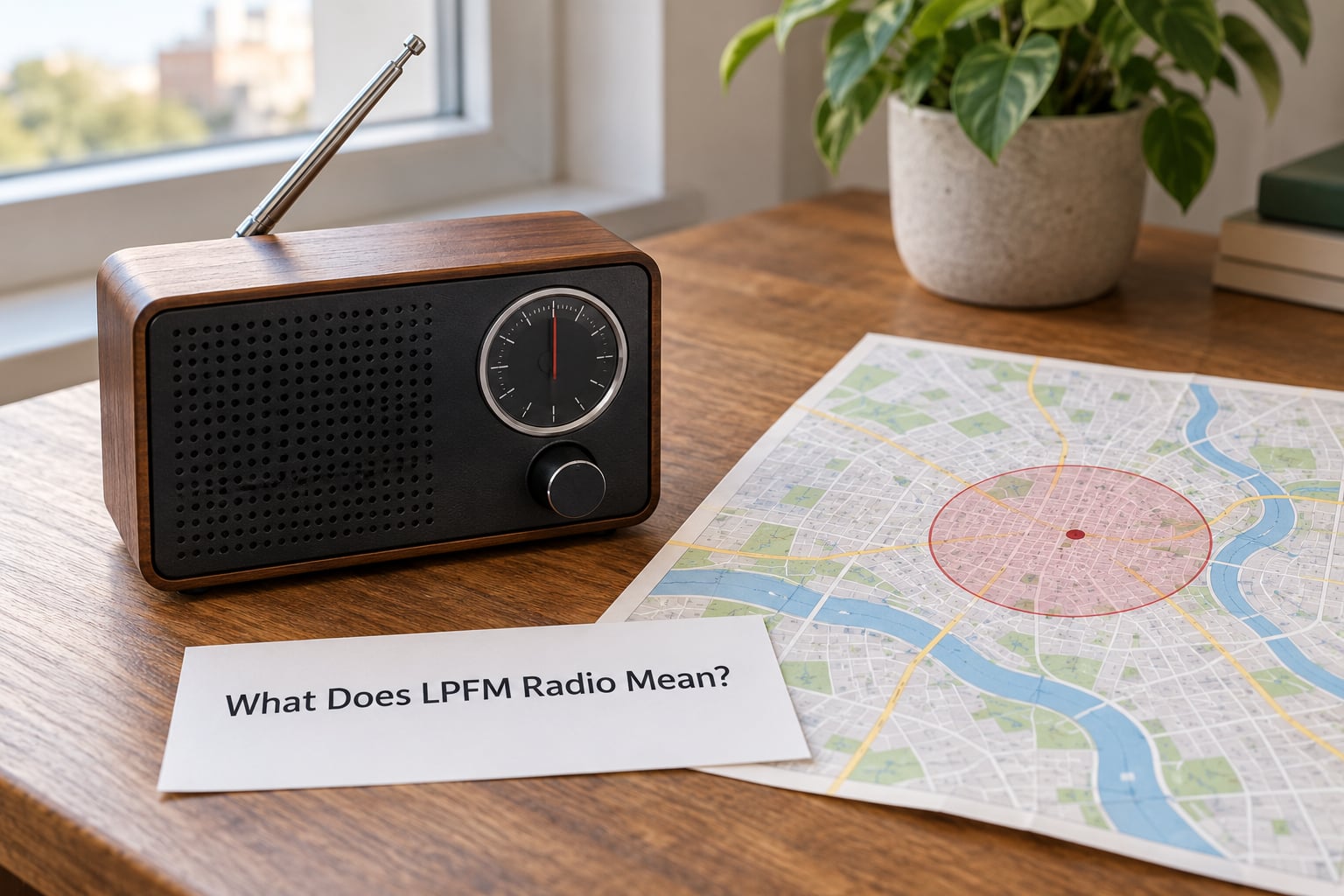
LPFM means Low Power Frequency Modulation. The “FM” part is the ordinary broadcast band every commercial radio station uses; the “low power” part is what makes it different, because the Federal Communications Commission caps an LPFM station at 100 watts of effective radiated power from an antenna no higher than 30 metres above average terrain.
It is also a licence category, not a format. An LPFM station can carry music, talk, news, school sports or a repeating emergency message, and the FCC decides none of that. The service was created in January 2000 for organisations that could not get on the air any other way, and call signs carry an “-LP” suffix so you can spot one on the dial.
How LPFM differs from the other radio terms you hear
- AM radio uses a different broadcast band and older modulation. LPFM shares nothing with it except the word “radio”.
- Conventional FM is the same technology at far higher authorised power, often tens of thousands of watts from a tall tower.
- Internet radio arrives over a data connection, not a transmitter, so it has no coverage area at all.
- Public-safety radio is a narrowband service for agencies and first responders, not for the public to tune in.
How Does Low Power FM Radio Work?
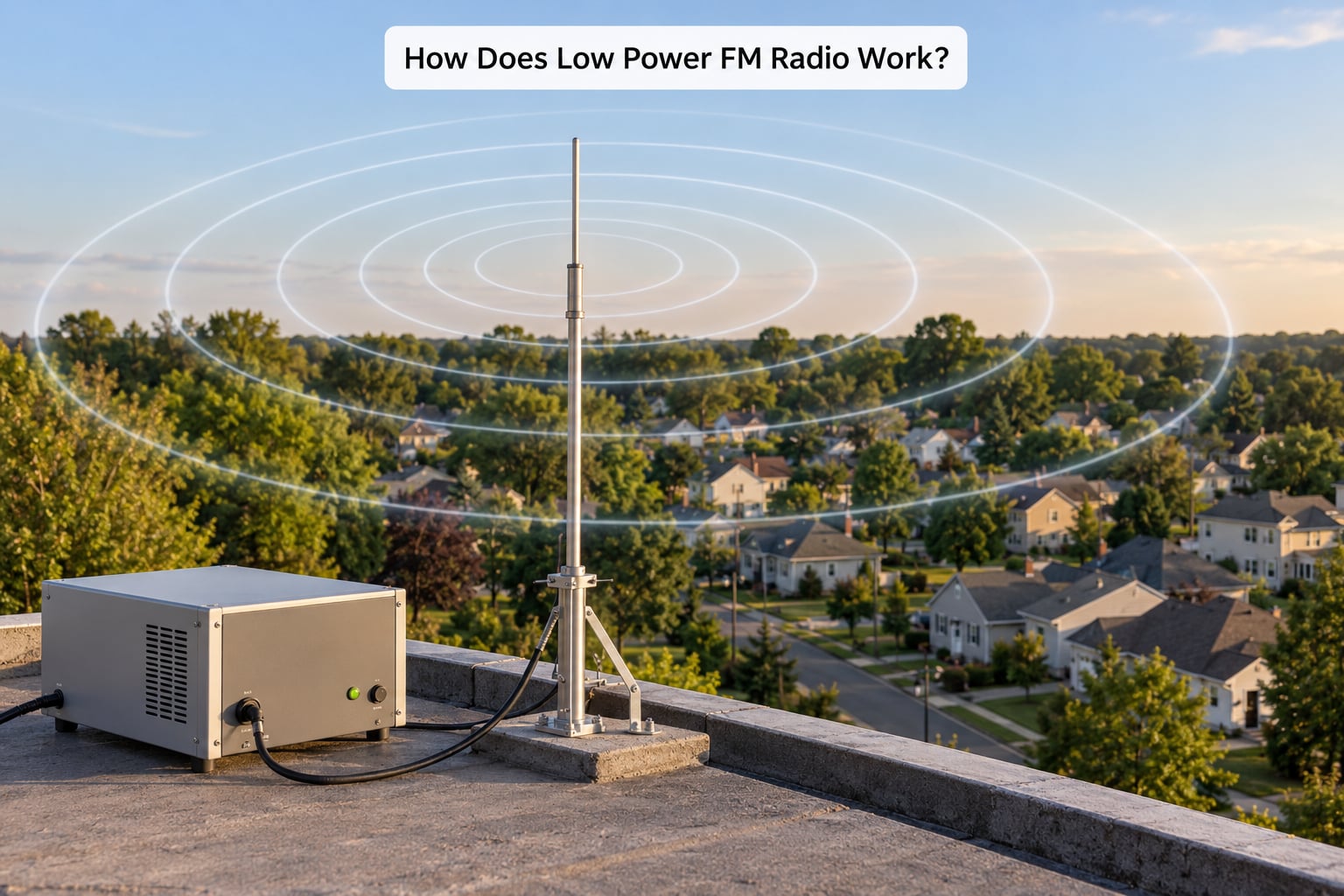
Low power works by limiting range, not by lowering volume or quality. A studio plays audio, that audio goes to a transmitter, the transmitter feeds a rooftop or hilltop antenna, and any ordinary FM receiver tuned to the station’s frequency within the coverage area gets a clean FM signal. The signal stops improving once you leave that area, because the transmitter has nothing more to give it.
Two numbers do almost all the work. Effective radiated power accounts for transmitter output and antenna gain together, and it is capped at 100 watts for LPFM. Height above average terrain is capped at 30 metres, roughly 100 feet, which is about the height of a mid-rise building or a modest cell tower.
One thing worth knowing before you judge the sound: LPFM is a secondary service. That means full-power stations are the primary occupants of the FM band, and LPFM stations take whatever interference comes their way without complaint. Two LPFM stations close together can also cause third-adjacent-channel interference, which is why channel placement in built-up areas is so difficult.
What Frequency Band Does LPFM Use?
LPFM broadcasts inside the same FM band as every other FM station: 88.1 MHz to 107.9 MHz in the US. That is why an LPFM station shows up on the same dial position as a full-power station would, and why any car radio or portable FM set can receive one with no special equipment.
Not every station in that band is LPFM. The designation comes from the station’s licence: its authorised power, its transmitter height and its non-commercial educational purpose. Two classes exist, LP100 at 100 watts and LP10 at 10 watts, both written into the FCC rules at 47 CFR 73.811.
Lowest frequencies sit just above 88.1 MHz, and not all channels are available in every location. Part 15 unlicensed transmitters sit below that band, which is why those cheap home transmitters never appear on a normal FM dial.
Why Do LPFM Stations Have a Smaller Listening Area?
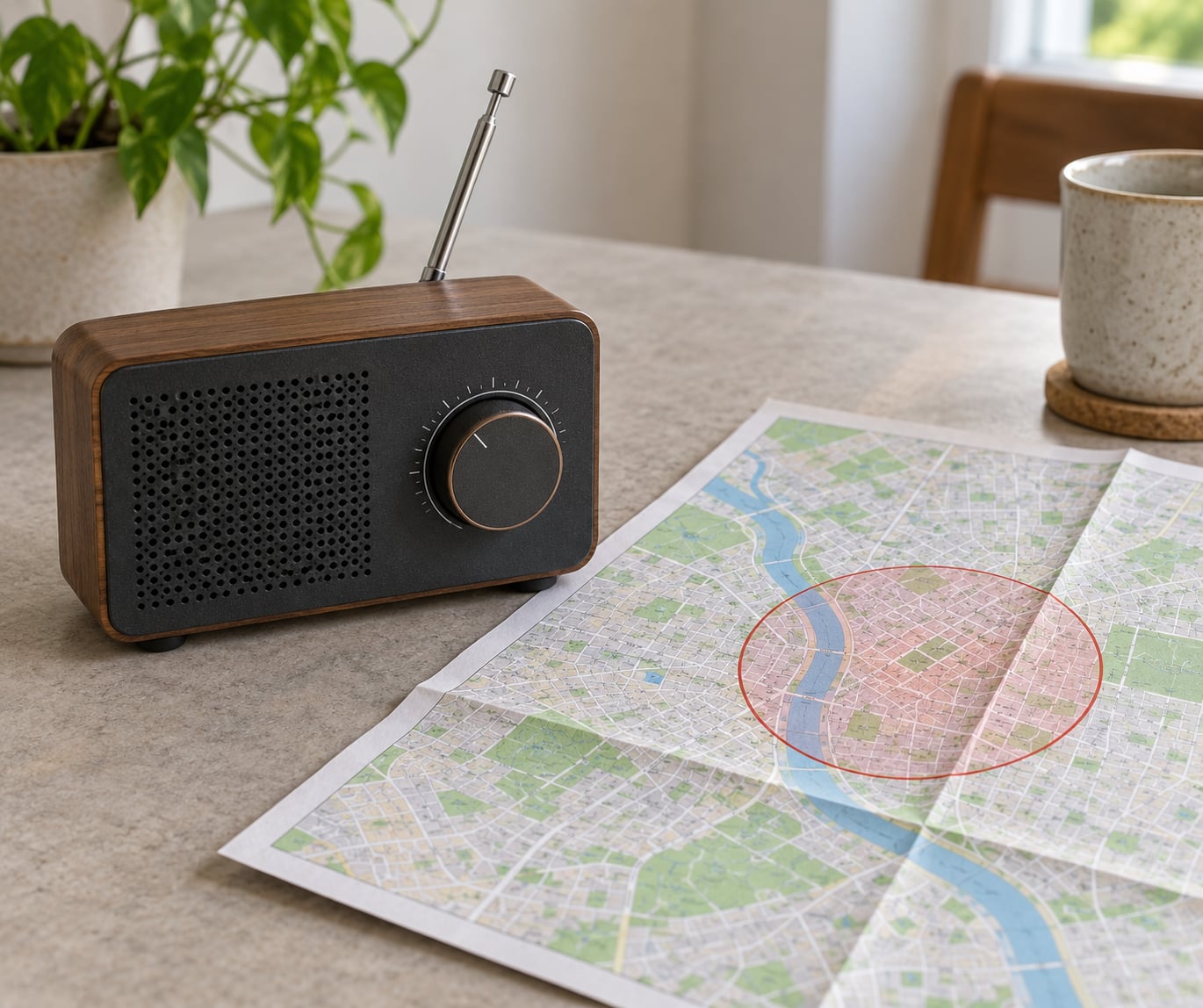
Because of power, antenna height, terrain, buildings and status, in roughly that order. A 100-watt station on a hill reaches much further than the same station on a low-rise roof, and a downtown canyon full of concrete eats the signal that a flat neighbourhood would receive.
The comparison below is the one to keep in mind. Reception varies with where you are standing, and every technical limit comes from the FCC licence the station holds.
| Radio type | Typical power | Expected range | Commercials? |
|---|---|---|---|
| LPFM | Up to 100 watts ERP | Roughly 3 to 5 miles in typical conditions | No |
| Conventional community or public radio FM | Tens of thousands of watts | Regional, often across a state | No, underwriting only |
| Commercial FM | Tens of thousands of watts | Regional to multi-state | Yes |
| FM translator or booster | A few hundred watts | Fills a specific gap in a full-power station’s coverage | Mirrors its parent station |
| Part 15 unlicensed | A few watts | A building or a street, legally | Depends on the broadcaster |
| Online-only radio | Not applicable | Anywhere with a connection | Often yes |
What Can You Listen to on LPFM Radio?
Anything a licence holder can afford to produce, which in practice means a lot of local voices. College and campus stations run student radio, campus news and niche genres that commercial stations ignore. Faith communities run teaching, worship music and local announcements. Non-profits cover farmworker issues, environmental campaigns, health outreach and multilingual programming for a specific immigrant community.
You will also find emergency information, road and traffic advisories, small local music showcases, and reading services for people who cannot read print material easily. The Hurricane Katrina experience pushed a lot of local organisations toward LPFM precisely because a small transmitter with a generator can stay on air when mains power and cell networks are down.
Treat the format as a fact about the station rather than about the licence. Plenty of LPFM stations carry syndicated music, and plenty of them run nothing but talk.
How Do You Find and Listen to LPFM Stations?
Finding one takes five minutes. Start low on the dial, around 88.1, and work up slowly with a car radio, because LPFM signals sit between stronger full-power stations and a quick scan often steps over them.
- Scan slowly from 88.1 MHz upward. Take a name or a distinctive piece of music rather than a tone.
- Look for the “-LP” suffix. A call sign ending in LP is a licensed LPFM station, which tells you its broadcaster holds a licence rather than a cheap unlicensed box.
- Note the frequency and the time. Community stations often run irregular or volunteer-run schedules, so a dead frequency at 3pm may be alive at 7pm.
- Check an online station directory. The FCC maintains a public database of authorised stations with their technical parameters, which is more reliable than a listener-submitted list.
- Ask locally. A public radio station, library or community media organisation in your area usually knows who holds a nearby licence.
What to do if a station fades as you drive
Note the direction of travel. If reception drops going away from the transmitter but recovers on the return trip, you are simply leaving the service area. If the station is steady at 60 km/h and only weakens in a particular street, that street is full of obstructions or a competing signal is nearby.
Is LPFM the Same as AM, FM, or Internet Radio?
No to all three comparisons, and the distinctions matter. LPFM is FM broadcast technology operating at a very low authorised power. AM is a separate modulation system on a separate band, generally covering much further with poorer fidelity. Internet radio is delivered through a data connection and has nothing to do with a transmitter.
The closer comparisons are with an FM translator and with Part 15 broadcasting. A translator repeats a full-power station’s signal into a gap; it is commercial or non-commercial depending on its parent. A Part 15 transmitter is unlicensed, legal only at extremely low power and range, and widely used by individuals who cannot hold an LPFM licence.
LPFM’s neighbours in the rulebook are LPAM, the low-power AM counterpart, and LPTV, low-power television. If a station you want to hear is called LPFM, it is on the FM band, under 100 watts, and licence-holder controlled.
Why Does an LPFM Station Sound Clear but Disappear Quickly?
Because the audio quality is FM, and the range is set by a 100-watt transmitter on a modest mast. FM gives clean reception right up to the edge of interference, then falls away faster than AM would, so the station sounds excellent in the street near the transmitter and simply is not there two miles further on.
Three things make it worse. Line of sight matters: hills, warehouse roofs and bridges cut the signal. A strong full-power station on an adjacent channel can swamp an LPFM signal, because LPFM stations are secondary and cannot complain. And a car moving under overpasses or into underground car parks loses the signal for seconds at a time.
What you can do is simple: open the car window or roof aerial, park in a clear spot with a view toward the transmitter hill, and try again. If the station streams online, that stream keeps working when the terrestrial signal does not.
How Is an LPFM Station Licensed in the United States?
Through the FCC, on a non-commercial educational licence granted to an eligible organisation for a specific frequency, transmitter site and technical specification. The applicant applies during a licensing window, publishes a public notice in a newspaper, and if no other applicant claims the same channel the application moves forward to a construction permit, which must be built to the authorised plan and then certified on air.
Eligibility is the part that surprises people. Individuals cannot hold an LPFM licence. Schools, universities, churches, non-profits, tribal nations, local governments and transport or public-safety agencies can. Once broadcasting, the station operates under public-interest obligations with no paid advertising; a business that supports the station may be acknowledged in a short underwriting credit, which is a statement of support rather than a pitch.
The FCC rules that govern the service live at 47 CFR 73.811, and the framework came from the Radio Broadcasting Preservation Act of 2000, later amended by the Local Community Radio Act of 2010, which raised the ceiling from 10 watts to 100.
Outside the US the term means something different. UK broadcasters would be looking at an Ofcom restricted service licence or small-scale local radio, Canada has its own low-power classes, and New Zealand licenses community and iwi stations under its own regime. None of them is the FCC licence described above.
Frequently Asked Questions
Is LPFM the same as regular FM radio?
Same technology, smaller permission. An LPFM station transmits FM audio on the same 88.1 to 107.9 MHz band, but the FCC caps it at 100 watts effective radiated power and a 30 metre antenna, and it is licensed as non-commercial educational. A commercial station runs at tens of thousands of watts and counts as a primary occupant of the band.
Why can I hear an LPFM station only near the station?
Because that is what the licence is for. Low power mainly limits how far a signal is meant to travel, so practical range is usually around 3 to 5 miles depending on antenna height, terrain and buildings. LPFM stations also have secondary status, meaning a strong full-power station can interfere without breaking any rules.
Can LPFM stations be listened to online?
Often, yes. Plenty of low-power stations simulcast their stream on the internet so distant listeners can follow along. Streaming does not change what the station is, though. The FCC licence covers the transmitter, and an online stream is a separate service. Some neighbourhood stations are radio-only and never go online at all.
Does LPFM mean the station has poor sound quality?
Not at all. FM itself is a clean format, and a strong signal from an LPFM station inside its service area sounds clear. What low power limits is coverage and to some extent how the signal competes with larger stations, not the audio itself. In the range the station is meant to cover, reception is normally as good as you would expect from FM.
How can I find LPFM stations in my area?
Slow-scan the FM dial from 88.1 MHz upward and look for a call sign ending in LP. The FCC public station database lists authorised facilities with their technical parameters, which is the most reliable source. A local public radio station, library or community media organisation can also point you to licences in your area.
Is LPFM used only for music?
No. LPFM is a service category, not a genre, so the FCC does not dictate the format. Campus stations run news and student programming, churches run worship and teaching, non-profits run public affairs and multilingual outreach, and some carry emergency or road advisory information. Music is common, but it is only one of many formats on air.
The Takeaway for New Listeners
Slow-scan from 88.1 MHz, listen for a call sign with -LP on the end, and expect excellent audio for a few miles rather than regional coverage. If you want to find out more about radio in general, the practical part is always the same: know your band, know your local stations, and know when you are hearing a stream rather than a transmitter.