College radio stations play mostly non-chart music chosen by student DJs: indie rock and alternative at the core, alongside hip hop, jazz, punk, metal, electronic, world, folk, blues and experimental tracks. Most stations add student interview shows, specialty genre blocks, campus news and live local bands, and nearly all of them stream online for free.
That mix is not an accident, and it is not identical at every school. A station in the Northeast might lean post-punk and hardcore, one in the South might give heavy rotation to rap, and a jazz conservatory station might barely touch guitar music at all. What ties them together is who makes the decision: students, working to a schedule shaped by a music director, with almost no commercial pressure.
This guide is updated for October 2026. Stations close, rebrand and move their streams, so treat the details here as a starting point rather than a permanent record.
Table of Contents
- What College Radio Stations Play at a Glance
- How College Radio Programming Is Different
- Common Music Genres on College Radio
- Why Stations Feature New and Independent Music
- Student-Made Shows and Specialty Programming
- Campus News, Sports, and Community Coverage
- How the Schedule Changes Throughout the Day
- How to Find and Listen to College Radio Online
- Frequently Asked Questions
- Conclusion
What College Radio Stations Play at a Glance
Most stations run four kinds of programming, and each one sounds different. Knowing which kind is on air tells you what you are about to hear before you tune in.
| Type of programming | What you hear | Who picks the music | When it runs |
|---|---|---|---|
| Freeform DJ show | Anything the DJ decides, usually a loose mix of rock, hip hop and older records | One student DJ, live or pre-recorded | Two or three hour shifts, morning and evening |
| Specialty block show | A single genre for the full slot: jazz, metal, classical, world, hip hop or punk | A student who runs that genre show every week | Usually a fixed weekly slot |
| New music and local rotation | Fresh releases, campus bands, regional artists and first spins of new records | Music director, with requests from listeners | Daytime, plus dedicated local hours |
| Campus and community coverage | Announcements, interviews, event listings, sports and campus news | Student producers and volunteer staff | Scheduled news blocks through the day |
One more category sits alongside these: public radio. NPR-affiliate stations carry national news programming and much less music. They share the non-commercial label with college radio but not the format, which is why listeners get confused about them.
How College Radio Programming Is Different
The defining feature of a student-run station is that the person on air chose the playlist. On commercial radio a programmer in another city decides what reaches the market; on a college station, a junior deciding what they want to play at 11pm decides.
Who actually runs a student station
Most stations are licensed to a university or a non-profit educational organisation, usually through a low-power FM licence with very little power, which is why the signal stays local. A volunteer or student management team runs the schedule, and a music director sits on the rotation decisions.
There is usually a training process too. New DJs shadow an experienced host, learn the board, get licensed, and then take a weekly slot. That training is the reason the same station can be excellent on Wednesday and loose on Saturday.
How a music director shapes the playlist
A music director receives far more new music than the station can play, from label submissions, publicists and artists mailing physical copies. They pick the records that enter rotation, which means a record is likely to appear on several different DJ shows in the same week rather than once.
Listeners sometimes assume a DJ can play anything. In practice, when a track enters heavy rotation it tends to be played regularly for a set period, and individual hosts still have room to go outside it.
How college radio differs from public radio
Public stations such as NPR affiliates focus on news, talk and public affairs programming, with music that supports a show rather than driving it. A few carry long-form music shows, but the mix and the schedule work differently from a student station.
College radio has almost no advertising. Stations carry underwriting acknowledgements or sponsorship reads at most, which removes the incentive to play what sells and leaves room for records nobody would test commercially.
Common Music Genres on College Radio
There is no fixed playlist, and no genre is universal on every station. Still, the categories below cover most of what college radio stations play, and you will hear most of them within a couple of hours of tuning in somewhere.
Rock, alternative and punk
- Indie rock and alternative: the most common core genre, from established bands to bedroom projects
- Punk, hardcore and post-punk: a strong tradition, especially at schools with active DIY scenes
- Shoegaze, dream pop and noise: regular specialty-show territory, often at stations with a noise-leaning music director
- Classic rock and oldies: common on request shows and morning shifts where a DJ has free rein
Hip hop, R&B and dance
- Hip hop: from new independent releases to classic records; several stations run a dedicated rap block
- R&B, soul and neo-soul: frequent alongside hip hop shows and on request programming
- Electronic: club music, ambient, experimental electronic and beat-driven selections
- Afrobeat, dancehall and reggae: common specialty slots, sometimes with Caribbean programming
Jazz, blues and roots music
- Jazz: standards, spiritual jazz, bebop and modern jazz, usually a long-running weekly show
- Blues: from regional players to the wider catalogue
- Folk, acoustic and singer-songwriter: a natural fit for request shows and open mic segments
- Gospel: common at historically Black colleges and universities
Metal and hardcore
- Heavy metal: a staple specialty show on many stations
- Hardcore and punk: often paired with the metal block or run separately
- Extreme and technical styles: death, black and progressive metal show up on the more specialised stations
World and classical
- World music: regional scenes, African, Latin, Asian and folk traditions, usually a weekend or Sunday block
- Classical: a daytime staple on many stations, sometimes syndicated from a public network
- Opera and spoken word: narrower, but present on classical-focused stations
Experimental, underground and local scenes
- Experimental and noise music: the least commercial corner of the schedule and one of the reasons listeners stay
- Local and campus bands: students and regional artists getting their first regular airplay
- Sound collage and library music: a specialty-show niche with a small but loyal audience
The last group is what separates student radio from everything else. Nothing about a noise record or a campus punk band makes sense for a commercial station, and that is the whole appeal.
Why Stations Feature New and Independent Music
Students are the biggest group of music fans who are still willing to try something with no name and no data behind it. Stations are built around that behaviour, and the effect on artists has been considerable.
Artists and labels treat college radio as a first real test. A record that gets consistent spins on a dozen campus stations tends to get picked up by press, playlist curators and other programmers, sometimes months before the mainstream notices anything. Stations also log what actually gets played, which is how a new release earns a heavier slot and a second one behind it.
The band-breakage history is real enough that people notice it. Artists such as R.E.M., Nirvana and Death Cab built an audience on college stations well before the wider public picked them up, and British bands often picked up extra American airplay the same way. Listeners check college radio for the same reason labels send music there: to hear what is rising while it is still rising.
Local discovery is the other half. Stations regularly air bands that play on or near campus, sometimes recording a short session or interviewing the members. Those recordings never chart, but they are often the reason a local group keeps playing after graduation.
Student-Made Shows and Specialty Programming
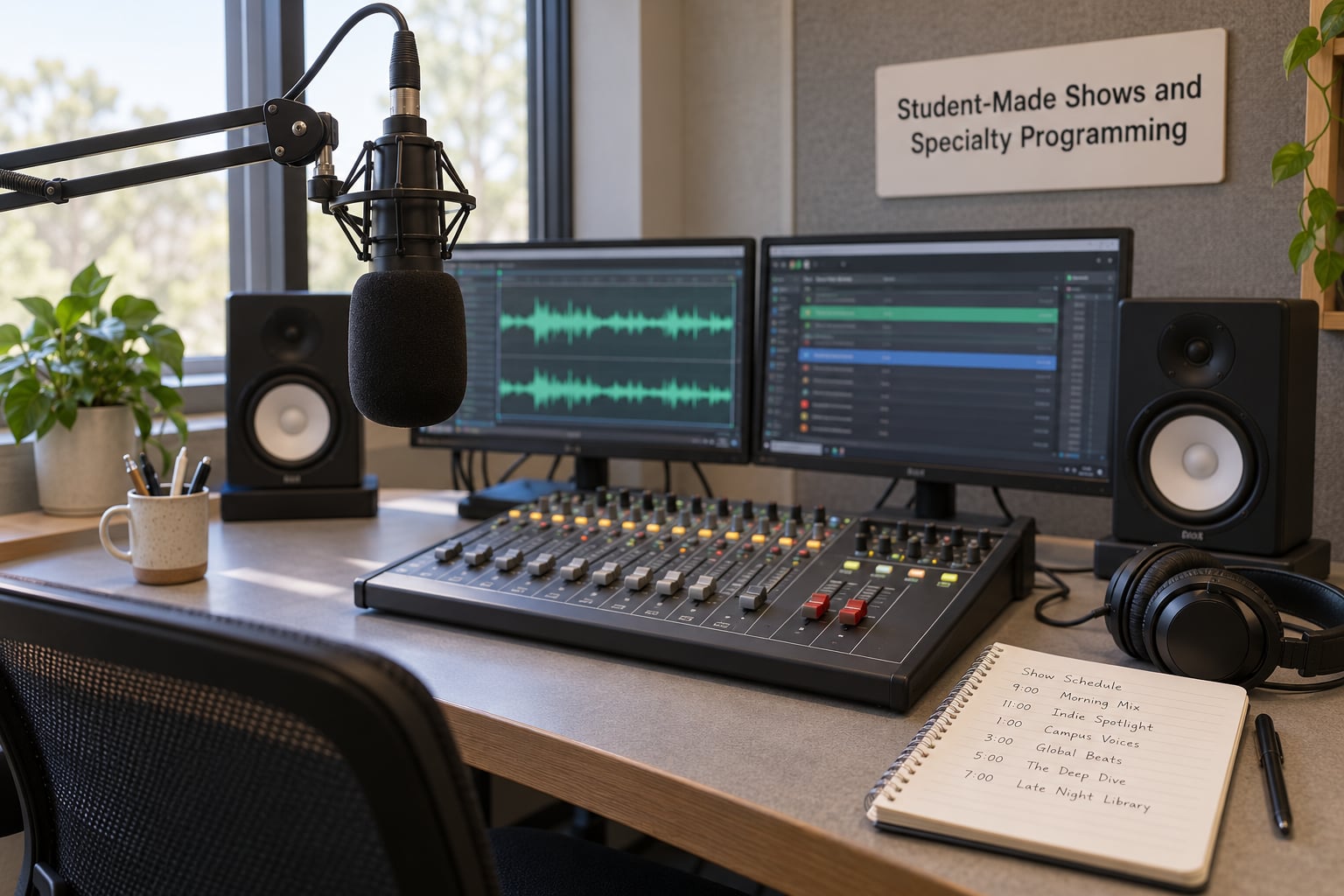
Music is only part of what you hear. The shows built around it are what people remember, and regulars tend to follow a DJ or a program rather than a station.
- Interview shows: a host talks to a band, often a local one, and usually records it as a podcast as well
- Artist sessions and in-studio performances: live sets, sometimes video as well as audio
- Mix series: a themed hour built around one idea, such as desert blues or Japanese city pop
- Chart shows: the most played records at that station, counted from the logs, which makes them more useful than commercial charts
- Genre blocks: a fixed weekly slot handed to whoever wants to run that style of music
- Talk and campus discussion: the show that fills the hours when music stops
A specialty show is the usual way a listener finds a genre they did not know they liked. The genre has to be claimed by someone, and the person who claims it keeps the slot for years, sometimes moving out of the general DJ pool into running their own program.
Campus News, Sports, and Community Coverage
Alongside music, most stations carry a fair amount of campus information: event announcements, interviews with staff and students, results from campus sports, and coverage of clubs and student organisations. Some stations also take on local community programming or work with a nearby public radio affiliate.
How much of that happens varies a lot. A station with a dedicated news team and a journalism course nearby may run structured newscasts several times a day. A smaller club station may air a morning announcements slot between DJ shows and nothing else.
There is also a licensing and editorial reason for the difference. Student stations have to meet non-commercial educational obligations, so some hours are treated as community service, which is why a station can hold a public affairs commitment even though its headline identity is music.
How the Schedule Changes Throughout the Day
Tuning in at a random hour on a random campus gives you a very different station from tuning in at a different hour. The daily shape is usually consistent enough to describe.
Early morning
Softer freeform sets and request shows. These are frequently the least produced hours, and listeners who want a calm background while working tend to find them here.
Midday and afternoon
New music, campus information and interviews. The station’s news team is usually active and local bands get airtime, so this is the block that feels most like a service to the school.
Late afternoon and evening
The peak of the DJ day. Longer freeform shows from more experienced hosts, usually with the widest range of genres in a single hour.
Late night and overnight
The most experimental slot on many stations: ambient, noise, dub, slowcore or long-form records. The audience is smaller but more committed, and the show usually prerecorded rather than live.
How to Find and Listen to College Radio Online
Almost every station streams, and most streams are free. The tricky part is finding a station that plays something you actually want to hear.
- Start with the school’s own website. The athletics or student affairs pages usually link the station, and the station site carries the live schedule.
- Use a directory to search by school or city. Radio Garden and campus.fm aggregate thousands of streams and let you browse by location. General radio apps such as TuneIn and myTuner Radio also carry a large selection, with format labels attached.
- Check the format before you commit. Directory pages list the genre tags the station uses, which is the fastest way to find a jazz, hip hop or metal show without sampling ten streams.
- Listen through whatever device you have. Most stations publish a direct stream link that works in any browser, and many have set up skills for smart speakers or are listed in car infotainment apps.
- Look for the archives. Stations often keep recorded shows and interview episodes on demand, which is often better than catching a live broadcast.
If a stream is silent or keeps dropping
This is the most common complaint in online college radio communities, and it usually has an ordinary explanation. Stations often broadcast from campus over a wired connection, so an outage or a quiet night on campus means no audio even though the page still loads.
Before assuming a station is gone, try a different browser, a different network, or a general radio app that hosts the stream rather than the station’s own player. Streams also move when a station rebrands or renews a streaming licence, so searching the current call sign will usually turn up the new location.
Frequently Asked Questions
What are college radio stations?
A college radio station is a low-power FM or online station licensed to a college, university or educational non-profit and operated mainly by student volunteers. The students host the shows and personally select the music, so the playlist reflects individual taste rather than a commercial programmer’s research. Some stations stream only online, and many carry little or no advertising.
Do colleges still have radio stations?
Yes. Hundreds of colleges and universities in the US still hold non-commercial educational licences and broadcast on FM, and the number has grown as streaming has made small stations affordable to run. Most are student-run with volunteer DJs, and a growing share are online-only. Some schools have consolidated or rebranded their stations, which is why older lists of stations go out of date quickly.
Does anyone listen to college radio?
Yes, though the audience is mostly local and mostly students, which is why the streams stay quiet in listener counts. Station hosts say regular listeners build habits around a show and a personality rather than the station itself. The wider influence is bigger than the raw audience: college DJs have historically broken bands such as Nirvana and R.E.M. before the mainstream picked them up.
What radio stations play indie rock?
Most college radio stations play indie rock somewhere in the week, though only a few make it the sole focus. Stations known for indie and alternative include WREK at Georgia Tech, WFUV at Fordham, WERS at Emerson and WPRB at Princeton, among others. Genre labels on directories like Radio Garden and myTuner Radio are the quickest way to filter for an indie-leaning stream.
What is the best app for listening to college radio?
There is no single winner, because college streams are spread across many platforms. General radio apps such as TuneIn and myTuner Radio host the largest number of stations, Radio Garden is better for browsing worldwide by location, and campus.fm focuses on student stations. Most stations also publish a direct stream link that plays in any browser or smart speaker without an app at all.
Is college radio the same as public radio?
No. Both are non-commercial, but public stations are NPR affiliates focused on news, talk and public affairs programming, with music in a supporting role. Student-run college stations are built around music first, with short news and campus announcement blocks. A few stations do both, which is the main reason the two get confused.
Conclusion
College radio stations play a deliberately broad mix of non-chart music: indie rock and alternative at the centre, with hip hop, jazz, punk, metal, electronic, world, folk, blues and experimental music around it, plus student interviews, local bands and campus information. The thread running through all of it is that students choose what goes on air.
Start with one step today: find your nearest campus station, check its live schedule, and set an alarm for its flagship music block and its late-night slot. Those two hours tell you more about what college radio stations play than any list ever will.