The easiest way to get into jazz through radio is to find one station that plays jazz all day and simply let it play, keeping a short note of anything you liked. Radio removes the three things that stop most beginners: the size of the catalogue, the cost of finding out, and the pressure to know what you are listening to. You can build a jazz habit in a week without buying a single record.
There is one trap worth naming before you start. Search for a jazz radio station and a lot of what comes back is smooth jazz or lounge, which is fine music but sends new listeners back out again. Real jazz radio is stranger, louder and far more varied. Knowing how to steer around that is most of the skill.
Table of Contents
What You Need Before You Start
You need very little: a radio service, a way to save what you like, and somewhere to write things down. That is the whole list.
- A source of radio. Local FM or DAB if your area carries a jazz station, or an internet stream if it does not. BBC Radio 2 carries a nightly jazz programme in the UK, Jazz FM broadcasts on Sky, Freesat and DAB, and in North America the likes of Jazz24 in Seattle and KJZZ in Phoenix run jazz around the clock.
- A way to save stations or programmes. Most streaming apps and smart speakers let you favourite a station, and that saves you the job of hunting for it again next week.
- Headphones or proper speakers. A lot of what makes jazz click is the recording quality, and laptop speakers flatten exactly the detail you are trying to hear.
- Something to write in. A paper notebook or a notes app. Five fields per track is enough: station, track, artist, style, your reaction.
None of that costs money, and none of it needs an account. Free and no-sign-up is the baseline you should expect from a jazz stream.
Step-by-Step: How to Get Into Jazz Through Radio
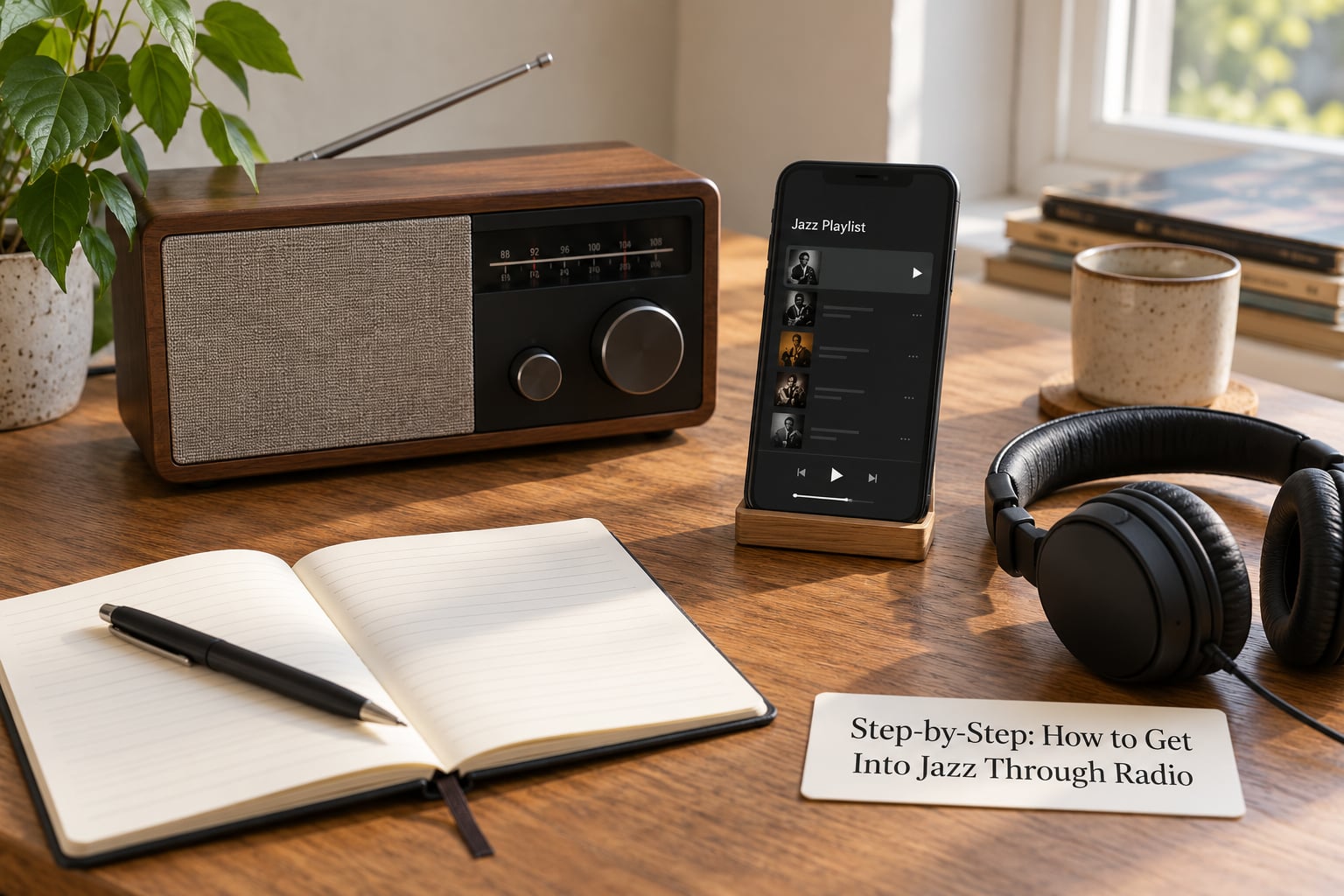
Step 1: Start with a radio station built for discovery
Start with a station that has a person behind it, not a generic algorithm. A named host who introduces tracks, gives context and explains why a song matters is worth more than a bigger library of unlabelled audio, because the context is what a beginner is actually missing.
Look for three things when you audition a station: a schedule you can read, a mix of eras rather than one style on repeat, and hosts you recognise after a couple of listens. Station line-ups change constantly, so treat anything here as accurate at the time of writing and confirm against the station’s own schedule page before you commit.
In the first two broadcasts, do less than you think. Notice the length of the tracks, whether anyone is singing, how many musicians are playing at once, and whether the rhythm feels pushed or straight. Those four observations tell you more about jazz than any amount of reading beforehand.
Step 2: Learn the main jazz styles by ear
Jazz is a family of sounds, not one sound, and you can learn the family faster than most people expect. Here is the short version, written to be heard rather than studied.
- Swing and big band. Brisk, polished, built around written arrangements for a dozen or more players. This is the sound most people picture when they hear the word jazz. Look for Duke Ellington, Glenn Miller, Count Basie.
- Dixieland and New Orleans jazz. Louder and looser, built on collective improvisation over a walking bass. Louis Armstrong sits at the centre of this world.
- Bebop. Fast, harmonically dense, built on intricate head-solos-head forms. Charlie Parker and Thelonious Monk made this the jazz that musicians study.
- Cool jazz. Calm, restrained, arranged with space in it. Dave Brubeck and Chet Baker belong here, and it is a very good first landing spot for beginners.
- Fusion. Rock and electric instruments grafted onto jazz structures, which is how a lot of listeners arrive and work backwards. Miles Davis and Herbie Hancock head this up.
- Smooth jazz. Radio-friendly production, groove-driven, mostly instrumental. Popular in the 1980s and still widely broadcast, though it sits at the edge of jazz rather than its centre.
- Spiritual and spiritual-jazz. Modal, exploratory, often building in long arcs instead of short songs. John Coltrane’s later work is the reference point.
- Vocal jazz and contemporary jazz. Singers first, with the band behind them — Ella Fitzgerald, Frank Sinatra, Norah Jones. Contemporary jazz means the current scene, and there is more happening in it right now than most stations let on.
The advice from long-time listeners on jazz forums is consistent: pick the corner of the family that comes closest to music you already like, and work outward. Somebody who arrived through fusion told it as a valid way in, and a hip-hop listener came through Frank Sinatra’s crooning. Both routes work.
Step 3: Track what you hear
Radio is random, which is exactly the problem. A note turns randomness into a method.
Write five things per track you liked: the station, the track, the artist, the style as you now understand it, and one honest reaction. “Too fast” is a valid reaction, as is “did not like the trumpet but liked the piano.” After ten broadcasts you will have a page that shows your own taste rather than a critic’s.
That page is also what makes the next step possible.
Step 4: Follow artists, shows and related stations
Follow the station into the platform. Once a broadcast gives you a name, search that artist on your streaming service and see what else they recorded, because one track is a sampling error and an artist’s catalogue is a reliable guide.
Most stations link the show or host somewhere, and following the host is the single best move for discovery. Forum listeners consistently ask for named humans rather than anonymous algorithms, and community and listener-supported stations are valued precisely because their hosts take risks with the running order.
Keep a shortlist of related stations too, so the night a show ends you are one tap from something else rather than back to a search box.
Step 5: Make jazz radio a repeatable habit
Two focused broadcasts a week is enough to start. Pick slots that already exist in your day — a commute, a cooking session, a wind-down evening — and jazz fills them better than repeat playback does.
Add one live programme a month if the station runs one, because a hosted show gives you the history you would otherwise never pick up while listening.
Be honest about the limits. A lot of stations lean heavily on smooth jazz, and algorithmic streams can recycle the same ten tracks for weeks, which is the exact failure new listeners complain about. The fix is variety on your side: alternate a big band hour with a contemporary hour, and revisit a named host rather than a station you never learn.
Common mistakes when learning how to get into jazz through radio
Mistaking difficulty for unlistenable. Bebop solos at full speed sound improvised because they are, and nobody plays them cleanly on the first try. That is the style working, not a bad recording. Start with cool jazz or vocal jazz and come back to bebop later.
Treating every unfamiliar track as a failure. Ten tracks in a row that make no sense to you is a normal first session. Keep the notes anyway; the ones you thought were failures are often the ones you replay a month later.
Choosing stations with no show information. If you cannot find a schedule or a host name, you have picked a stream rather than a station. Swap it.
Researching instead of listening. Reading guides about jazz while never putting it on is the most common way a beginner stalls. Set a rule: one broadcast first, then look anything up afterwards.
Frequently Asked Questions
What is a good jazz station on the radio?
In the UK, Jazz FM (Sky, Freesat and DAB) is the most straightforward full-time jazz station, and BBC Radio 2 carries a nightly jazz programme alongside its wider playlist. In North America, Jazz24 in Seattle and KJZZ in Phoenix run jazz around the clock. Whichever you pick, check the station’s own schedule first, since line-ups shift with the season.
What is the best jazz radio station to listen to online?
Online-only streams give you the widest choice and the most sub-genre variety. jazzradio.com runs themed channels, Swing Street Radio sticks to big band and swing, and directory sites list dozens more including acid, fusion and contemporary channels. Start with one themed channel rather than the general jazz stream, because the narrower mix teaches you faster.
What is the best app for listening to jazz music radio?
Any app that plays a raw station stream works, so the choice comes down to how you listen. A smart speaker app is best for hands-free listening while cooking or working. A phone app suits the commute and lets you save stations. A car system handles driving. Platform music apps are useful afterwards for following artists, but their jazz channels are algorithm-driven and narrower than real station streams.
Why does smooth jazz sound nothing like the jazz I keep hearing recommended?
Smooth jazz is a 1980s and 1990s branch of jazz with polished production and a strong groove, and a lot of radio runs on it because it suits broad audiences. The jazz most people mean when they say the greats sounds earlier and rawer: big band swing, bebop, cool jazz. Both are jazz, but only one of them is where new listeners usually end up if they search for a station.
How long does it take to understand jazz?
Expect a few weeks before you start recognising styles and a few months before you know what you like. Nobody understands improvisation on day one, and hearing the difference between a swing feel and a straight one comes quickly while the harmonic details arrive slowly. The habit matters more than the timeline; a couple of broadcasts a week keeps the learning going without becoming homework.
Does Gen Z listen to jazz?
Fewer young listeners tune in on purpose than previous generations, but contemporary jazz is doing plenty to change that. Artists working between jazz, hip-hop and electronic production now chart well, and younger listeners frequently arrive through that crossover rather than through a jazz station. Radio still plays the historic canon; the fastest route in for a new listener today is usually streaming, with radio as the sampler that fills the gaps.
Conclusion
Do one thing tonight. Pick a single jazz station with a named host and a readable schedule, put it on for a full broadcast without changing anything, and write down five tracks with your reaction to each. Two broadcasts a week, a page of notes and a saved host will get you further than any guide, including this one.
Updated for October 2026. Station line-ups change, so check each station’s own schedule before you settle in.