Pirate radio stations ran on unlicensed transmitters, usually sitting at sea beyond the coast or on a rooftop above a city, and they played the pop music the BBC would not. Teams of a dozen or fewer built the studio themselves, sold the airtime to sponsors, and went silent the moment officials arrived. Between the late 1950s and the early 1990s that was the whole operating model, and the story explains how a small crew could cover a whole country.
This is a history of how pirate radio stations operated, not a guide to starting one. Transmitting without a licence is an offence in most countries, and nothing here is advice on how to do it.
Pirate radio is any station that broadcasts without a valid licence. That covers unlicensed FM, AM and shortwave, on land or from ships anchored in international waters. It also applies when a licensed operator breaks the rules, for example by failing to identify the station or exceeding a power limit.
Table of Contents
- What Were Pirate Radio Stations?
- How Pirate Radio Stations Operated
- What Equipment Did Pirate Radio Stations Use?
- How Did Stations Produce and Schedule Their Programming?
- How Did Pirate Stations Reach Listeners?
- Why Did People Start Pirate Radio Stations?
- What Legal Risks Did Pirate Radio Stations Face?
- How Did Pirate Radio Build a Community?
- How Pirate Radio Stations Operated Over Time
- Frequently Asked Questions
- Conclusion
What Were Pirate Radio Stations?
The label comes from broadcasting itself. Anyone transmitting on allocated frequencies without permission is a pirate, whether they are running a national pop network from a hired ship or relaying a parish newsletter from a bedroom in Cork.
Three things usually made a station unlicensed: no transmit licence at all, no station identification, or more power than the licence allowed. The last two catch people by surprise, because the transmitter itself can be perfectly legal. An amateur radio operator pushing beyond the limits of their call sign is committing exactly the same offence as an offshore pop station.
There is also a jurisdictional quirk that sat at the heart of British pirate radio. Content can be legal where it is transmitted and illegal where it is received. A station on a ship outside the territorial limit was not, strictly, transmitting illegally from British soil, while the listener tuning in from a British living room was in a much greyer position than the broadcaster.
It is worth separating the words people use loosely. Free radio describes stations run without state control or commercial ownership, and it was a badge of pride rather than an insult. Bootleg radio usually means a rebroadcast of another broadcaster’s feed. Clandestine radio means a station hiding its transmitters and staff from a government, which is a different and more dangerous game. A border blaster is an American term for a high-power station just outside the United States, aimed at American listeners.
How Pirate Radio Stations Operated
Three operating models dominated, and they differ on almost every practical detail. Knowing which model a station used tells you where it sat, how it got power, who worked on it and what it was most afraid of.
| Model | Where it sat | Power source | Typical reach | Crew size | Biggest risk |
|---|---|---|---|---|---|
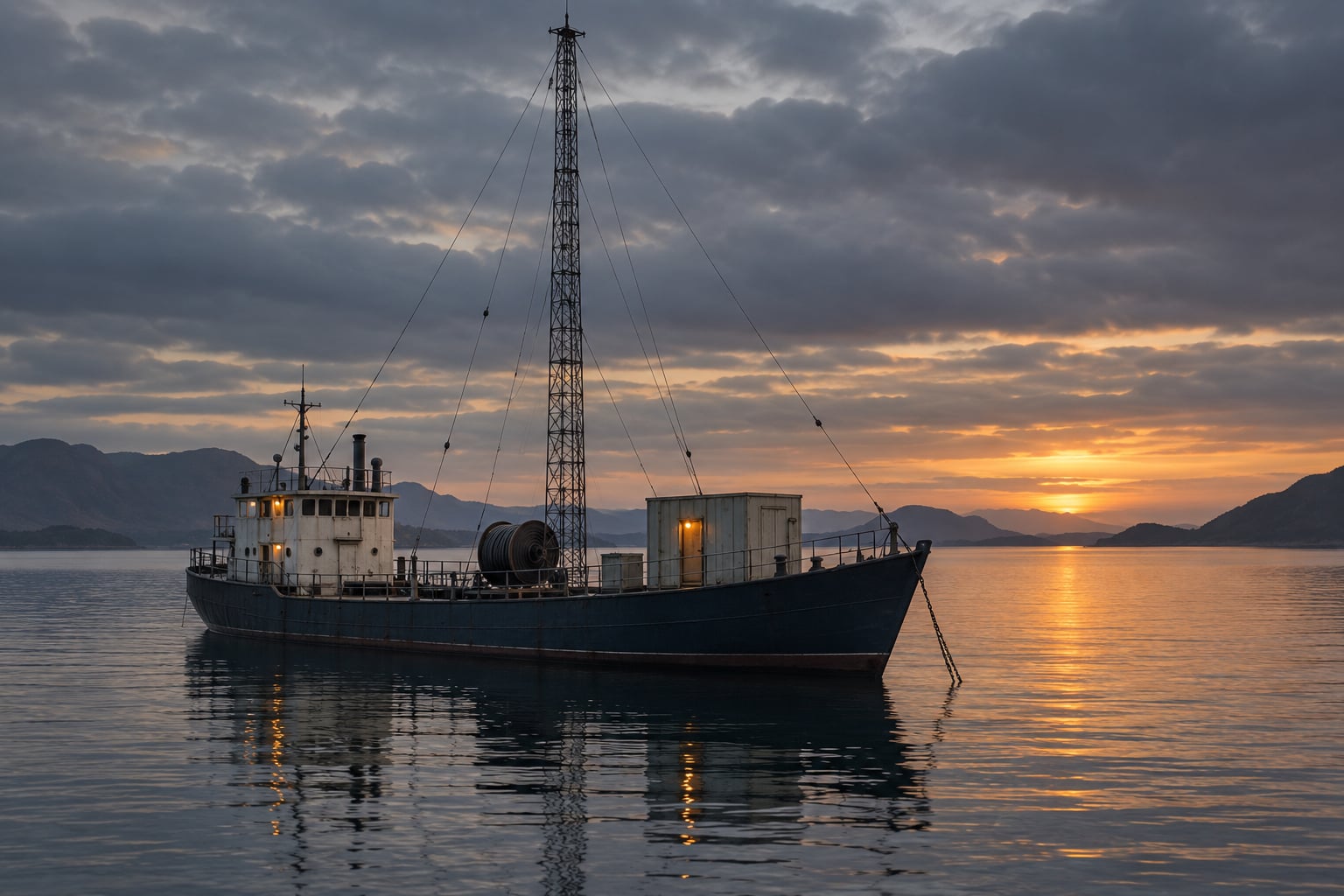
| Offshore ship | Hired ship anchored beyond the 12-mile limit | The ship’s own diesel generator | County-wide to most of a country, better at night | 15 to 25 including DJs and engineers | Supply being cut off and the ship being arrested without boarding |
| Fixed platform | Disused sea fort or offshore platform | Mains generator, sometimes with a battery | Similar to a ship, but a stable mast site | 12 to 20 | The platform itself being reclaimed or boarded |
| Land-based rooftop | Tower block, factory roof, church tower, hillside | Mains electricity, sometimes a UPS to keep the studio alive briefly | A few miles to a city-wide footprint on FM | 1 to 4 | Direction-finding to the door, and being identified by a caller |
| Shortwave | Anywhere, including a bedroom or a garage | Mains or generator | Continental or global, depending on the band | 1 to 3 | Logging, identification and being heard by listeners abroad |
Only the first three of those ever tried to be a mass-audience pop station. Shortwave pirates were a different scene, mostly in the United States, sitting just above and below the 40 m amateur band, and they treated the whole world as the audience.
The Main Parts of a Pirate Radio Operation
Take any of those stations apart and you find the same eight pieces, whether it sat in the English Channel or on a third-floor balcony in Pennsylvania.
The studio. A room with an audio mixing console, microphones, a cartridge machine, two turntables and a small record library. Larger stations added a second console for the news and jingle desk, a reel-to-reel tape machine for recorded links, and a small booth for the DJ to sit in.
The transmitter. Usually a repurposed piece of kit. Operators bought commercial FM transmitters, built kits from electronics magazines, and pressed surplus television amplifier stages into service. A low-power unit might manage a watt or two; a serious rooftop station could push forty.
The aerial. Height is reach, which is why tower blocks and hills were chosen. Common antennas were a ground-plane made from a few lengths of aluminium tube, a long wire, or a properly built yagi or quarter-wave mast.
The studio-to-transmitter link. If the studio and the aerial were not in the same place, audio had to travel there. Operators used radio links on the VHF and UHF bands, or a microwave link for short distances, often piggybacking on equipment meant for television.
Power. A ship at sea had to generate its own electricity and would only stop if the generator did. A rooftop station ran off the building’s supply and needed enough stored energy to keep the studio alive after the transmitter had already been killed, so the crew could record their own apology or play a jingle.
The schedule. Every station ran one. Presenters worked to printed rotas, and because a tiny crew covered twenty-four hours, the same handful of people kept the station on air around the clock whether or not they felt like it.
The programming. Records, occasional talk, news packages assembled from wire service copy, jingles, adverts read straight into the microphone by a volunteer.
Listener contact. Phone-ins, letters, and later recordings. This was the weak point on land-based stations: one caller who recognised a voice could bring the whole thing down.
That last part is why the offshore model lasted so much longer offshore. Everyone on the ship shared the same risk, and none of them could be identified by a voice on a telephone line in Croydon.
What Equipment Did Pirate Radio Stations Use?
The honest answer is that it varied wildly, and the version people romanticise was the exception rather than the rule.
Most operations started with a microphone, a mixer and a transmitter that somebody else had built. Kits were common, and operator memoirs are full of the specific failures that followed: a phase-locked loop that would not lock, so the frequency oscillator was driven by hand and the signal drifted slightly; an oscillator that warmed up for ten minutes before settling; a frequency that moved enough during a record to lose the audience at the edge of coverage.
Those accounts, published on ham radio forums decades later, are the best technical source that exists on this subject. One operator drove a one-watt mono FM kit, then amplified a discarded VHF television amplifier to produce roughly forty watts of clean output. He fed it from a ground-plane antenna built from four short masts on a third-floor balcony, and he and one friend broadcast from there on Friday nights. The most valuable thing in the account is not the power, it is that the entire station, masts included, came down and went into hiding after every weekend.
Antennas were the improvised part. Ground-planes were popular because they were cheap and easy to build from mast sections and alloy tubing. Longwires strung between buildings or across a field gave extraordinary results on AM and shortwave. Yagis were used where direction mattered and someone knew what they were doing.
Monitoring was a receiver and often a spectrum analyser, so a DJ could watch other stations appear where they were meant to be. A spectrum analyser is also exactly what a monitoring authority uses, which is the uncomfortable symmetry of the whole story.
How Did Stations Produce and Schedule Their Programming?
Programming was made by a small rota of volunteers on a tight budget, and the schedule was the thing they held together with.
Records were the core. A station that could get hold of an unreleased track had a reason to exist, because pirate play was often the only route a record took to air. Libraries were assembled from members’ collections and from records shipped in from shore, so keeping the request show moving depended on getting sleeves physically to the studio.
Talk was the second layer. DJs were personalities, because the audience followed people rather than call signs. Tommy Vance and Alan Freeman both worked offshore early, and Simon Dee fronted Radio London, known as the Big L. Presenters were chosen for voice and nerve, often recruited from record shops, student radio or the stage door of a club. Fictional identities were normal, partly for legal reasons and partly because a name was a brand the station could build.
Between records went jingles and recorded links: news read from wire service copy, traffic reports, a weather bulletin, adverts recorded by a voice-over artist. Some stations recorded entire shows to tape and played them back, which covered the small hours when no presenter was awake.
Request shows were the bridge to the audience. Listeners wrote in, telephoned, and sent greetings and dedications. On a rooftop station in the city, that intimacy was also the danger, because a listener who knew a presenter’s voice could name it on the telephone.
Scheduling around limited staff produced a recognisable rhythm: live drive shows in the evenings when the audience was listening, recorded or automated material overnight, and a weekend shift that everyone in the operation took turns on.
How Did Pirate Stations Reach Listeners?
Coverage was a function of height, power and the band, and those three explain most of what listeners experienced.
Medium wave offshore stations on 557 kHz and its neighbours behaved very differently after dark. The ground wave carried the signal out well, and the ionosphere returned a skywave at night that could be heard far beyond the intended footprint. In daylight the skywave vanished and coverage shrank sharply. Listeners who had grown up with the stations remember tuning across the dial at lunchtime and hearing almost nothing, then hearing it perfectly at nine at night.
FM land-based stations had no night magic. FM is line-of-sight, so the station’s reach was decided by the aerial height and how much concrete stood in the way. A tower block transmitter might cover a district; one on a hill behind the city could cover the whole of it.
Shortwave behaved like weather. Propagation changed with the time of day, the season and the sun. Operators followed the bands and moved frequencies, and listeners would be surprised by a station that had vanished or come back.
Promotion was done the hard way. There were no adverts. Word of mouth travelled through record shops and clubs, listings appeared in the small print of music magazines, and request shows built a postal list of listeners that the station answered with QSL cards and printed reception reports. A listener who reported hearing the station, gave a signal strength and a date was giving the station the proof it needed that it was a national station.
Later, stations added shortwave relays and eventually internet streaming, which removed the transmitter from the equation and with it most of the risk.
Why Did People Start Pirate Radio Stations?
The usual answer is music, and it is true but incomplete. Four motives sit behind almost every start-up.
There was nowhere to hear the music. The BBC played very little of the new pop, and record labels had no channel to it. A pirate station playing the new release was solving a genuine gap, and the listening figures were enormous.
Some communities had no station at all. Ethnic language programming, local talk, jazz, northern soul and, later, acid house all found audiences that the national networks ignored. Many land-based stations were set up by a group with a shared interest and a tower block that had a flat roof.
Some groups wanted to argue a political case. Anarchy and anti-corporate activism produced stations with an explicit political line, and in Ireland the pirate stations funded by regular audiences had a role in a much longer argument about broadcasting in Northern Ireland.
Some people just wanted to build a radio station. This is the least romantic motive and the one that survives today. Technicians who wanted to build transmitters, engineers who wanted a challenge and hobbyists who liked the music kept pirate stations running long after the pop boom had gone.
What Legal Risks Did Pirate Radio Stations Face?
Unlicensed broadcasting is an offence, and the legal route to closing a station was unusually deliberate.
Monitoring was continuous. The Post Office monitored the bands for the Department of Trade and Industry, and later Ofcom took over, recording transmissions and taking bearings from more than one site to triangulate the source. Direction-finding narrows a bearing until only one roof fits.
For offshore stations the authority faced a problem it could not solve by sailing alongside. British law allowed a ship’s crew to be arrested without the vessel itself being boarded, so officials could sit outside the territorial limit, prevent the crew from landing and starve the station of everything it needed from shore. Fuel, food, records, spare parts and mail all came by tender, and the tenders were the real target. The Marine Broadcasting and Works Act 1964 was written around that supply line.
Alongside legal pressure came jamming. A technical programme, run with government support, put a carrier on known frequencies and a distorted version of the station’s own audio over the top, so that a listener tuning to the station got noise instead.
Land-based stations were dealt with differently, and more directly. A direction-finding bearing was followed to a door, officials entered, equipment was seized and the operators were interviewed. Broadcasting under the Wireless Telegraphy Act 1906 was an offence, and in the Radio Luxembourg era some British listeners were prosecuted for the act of tuning in rather than for transmitting. Listening to a commercial longwave service in the 1930s became a criminal matter, which tells you how seriously interference with a licensed service was treated.
The Broadcasting Act 1990 raised the penalties sharply: unlicensed broadcasting could carry a fine and up to two years’ imprisonment. Ofcom estimated in 2007 that roughly 150 stations were still transmitting illegally in Britain. In the United States, unlicensed FM and shortwave enforcement produces five-figure fines, and the low-power FM licensing route exists precisely to give small stations a legal way to do what the pirates had been doing.
How Did Pirate Radio Build a Community?
A pirate station is a community with a frequency, and the people in it were more varied than the cartoons suggest: presenters, producers, engineers, the people who drove records across town, the local businesses that paid for the airtime and the listeners who wrote in every week.
The commercial model was local sponsorship. A garage, a taxi firm or a record shop bought a thirty-second spot read out live. That money was often what kept a rooftop station alive, and it made the station part of the neighbourhood rather than an anonymous broadcast.
Voluntary funding ran alongside it. Membership subscriptions, collections at gigs, and donations from listeners who wanted to support something the BBC had no interest in supporting. Some stations were formal enough to take membership seriously and publish a mailing list.
Offline, the community met at live events, at record fairs, and in the record shops that became unofficial headquarters. Online, shortwave listening groups and later internet forums kept the tradition documented, with members logging reception and trading QSL cards and recordings. That documentation is why we know so much about stations that officially never existed.
Shared identity mattered more than programming. The station had a name, a voice, a signature tune and a joke. Listeners recognised the sound of the transmitter warming up before the programme started, and that familiarity was the whole product.
How Pirate Radio Stations Operated Over Time
The models did not run in sequence one after the other, and assuming they did is the most common mistake in retellings. Offshore stations and land-based stations overlapped for two decades, and shortwave never stopped at all.
| Station | Platform or location | Years on air | Band | How it ended |
|---|---|---|---|---|
| Radio Mercur | Ship anchored off Denmark | 1958 to early 1960s | Medium wave | Closed after sustained legal pressure in Denmark and the Netherlands |
| Radio Veronica | Light vessel, then the MV Norderney, then REM Island | 1959 to 1976 | Medium wave | Left REM Island in 1971 and went off air in 1976 after legal action |
| Radio Caroline | The MV Caroline, a former Danish passenger ferry | 1964 to 1967 | Medium wave, 557 kHz | Shut down when the Act of 1964 cut off its supplies and it ran out of fuel and equipment |
| Radio Noordzee | Hired ship off the Belgian and Dutch coast | 1960s to 1969 | Medium wave | Closed after Dutch legal action |
| Radio Atlanta | Ship off the English coast | Mid 1960s | Medium wave | Short-lived; closed down |
| Radio Jackie | A house in Dollis Hill, north London | 1964 to 1967 | Medium wave | Enforcement traced the studio address. It was also registered for VAT and listed in phone books |
| Radio London, the Big L | Transmitter site on the marshes outside London | 1965 to 1967 | Medium wave | Closed down after jamming, staff prosecution and sustained legal pressure |
| Radio North Sea International | Ship, then REM Island, then a site in the Netherlands | 1970 to 1976 | Medium wave | Went off air in 1976 |
| Laser 558 | Roughs Tower sea fort off Kent | 1983 to 1984 | Medium wave, 558 kHz | Closed abruptly in 1984 after a police raid on the fort |
| Radio Solidarity | Polish city studios and offshore | 1980s | FM and medium wave | Shut down during the crackdown that followed martial law |
| Kool FM and Rinse | London rooftops and lofts | 1990s | FM | Both eventually took out community licences and became legal stations |
| Free Radio Santa Cruz | A tower block in Santa Cruz, California | On air since 1995 | Low-power FM | Still broadcasting, funded by donations and membership |
The broad shape of it runs from the late 1950s to the present. Radio Mercur broadcast from a ship off Denmark in 1958, six years before the story everybody knows. Radio Caroline began regular transmission from the MV Caroline on 28 March 1964, and a cluster of competitors followed it within months.
The offshore boom lasted about three and a half years. Supply legislation, jamming and a shift in listening habits thinned the field through 1966, and by 1967 the major offshore stations had gone quiet. That silence broke the BBC’s monopoly on popular music, which was the point the stations had been making, and the political settlement that followed built commercial radio.
Land-based operation filled the gap and changed the character of the thing. Smaller crews, smaller reach, less money, far more risk of a knock on the door, and programming that became progressively more local and more political through the 1970s and 1980s.
The 1990s brought London stations tied to rave and acid house, and again the pattern repeated: build something illegal, build an audience, take out a licence. Internet streaming then removed the transmitter entirely. Stations that had spent years hiding equipment could now publish a playlist on a Friday afternoon, which is a remarkable change in what the word means.
None of it ended with a clean break. Today the same three models are all in use somewhere: low-power FM from tower blocks funded by listeners, unlicensed shortwave with enthusiasts logging stations and requesting QSL cards, and a handful of stations broadcasting online in ways their own communities argue about.
Frequently Asked Questions
Are pirate radio stations illegal?
Yes. Broadcasting without a valid transmit licence is an offence in the UK, Ireland, the United States and most other countries, and failing to identify the station or exceeding a permitted power level counts too. Penalties under the Broadcasting Act 1990 include a fine and up to two years in prison, and US enforcement reaches five-figure fines. In some cases content is legal where it is sent and illegal where it is received.
What equipment is needed to operate a pirate radio station?
Historically the list was short: microphones, a small audio mixer, a transmitter built or bought second-hand, an antenna, cables and a power supply. Offshore stations added a mixing console, turntables, cartridge and tape machines, a telephone line and the ship’s generator. Land-based stations used much less. This article documents that history rather than recommending it, since transmitting without a licence is illegal.
How far can a pirate FM radio station broadcast?
FM is line-of-sight, so range comes from aerial height and clear path rather than power. A transmitter on a tower block covered its own district, while one on a hill behind a city could cover the whole city. Medium wave offshore stations behaved differently: their night-time skywave carried them far beyond the intended footprint, and their daytime coverage was much smaller.
How did pirate radio stations get money?
Four ways, mostly together. Local businesses sponsored short spots, sometimes called tags, read out live. Listeners paid subscriptions and sent donations, and some stations ran a formal membership. Some sold airtime through advertising that would not have passed a legal broadcaster, and others sold records. Radio Jackie is the odd case worth knowing: it was registered for VAT and its address appeared in local phone books.
Were pirate radio stations always operated by volunteers?
Mostly. Offshore crews were unpaid DJs, engineers and producers supported by sponsorship, and land-based stations were almost entirely volunteer-run from a room in someone’s flat. The exceptions were organised political stations with funding networks behind them, and stations that ran as semi-commercial businesses with a payphone on the studio wall. Some later stations paid a small retainer to a few regular presenters.
How is pirate radio different from online radio?
Pirate radio uses spectrum, which is limited, licensed and policed, so every broadcast is contested and every shutdown is a legal event. Online radio costs almost nothing to publish and can be taken down in seconds, so the risk shifts from spectrum offences to copyright and platform rules. What used to require a transmitter, an aerial and a hiding place now needs a server, leaving the mystery on the wrong side of the argument.
Conclusion
How pirate radio stations operated comes down to three workable ideas and one stubborn refusal. Someone found a frequency nobody was policing, someone else’s height gave them reach, a small crew produced enough programming to justify sponsors, and the whole operation refused to acknowledge that the licensing system existed.
If you want to go further, start with the station records. Offshore stations left ship logs, shipping manifests and Post Office monitoring paperwork; land-based stations left QSL cards, reception reports and the oral histories that forum members and club veterans still argue over, usually with a wattage attached. Those sources are where the day-to-day detail lives, and they are far more interesting than the retellings built around the film.