Ham radio operators help in disasters by taking over the communications that fail first. When the cell towers go down, the landlines go quiet and the internet drops, licensed amateur radio operators set up stations powered by batteries, work organised emergency nets, and pass messages between evacuation shelters, emergency operations centres, hospitals, relief agencies and families who cannot reach each other. Nobody pays them and no network is required. The radio, the antenna and the trained operator are the whole system.
I have found the most useful way to think about this is not “radio people turn up and fix comms”. The reality is more ordinary and more organised than that: volunteers are registered in advance, they have standing agreements with the agencies they support, and they do specific jobs on a schedule. The job itself is mostly traffic handling — writing messages down, passing them accurately, logging them and keeping a net orderly while a hundred other people want to talk.
This guide covers what operators actually do, how the equipment keeps working when the grid does not, what they will and will not transmit, and how a reader in the UK can get involved. It also covers the honest limitations, because satellite phones, mesh networks and long-life battery systems have taken a real bite out of the ham radio monopoly on emergency comms.
Table of Contents
- What Do Ham Radio Operators Do in a Disaster?
- How Ham Radio Operators Help in Disasters
- How Does Amateur Radio Work When Other Networks Fail?
- What Communications Do Ham Radio Operators Relay?
- How Local Emergency Teams Use Ham Radio
- What Can Ham Radio Operators Do That Cellphones Cannot?
- How Do You Prepare to Help During an Emergency?
- What Are the Limits and Safety Rules for Ham Radio Help?
- Frequently Asked Questions
- Conclusion
What Do Ham Radio Operators Do in a Disaster?
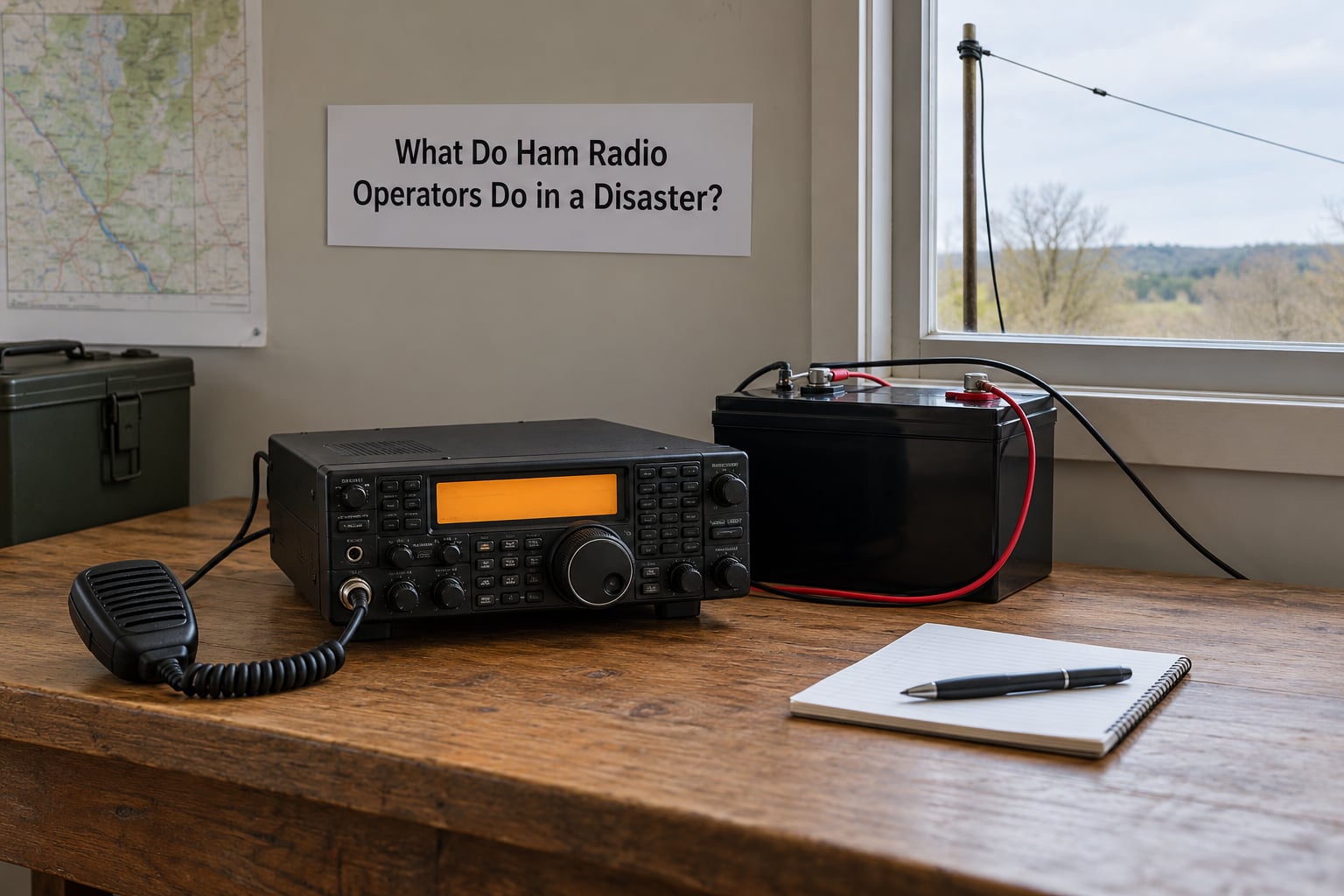
The short version: they provide a communications channel that nobody can switch off. A mobile network depends on masts that need grid power and backhaul fibre. A landline depends on the same exchange. Amateur radio needs a transmitter, an antenna and a battery, and it can be set up in the time it takes to unpack a case.
That makes the emergency role quite different from everyday hobby use. At a club contest station nobody cares whether the neighbours can call a hospital. In a disaster the operator is often the only person carrying traffic between a village and the emergency operations centre for hours at a time.
Most volunteers belong to a formal group rather than turning up alone. In the United States that is usually the Amateur Radio Emergency Service (ARES), the Radio Amateur Civil Emergency Service (RACES) or a Community Emergency Response Team (CERT). In the UK the national society is the Radio Society of Great Britain (RSGB), and local groups work alongside local authority emergency planning teams and volunteer responder schemes. Volunteers are generally asked to register their details, their equipment and their availability in advance, so an emergency manager knows exactly who can be reached and what they can bring.
Deployment tends to fall into three tiers, and the tier decides how much of your life you are committing:
- Public service events. Marathons, charity rides, festivals and field days. These run to a published plan, operators know their channel in advance, and it is the training ground for real activations.
- Localised disasters. Flooding, a storm, a building collapse affecting a few streets. Volunteers are mobilised by the local group or agency, often within hours.
- Major disasters. Hurricanes, severe flooding, wildfires. Volunteers are tasked for days, deployed to a staging area, and handed a specific station to staff — a shelter, a hospital, a county EOC, or a mobile unit feeding those posts.
The American Radio Relay League (ARRL) puts it as “when all else fails”, and the phrase is closer to a job description than a slogan. These operators are a backup line of communication, not a replacement for the emergency services. Knowing that distinction is what keeps the relationship with agencies working.
How Ham Radio Operators Help in Disasters
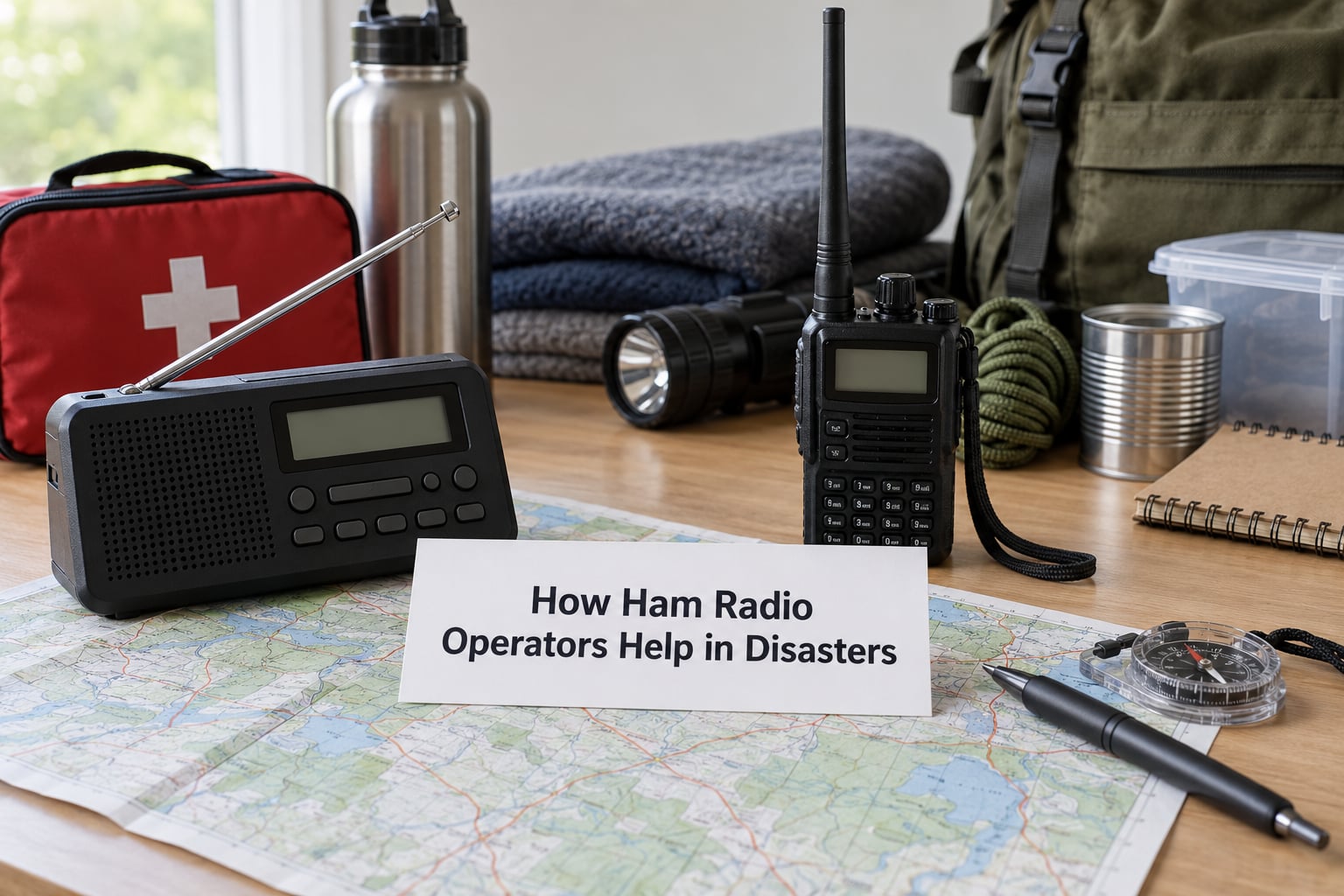
Six roles cover most of the work. The mix changes with the event, and one activation might involve three of them simultaneously.
1. Running the emergency net
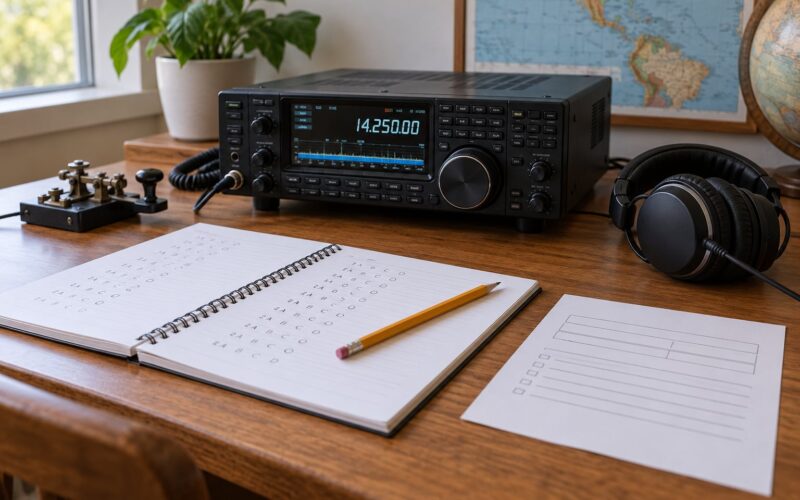
A net is simply an operating schedule on one frequency. Volunteers check in at set times, report status, and pass traffic to a net control station. Net control logs every message, keeps transmissions short, prevents a dozen people talking at once and decides what gets moved to a higher-frequency channel or a direct contact. Without that discipline a frequency fills with well-meaning chatter and no actual traffic moves.
2. Carrying shelter and EOC traffic
Shelters need to report numbers of people present, supply shortfalls, medical problems and requests for generators or fuel. The Emergency Operations Centre needs those reports to plan. A common pattern is one volunteer in a shelter and another in the EOC, passing status reports on a schedule rather than waiting for someone to call. The radio link is usually the backup path when the shelter’s own commercial circuits are congested or offline.
3. Handling health and welfare messages
This is the part the public notices and the part families care about. Relaying a short factual message to a relative outside the affected area, such as a parent’s location and condition, a household address so an evacuated person can be found, or confirmation that a missing person has turned up at a shelter. Rules apply to how these are passed and are covered further down.
4. Supporting search and rescue
Operators pass information between the incident command post, search teams and communications staff. That includes a team calling in that a sector has been cleared, a request for a medic at a grid reference, or a route update that other teams need. Amateur radio rarely directs the search itself, which is the job of trained authorities, but it keeps the information moving between them.
5. Reporting weather and storm conditions
In the United States this is a formal programme. SKYWARN volunteers are trained by the National Weather Service to observe conditions that official instruments miss — hail size, wind damage, rotating wall clouds, flooding underpasses — and report them in a defined format, which forecasters use to issue warnings. In the UK, RSGB-affiliated groups and some local clubs run weather nets during flooding, ice and wind events, feeding observations to the Met Office and to local resilience forums.
6. Cross-boundary and long-range coordination
When two councils, two counties or two states are affected, the voice traffic can exceed the local repeaters and even the local bands. High-frequency (HF) links, and digital modes that copy weak signals, carry traffic into neighbouring areas and occasionally across continents. International coordination runs through the International Amateur Radio Union (IARU) and its national societies, which is how a request for help can be matched with a group on another continent with spare capacity.
That last role is easy to overstate, and volunteers are usually careful not to. A single operator does not single-handedly coordinate an international response. What they provide is one more route for a message to move when every other route is congested.
How Does Amateur Radio Work When Other Networks Fail?
Two ways, both simple to describe.
Repeaters. A repeater is a fixed station, usually on a hill or tall tower, that listens on one frequency and re-broadcasts on another. Handheld radios in a valley talk to the repeater, and everyone else on the mountain hears them. Local repeater groups are a huge part of emergency response because a repeater placed well can cover a whole county, and its power is backed up. UK groups commonly run 2 metre (145 MHz) and 4 metre (70 MHz) repeaters, with 70 cm (435 MHz) used more for local working.
Direct (simplex) working. Radios talk straight to each other with no repeater in the middle. This is how field teams, search parties and neighbourhood groups work, and it is often the only option when a repeater site itself has lost power.
High frequency. On HF, signals bounce off the ionosphere, so a station can reach hundreds or thousands of kilometres with a relatively small antenna and modest power. HF is less convenient for local chatter because the band is crowded and signals arrive from unexpected directions, but it is the mode that ignores geography and the mode that outlasts local damage.
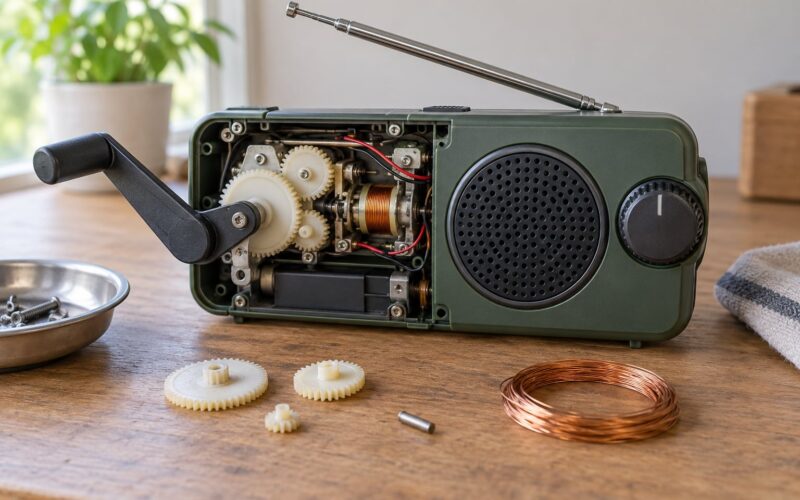
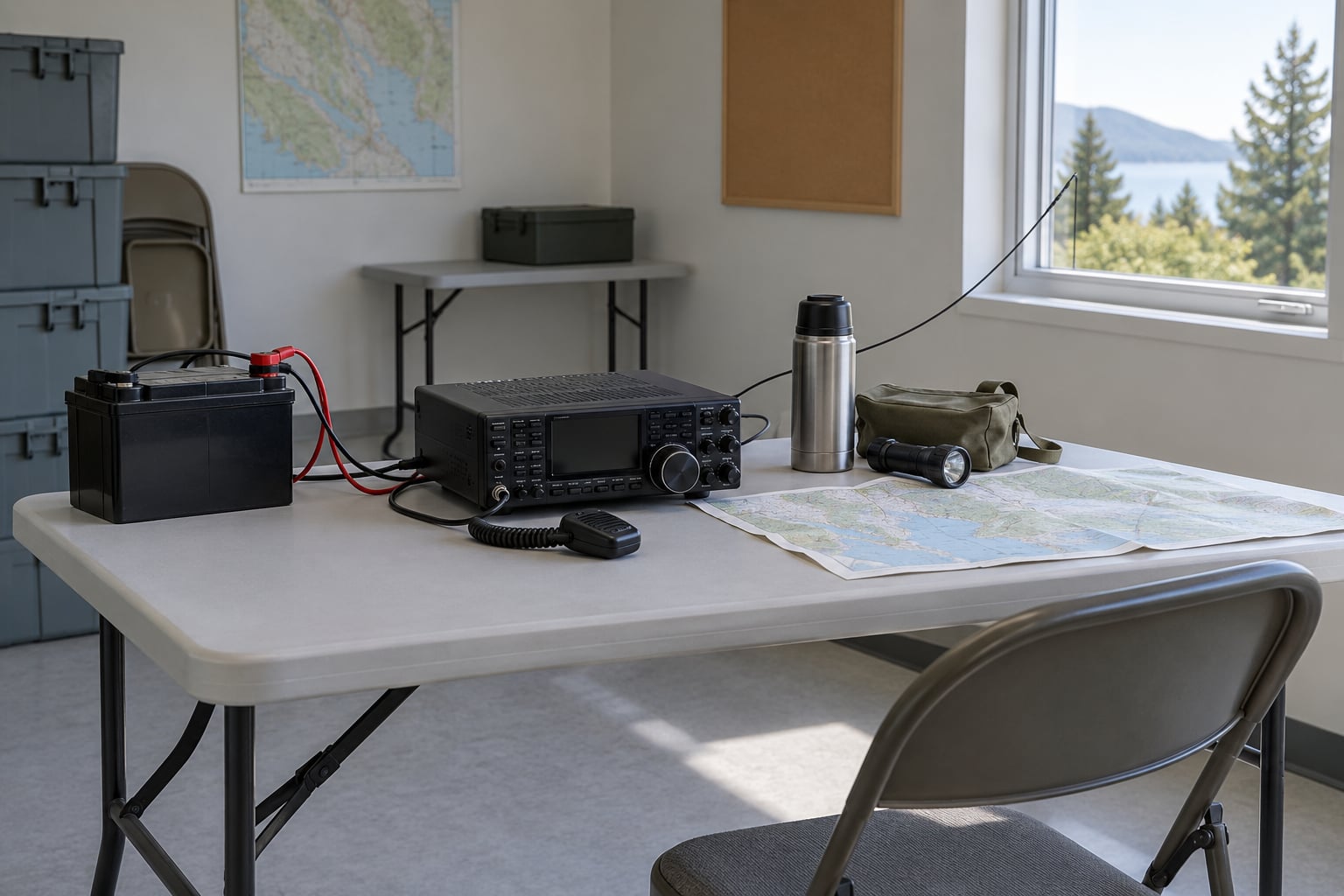
What makes this independent of the infrastructure is the power and the antenna. A charged battery, a spare pack and a length of wire cut for the band will keep a station running when the grid is gone. Solar charging and small generators extend that. Antennas can be improvised — a wire to a fence, a length of coax hung from a tree, a temporary mast in a car park — and experienced operators treat improvisation as a skill, not a failure. Amateurs regularly say the hobby’s real lesson is that you can build a working station from whatever is on hand.
Radio is not voice-only, which comes up often in amateur forums. Packet radio and APRS carry short text, position reports and telemetry. Digital modes such as FT8 and FT4 decode at very low signal strength, which makes them excellent for confirming a path is open or carrying a page of text where voice would be marginal. An operator on the r/amateurradio forum asked whether a bushfire-cut Australian township could exchange timestamped records synced to a database, and the honest answer is: partly. Throughput is low and it needs the same radio and antenna as everything else, but structured data, including position and status, is genuinely feasible where a full document exchange is not.
What Communications Do Ham Radio Operators Relay?
The traffic is plainer than people expect. It is short, factual, addressed, and logged.
- Health and welfare. Word of a relative’s location and condition, confirmation that a missing person has been located, notification that a family has been notified. These follow specific rules, covered below.
- Shelter status. Population count, supplies, medical needs, requests for transport, generators or volunteers.
- Infrastructure condition. Power status at a water plant, whether a bridge is passable, which roads are open, condition of a communications site.
- Weather observations. Ground-level detail that official instruments do not capture, in the format the receiving service expects.
- Agency coordination. Routine status between an incident command post, an EOC, a hospital and a relief organisation, particularly when their own systems are down or congested.
- Logistics and tasking. Movement of supplies, staging of volunteers, confirmation that a message reached its destination.
The health and welfare rules that catch beginners
Health and welfare traffic has a specific meaning in amateur radio, and abusing it is one of the fastest ways to lose the trust of an emergency manager. In practice it means a message about the welfare of a third party that passes through at least two amateur stations, often with the message originating with a relative outside the affected area and destined for someone near the disaster.
Most groups are conservative about it. A reasonable and widely applied set of rules:
- Never handle a message about a life-or-death emergency on the amateur bands. That goes to the emergency service by radio or phone, full stop.
- Only handle health and welfare traffic that the responsible agency or organisation has asked for, or that is clearly informal family contact with no operational weight.
- Keep it factual. No speculation about injuries, no “last seen” rumour from a Facebook post, no claims you cannot trace.
- Include the call signs of both stations in the message, and record every one in the log. That log is what an agency uses afterwards, and a message with no provenance is useless to them.
Amateurs on r/HamRadio and r/amateurradio are blunt about this. The consensus is that well-meant improvisation causes more harm than help, and that the correct instinct when unsure is to log it and pass it to a net controller rather than transmitting it yourself.
How Local Emergency Teams Use Ham Radio
The professional side of this runs on paperwork as much as on radios.
Local radio groups operate under a Memorandum of Understanding, or MOU, with the agencies they support. An MOU sets out who calls whom, who is authorised to task volunteers, who is responsible for training standards and insurance, and how volunteer records are handled. Without one, an agency manager has no basis for tasking a stranger in a disaster zone, and the volunteer has no cover. The Red Cross, the Salvation Army and the national volunteer coordination bodies all use this model, usually through their disaster operations coordinator rather than ad hoc.
Inside an EOC you will normally find a radio room with a roster on the wall, a logging sheet, one or more antennas, and volunteers working in shifts. Every volunteer identifies with their call sign. Net control is a defined role, not whoever talks loudest, and the log records the time, the stations involved and the outcome of each message. Repetition of formal procedures matters: prowords, the phonetic alphabet, clear identification, no assumptions about who is on frequency.
A well-documented example is Hurricane Ian in Florida in 2022, where Lee County ARES staffed shelters and provided a backup link to the county EOC. ARES coordinator Rich Schneiders described the role as exactly that — a backup path between shelters and the centre — and stressed the shortage of volunteers willing to man shelter stations. Local reporting from that activation quoted a volunteer who had been the only means of communication in past emergencies and who described the emotional pull of helping people one message at a time. That last observation is worth sitting with, because it is the part of this work that never makes it into a technical briefing.
Volunteer wellbeing comes up in ARRL’s own material, which is unusual and welcome. Deployments are long, the work is repetitive, sleep is broken, and dealing with other people’s worst day is hard. Clubs that take this seriously rotate people, schedule rest, and keep a phone number for post-deployment support. It is a real reason why some groups struggle to staff every shelter during a major activation.
What Can Ham Radio Operators Do That Cellphones Cannot?
Here is the honest comparison. No system wins every column, and the point is not that ham radio beats everything — it is that ham radio fails differently.
| System | Typical range | Needs infrastructure | Power source | Main failure in a disaster |
|---|---|---|---|---|
| Amateur radio | Local to intercontinental (HF) | Antenna only | Battery, solar, generator | Operator skill and equipment availability |
| Mobile phone | Coverage wherever a mast stands | Mast, backhaul, core network | Handset battery | Mast down, congestion, damaged fibre, power loss |
| Landline | Fixed premises only | Copper or fibre to the exchange | Line power at both ends | Exchange flooded, cable cut, lines down |
| Satellite phone | Continental to global | Satellites in orbit | Handset battery | Sky view blocked, satellite or gateway damaged |
| Internet or mesh | Local to wide area | Backhaul, power, node coverage | Mains, battery, solar | Backhaul cut, power out, node saturation |
What the phone cannot do is work with no mast, no cable and no account. It also cannot be lent out freely to anyone in a shelter to call one number from a list. What ham radio cannot do is serve as a general-purpose phone replacement: it has no address book, no messaging app, no photographs, it needs a licence, and it needs an operator who is awake and practised.
Modern kit has narrowed the gap in both directions. Satellite phones are now small and inexpensive enough for agencies to hold in quantity, and they are the preferred tool for long-range rescue coordination. Mesh networks and low-orbit broadband are far better at carrying data, and a laptop plus a data radio has no trouble sending structured reports that a voice net would struggle with. Experienced operators say it plainly: ham radio matters less for disaster comms than it did twenty years ago, and the case for it today is redundancy rather than necessity.
The argument for keeping it is redundancy. Cell networks come back quickly in a developed country, and the gap is hours. In a region where the backhaul cable sat underwater or the mast was destroyed, the gap can be days, and that is the window ham radio is built for. Yorkshire readers saw exactly this with the flooding that repeatedly cut off rural roads and left some communities without power or signal; the recovery window is where volunteer groups matter most.
How Do You Prepare to Help During an Emergency?
If this has made you think about getting involved, the path is straightforward in the UK and takes a few months rather than a weekend.
1. Get a licence. In the UK that means training and an examination through the RSGB for the amateur radio licence. The training covers radio theory, the licence conditions, operating practice and safety. It is not a formality — it is the bit that teaches you not to interfere with emergency services, which is exactly the knowledge a volunteer group wants.
2. Join a local club and then the emergency group. A club teaches you to operate. Local ARES, RSGB emergency or group, or your area’s volunteer responder scheme teaches you the rest: net discipline, message formats, logging, the local agencies and their procedures. Clubs vary in how welcoming they are to newcomers, and asking specifically to help with public service work tends to land better than arriving with no context.
3. Register and complete the paperwork early. Registration, background details, an equipment list and availability. This is the unglamorous part that decides whether you get tasked, and it happens in calm conditions rather than during an evacuation.
4. Build a kit that is genuinely portable. Many groups use a tiered model: a Go Kit that stays with you and can be carried out of the door in minutes, a Deployment Kit with a spare radio, more batteries, feed line and a mast, and a mobile response unit with an HF capability, a generator and shelter for longer stays. Every tier assumes no mains power, no working mobile coverage and a stranger’s help to carry it.
5. Prepare your own household. This is the advice people ignore and then regret. A volunteer who is called out at 2 a.m. needs a plan for their family, pets, food, medication and a way to get to the staging point. Amateur radio clubs tend to be unusually realistic about this, because they have seen the volunteer disappear to deal with a flooded home mid-deployment.
6. Practise the 3-3-3 rule. Three days of essentials, three ways to get a message out, and roughly three hours of hands-on practice with your own equipment. It is a widely used amateur preparedness guideline and it is good enough for most households.
7. Prepare for the amateur version of the 3-3-3 frequency question. For listening, know the local repeaters and the 2 metre simplex calling frequency for the UK, which is 145.500 MHz, and the equivalent in whatever country you are in. For a beginner in the UK that is a sensible first channel to sit on. A short handheld, a spare battery and a length of coax is a perfectly respectable first station.
And if you are not licensed, or simply do not want to be, there is still useful and lawful things to do. Do not transmit on amateur frequencies — a penalty notice is a real possibility and a net controller will ask you to stop. Listen if you want to understand what is happening. Send a text rather than making a call if your signal is marginal, because a text takes seconds and a failed call takes a minute of a congested network. Call 999 or 112 for anything urgent. And follow the instructions of the authorities, who have the whole picture and the legal authority to give orders.
What Are the Limits and Safety Rules for Ham Radio Help?
Nobody is going to thank you for a heroic, unauthorised trip into a flooded street. The rules exist because well-meaning interference costs more than it solves.
- Transmit only on frequencies your licence permits, within the power limits, using the identification you are required to use. A penalty notice is the likely outcome of ignoring this, and an emergency is not an exception.
- Do not self-deploy. Go where you are tasked, or stay on the net. Unmanaged bodies in a search area get in the way of teams with protective equipment.
- Protect personal data. Medical details, addresses of vulnerable people and the locations of survivors are passed on a need-to-know basis and are not for a public net or a chat channel.
- Verify before you pass it on. If you cannot trace the source of a report, log it for a controller rather than transmitting it.
- Work through the established channels. The MOU exists so an agency knows who is operating on its frequency, with what training, under whose insurance. A volunteer who bypasses it is not helping the response, they are adding an unmanaged channel to it.
- Expect it to be a long, dull job. Fatigue, cold, poor food and the emotional weight of other people’s emergencies are the norm. Preparation and rest discipline are part of being useful.
The last limitation is the one almost every experienced operator volunteers without being asked. Amateur radio is one layer of a much larger emergency system, alongside the emergency services, the official agencies, commercial networks, satellite services and increasingly mesh and low-orbit broadband. It is the layer that is easiest to mobilise, cheapest to hold in reserve and entirely independent of the power and cable infrastructure. Used that way, inside a coordinated response, it is genuinely valuable. Treated as a solution on its own, it is not.
Frequently Asked Questions
What is the 3-3-3 rule for ham radio?
The 3-3-3 rule is an amateur radio preparedness guideline rather than a rule of the radio itself. It means three days of essential supplies such as food, water, medication and light, three ways to get a message out if one system fails, and about three hours of hands-on practice with your own equipment. Amateur societies promote it because emergency preparation decays quietly: batteries die, antennas get moved and firmware gets forgotten.
What is the best ham radio frequency for emergencies?
There is no single emergency frequency. Local VHF and UHF repeaters handle most day-to-day traffic, and the 2 metre simplex calling frequency in the UK is 145.500 MHz, which is a good first channel for a beginner to listen on. Health and welfare messages in the United States often travel through the National Traffic System on HF, typically in the 80 metre and 40 metre bands. Net control announces the frequency, so listen before transmitting and follow what the local group uses.
What radios will work if cell towers are down?
Any handheld or mobile amateur radio will work, provided it has a charged battery and an antenna, because nothing beyond the radio itself is required. CB and marine VHF sets also work but carry different rules and are not interchangeable with amateur bands. A licence-free FRS or PMR446 handheld is useful for talking locally inside a group but will not reach beyond line of sight. Satellite phones and radios using a mesh or broadband link are the practical modern alternative for agencies that hold them.
Can I use a ham radio in an emergency without a licence?
No. Transmitting on amateur frequencies without a licence is unlawful, in an emergency as much as at any other time, and you can be required to stop or face enforcement. Listening is fine, and members of the public can help in other ways: call 999 or 112 for anything urgent, send a text instead of a call when the network is congested, and follow instructions from the authorities. Volunteer properly through a local club and the emergency group, which handles licensing and training.
Will an EMP destroy a ham radio?
There is no confirmed real-world case of a radio being destroyed by an electromagnetic pulse, so the honest answer is that nobody knows. A strong external surge would couple into a long antenna, the coax run or the mains wiring, and a basic external surge protection device and unplugging the equipment would reduce the risk considerably. The more likely failure in a real disaster is mundane: a flat battery, water damage, or an operator who has not practised.
Do I need a licence to help in a disaster?
To transmit, yes. In the UK the route is training and an examination through the RSGB, followed by joining a local club and then its emergency group so you are registered and properly tasked. Volunteering to a shelter, first aid team or council resilience team does not need a radio licence at all, and those organisations value that help just as much. The radio licence only matters if your specific job involves passing traffic.
Conclusion
The first step is to find out who runs emergency communications in your own area, because a national society cannot tell you which shelter needs a radio operator next Tuesday. Contact the RSGB, a local amateur radio club or your council’s volunteer resilience team, and ask what the public service involvement looks like where you live. From there it is training, a licence, a registered group and a portable kit that runs off a battery.
If a disaster is happening now, the radio operators are already working and they are busy. Call 999 or 112, follow the authorities, and let them use the channel they have.