How sports talk radio shows are structured comes down to one repeatable pattern: a station opens with the biggest story of the minute, works through analysis and argument, brings in guests or listeners, breaks for commercials, then resets and teases what comes next. Every hour follows the same skeleton, and once you can hear that skeleton, a show that felt like noise starts feeling like a broadcast you can navigate.
That is genuinely useful whether you have listened for twenty years or twenty minutes. You learn why a host repeats his name every few minutes, when the news sits in the hour, and which ten minutes are worth rewinding later. It also explains the odd habit sports radio has of starting a thought, stopping for adverts, and picking it up again word for word.
The structure is not a secret among broadcasters. Producers build it, program directors sign it off, and hosts fill it in live. Here is what the standard looks like, segment by segment.
Table of Contents
- How Sports Talk Radio Shows Are Structured
- The Typical Sports Talk Radio Show Format
- How the Show Begins: The Cold Open and Headlines
- How Analysis and Debate Develop
- Interviews, Callers and Listener Participation
- Breaks, Updates and the Return from Advertising
- How Hosts End the Show
- How to Tell Different Sports Talk Formats Apart
- How to Listen to Sports Talk Radio as a New Fan
- Frequently Asked Questions
- Conclusion: What to Listen for First
How Sports Talk Radio Shows Are Structured
A sports talk radio show is a live, scheduled spoken-word programme built on a repeating clock of timed blocks. Those blocks normally run in this order: a cold open and station identification, a headline roundup, deeper analysis and debate, a guest interview or listener call-in segment, news and sports updates, then a tease into the next hour and a sign-off. Commercial breaks and music sit between the blocks rather than inside them.
The clock is designed by a producer and approved by a program director before the show goes live. What you hear live is the host filling those fixed slots with whatever the morning actually produced: a result, an injury, a trade, a row.
Three things make it recognisable as sports talk specifically. It is live rather than recorded, it carries an argument rather than just information, and it assumes you cannot see the screen, so everything is said out loud.
Who builds the clock, and who fills it
Four roles sit behind a sports talk hour, and separating them explains most of what you hear. The host is the voice you recognise, and he decides how the argument runs in the moment. The co-host is the second voice whose job is disagreement, keeping the segment from becoming a monologue.
The producer is off air and mostly invisible. They write the show sheet, log the games and links, screen the phone, hand the host the statistic that wins an argument, and keep an eye on the clock so the guest segment does not eat the update. The program director sits above that, owns the overall format, decides how many ad minutes the hour carries, and is the person who ultimately signs off on what the show sounds like.
When a show feels tight, that is the producer. When it feels loose and repetitive, that is usually a show sheet nobody updated.
The five rules the format runs on
Strip away the personalities and the format rests on five habits, and you will hear all five on any decent show.
- Get into the story immediately. No long greeting, no weather small talk before the headline.
- Identify everything out loud. Host, show, station, guest, caller. A listener tuning in mid-sentence needs to know who is talking.
- Tease the next segment. The host announces what is coming so people stay through the adverts.
- Pay off the tease. Come back to it after the break. This is the rule listeners complain about most when it is broken.
- Reset the conversation. After an advert or a phone call, restate where things stand before moving on.
Trade writers in the United States have been saying versions of this for years, and the criticism is always the same: shows that stop identifying, stop resetting, and stop paying off what they teased.
The Typical Sports Talk Radio Show Format
A typical sports talk radio show format runs as a repeating hourly cycle, not as a fixed list of segments that never moves. The order of the blocks is fixed, so the show feels predictable. The length of each block shifts constantly, because a ten-minute argument about a trade deadline matters more on one day than the next.
What does not shift is the shape. Think of each hour as four quarter-hour chunks: open and headlines, first block of analysis, break, second block with a guest or callers, break, update and tease. Producers call these quarter hours, and the ratings system measures listening in quarter-hour slices too.
Here is a plausible hour, minute by minute. The timings are typical rather than universal, but every sports talk station has some version of this shape.
| Time | Segment | Typical length | What the host does | What the listener gets |
|---|---|---|---|---|
| 00:00-03:00 | Cold open | 3 minutes | Drops straight into the lead story mid-sentence | Instant orientation, no preamble |
| 03:00-05:00 | Identification and headlines | 2 minutes | Names himself, the show and the station, runs the news list | Knows who he is and what happened |
| 05:00-12:00 | First take and analysis | 7 minutes | Facts, then interpretation, then a co-host disagreement | The reason most people tune in |
| 12:00-15:00 | Commercial break and music | 3 minutes | Identifies the station, music bed, adverts | A pause, and a cue to come back |
| 15:00-20:00 | Reset and deeper analysis | 5 minutes | Restates the argument, adds a statistic or a historical comparison | The debate gets sharper |
| 20:00-28:00 | Guest interview or caller block | 8 minutes | Introduces the guest, asks prepared questions, opens the phones | A voice other than the hosts |
| 28:00-31:00 | Commercial break and station promo | 3 minutes | Station identification, promo, adverts | Reminder of who funds the show |
| 31:00-36:00 | Reaction and listener segment | 5 minutes | Reads messages, takes two calls, pushes back | His or her view treated as part of the show |
| 36:00-41:00 | Sports update | 5 minutes | Scores, transfers, injury news, next fixtures | Anything missed while driving |
| 41:00-45:00 | Reset, tease and sign-off | 4 minutes | Previews the next hour, says what he wants to hear from callers | Knows when and what to come back for |
Two details in that table explain a lot of listener behaviour. The sports update at minute 31 exists because listeners miss things, and the tease at minute 41 exists because the advertiser, not the host, owns the next few minutes. Both are structural, not personal.
Why the same hour repeats all day
Run the table again in a different slot and you will find almost the same skeleton. Breakfast carries overnight news and transfer talk. Midday carries longer features and interviews because fewer people are listening closely. Drive time compresses the segments, because a listener arriving late needs the headline in the first thirty seconds.
Weekends are where the format loosens most. Ad breaks shorten, callers get more time, and a station with a big match that day will sometimes run a pre-match show for two or three hours using the same blocks at a slower pace.
What a fixed schedule would look like, and why nobody uses it
A rigid schedule, where the news is always at :05 and the guest is always at :20, sounds tidy and mostly does not work. Real stories arrive on their own schedule, and a rigid clock forces hosts to abandon a good argument to hit a slot.
What stations fix instead is the order and the approximate size of the blocks. The producer knows the news goes early, a guest sits in the second half of the hour, and an update lands near the end. Everything inside those boundaries floats with the day. That flexibility is the main difference between a show sheet and a rigid timetable.
How the Show Begins: The Cold Open and Headlines
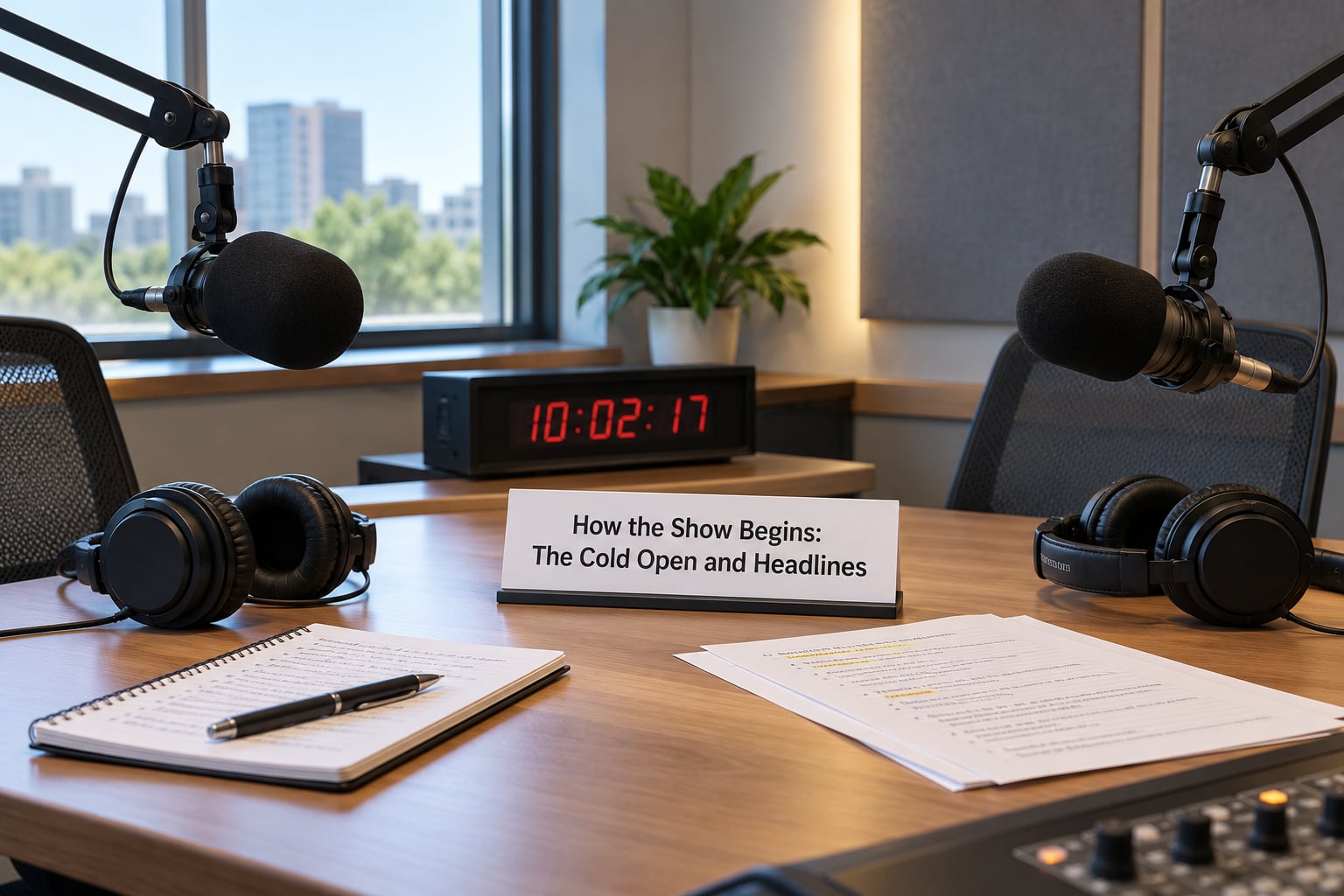
The show begins with the story, not with a greeting. A cold open is the first two or three minutes, where the host drops you into the biggest item already in progress and catches up the listener in plain words.
Here is a realistic one. It is the morning after a game, and the lead story is a late roster change. The host opens: “Eleven minutes past seven, and we still do not know who is starting. That is the third straight game this manager has gone with the same young lad and the box score says it has not been pretty.” That is an open, a headline, a stake and a tease in three sentences.
Why the greeting comes later, if it comes at all
Somewhere in the first five minutes the host will say who he is, what the show is called and which station it is. Not as small talk, but as information a passing listener needs. On stations where the opening is already loud and specific, that identification can happen four or five minutes in, and it happens again twenty minutes later.
What follows the headline is usually a rapid roundup. Scores first, then a roster move, then whatever else the news desk produced overnight. The host is reading a list and reacting to it, which is why this section often moves faster than anyone expects.
How Analysis and Debate Develop
Analysis develops in stages, and the order is almost always the same. Facts first, because radio listeners cannot rewind as easily as podcast listeners. Then interpretation, meaning the host tells you what he thinks the facts mean. Then comparison, usually against a previous game, a previous season or a similar situation in another sport. Then argument, which is the part listeners actually stay for.
The comparison stage is where good shows separate themselves. Saying a goalkeeper had a poor game is opinion. Saying he faced six shots from inside the six-yard box in the first half alone is a fact. Putting those two together is analysis, and it takes about twenty seconds.
Debate comes from the co-host or a second host disagreeing. That is a format choice, not an accident. Two voices arguing about a decision that has already been made is easy to listen to for twenty minutes, and the show is essentially manufacturing an argument the listener can join in with a phone call.
Nothing about this is scripted, but it is not loose either. The producer hands the hosts talking points on the show sheet, and the hosts know roughly how long each topic should run. The talk is unscripted. The structure holding it together is not.
Where soundbites and links come in
A soundbite is a short clip of someone’s voice, usually three to ten seconds, recorded earlier and played inside a segment. A manager’s press conference line played twice in twenty minutes becomes the spine of an argument, and hosts treat it as evidence: here is what he said, here is what happened afterwards.
That is also why hosts repeat a line rather than paraphrase it. Radio listeners are not rewinding, so the exact wording matters more than on a podcast where the listener can scrub back.
What a newcomer should do when an argument gets loud
Turn the volume down a notch and keep listening. Two hosts disagreeing is the format working, not the format failing. If the tone turns personal, that is a different judgement, and the honest advice is to check whether the show recovers within a few minutes. Most do, because the segment has to end at some point anyway.
Interviews, Callers and Listener Participation
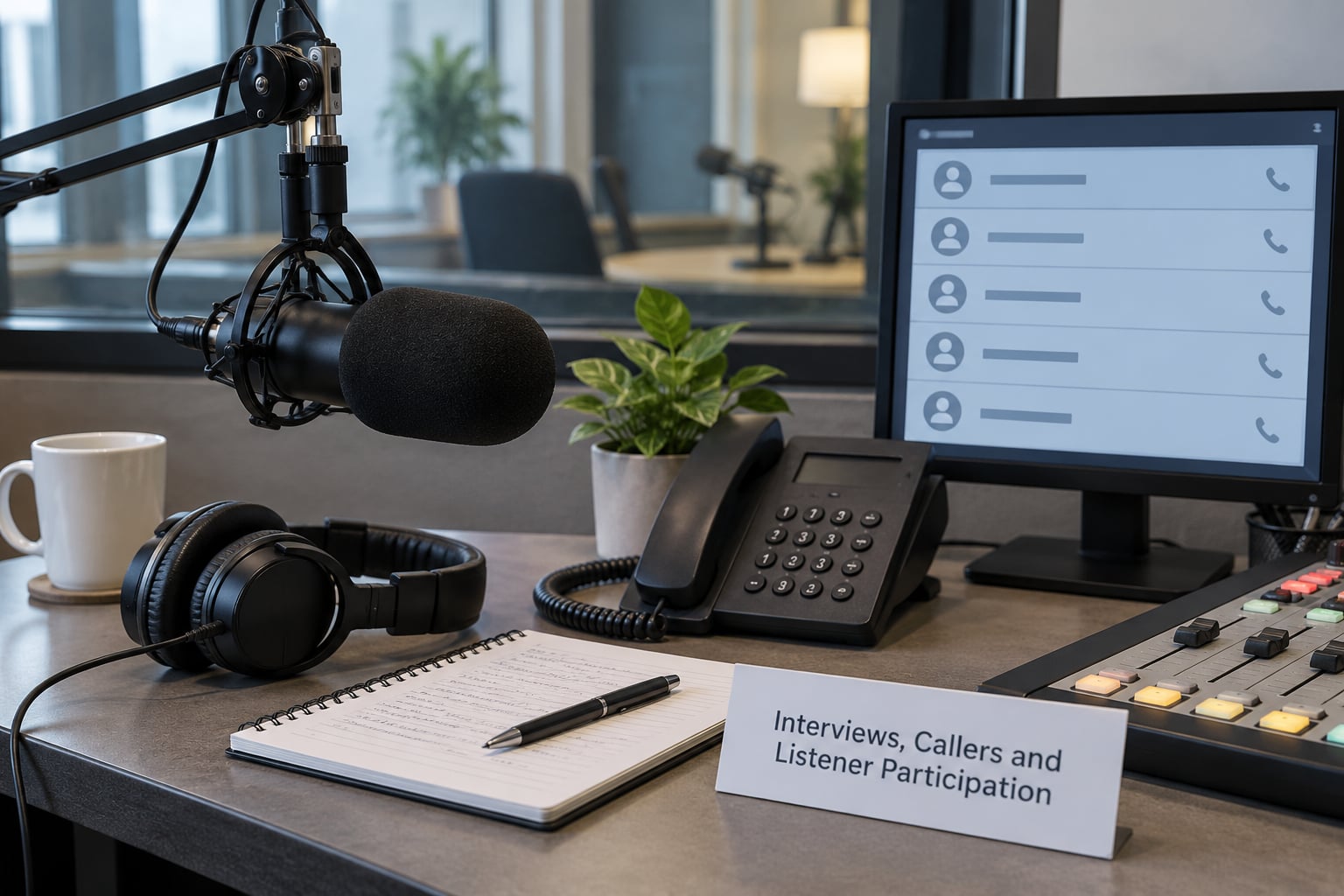
Guest interviews and call-ins both add a voice that is not the host, but they work in opposite ways. The interview is controlled and prepared. The call is live, unscripted and filtered.
Guest interviews
A guest block usually runs eight to fifteen minutes and follows a predictable shape: identification, a soft opening question, two or three prepared questions, then one or two that go somewhere the producer did not plan. Hosts are supposed to name the guest again every second or third answer, because a lot of listeners tune in halfway through and have no idea who is speaking.
Weak interviews are the ones where the host talks over the guest to get back to his own take. Forum discussion around the format keeps circling the same complaint: a host with an opinion about the guest’s career instead of curiosity about it.
Call-ins and audience messages
On a call-in show, the producer or a phone screener takes calls before the host takes one. The screener listens in, decides which caller fits the topic, and puts them in the queue. That filtering is why the calls that make air tend to be on-topic. The host still controls the conversation by asking the question, asking the follow-up, and moving on when it dries up.
Text and social messages work differently. They arrive in writing, so they are read out rather than answered live. The host reads one, reacts, and moves on. Some shows read ten in a row, which is fast and shallow. The better ones read two and turn them into an argument.
The practical difference between the two: a phone call is a conversation, and a message is a prompt. Shows that read message after message without answering any of them lose the segment quickly.
Breaks, Updates and the Return from Advertising
Commercial breaks are structural, not interruptions. Adverts sit at predictable points in the hour, usually after a strong block rather than in the middle of an argument, because a break during a heated segment loses the listener and the advertiser both.
What fills the break varies. Often a music bed, which is a short piece of music with a station ident either end. Often a station promo, which is the programme telling you about itself. Occasionally a traffic and weather bump, a fast update on travel and conditions tucked between items.
The return is where discipline shows. A host who comes back from a break without restating the argument makes the listener mentally rejoin a conversation they were already in. The good ones say something like: “So before the break, we were talking about the goalie’s positioning, and Colin thinks he was covering for the centre-backs. Pick it up there, Colin.” That is a reset, and it takes about fifteen seconds.
Practical advice for following a show after an interruption: listen to the first thirty seconds after the adverts, because that is where the reset happens, and if you hear a tease for a segment you missed, wait for it. Shows repay the tease more often than listeners expect.
How Hosts End the Show
Shows rarely end with a conclusion. Sports talk is a rolling format, so the ending is a handover. The host runs the last headlines, reminds listeners of tomorrow’s guests or the weekend schedule, asks for calls on the story he expects to dominate the next hour, and signs off with the station identification.
The final two minutes are worth noticing. Good ones contain a genuine prompt, such as the phone number for the call or the handle for messages, tied to a specific topic. Bad ones contain a generic sign-off with no reason to tune back in, which is a waste of the most valuable ninety seconds in the hour.
Some shows also handle the handover between programmes. One host says the next show’s name and what it covers, which is effectively a promo that costs the station nothing and keeps the listener on the frequency.
Get that right and a listener stays with the station for hours rather than switching away at the top of each hour. It is unglamorous work that decides whether the station holds the audience through the afternoon.
How to Tell Different Sports Talk Formats Apart
Not every spoken-word sports station runs the same show. Four types cover most of what you will find, and you can tell them apart within a few minutes of listening.
Local news and talk
These run a mixed clock: school news, council news, traffic and weather, then a sports block. The sports segments tend to be shorter and they lean towards the local club. On UK stations this is the dominant sports format, and it is why the same club can appear on four different stations across a county.
National debate shows
Syndicated shows such as First Take or the Dan Patrick Show are produced centrally and carried on many stations. The clock is tighter, the argument is louder, and the local content is thin because the show is national. Local hosts often sit either side of them.
Play-by-play and fan programmes
Match coverage and dedicated club or fan shows sit closer to the broadcast end. There is less argument per minute, more description during a game, and a lot more setup and preview around it. League and lower-division clubs in particular often only exist on this kind of show, which is why fans hunting streams for a small club are often pointed here.
Community and campus stations
Smaller operations, often online-only or run from a university, where the host may also be the producer and the guests are volunteers from local clubs. Structurally the same, but with fewer guests and a lot more caller time.
Where sports talk lives: AM, FM and streaming
The old stereotype is that talk radio sits on AM, and that is still partly true. In the United States, a handful of big-market sports stations remain on AM because the historical licences live there. In the UK and most of Europe the pattern reversed: sport moved to FM during the 1990s as audiences grew and the FM signal won. Today you will find sports talk on both bands, and plenty of stations have moved between them over their history.
The real answer for a listener is that band matters less than format. A station is not a sports talk station because of its frequency, it is one because of its clock. Most stations now stream live online and many simulcast, so if you cannot find the show on the dial, searching for the station plus the show name usually gets you a live feed within seconds.
A short glossary of what you will hear
New listeners often feel disoriented because of the jargon. These are the terms that come up most.
- Clock or format clock – the plan showing which segment runs in which part of the hour.
- Daypart – a named slice of the broadcast day, such as breakfast or drive time.
- Drive time – the commuting hours, when sports radio audiences peak.
- Quarter hour – fifteen minutes, the standard unit the format is planned in and measured in.
- Show sheet or rundown – the producer’s document listing topics, timings and links.
- Talking points – the prepared notes behind the conversation.
- Soundbite – a short recorded clip of someone’s voice, played as evidence or atmosphere.
- Music bed – short music used to bookend adverts or a break.
- Liner – a recorded ident, the station’s jingle or the local voiceover promo.
- Simulcast – the same show carried live on radio and at the same time on a stream or podcast feed.
- Phone screener – the producer deciding which callers go into the queue.
- Hot take – a fast, deliberately arguable opinion used to provoke a response.
If you can read that list, you can follow any sports talk show in the country, whichever station it comes from.
Sports talk radio versus a sports podcast
The same host, the same argument, and a completely different structure. Radio is a live clock you show up for: the topics are decided that morning, the timing is fixed, and you cannot skip the traffic report. A podcast is edited and on demand, so the interview is first and the adverts may be gone.
Many stations now simulcast, putting the radio show online as a podcast within hours. That gives you the radio structure on your own time. What you lose is the shared clock. Nobody is listening to the same segment at the same moment, which is exactly the thing that makes radio feel like company rather than content.
For a newcomer, the practical split is this. Use live radio for the daily habit and for matches. Use the podcast version for anything you genuinely want to rewind and keep.
How to Listen to Sports Talk Radio as a New Fan
Give it three mornings before you decide whether you like it. The first hour is disorienting because you have no idea who anyone is or why a goalkeeper is suddenly the most important person in the county.
On the second morning, note the times. You will find the news lands early, the argument you actually enjoy tends to sit in the middle of the hour, and the update near the end is the one you will need most. On the third morning you will find yourself arriving a minute early so you do not miss the open, which is the point at which the habit has formed.
Seven things to listen for
- The ID. Host, show, station. Every few minutes.
- The tease. What he promises for after the adverts.
- The payoff. Whether he actually gets there.
- The reset. The thirty seconds after a break restating the argument.
- The soundbite. A repeated line that anchors the discussion.
- The screen. You never hear a producer, but you hear their notes landing.
- The handover. The hand-off to the next programme that keeps you on the station.
What makes people turn it off
The complaints that come up most from listeners are all execution failures rather than format failures. Unidentified guests for fifteen minutes. A teased segment that never arrives. Ad breaks long enough to lose the thread. A host talking over the topic he announced. The same take repeated for three days with nothing added.
None of those are inherent to sports talk. Every one of them is a show that stopped following the five rules.
Frequently Asked Questions
How long is a typical segment on a sports talk radio show?
Most blocks run five to eight minutes, with the news roundup near two minutes and interviews or caller segments nearer ten. Producers plan in quarter-hour chunks, so a full topic often occupies a quarter of the hour. Lengths flex with the story, and a big day pushes a two-minute item out to eight.
Why do hosts repeat their name and the station so often?
Because people tune in mid-sentence. Radio has no visual cue for who is talking, and listeners arrive constantly during a drive. The rule of thumb is to identify the host, the show, the station and any guest regularly, especially after a break or a call. It sounds repetitive and it is deliberate.
How do I get a comment or question on to a sports talk radio show?
Call during the segment the host is teasing, not the one already running, and be ready to say who you are and what your point is in one sentence. Calls are screened before air, so on-topic callers get through more often. Text lines and social messages work too, though they get read rather than debated.
Are sports talk radio shows recorded in advance?
The discussion is usually live, though a recorded version is often posted as a podcast soon afterwards, so you can rewind a segment you missed. Some stations use pre-recorded interviews with unavailable guests and pre-produced openers, but the core of the show is live conversation with unpredictable timing.
How do I choose a sports talk radio station to listen to?
Start with who covers your team or sport most often, then check whether the show leans towards debate or towards results and fixtures. Local news-and-talk stations suit regional coverage, syndicated shows suit national debate, and club fan shows suit lower-league coverage. Listening for fifteen minutes tells you more than any description will.
Conclusion: What to Listen for First
The whole format reduces to one idea: a fixed hourly skeleton filled live with whatever the day produced. Headlines, analysis, debate, guests or listeners, updates, tease, sign-off, with adverts sitting between the blocks and never inside them.
If you listen for one thing on your first morning, listen for the tease. When the host promises a segment after the next break, note the time and see whether he actually gets there. That single habit teaches you the structure faster than any guide, because you are tracking the clock yourself rather than being carried along by it.