Short answer: what you can and cannot do on ham radio is set by 47 CFR Part 97, the FCC’s rules for the Amateur Radio Service. Licensed operators may talk to each other, pass messages, run contests, work satellites and build equipment. They may not broadcast, sell airtime, encrypt transmissions, or exceed their licence class limits, even in a disaster.
One scope note before anything else. The rules described here are United States rules, written by the Federal Communications Commission. UK readers are regulated by Ofcom under a different framework with different licence classes, and other countries have their own arrangements entirely. If you are reading this in Yorkshire and you hold a UK Amateur Radio Licence, the principles are broadly similar but the specifics are not interchangeable.
The rest of this guide covers the permitted side, the prohibited side, where you can transmit, how far a signal realistically reaches, and what happens to people who break the rules. I have kept the rule numbers in because operators trust a citation far more than a paraphrase, and because the exact section is what you need when you want to check something yourself.
Table of Contents
- What You Can and Cannot Do on Ham Radio at a Glance
- What Is Ham Radio Used For?
- Do You Need a License to Operate Ham Radio?
- Where Can You Transmit From?
- How Far Can You Talk on Ham Radio?
- Can You Use Ham Radio for Emergency Communication?
- Can You Listen Without a Ham Radio License?
- What Are the Main Ham Radio Rules and Limits?
- Frequently Asked Questions
- Can you listen to ham radio without a license?
- Can you use a ham radio repeater without holding a license?
- Can ham radio be used for paid work or commercial communication?
- Can you talk to other countries on amateur radio?
- Do you have to give your callsign on every ham-radio transmission?
- Can you buy and sell ham-radio equipment on the internet?
What You Can and Cannot Do on Ham Radio at a Glance
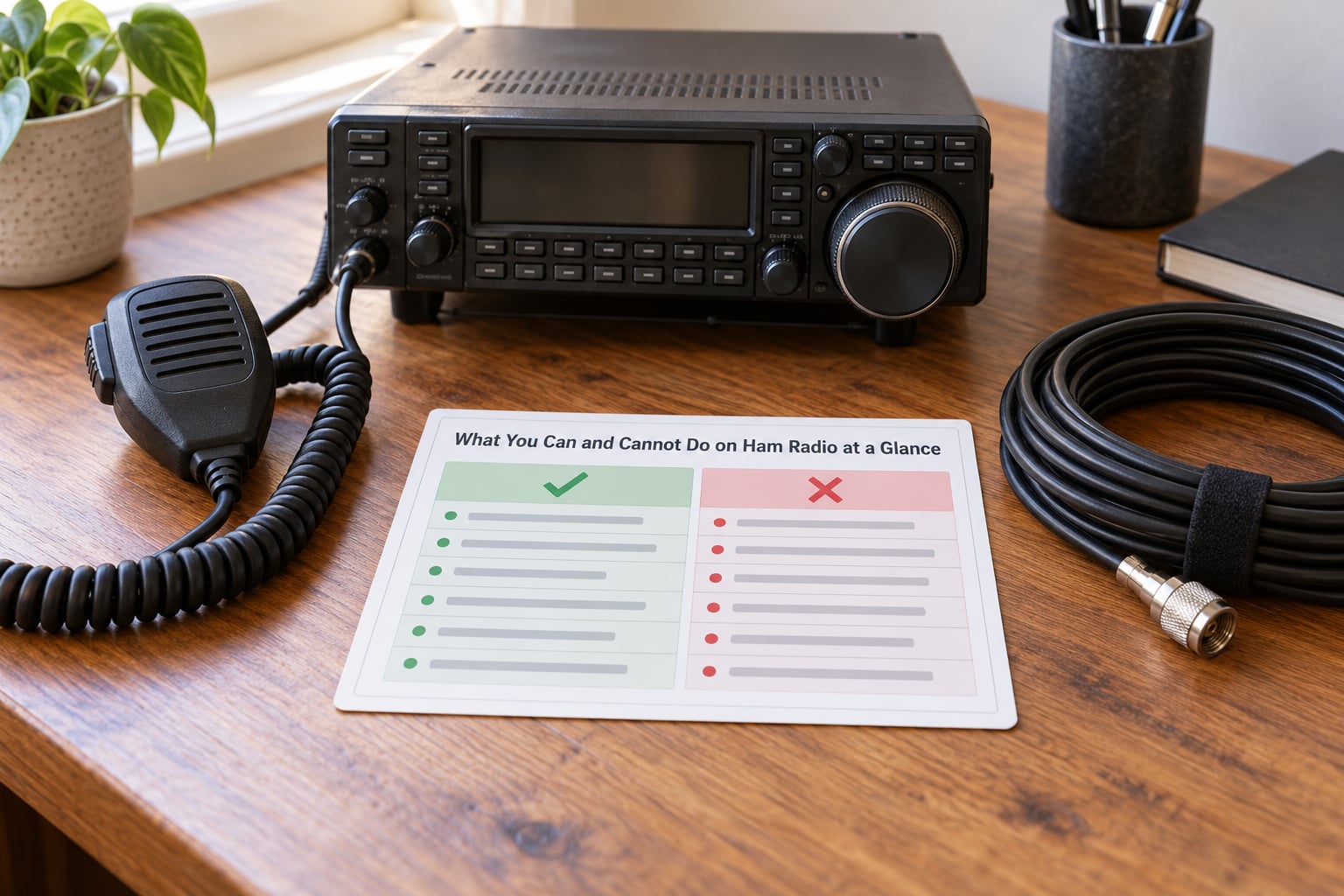
The fastest way to understand the amateur service is to split every activity into two piles. Almost everything people imagine ham radio is used for sits in the first pile, and almost everything that gets operators in trouble sits in the second.
What you can do with an amateur station licence:
- Talk with other licensed amateur operators, locally or around the world
- Use repeaters, and take part in regular club nets and traffic nets
- Pass third-party messages on behalf of friends, family and neighbours
- Run contests, make awards, and work DX (distant stations)
- Operate through amateur satellites, including the ISS repeater
- Build, modify and repair your own equipment, and self-certify it
- Assist organised public-service and disaster-relief communications
- Operate from a home station, a portable location, or a mobile vehicle
- Identify your station with your callsign, as the rules require
What you cannot do, even with a full licence:
- Transmit without a valid licence and a station identification
- Broadcast, or make one-way transmissions to anyone at all (47 CFR 97.113)
- Transmit for money, or on behalf of any business or person for payment (47 CFR 97.113(b))
- Act as a message broker for anyone other than a party to the communication
- Transmit on FRS, GMRS, PMR446, marine or commercial frequencies with a ham licence
- Encrypt, scramble or obscure the meaning of a transmission (47 CFR 97.219)
- Exceed the power, frequency or emission limits for your licence class
- Interfere deliberately, key up over a station in progress, or act as a latchkey pirate
- Use someone else’s callsign, or lend your licence to another operator
- Assume a disaster suspends the rules. It does not (47 CFR 80.5)
That list is the whole of it, more or less. Everything else in this article is detail underneath those two columns.
What Is Ham Radio Used For?
Amateur radio exists for communication, technical learning and public service. That is the legal purpose written into the rules, and the reason a licence is issued rather than sold like a consumer service.
Communication. It is a two-way service, person to person, licensed to licensed. That includes everything from a conversation across town to a path that bounces off the ionosphere and lands you on the coast of New Zealand.
Technical learning. A licence is not just permission to press buttons. Holders are expected to understand enough about radio to build, tune and repair their own stations, which is why the amateur service is treated differently from services like FRS or GMRS where the equipment simply works out of the box.
Public service. Amateur radio is frequently the backup when cell networks are overloaded or down, particularly for weather, wildfire, flood and search-and-rescue support. It is a supporting service, not a replacement for public safety agencies, and the difference matters legally.
Contesting and awards. Two operators try to make as many valid contacts as possible in a fixed window, logging every exchange. Award programmes such as Parks on the Air work the same way on a slower clock.
Satellites and space. Low-orbit amateur satellites and the ISS digipeater let a home station with a modest antenna work global distances. Operators also handle telemetry and downlink reception.
Experimentation. Antennas, transmitters, digital modes, digital television, low-power operation, meteor scatter, moonbounce. This is the part of the hobby that most people fall into eventually.
International contact. There is no licensing barrier between countries at the point of transmission, though each country sets its own rules and some require a notification or a reciprocal agreement. Work between countries is normal and encouraged.
What ham radio is not: a broadcast service, a commercial network, a paid messaging system, or a general-purpose emergency service that operates outside the rules.
Do You Need a License to Operate Ham Radio?
Yes, in the United States you need a valid amateur station licence before you transmit anything, other than as a very narrow one-time exception for a genuine immediate danger to life or property. Receiving is a separate matter entirely.
An amateur station is a set of transmitting equipment at a defined location, operated by a person holding a licence, identified by that person’s callsign. The US has three licence classes, each with its own band privileges:
- Technician — the entry class. Wide frequency access, but limited to the most useful portions of the bands. Most veterans describe it as a licence to learn, not a finished qualification.
- General — adds a large amount of HF (shortwave) access that Technician operators do not have.
- Extra — the full set of amateur privileges.
There is also a station structure to understand. A club station is operated by a club with a trustee. A control operator is the named person at the keyboard of a station that is not their own, who is personally responsible for what goes out over the air during their turn. Novices running a club station often miss this point, and it is the one that matters on field day.
You also need a station identification. Your callsign gets transmitted when you begin and when you end a transmission, and at least every ten minutes during it, with exceptions for very brief exchanges and for station-in-distress traffic.
What You Can Do on Ham Radio
Once licensed, the permitted list is wide. These are the activities that fill a normal ham radio life.
Local contacts. Handheld radios on a local repeater cover tens of miles; a rooftop beam covers a whole county. This is where most people start and most people stay for years.
Distant contacts. On HF, station identification alone is a genuine accomplishment. On VHF and UHF, tropospheric openings, Sporadic E openings and scatter get you hundreds of miles; on microwave bands, narrowband operators work well beyond line of sight.
Nets. A scheduled net on a repeater is a group of stations who check in, pass information, and often handle formal traffic for people who cannot get on the air themselves. Newcomers who join a net are far more likely to stay in the hobby than those who transmit once and put the radio in a drawer.
Digital modes. FT8, FT4, PSK31, RTTY, MFSK and WSJT modes run modes where your computer makes the signal, and the signal is surprisingly effective for the power involved. APRS sends position packets and short messages over VHF.
Contesting and awards. Contest logs are checked and submitted. DXCC is the most widely recognised award, requiring confirmed contacts with a large number of countries and entities.
Satellites. Two-way contacts through linear polarisers, and one-way reception of telemetry and slow-scan television.
Homebrew equipment. Building a transceiver, an antenna, a filter or a digital interface is entirely within the rules, and the finished equipment is self-certified by you under 47 CFR 97.201.
Public service preparation. Training, drills, and net sign-up for weather and disaster support, run in cooperation with established agencies rather than alongside them.
Etiquette matters more here than in most hobbies. The 3-3-3 rule is a good baseline: wait three seconds after a station stops transmitting before keying, wait three seconds after someone else stops before you speak, and leave three megahertz between conversations on a shared channel. The golden rule of ham radio is simpler: be a guest in someone else’s band.
Where Can You Transmit From?
You can transmit from your home station, from a portable setup, or from a mobile vehicle, and the same rules apply in each case, with one important exception on the road.
Home. A fixed station is straightforward. Your address is part of your station licence, so moving means updating the FCC record, and using the station before the change shows is operating from an unlicensed location.
Portable. A licence class that has no operating restriction can operate from a location away from the home station, subject to the normal limits. Operation from a different country is allowed but subject to that country’s rules and sometimes a notification or a reciprocal licensing arrangement.
Mobile. A home station may be operated from a vehicle. Operating portable from a vehicle while the vehicle is in motion or with passengers in the vehicle is a different question, because the rules on transmitting from a vehicle vary by jurisdiction and the driver’s duty of attention to the road is not waived by holding a licence. Check the rules where you drive, and keep your hands on the wheel.
Two things apply wherever you transmit. Local ordinances, homeowners associations and planning rules can constrain antennas even where the FCC does not. The FCC has ruled that homeowners associations generally cannot ban a visually inconspicuous amateur antenna, but a municipality can impose zoning and safety restrictions on tower height, guy wires and structure certification, and a community association agreement you signed voluntarily can still be enforced as a contract. The FCC’s 2017 PR-1007 ruling on deed restrictions and towers is worth reading if your situation is a dispute.
So: your licence lets you transmit from many places. It does not let you ignore the local law where you stand.
How Far Can You Talk on Ham Radio?
There is no fixed range. Distance is set by frequency, antenna height, terrain, power, obstacles and the state of the ionosphere, and a good day on HF beats a bad day by thousands of miles.
Line of sight. On VHF and UHF, radio waves travel in roughly a straight line from the transmitter to the horizon of the antenna. A hand-held at 1.5 metres above ground talking to a repeater on a hill 30 miles away is normal; the same handheld talking to that repeater from inside a metal building is not.
Height is the whole game. Putting the same radio and antenna 30 metres up on a hill or tower changes the coverage completely, because it changes the distance to the horizon. An operator with a modest rooftop vertical often hears stations that a nearby operator with a better radio on the ground cannot.
Repeaters. A repeater receives on one frequency and transmits on another, usually with a time-out. Using one lets a handheld or a car radio reach far beyond its own line of sight, and the coverage is really the coverage of the repeater site.
Ionospheric propagation. On HF, the ionosphere reflects signals thousands of miles, and the ionosphere is not cooperative. Signal quality follows the solar cycle, the time of day, the season and the sunspot cycle. Bands in the lower HF range behave very differently at midnight than they do at midday.
Other paths. Sporadic E, tropo, meteor scatter, aurora, transatlantic and transpolar paths all open and close without notice. On microwave bands, rain scatter, moonbounce and satellite work push distances far beyond anything you would expect from the equipment cost.
Two common expectations are wrong. Cheap unlicensed radios are usually advertised with a range they cannot deliver in real terrain, and one modest licensed station routinely out-hears equipment the adverts claim is superior. The specification that matters is not the number on the box.
What You Cannot Do on Ham Radio
The prohibited list is short enough to learn and short enough to remember. Each item below maps to a specific section of the rules.
No broadcasting, and no one-way transmissions. 47 CFR 97.113 prohibits transmitting communications for the purpose of broadcast, or to any person or audience at large. Point-to-point communication with other licensed stations is the service. A beacon, a standing transmitter feeding a public audio stream, or a station talking to nobody is not amateur operation.
No third-party traffic for money. 47 CFR 97.113(b) prohibits transmitting communications for the purpose of providing a third party with a communications service for hire, and any form of paid advertising. You may not sell airtime, run a business radio service, or accept payment in any form, including goods or reciprocal obligations, for passing messages for someone else.
No message brokerage. You may pass a message between the parties to a communication, or between a person and a station, where the message is genuinely theirs. You may not become a relay business, passing traffic for others for a fee or as a paid arrangement.
No encryption. 47 CFR 97.219 prohibits transmissions that are encrypted or obscured, with narrow technical exceptions for amateur station identification and for store-and-forward packet radio. Scrambling a voice channel to hide what you are saying is not one of the exceptions.
No unlawful, deceptive or profane transmissions. 47 CFR 97.205 restricts the purpose of amateur transmissions to communications relating to amateur radio as a technical and personal hobby, and to reasonable public-service communications. Transmitting obscenity or indecency is prohibited. The rules do not ban political discussion, but they do require the content to relate to amateur radio as a hobby rather than being a general broadcast, and most clubs have their own standards on top of that.
No interference, and no malicious behaviour. Deliberate interference, transmissions maliciously interfering with another station, and deliberately interfering with the authorised use of a frequency are all prohibited. Repeating a transmission in order to jam it, holding a repeater open past its time-out, or keying over a station in a net is the same category of behaviour.
No operation without authorisation. No licence, no station identification, no transmission. Transmitting as another operator or lending your call sign to someone else is a falsification offence in its own right.
No use of the emergency rules as a shortcut. The emergency provisions in 47 CFR 97.403 and 97.405 apply during a genuine emergency. 47 CFR 80.5 is explicit that the rules of the various services are not suspended because of an emergency, and Part 80.5 exists to say so. This is the single most persistent misconception in the hobby and it is worth being blunt about: a disaster does not hand you a new frequency, a new power level, or permission to run a business station.
Can You Use Ham Radio for Emergency Communication?
Yes, and the hobby is built on it, but the honest version is that amateur radio supports emergency response rather than replacing it. Understanding the difference is a legal requirement, not a personality trait.
Public safety agencies and communications providers keep operating through most emergencies. Amateur operators take traffic, provide path information where backhaul is broken, supply comms support for public events, and handle health and welfare messages from the general public. In a major disaster they may be the only station in the area working from the scene.
What you must not do is assume the rules evaporate. A genuine emergency lets you take unusual actions within Part 97, such as prioritising immediate safety, making flexible use of facilities, and using stations under the control of a single operator where a distress situation requires it. It does not let you use frequencies outside your licence, exceed your permitted power, or run a one-way broadcast to an audience.
Preparation is where the real value is, and it is legal in every sense. Practise with your normal equipment on normal frequencies. Keep a paper log as well as whatever software you use. Know the nets in your area, who the net control stations are, and how the local emergency services groups radio operators. Have a go-bag with spare fuses, a backup power source, coax adapters and a written card of your station details and the frequencies of nearby repeaters.
Drills and exercises are worth more than gear. The common failure in amateur emergency response is not the radio; it is an operator who has never made a contact outside a club net and does not know the local procedure when the pressure is on.
The practical takeaway: what you can and cannot do on ham radio does not change in a disaster, but the situations in which it is socially and operationally valuable change enormously.
Can You Listen Without a Ham Radio License?
Yes. Receiving amateur transmissions requires no licence anywhere in the United States, and no registration, no call sign and no record-keeping on your part.
Receiving is not a service in Part 97 in the way transmitting is. Anyone may listen, and you can do it with an ordinary communications receiver, with a software-defined radio, or through public online receivers that stream public amateur frequencies. Listening is also entirely legal on equipment that could not legally transmit, which is one reason receiver-only participation is so common.
What you may not do is transmit, and you may not represent yourself as a controlled amateur station without authorisation. Listening in does not make you a station, and a listener cannot be the control operator of somebody else’s transmitter.
This is genuinely the easiest way into the hobby. Months of listening teaches you what a repeater sounds like, what a pile-up is, how a contest exchange runs, and which local stations are worth talking to before you ever key a microphone.
What Are the Main Ham Radio Rules and Limits?
The main limits fall into five groups: who may transmit and identify, which frequencies and modes, how much power, what content, and what you are accountable for when something goes wrong. In the United States, Part 97 of Title 47 CFR is the controlling text and the eCFR and the ARRL’s public documents are the reference points experienced operators use.
Station identification, frequency and mode
You must identify with your call sign, at the start and end of a transmission and at least every ten minutes in between, with narrow exceptions. You must operate only on frequencies authorised for your licence class, and only with emission types permitted on that frequency.
Band plans matter. Amateur bands are shared, and the informal plan that divides voice, CW, digital and beacon activity within a band is how thousands of stations coexist. Staying on the plan is what keeps local interference down, and the amateur service has secondary status on most HF bands, meaning you must not cause interference to a primary service and must yield if it appears.
Bandwidth and spectral purity are regulated too. Transmitting wider than the emission allows produces out-of-band signal, which is the most common technical cause of interference complaints, and it is exactly the problem that FCC Enforcement Advisory DA 18-980 warns about in connection with imported handheld radios that transmit wider than they should.
Power limits
The ceiling for most amateur stations is 1500 watts of effective radiated power, with specific lower limits on certain bands and modes. Within that ceiling you may use any power you like, and low-power operation well under 25 watts is a respected and rewarding part of the hobby. The technical standard is not simply what your amplifier can produce; it is the power your signal actually radiates given your antenna gain and feed line losses.
On the 60 metre band the limits are more restrictive and the band has additional operating conditions. The 219 MHz and 902 MHz bands carry their own specific limits and modes. Check the band edges rather than trusting a radio’s menu.
Equipment rules
Amateur stations are self-certified by their operators. You do not need the FCC to approve your transmitter, and you do not need a type acceptance for homebrew equipment, because certification applies to commercially manufactured units. The asymmetry trips people up:
- Equipment certified under another rule part, such as Part 90 commercial or Part 95 FRS and GMRS, may be used on amateur frequencies by a licensed operator.
- The reverse is not true. Your amateur licence does not let you transmit on FRS, GMRS, PMR446, marine or commercial frequencies.
- Equipment with no FCC ID at all is a different matter. A transmitter without an FCC ID was never certified for anything, and unapproved transmitters are prohibited, which is a large part of why enforcement actions in this hobby have focused on imported handheld sets.
- Receivers are a separate and looser case. Part 15 applies to receiver design and scanning capability, and a scanner that can do more than the rules allow is a different offence from transmitting without authority.
In the UK, a related and very common confusion is PMR446. PMR446 and its licence-exempt cousins are governed by Ofcom, not the FCC, and the sets sold for them are not licensed for amateur use.
What you may and may not say
Part 97 restricts the purpose of an amateur transmission. It must relate to amateur radio as a technical and personal hobby, or to reasonable public-service communications. Obscenity and indecency are prohibited outright. Political, religious and controversial topics are not specifically banned, but the transmission still has to be a two-way amateur communication rather than commentary broadcast to anyone who happens to tune in.
Most clubs have their own expectations on top of the rules, and an operator who is technically legal but is the reason a club loses a repeater is not going to last. Being a good neighbour on a shared frequency is not in the CFR, and it is the reason repeaters are available to people at all.
Enforcement, penalties and accountability
The operator is accountable. You are responsible for interference caused by your station, and unlike almost every other radio service, Part 97 makes the amateur personally and specifically responsible rather than pointing at an equipment manufacturer. That is why the answer to a neighbour’s complaint is a well-functioning station, a clean signal and a documented log.
Sanctions run in order of severity. The FCC can issue a warning, impose a condition on your licence, suspend an operating privilege, suspend or revoke the licence itself, and impose a monetary forfeiture for violations. Enforcement has included cases where unlicensed parties were fined in the tens of thousands of dollars and where a licence was permanently lost, and the pattern is consistent: the serious cases involve unlicensed operation, out-of-band signal, third-party commercial traffic, and deliberate interference.
There is also a privacy reality worth stating plainly. A ham radio transmission can be traced. Your call sign is transmitted and it identifies you, the station is at a licensed location, and a monitoring organisation or a regulator can connect the two. You are not anonymous on air, and treating amateur operation as a private channel is both mistaken and a fast way to attract attention.
UK and international readers
If you are in the United Kingdom, none of the FCC sections apply. Ofcom administers amateur radio under the Amateur Radio Licence, with its own call sign series, operating conditions and penalties. Licence-exempt PMR446 sets are regulated separately, and importing equipment for another service is a real enforcement risk in several jurisdictions, including confiscation of equipment in Australia. Elsewhere, the pattern is similar: a national regulator, a licence class structure, and a published rulebook. Check your own regulator before borrowing an answer from anyone else’s article, including this one.
Frequently Asked Questions
Can you listen to ham radio without a license?
Yes. Receiving amateur transmissions needs no licence, registration or call sign in the United States. You can use a communications receiver, a software-defined radio or a public online receiver. What you cannot do is transmit, or hold yourself out as a controlled amateur station. Listening is also fine on equipment that could not legally transmit, which makes it the easiest way to learn the sound of a repeater before you ever key a microphone.
Can you use a ham radio repeater without holding a license?
No. Using a repeater means transmitting, so you need a valid licence and the repeater’s permission under its stated rules. You need to know your club’s call sign, the repeater’s tones and time-out, and how to identify yourself. Many clubs welcome visitors, but the station licence class and the repeater’s own rules still apply to you exactly as they do to everyone else. Listening to the repeater without a licence is fine.
Can ham radio be used for paid work or commercial communication?
No. The rules prohibit transmitting communications for the purpose of providing a third party with a communications service for hire, and they prohibit any form of paid advertising. That covers running a business radio service, selling airtime, or accepting payment in any form for passing messages. You may pass genuine third-party messages between the parties to the communication, free of charge, and you may take part in organised public-service events run on a non-commercial basis.
Can you talk to other countries on amateur radio?
Yes, and it is one of the most rewarding parts of the hobby. On HF bands, ionospheric propagation regularly carries signals thousands of miles, and amateur satellites and the ISS digipeater give worldwide paths with a modest home station. There is no barrier at the point of transmission, but each country sets its own rules, and operating from or into some countries requires a notification or a reciprocal arrangement. If you transmit from outside your own country, check that country’s rules first.
Do you have to give your callsign on every ham-radio transmission?
You must identify with your call sign at the start and end of a transmission, and at least every ten minutes during a longer one. There are narrow exceptions for very brief exchanges and for station-in-distress traffic, where a station in trouble may use shortened or abbreviated identification. The call sign is not optional decoration; it is how the station is legally identified, and every transmission has to carry it.
Can you buy and sell ham-radio equipment on the internet?
Yes. Private sales between individuals are ordinary commerce and are perfectly legal, and swapmeets and club sales are normal events in the hobby. What is not allowed is advertising that you will pay a third party to pass messages for them, or conducting a commercial service for hire. Experienced operators also warn against making regular on-air trading a daily habit, because a continuous sales net on an open frequency attracts the attention of other operators and of regulators.
Start with listening. Pick a band you will actually hear, learn the sound of a local repeater, and note how the operators there behave. When you are ready to transmit, sit the exam, get your call sign, and put a station on the air within the limits of whatever class you hold.
The habit worth building early is checking your transmissions. A clean signal, a logbook, and a station that is a good neighbour are what separates a licensed operator from someone transmitting. Those same habits are what the amateur service is actually for, and what you can and cannot do on ham radio is ultimately a short list: talk to other licensed amateurs, pass messages, build things, help when asked, and stay inside Part 97 while you do it.