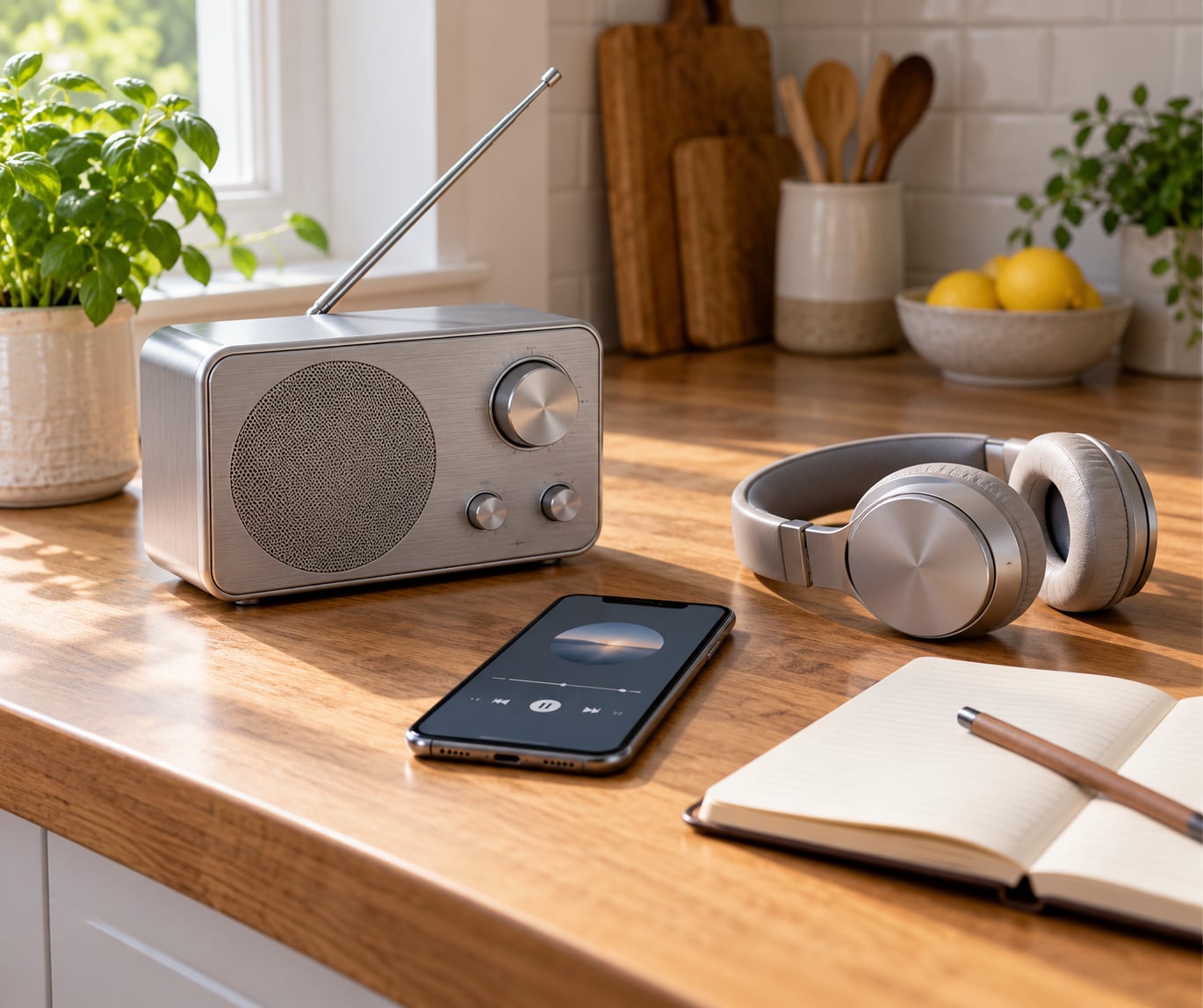
Radio still has listeners because it is free, local, screen-free and habitual. It needs no subscription and no mobile data, it keeps working in the car where a phone signal drops, it hands you local information nobody else is carrying, and it fills the gaps in your day with a familiar voice and some music you would never have picked yourself.
Ask most people why they leave a station on in the kitchen and you rarely hear them talk about sound quality. They talk about the presenter they know, the traffic update that saved them ten minutes, and the song that came on at exactly the right moment. That is the whole argument, really: radio does one job, does it for nothing, and lets you get on with everything else.
Streaming services took the music. They did not take the schedule, the local information, or the voice. Understanding why radio still has listeners in 2026 means looking at what survives when every other audio option is competing for your attention.
Table of Contents
- Why Radio Still Has Listeners
- What Listening Benefits Radio Still Provides
- How Online Radio Changes the Experience
- Why Local and Community Radio Matters
- How Music Radio Keeps Listeners Engaged
- What Radio Offers That Other Media Does Not
- Will Radio Keep Growing or Just Endure?
- Frequently Asked Questions
- Conclusion: The Best Way to Judge Radio’s Value
Why Radio Still Has Listeners
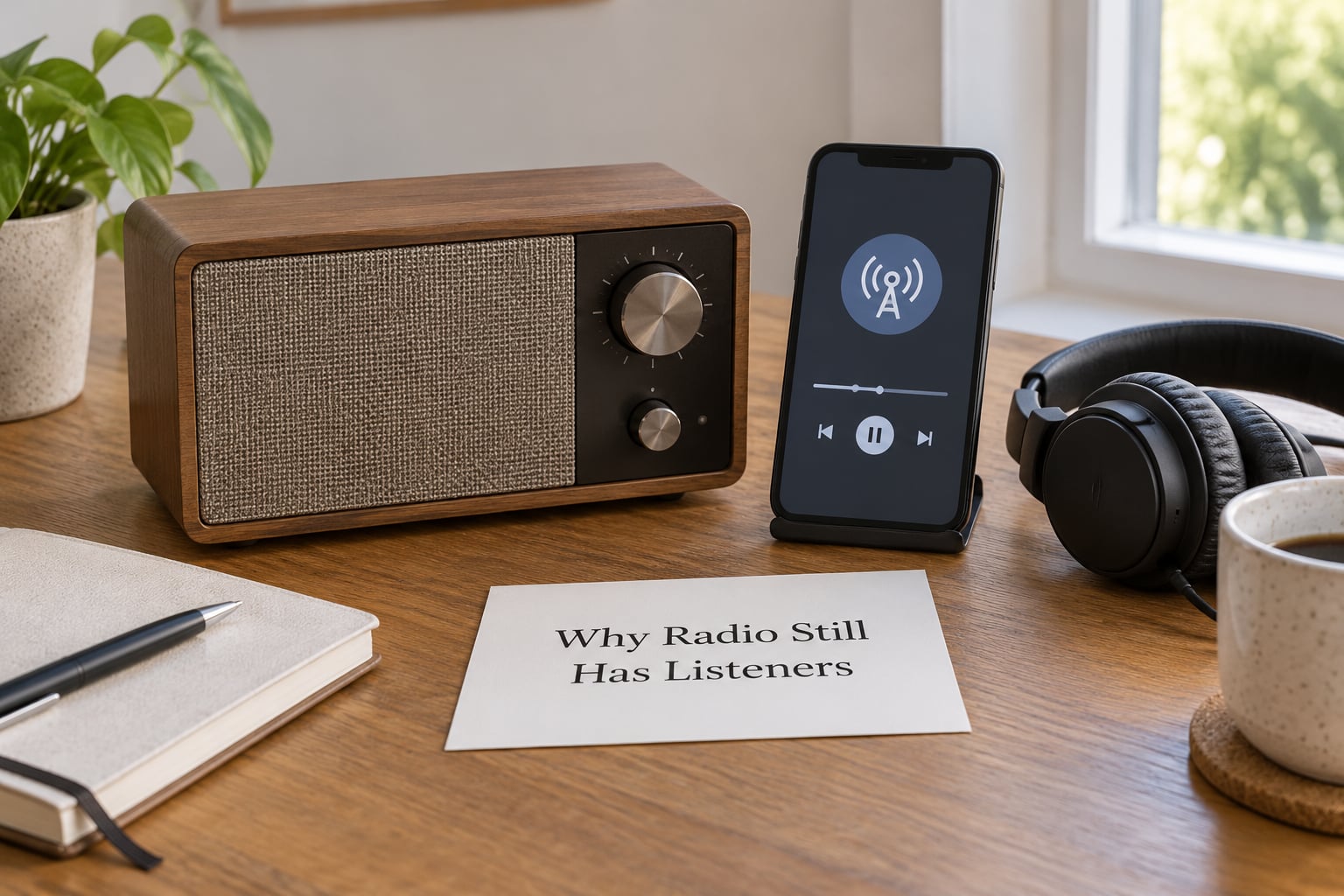
The honest answer is that radio does several modest things at once, and each one alone is easy to dismiss. Together they are hard to replace. Here is what keeps listeners coming back, roughly in order of how often it comes up in conversations about radio:
- It costs nothing and uses no data. A subscription streaming service is a monthly bill. Radio is a receiver and a signal, and that is the whole business model.
- It works where phones struggle. Rural roads, underground car parks, motorway stretches and metal-roofed kitchens are exactly where reception holds up and mobile data gives up.
- It carries information about your area. Road closures, school notices, local sport, weather warnings and community events are the material no recommendation algorithm is going to prioritise for you.
- The voices are familiar. People attach to presenters the way they attach to a colleague at work. You tune in for the person as much as the format.
- It discovers music for you. A station plays a mixture of songs you know and songs you would have skipped past. That surprise is the point.
- It demands nothing. No screen, no searching, no choosing. You switch it on and it starts.
- It fits alongside another task. Driving, cooking, ironing, painting a room. Radio is the one audio medium that is happy being ignored for minutes at a time.
- It feels like a shared place. Hearing the same station as thousands of other people in your area gives the morning a sense of belonging that a playlist does not.
Those eight points explain why radio still has listeners far better than any single statistic does. Numbers are useful, but they are a symptom of the behaviour, not the reason for it.
Radio by the numbers
As of 2026, the most widely published measurement figures look like this. Note that different panels measure slightly different things, so you will see the numbers vary between sources.
- Weekly reach in the US: Nielsen measurement puts radio reach at around 90% of adults weekly, with industry guides citing 2024 data putting reach among adults 18 and over at about 84%.
- Share of ad-supported audio: radio accounts for roughly two thirds of ad-supported listening time, with published figures ranging from about 67% to 69% depending on the panel.
- Age split of total audio time: radio is about 45% of total audio time among 18 to 34 year olds, against about 74% for listeners aged 35 and over, according to Nielsen data cited in 2024.
- In-car listening: roughly a third of all radio listening happens in the car, and one widely cited estimate puts radio at around 80% of in-car audio consumption.
- Biggest formats: News and Talk leads at about 11% of listeners, followed by Adult Contemporary at 8.6%, Classic Hits and Country at 5.9% each, and Sports at 4.5%.
- Podcast comparison: around 55% of US adults listen to a podcast monthly, which is a large audience but a different habit from turning on a station.
In the UK, RAJAR measures audiences quarter by quarter for the broadcast industry, and Ofcom publishes its own research on radio listening. Those bodies report different things from Nielsen, so UK figures are best read as a trend rather than compared directly with US numbers.
How Radio Turns Listening Into a Routine
Radio survives because it is predictable in a way on-demand audio is not. The same programme sits in the same slot, the same presenter turns up, and the drive home has its own show. That fixed shape is what turns listening into a routine rather than a decision.
Behaviour like that is sticky. Once a station is part of the morning, the cost of changing it starts to look higher than the cost of putting up with it. Users on listening forums describe exactly this: they complain about the same songs, the same adverts and the same long talk segments, then admit they would be lost without the station in the car.
That is also why presenter changes hit harder than they should. A new voice breaks the small piece of predictability that made the habit comfortable, and listeners take it personally.
What Listening Benefits Radio Still Provides
The useful part of radio is not that it plays music. It is that it lowers the effort of being entertained while you are busy with your hands. Four benefits come up most often when listeners explain themselves.
Discovery without effort. On-demand listening rewards effort, and most people are lazy about discovery. They build a playlist once, add a few songs a month, and hear the same twenty tracks until the algorithm catches up. A station is continuously making those choices on your behalf.
Company. A talk show or a breakfast presenter gives the house a voice in it. That sounds soft until you have heard people describe turning a station on while working from home, where silence is otherwise the default.
Local awareness. Even people who moved years ago keep an ear out for local news, because some of it still matters to them. Hearing your own area named on air is a small but reliable pleasure.
Variety without effort. News, weather, sport, chat, quiz shows and music all arrive inside one broadcast. A streaming app gives you one of those at a time, and asks you to go looking for the rest.
Why Radio Still Has Listeners Compared With On-Demand Music
The comparison is not really music against music. Streaming services are better at depth: a library of millions of tracks, sound quality you can choose, and the ability to follow an artist from a ten-song playlist into a full album.
Radio wins on the axes streaming is bad at. It is free, it needs no connection, it asks for no decisions, and it delivers something to a room, a car or a shop rather than to one person and one pair of headphones. For a lot of those listening situations, a subscription service is solving a problem the listener never had.
How Online Radio Changes the Experience
Online radio removes the two things broadcast could not do well: distance and history. The same station you can hear on a car radio is usually available on an app, a website or a smart speaker, and most of them keep a catch-up window so you can hear yesterday’s interview.
It also adds reach. Where a car radio in one region might give you a couple of dozen stations, an internet connection gives you hundreds, plus podcasts, talk shows and shows made by people who would never get an FM licence. New formats appear overnight and cost nothing to publish.
What has not changed is the appeal underneath. An online station still runs to a schedule, still has hosts, still puts songs between songs, and still expects you to arrive at a time and stay for a bit. The transmission changed. The habit did not.
One thing did get harder. Finding a station used to mean turning a dial, and turning a dial is an active, deliberate act. Finding one on a car touchscreen often means hunting through a menu, which is why a growing number of drivers simply put a streaming app on the home screen and leave the broadcast band alone. The complaint forum after forum repeats is not that broadcast radio is bad, but that it is awkward to reach.
Why Local and Community Radio Matters
Local is the part of radio that genuinely cannot be copied by a national service. A regional station knows which roads have resurfacing this week, which school is closed, which non-league club is through to a semi-final, and who is organising the fun run on Saturday. None of that is expensive to produce and all of it is worthless once it leaves the area.
Listeners defend local stations far more emotionally than they defend national ones. Forum threads repeatedly name individual presenters, mention a charity appeal a station carried out, or recall a phone-in that actually changed something. That attachment is to a person in a place, and no streaming playlist has a version of it.
The same intimacy cuts both ways, and listeners are honest about it. A station that drops the traffic report, or that pads a talk show with ten minutes of nothing, gets criticised far more sharply than a faceless streaming app would, because people feel ignored rather than underserved.
There is a practical function underneath the community one. Local stations carry severe weather warnings and emergency information aimed at specific areas, which is why forecasters treat them as part of the warning system rather than as entertainment.
How Music Radio Keeps Listeners Engaged
Music is the engine of most music radio, and it works differently from a playlist in a way most people underestimate. A station is playing the same thing to a car park full of drivers, a shop floor and a kitchen, which forces it to a middle setting that always fits. A playlist is tuned to one person and can take risks. Radio cannot.
That constraint is also its appeal. The station will play the new song you would have skipped, and you will hear it in the middle of three you know, which is roughly how music discovery works in real life.
Now the part that gets complained about. The single most repeated grievance on radio forums is repetition: the same small set of songs cycling endlessly, with the same adverts in between. It is a fair criticism, and stations defend themselves with format rules and research, but listeners are describing a real experience.
The second grievance is talk. Long segments with padding push people to press the button and look for another station, which is why the most popular presenters are usually the ones who keep it short and have a sense of humour.
What Radio Offers That Other Media Does Not
Radio’s usefulness is easier to see by lining it up against what people use instead.
- Against a streaming playlist: radio wins on effort, surprise and lack of cost. Streaming wins on choice, sound quality and control.
- Against podcasts: podcasts win on depth and intimacy, and you choose the exact episode. Radio wins on immediacy, because it is live and does not need a download.
- Against social video: video is better when you want to see something. Audio is better when your eyes are on the road, your hands in a bowl, or the screen across the room.
- Against television: a screen and a schedule force attention. Radio can be half-heard, which means it can be on for twelve hours without anyone noticing.
- Against a smart speaker: a smart speaker is a way of reaching radio, not a replacement for it. Ask for a station by name and you get radio on demand.
The pattern is consistent: where the alternatives demand attention, choice or a subscription, radio offers presence and company at no cost.
Will Radio Keep Growing or Just Endure?
Radio is unlikely to disappear, but it is also unlikely to grow the way streaming did. Expect it to endure as infrastructure: broadcast stations keep their FM and DAB signals, and the same audio is pushed to apps, car systems and smart speakers at the same time.
The honest counter-argument is worth stating plainly. Radio is losing young listeners to short-form video and to on-demand audio. It is losing time to podcasts. Playlist complaint levels are high, and local stations in small markets have less genuinely local material to offer than they used to. Listening is also no longer a broadcast-only habit, which means stations now compete with themselves online.
None of that adds up to collapse. It adds up to a medium that is smaller than it was, still free, still local, and still uniquely good at being on in the background. What is shrinking fastest is not radio but the narrow station with nothing local to say.
Frequently Asked Questions
Why do people still listen to radio if they can choose their own music?
Because choosing is work. Building a playlist takes time, most people end up repeating the same handful of songs, and radio hands over a mix of familiar and unfamiliar music without any effort. A station is also a fixed point, with the same presenters and the same show in the same slot. Listeners trade a little control for surprise and company, and streaming has not replaced that trade.
Is radio mainly used as background sound?
Mostly yes, and that is a strength rather than a limitation. Radio is built to run underneath whatever else you are doing: cooking, tidying, driving, working out. Because it needs no screen and no interaction, you can give it partial attention and still catch what matters, such as a traffic report, a local result or a weather warning.
What is the main advantage of local radio?
Local information nobody else is carrying in the same form: roadworks, school announcements, local sport results, community events and severe weather warnings, delivered by presenters listeners know by name. National and online services will give you news from anywhere in the world, but a local station is the one that knows what is happening on your road this morning.
Is online radio the same as broadcast radio?
The music and speech can be identical, but how you receive it changes what you get. Broadcast radio arrives free, works without data and holds a fixed place in the schedule. Internet radio adds hundreds more stations, catch-up listening, podcasts and personalised recommendations, but it needs a connection and hands you more decisions to make.
Will traditional radio stations disappear?
Unlikely in the near term, though formats will keep changing. Broadcasters now push their feeds to smart speakers, apps and car systems, so a station can be heard without anyone touching a dial. What is shrinking is a particular kind of station, the narrow regional one with little local content, rather than radio listening itself.
Conclusion: The Best Way to Judge Radio’s Value
The case for radio is not that it beats streaming. It is that it does something streaming cannot, at a cost of nothing, while you are doing something else with your hands.
So start where the habit will actually form: pick one station that matches what you already care about and where you live, decide where it will play, and give it two weeks without pressing the button. Judge it on the local information and the presenter first, and on the music second. If you find yourself turning it on without deciding to, that is the whole answer to why radio still has listeners.