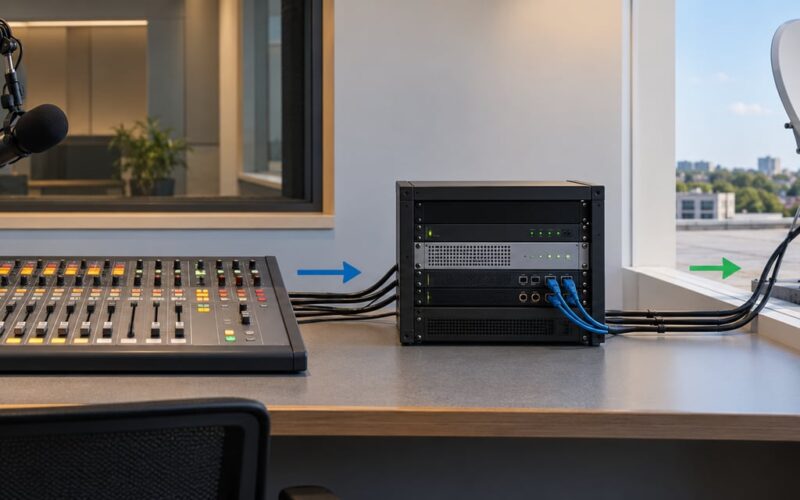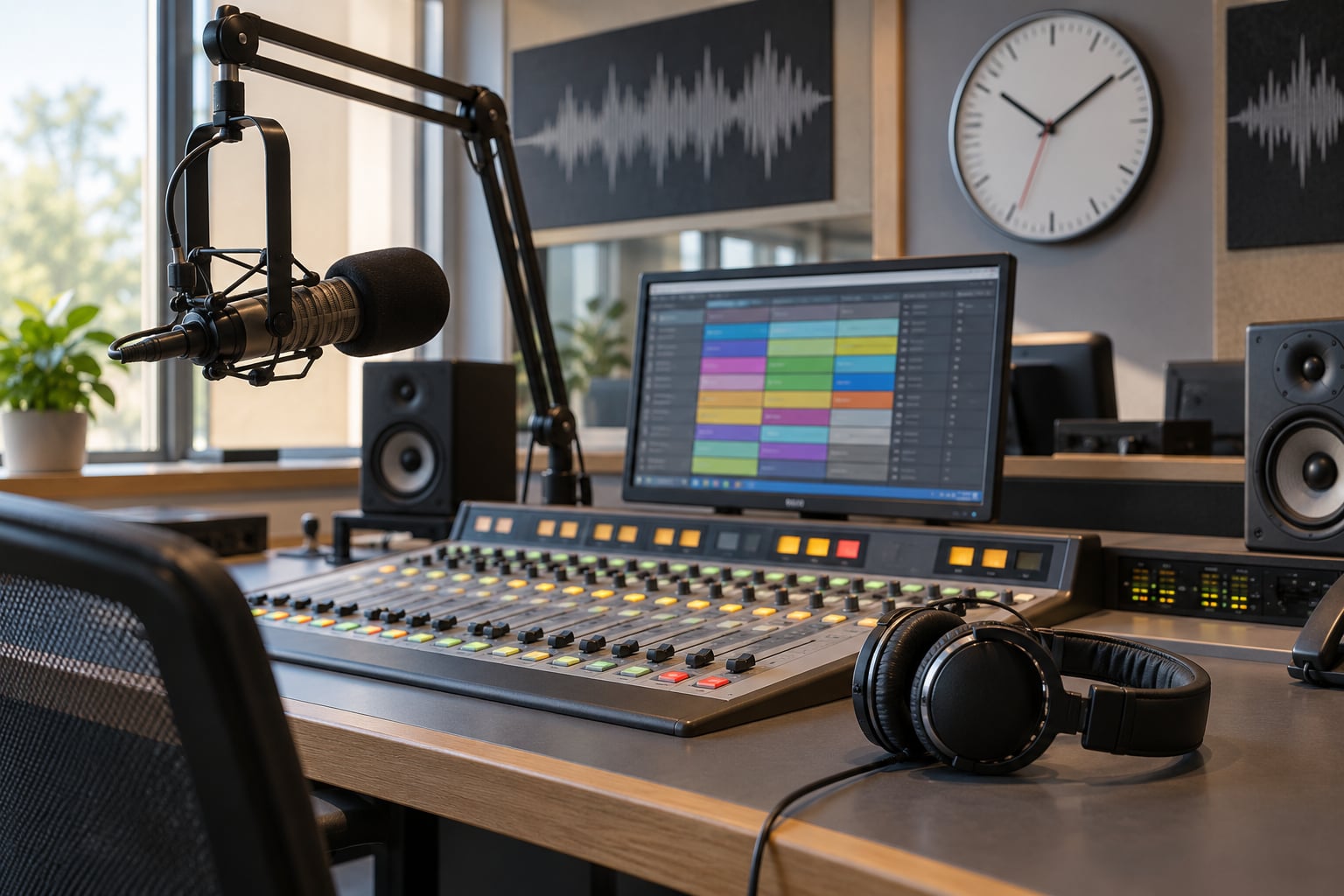
Radio stations choose their playlists with a mix of format rules, audience research, chart data and record label promotion, then load the winning songs into scheduling software that decides exactly when each one plays. The person who owns that decision is usually the program director, working from research that listeners never see.
The interesting part is how much of it is math and how much is negotiation. A song has to fit the station’s sound, prove itself in testing, fit a slot in the hourly clock, and not offend listeners who just heard the same artist twenty minutes ago.
Table of Contents
- What Factors Do Radio Stations Use to Choose Music?
- How Do Stations Define Their Format and Audience?
- How Does Audience Research Affect Playlist Decisions?
- How Do Stations Balance Familiar Songs and New Music?
- How Do Stations Plan Rotations for Each Daypart?
- What Happens When a Song Is Added to the Rotation?
- How Do Online and Streaming Stations Choose Their Playlists?
- Can Listeners Request Songs or Influence a Playlist?
- Frequently Asked Questions
- What Should Listeners Notice About a Station’s Playlist?
What Factors Do Radio Stations Use to Choose Music?
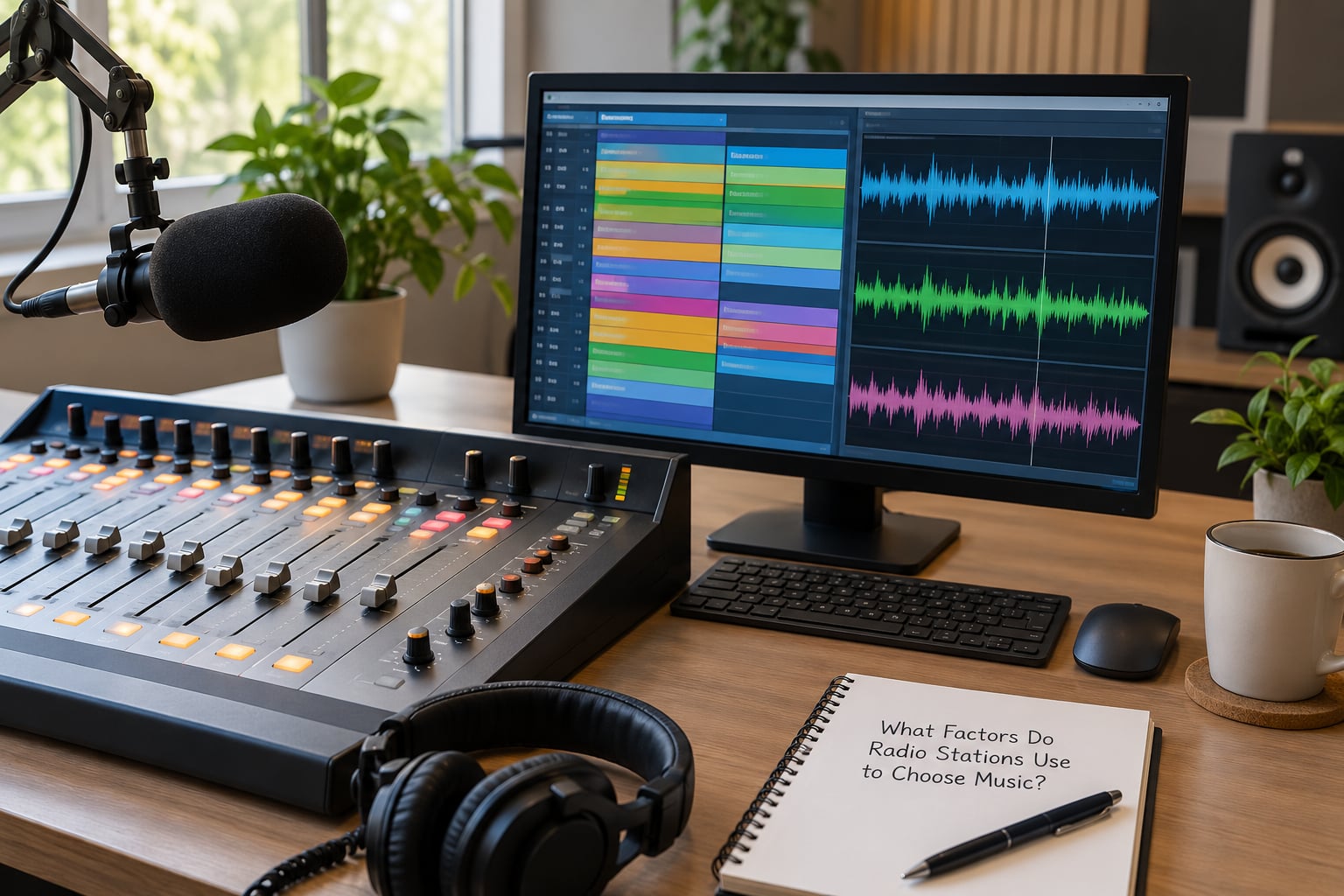
A station weighs roughly ten things before a song gets airtime, and they rarely all point the same direction. The format comes first, because a station cannot play what its audience does not expect.
- Station format — the genre, era and mood the station promises to deliver.
- Audience research — testing scores, listener panels and call patterns.
- Chart position — where the song sits on sales, airplay and streaming charts.
- Label promotion — what the record label is actively pushing this week.
- Familiarity — how many listeners already know the song or the artist.
- Rotation rules — how often a category of song is allowed to play.
- Time of day — whether the song suits morning drive or overnight.
- Local competition — what the other stations in the market are already playing.
- Licensing — whether the station holds the rights to air the recording at all.
- Station brand — the identity the station has promised its audience.
Those last two are the ones listeners rarely think about. A station can love a song and still not play it if the clearance paperwork is a mess, and a station will pass on a number one hit if it sounds like something the station has spent years telling listeners it does not play.
Who actually makes the call?
The titles matter more than most listeners expect, because authority sits with very few people.
| Role | What they own | How much music control |
|---|---|---|
| Program director | Format, budget, playlist and research | Final say on every category |
| Music director | Daily song selection and rotation | Chooses what goes in and what comes out |
| Format consultant | The station’s overall sound and clock | Sets rules the station must follow |
| Host or DJ | Talk, personality, requests within limits | Very little on a fully automated log |
| Station manager | Commercial targets | Pressure on the PD, not the song list directly |
On a large station owned by a corporate group, the music director may not even be in the building. Formats get written centrally, exported to a shared system and pushed to every station in the group. Listeners have noticed. The long-running complaint over at r/radio is that stations in different cities play near-identical logs, which is usually down to a national format rather than a local music director.
How Do Stations Define Their Format and Audience?
A format is a sentence a station makes out loud: this is adult contemporary, this is country, this is classic hits from a defined window, this is jazz for people who work nights. Everything else on the playlist gets measured against that sentence.
Underneath the genre sits a target audience. A station usually writes down an age range, an income bracket, a listening occasion and a coverage area — commuters within fifteen miles of the transmitter, or a regional audience across three counties.
From that, the boundaries follow. A station might define itself as music from 1980 onward, or explicitly exclude rap, or restrict specialty shows to certain hours. Those boundaries are what keep a playlist coherent when a dozen programmers are each adding songs they personally like.
Why format comes before taste
Personal taste is a poor scheduling tool because it varies by person and by day. A format converts taste into a rule that anyone on the team can apply the same way. That is the whole point: the format is a shared decision, the schedule is just the software following it.
How Does Audience Research Affect Playlist Decisions?
No single dataset decides a radio playlist. Programmers combine several sources because each one is wrong in a different direction.
National charts tell you what is popular overall, not what fits this station. Streaming data tells you what listeners play on demand, which rewards deep cuts and skips anything slow. Station audience panels and surveys tell you what this station’s own listeners think. Call-ins and request apps show who is asking, though regular requesters skew toward new music and away from what most listeners want.
When a station adds a song, it usually passes through a formal music test. Listeners hear a short batch of candidate songs in the context of the station’s show and say whether they would want to hear it more or less often. Songs that come back as familiar and liked move up. Songs that test as neither tend to sit in a low slot or get dropped.
Listeners are also asked how familiar each song is, from never heard to know every word. That number is what places a track in a category. A song nobody recognises cannot be a heavy rotation track no matter how good it is, because heavy rotation assumes recognition.
How Do Stations Balance Familiar Songs and New Music?
Stations run a deliberate ratio between music people already know and music they are being introduced to. That ratio is the reason two stations with the same song list can feel completely different.
Two rules do most of the work. Artist separation limits how often one artist can appear in a set of songs, which is what stops a morning show from turning into one artist’s mixtape. Title rotation limits how often the same song comes back in a given window.
New music is risk, and stations spend that risk carefully. A handful of slots are reserved for songs with no established audience yet. If a newcomer keeps testing well, it moves from that low slot into current rotation and starts getting more airtime, which is how a debut single becomes a record people recognise from the radio.
Labels add pressure at this stage. Promotion reps visit program directors regularly with new releases, and that attention is heavier in major markets than in small ones. The honest answer is that most stations describe their process as test-driven, while listeners often believe placement is bought. Both things happen; the research process is real and it is also easy to influence.
How Do Stations Plan Rotations for Each Daypart?
The same song library is reprogrammed for each part of the day, because listeners are different at 7am and different again at 2am.
Scheduling software handles this with what is called a format clock — a repeating pattern of song categories that fills an hour. A clock can reserve a position for a certain rotation level, a certain tempo, a certain era or a certain artist mix, and the software fills the rest from the library.
Song timing matters as much as category. A three-and-a-half-minute song placed at the top of an hour leaves a gap, so stations plan for average length and adjust. Tempo and energy flow are handled the same way: the clock can call for a gradual build rather than a jump.
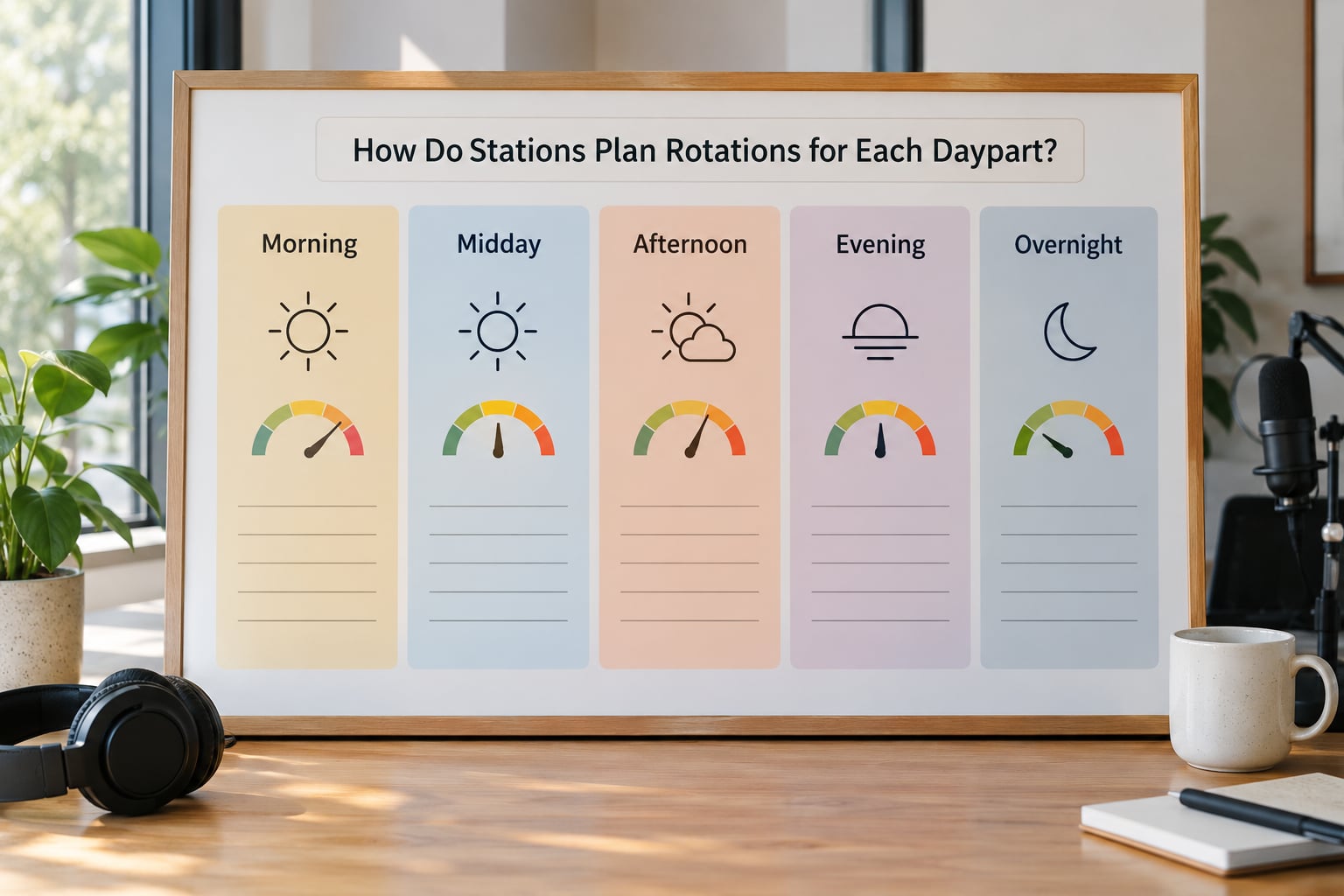
| Daypart | Typical approach | Music character |
|---|---|---|
| Morning drive | Highest familiarity, tighter clock, more headlines and talk breaks | Familiar, upbeat, current-heavy |
| Midday | Broader mix, more requests | Balanced across rotation levels |
| Afternoon drive | Energy built toward the end of the block | Current-led with a gradual rise |
| Evening | Longer shows, more specialty segments | Wider, artist-driven |
| Weekend | Countdown shows, themed blocks, specialty shows | Deep catalogue and specialty genres |
| Overnight | Lower repetition rate, fewer interruptions | Slower, softer, more familiar |
Overnight is where the difference is most obvious. The audience is small and loyal, often working, so stations cut repetition and lean on softer material. Weekends, by contrast, are where a station can be adventurous, because the audience actively came for discovery.
What Happens When a Song Is Added to the Rotation?
A song gets on the radio through a sequence that most listeners never see. Here is a realistic version, using a new indie single as the example.
- It gets logged. A label rep sends the track, or the music director finds it independently. It lands in the incoming log with basic technical details.
- It gets vetted. Programming software checks the tempo, length, loudness and artist separation against the current clock. Anything that fails is ruled out before research even starts.
- It gets tested. The song enters a music test or plays in a short trial period. Familiarity and acceptance scores come back.
- It gets clocked. If the results hold, it takes a slot in a rotation category with a defined play frequency. The software places it in specific hours.
- It gets tracked. The station watches how it performs in real rotation — requests, complaints, whether listeners stay through it.
- It gets moved or cut. The song is promoted to heavier rotation, held where it is, or removed when the test window closes.
Here is how those categories normally look:
| Category | What it means | Typical frequency | Song age |
|---|---|---|---|
| Current / heavy | The newest and most-played material | Several times a day | Newest releases |
| Recurrent | Established tracks still in active rotation | A few times a day | Months old |
| Gold / classic | Familiar records that never left the library | Daily or weekly | Any age |
| Catalog | Older and less-played records | Infrequent | Older releases |
The trap is testing well but not being recognisable. A song can be liked and still fail, because listeners rate songs they already know far more highly. That mismatch is why stations underplay good new music and lean on catalog more than the music press would like.
How Do Online and Streaming Stations Choose Their Playlists?
Online-only stations have more freedom and less history. There is no transmitter, no coverage area and often no local studio, so the playlist is built from a genre and a mood rather than a market.
The toolset is different too. Instead of a research panel, an online station leans on streaming analytics, listener requests, community votes and tag-based curation. That makes discovery easier, which is why small independent artists get airplay on online stations at rates terrestrial stations rarely match.
The failure mode is obvious: a random mix generated purely from genre tags sounds like every other station on the same platform. Good online stations keep a strong identity instead — a specific era, a specific mood, a host voice that runs the show — and use the algorithm to fill gaps rather than to make the decisions.
Public and non-commercial stations run a third model. They have fewer commercial constraints, so they can take more chances with unfamiliar music and use fewer repeats. What they lose is the strict format clock that keeps a terrestrial log tight, so their variety often comes at the cost of consistency.
Can Listeners Request Songs or Influence a Playlist?
Yes, within limits. Requests reach programmers through station apps, websites, call-ins, contests and social posts, and the music director sees all of them.
What a request can realistically do is promote a specific record for a specific show, add a title to a feature, or prompt a station to research a song that listeners are asking about. What it will not do is override the format. If a song falls outside the station’s boundaries or the promotion window has closed, the answer is usually no, however many people ask.
Stations handle request volume carefully. A song that already plays six times a day does not need more requests, and letting the loudest requesters set the playlist would hand control to a small, self-selecting group. That is why many stations weight requests by recency and by whether the artist is already represented.
Frequently Asked Questions
Why do radio stations play the same songs over and over?
Repetition is a scheduling rule, not an accident. A station runs a fixed clock in which each song category has a set play frequency, and artist separation limits how often one artist appears. Familiar songs hold the audience through a drive or a work shift, and research shows listeners rate songs they already recognise far more highly than new ones. The trade-off is that a tight rotation feels repetitive, which is why listener complaints about it never really stop.
Do DJs choose the music they play on air?
Rarely, on a fully automated station. The playlist and the hourly schedule are built in advance by the program director and music director, and the automation software plays what the log says. On-air hosts still control talk, personality, interviews and sometimes song intros, and some stations let hosts pick within limits. But the song list itself is almost never improvised live.
What is heavy rotation in radio?
Heavy rotation, also called current rotation, is the most-played category in a station’s schedule. Those songs run several times a day and are usually the newest and most-requested releases. A song has to test as both familiar and liked to reach it, which means heavy rotation favours songs listeners recognise rather than songs that are merely good.
Do artists pay radio stations to play their songs?
Direct payment for a specific track is illegal in the US under federal anti-payola rules, so labels cannot simply buy a spin. What does happen is promotion: label representatives visit program directors, supply new releases and push artists for airtime, and those relationships can influence what gets tested. Stations also have a real commercial incentive to play songs that will keep an audience listening to their advertising.
Can radio stations track how many listeners they have?
Yes, in detail, and from several directions. Terrestrial stations use Nielsen-style audience measurement panels that sample households, plus over-the-air data from the station itself. Online stations get far more granular figures from streaming logs and apps, including which song prompted someone to tune in. Those numbers then feed back into research, since knowing when people tune out is as useful as knowing when they tune in.
Can listeners request a song on the radio?
Almost always, through the station app, website, phone line or a contest. Requests reach the music director, who can use them to add a specific title to a show or a feature. What a request usually cannot do is change the playlist as a whole. If the song sits outside the format, or the artist is already heavily rotated, or the promotion window has closed, the station can decline without giving a reason.
What Should Listeners Notice About a Station’s Playlist?
Now that you know the machinery, four things become audible. Start with the rotation pattern: note the time between the same song returning, and whether an artist comes back too soon. Then track the daypart, because the shift from morning energy to overnight softness is usually the biggest shift you will hear in a day.
Watch what gets added. If a track you did not know suddenly appears three times a week, it has passed whatever test the station runs, and it will either climb into heavy rotation or quietly disappear. And keep an ear on the familiar-to-new ratio — a station that plays roughly two thirds material you recognise is doing something different from one that plays a new song every half hour, and both are legitimate formats.
If the repetition bothers you, the fix is not usually a request. It is a different station, or a different type of station, since a public broadcaster, a college station and a commercial classic hits outlet will sound nothing alike. Understanding how radio stations choose their playlists turns a complaint into a choice.