Music gets on the radio when a finished, correctly delivered track reaches a station and a music director decides it belongs in the playlist. From that moment playout software schedules it to air, on repeat, inside the station’s hourly clock. Labels and distributors handle delivery for signed artists; unsigned artists pitch directly. Nobody buys a spin.
Most people ask this from one of two directions. Listeners want to know why the same twelve songs come round again every hour. Artists want to know how to get their own track onto a station they have never spoken to. Both answers start in the same place, so this guide covers the mechanics first and the practical pitching side second.
Table of Contents
- How Music Gets on the Radio: The Basic Path
- What Does a Song Need Before It Can Be Radio-Ready?
- How Do Artists and Labels Submit Music to Radio?
- How Do Radio Stations Decide What to Play?
- What Is the Difference Between Airplay, Streaming, and Radio Streaming?
- How Does Music Licensing and Royalties Work?
- How Can a New Artist Improve Its Chances Without Buying Airplay?
- Frequently Asked Questions
- How does a song get radio play?
- Who decides what songs get played on the radio?
- How much do I get paid for my song being played on the radio?
- How can radio stations play copyrighted music without permission?
- Why do radio stations play the same songs over and over?
- Can I submit music to radio without a record label or publisher?
- What to Do First
How Music Gets on the Radio: The Basic Path
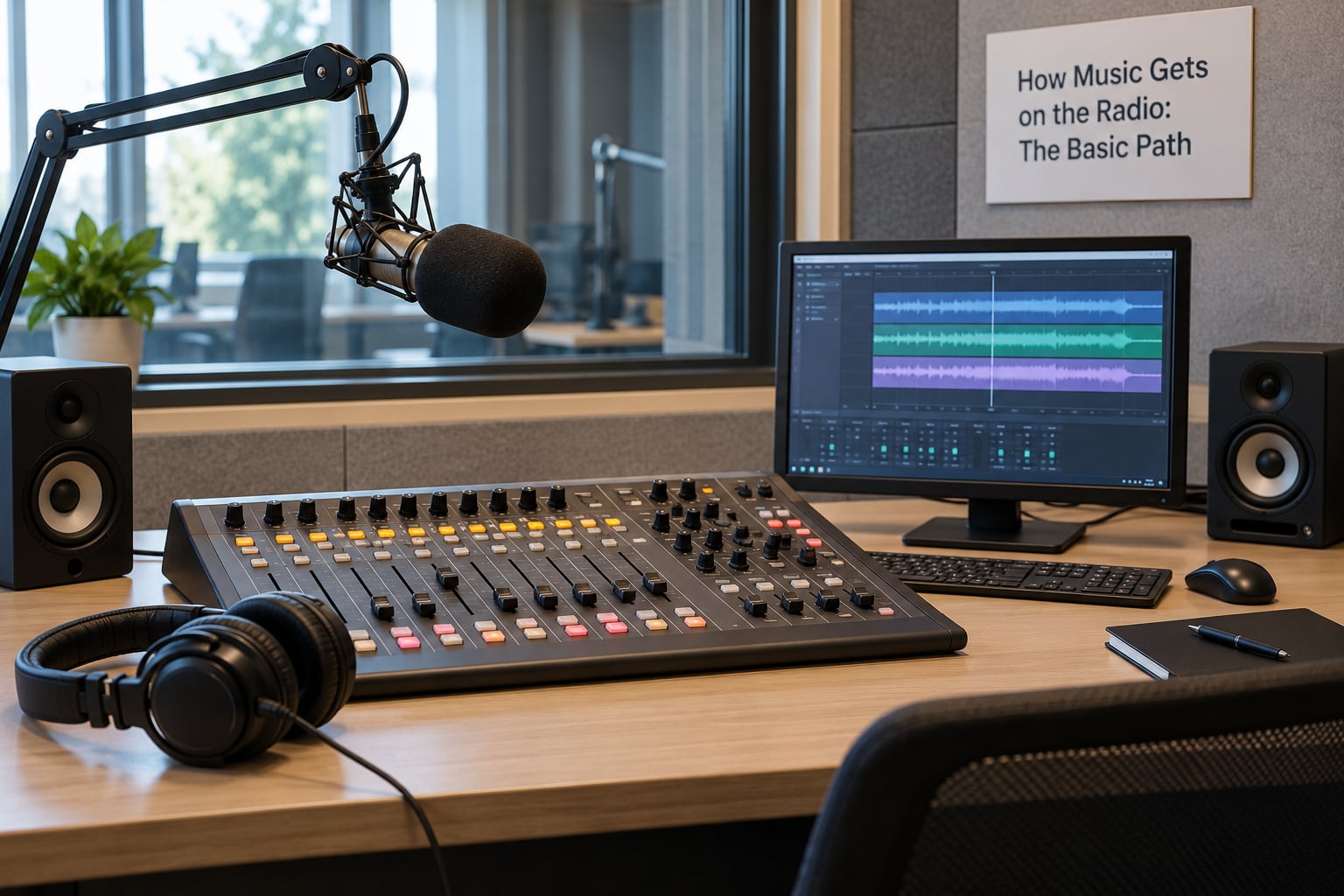
A song reaches air through six steps, and each one belongs to a different person with a different job.
- The recording is finished and the details are correct. Mastered audio, right spelling on every name, right songwriter and producer credits, and a clean edit if the station needs one.
- The track is delivered to the station. For label and distributor releases this happens automatically through music delivery platforms. For independent artists it is usually a private audio link in an email.
- A music director logs it. The music director is the person who adds, moves and removes songs on a station’s playlist, and new music arrives from dozens of sources every week.
- The song is heard properly and judged. Many stations run a scheduled music meeting where the team listens to everything new and decides. Some decide faster, one track at a time, and smaller stations often skip the meeting entirely.
- It enters rotation. A format clock is the repeating hourly schedule that decides when music plays. A song is given a category and a level of rotation, which is how many times per week it gets played.
- It airs and the spin is logged. The station reports the play to a monitoring company and to the bodies that collect royalties, which is how airplay turns into a chart position or a royalty statement.
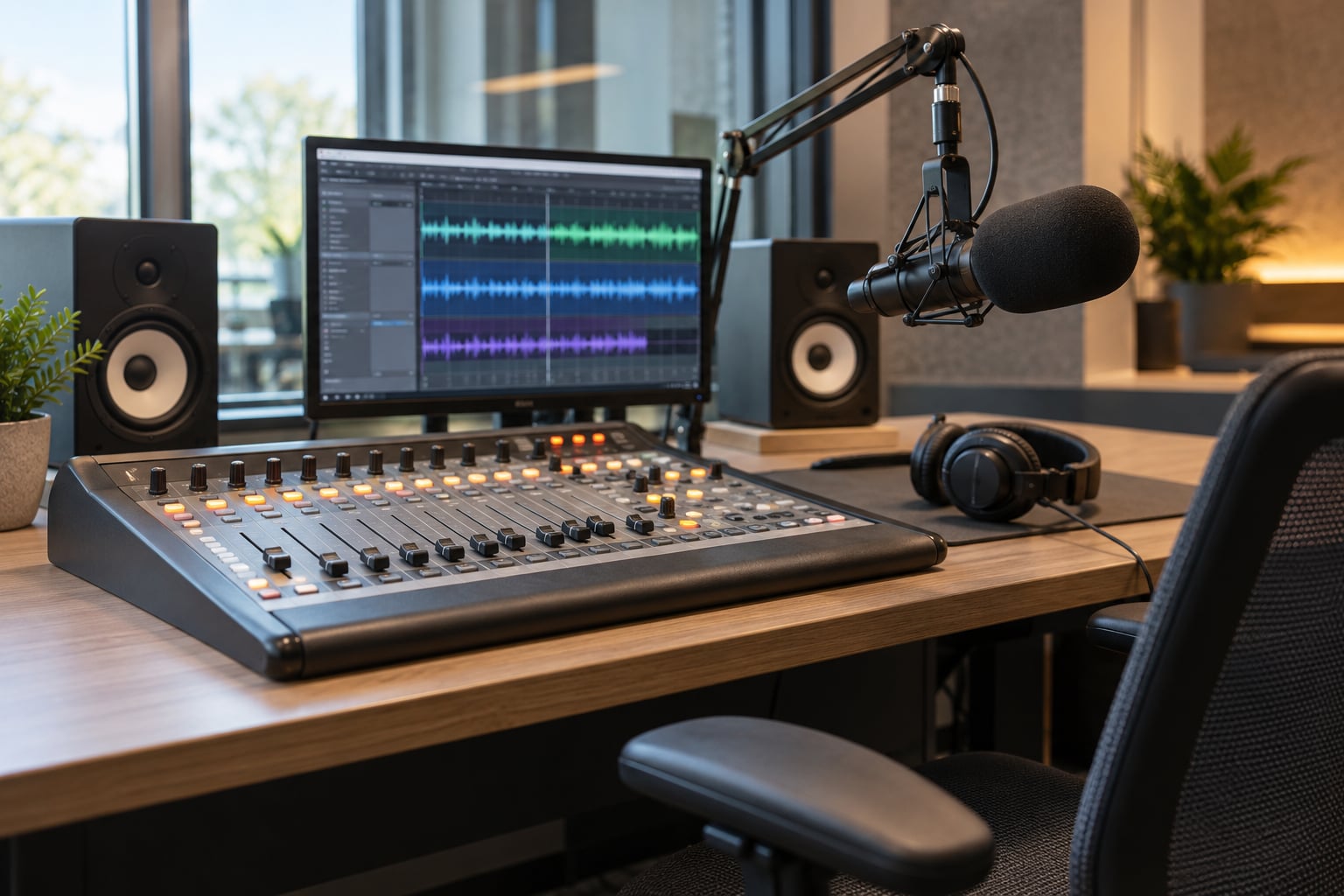
The music itself is not usually played by hand. The playout system is the automation software that schedules and plays audio on air, handling jingles, adverts, news and voice tracking. Systems such as MusicMaster, PLUGGER and Audacy run on a station computer, and the audio leaves through the transmitter for FM, AM and DAB, or through a stream for online and satellite output.
That pipeline is identical whether the station is a national commercial network, a small community station or a stream-only internet service. Only the number of people involved changes.
What Does a Song Need Before It Can Be Radio-Ready?
Most silent pitches fail on preparation, not on talent. Before anything is sent out, these need to be finished.
- Mastered audio, broadcast-ready. Around -14 LUFS integrated loudness is the usual target. An unmastered mix sounds like a different record on air because FM applies heavy compression and peak limiting on top of it.
- A radio edit. A shorter, clean version with any explicit language removed. Commercial formats will reject a five-minute album track with no exception.
- A runtime that fits the clock. Around 3:40 is the working maximum for most music formats, because anything longer crowds the advertising and news breaks.
- A hook inside the first 15 seconds. Music directors often move on before the chorus arrives. This is the single most repeated complaint about rejected submissions.
- Clean metadata. Artist name, track title, featuring artists, writers, producers, label and ISRC code, all spelled the way the station will log them. A typo in a writer credit means the royalty never reaches the person who wrote it.
- Artwork that looks intentional. Cover art is usually the first thing a music director sees. Plain text on a flat colour block is an instant credibility loss before a note is played.
- An electronic press kit. One page with the audio, a short bio, a press photo, genre, tempo, a releases-ink-if-you-like list and your contact details.
A radio plugger interviewed on a music industry podcast put it plainly: artists are judged on presentation before the song is even heard.
How Do Artists and Labels Submit Music to Radio?
There are four routes, and they differ mostly in who takes responsibility for delivery.
Label and distributor delivery. When music goes out through a distributor, it reaches stations automatically through music delivery systems that label teams set up once. This is the smoothest route because metadata and audio arrive formatted for the station’s system, and it is why unsigned releases often need a distributor even without a record deal.
Direct to the music director. A short email with a private streaming link, one paragraph on why the song suits that specific station, and nothing else. Mass mailouts to scraped lists rarely work and can mark you as spam.
Specialist, community, hospital and student stations. These are the realistic first-entry routes for UK artists with no audience. Hospital radio trusts and community stations run open submission and local-access schemes, and student stations give emerging acts hours of play. BBC Introducing is the public service equivalent, and it has been the entry point for a lot of UK acts.
Through a plugger. A radio plugger pitches on your behalf using existing station relationships. The useful ones will criticise the song before they send it anywhere and will go back with new evidence after a station declines.
Whatever the route, deliver the actual file or a stable link rather than an attachment, keep the email shorter than you think necessary, and never misrepresent where the song came from.
How Do Radio Stations Decide What to Play?
The music director decides. The programme director sets the rules the music director works inside, and at most UK commercial stations one person holds both jobs.
On a music-led station, the decision usually comes down to fit. Someone who has run stations and pitched to them for decades describes the test as simple: listen to a station for days, learn its tone, then ask whether your track would sound right sitting between two songs they already play. Sound competitive is the bar, not exceptional. Those voices also note that stations hold slots for unsigned artists precisely so new music can sit in the mix next to established acts.
Alongside fit come format and research. Songs are categorised by tempo, era, mood, artist history and how much airplay they have had. Audience research tells the station whether the listeners it has actually liked that sound, and a song that tests badly or clashed with an earlier rotation tends not to be added again.
Some formats track charts. The Official Charts Company and the specialist UK genre charts, and Billboard in the US, feed directly into programming decisions at stations that follow them. A track climbing matters more to a programmer than a track that is merely good.
After that comes rotation. A new add is often played heavily for a week or two while listeners react, then thinned out. Some tracks go into recurrent rotation, meaning they stay in the schedule for months at a lower level, while others get two spins and disappear. That is where the painful arithmetic sits: a major station playing your song once can earn the same royalty as a small station playing it thirty times, because the fee follows audience size, not the number of spins.
What Is the Difference Between Airplay, Streaming, and Radio Streaming?
The same song can appear on four different platforms that listeners routinely mix up.
Airplay is broadcast transmission. The audio goes to a transmitter and reaches FM, AM or DAB listeners who have no control over it. It is counted by broadcast audience measurement and reported to the broadcast royalty bodies.
Radio streaming is the same station’s playout output sent over the internet. The music decision is identical, so the playlist usually matches the broadcast version, but listening data is far richer because the station knows exactly who tuned in and for how long.
Digital-only internet radio has no transmitter at all. A playout server pushes audio straight to your device, and stations in this category can be far more experimental with genre because they are not bound by a broadcast licence in the same way.
Playlist streaming is a different business entirely. There the listener chooses, and a skip after eight seconds counts against you. That difference is why radio still matters: it is one of the last places a listener hears a full song they did not go looking for.
| What you are hearing | How the audio travels | How plays are counted |
|---|---|---|
| Terrestrial airplay | FM, AM or DAB transmitter | Broadcast audience panels, reported to broadcast royalty bodies |
| Stream of a broadcast station | The same playout system, encoded to an internet stream | Station listening data, often folded into broadcast reporting |
| Digital-only internet radio | Playout server to a listener’s device | Third-party audience measurement such as Nielsen in the US |
| Playlist streaming | Streaming platform audio | Streams and skips, not spins |
How Does Music Licensing and Royalties Work?
Stations do not need permission song by song. They buy blanket licences that cover the whole repertoire, which is why you cannot pick a track and say yes or no to a named station.
In the UK the bill is split across several bodies. PRS for Music collects performance royalties for the composition when it is played publicly, and pays the songwriters and publishers behind it. PPL licenses the sound recording itself for broadcast. MCPS covers the making of recordings, so it matters to producers rather than performers. A commercial station pays all three through a broadcast licence, with the BBC covered by the BBC’s own arrangements.
In the US the split is different. BMI, ASCAP and SESAC are performance rights organisations for the composition, and a songwriter or publisher joins one of them. SoundExchange collects digital performance royalties for the sound recording from satellite and internet radio. Terrestrial stations in the US sit under a statutory licence and do not pass on performance royalties for the recording at all, which is a genuine difference from the UK.
Here is the part that catches artists out. Radio royalties are not automatic, and they are not large. The people collecting most of the money are the songwriters and publishers registered with a rights body. A recording artist with no publishing deal and no registration often receives nothing from a spin, which is why unsigned UK artists are advised to join PRS for Music if they write their own material, and to keep the publishing split agreed in writing before release.
How Can a New Artist Improve Its Chances Without Buying Airplay?
Everything below is free. None of it is guaranteed, and anyone who tells you otherwise is selling something.
Fix the recording before the pitch
Get the mix and master right, produce the radio edit, and cut the intro so the hook lands early. A plugger quoted in industry interviews says roughly 60 per cent of releases submitted to his company are refused outright, usually for technical reasons rather than taste.
Build a short, targeted list
Twenty stations that genuinely play your genre beat two hundred that might. Listen to each one for a couple of days and write down why your track fits, because that sentence is your pitch.
Contact the right person, briefly
Most stations publish a music submission address or a music director’s name. Keep it to a few lines, one link, and a genuine reason for that station. Send a radio drop only if you have something real to offer, not a re-record of the same song with your voice on it.
Follow up once, then wait
A single polite follow-up after seven to ten days is normal practice and is generally welcome. Then leave it. Chasing weekly gets you blocked, and stations rarely reply with a rejection either way.
Start where access is realistic
Community, hospital, student and BBC Introducing routes in the UK are where new acts get their first play, and those plays are worth having because they prove the track works in a real broadcast system.
Never pay for airplay
Payola, paying for a spin without disclosing it, is illegal in most jurisdictions and treated as a serious regulatory breach in the US through the FCC. In the UK, commercial broadcasters operate under rules that prohibit payments or inducements tied to playing particular material. There is no grey area here: if a service promises plays in exchange for money, it is either paying off a station or lying to you.
To vet a plugger, ask who they have worked with and what stations they can name. If they will not say, or they promise a fixed number of spins for a fee, walk away. A good plugger tells you which format your track suits before they send it anywhere.
A realistic timeline: a pitch to a small or community station can land in a few weeks. National commercial and major BBC stations usually work in three to six month cycles, and one play rarely turns into recurrent rotation on its own. What a first play does buy you is credibility, which makes the follow-up single and any support slot or festival conversation considerably easier to have.
Frequently Asked Questions
How does a song get radio play?
A song gets radio play when it is delivered to a station’s music system and a music director adds it to the playlist. Once it is scheduled inside the station’s format clock, the playout software airs it repeatedly at a set rotation level. For signed artists this happens through label and distributor delivery; independent artists usually pitch directly by email with a private audio link.
Who decides what songs get played on the radio?
The music director decides, working inside a format set by the programme director. On many UK commercial stations one person holds both roles. The judgement is mostly about fit: whether your track sounds right next to what they already play, whether research supports it, and whether it suits the station’s tempo and mood categories. Listeners rarely have any direct say.
How much do I get paid for my song being played on the radio?
Often very little, and sometimes nothing. Stations pay a blanket licence, so there is no per-spin fee. In the UK, PRS for Music collects performance royalties for the composition and pays songwriters and publishers, while PPL covers the sound recording. If you have no publishing registration, a spin may not reach you at all, which is why self-written songs should be registered properly before release.
How can radio stations play copyrighted music without permission?
They do not need permission for each song. Instead they hold blanket licences covering large parts of the repertoire, which is why a station can play any licensed track without asking the artist first. In the UK that means PRS for Music, PPL and MCPS, paid through a broadcast licence. In the US, BMI, ASCAP and SESAC cover the composition, with SoundExchange handling digital performance royalties.
Why do radio stations play the same songs over and over?
Because rotation is engineered around research, not taste. Every station runs a format clock with categories for tempo, era and mood, and songs are given a spin level that repeats them at controlled intervals. Recurrent tracks stay in the schedule for months because they tested well with the audience panel. The repetition is the product, not an accident.
Can I submit music to radio without a record label or publisher?
Yes. Distributors release music without a label deal and still deliver it into station music systems, which is the cleanest route. You can also email music directors directly. What you should sort out yourself is the songwriting and publishing side, since that is where royalties come from. Without it, airplay can be good for credibility and worth nothing financially.
What to Do First
Finish the release properly before you contact a single station. Get the master broadcast-ready, produce the radio edit, and check every credit in the metadata, because that is the file the music system logs and the information the royalty bodies pay against.
Then pick one genre that genuinely fits, find three stations that already play that genre, and send each music director a short, specific pitch with a private link. That one afternoon of work puts you ahead of most submissions, and it is the only part of the process you fully control.