If you want the short answer: a hand crank radio works by turning your arm’s motion into electricity. A small generator, usually a dynamo, spins inside the case and charges a rechargeable battery or a capacitor bank. That stored power then runs the receiver, which picks up radio waves through an antenna and turns them into sound.
The crank supplies energy. It does not carry audio, and it has nothing to do with how good the reception is. Once the radio has power, it behaves like any other AM, FM or weather-band receiver.
Table of Contents
- How a Hand Crank Radio Works at a Glance
- The Parts That Make a Hand Crank Radio Work
- How the Crank Produces Electrical Power
- How Radio Signals Become Sound
- AM, FM, and Shortwave Signals
- Why Some Hand-Crank Radios Need More Cranking
- What to Look for in a Hand Crank Radio
- Frequently Asked Questions
- Conclusion
How a Hand Crank Radio Works at a Glance
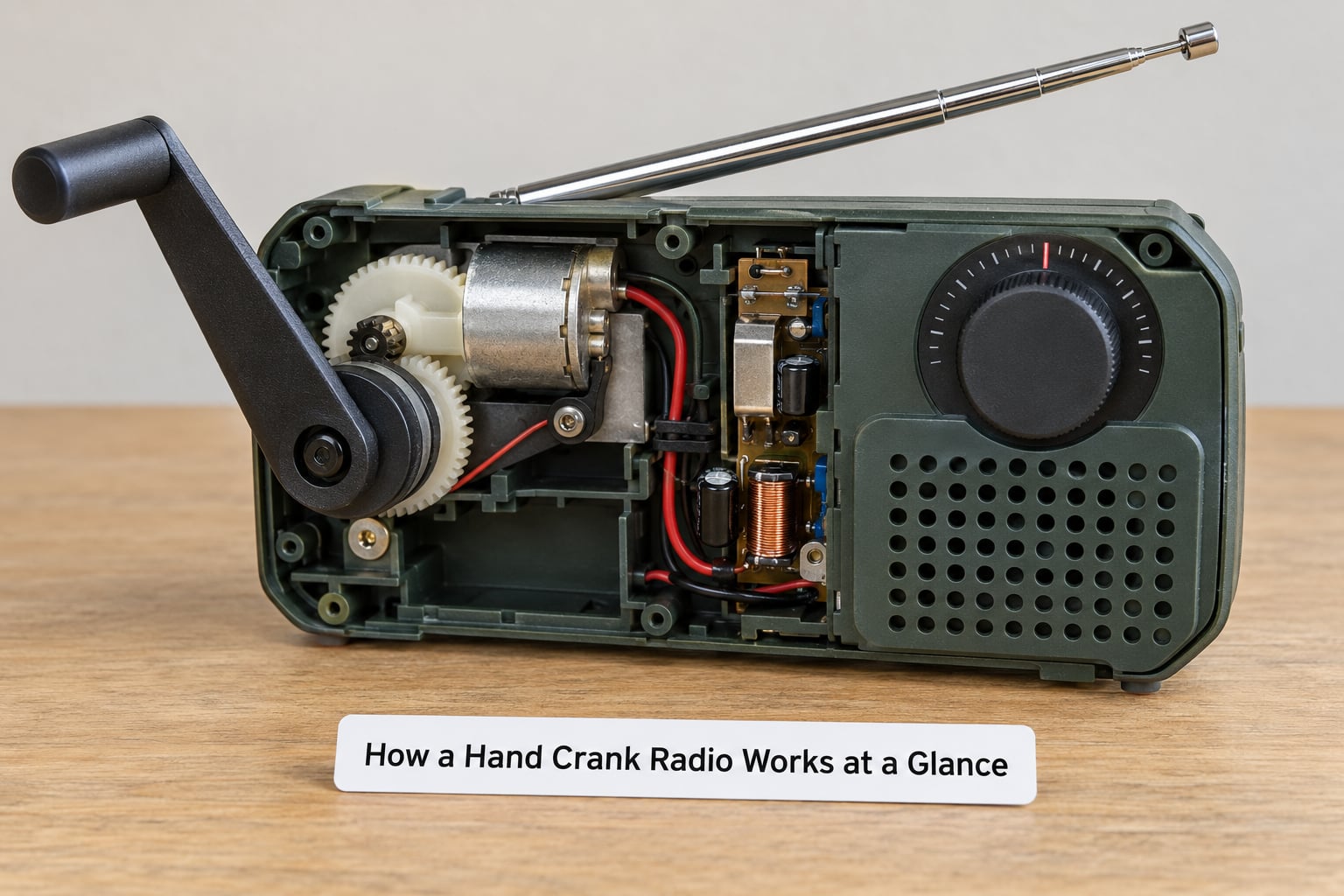
Here is the whole chain in one view. Every stage exists to move energy or signal to the next stage, and each one loses a little something along the way.
| Stage | What happens | What it contributes |
|---|---|---|
| Crank motion | You turn the handle at roughly one to two revolutions per second | Mechanical energy from your arm |
| Gear train | A set of gears multiplies crank speed and torque | Turns a slow handle into a fast shaft |
| Generator | A permanent magnet dynamo spins, changing magnetic flux | Small alternating current |
| Rectifier and charge controller | AC is converted to DC and regulated | Direct current safe to store |
| Storage | A rechargeable cell or capacitor bank holds the charge | Power you can use later, not only while cranking |
| Converter | A DC to DC boost converter raises the voltage to a steady level | Stable supply for the electronics |
| Antenna | The telescopic aerial intercepts radio waves | A tiny signal voltage |
| Tuner | A variable capacitor selects one frequency out of the whole band | Separates your station from all the others |
| Receiver and speaker | The audio is amplified and pushed out | Sound |
The Parts That Make a Hand Crank Radio Work
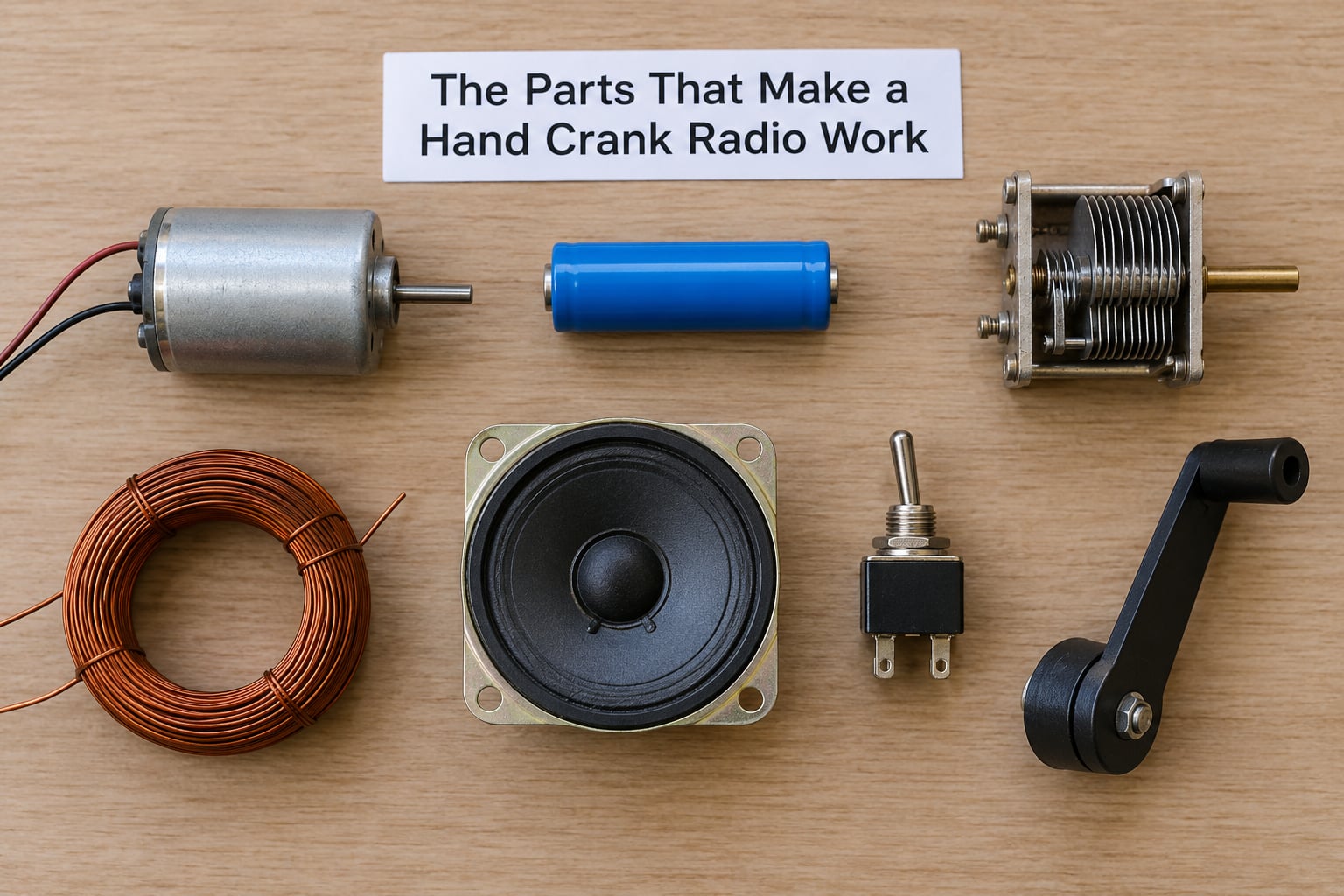
Almost every hand crank radio is the same eight or nine components wired together. Knowing what each one does turns a confusing box into a chain you can follow.
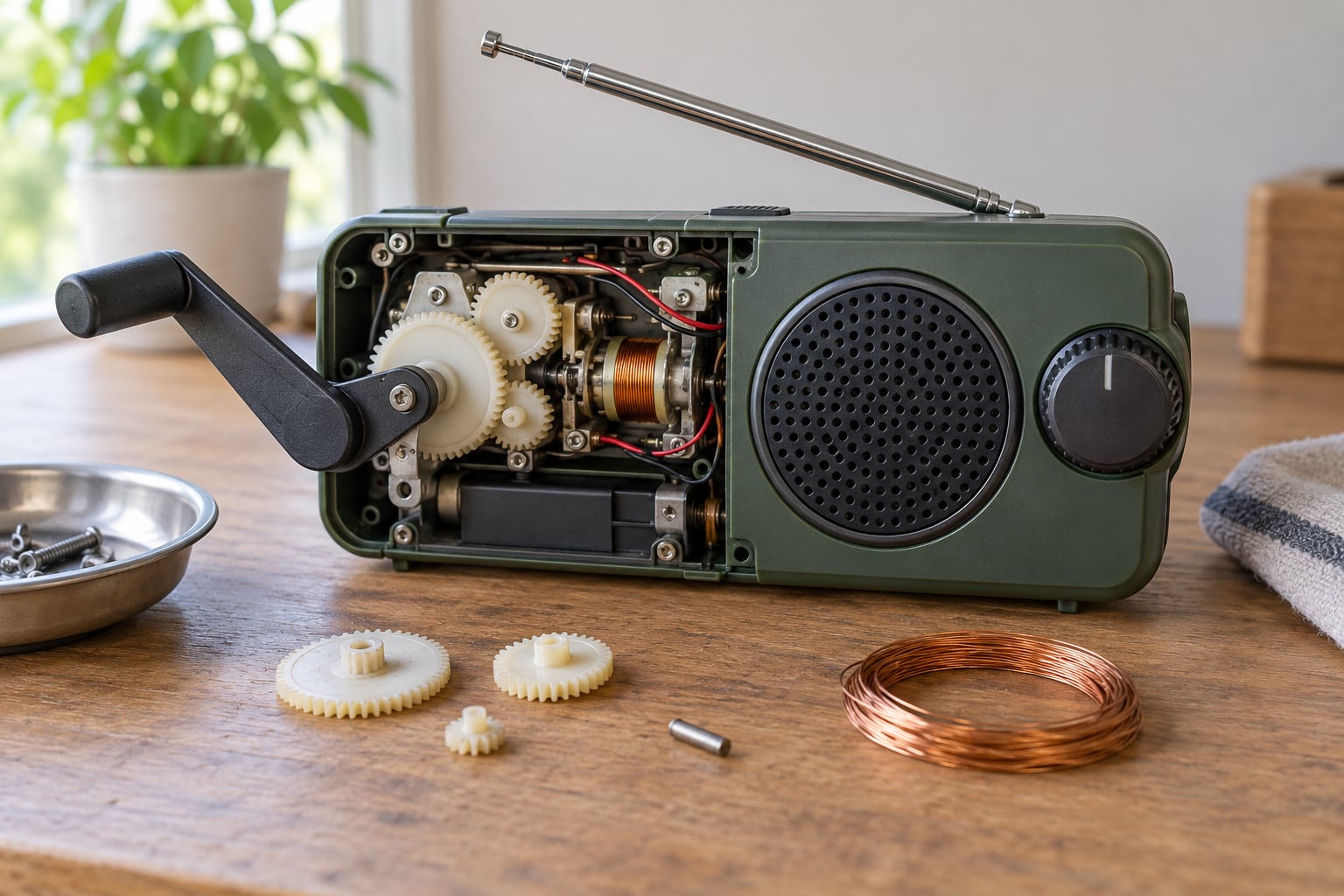
- Crank and gear train. The handle turns a shaft, and a set of small gears steps that rotation up. Some sets also step it down in torque to keep the handle from becoming painfully stiff.
- Generator. A permanent magnet dynamo, sometimes a small DC motor used backwards as a generator. It produces a low-voltage alternating current.
- Rectifier. Diodes flip the alternating current into direct current, because a battery cannot be charged with AC.
- Charge controller. A small circuit limits current and stops the cell from being overcharged.
- Storage. Either a rechargeable lithium-ion cell, often an 18650, or a bank of supercapacitors. A few designs carry both.
- DC to DC converter. Steps the cell voltage up or down to a steady value the receiver can use.
- Receiver circuitry. Amplifier, detector and, on weather models, a digital decoder for alert tones.
- Tuning controls. A variable capacitor with a dial or buttons, plus a band switch on sets that cover more than FM.
- Antenna and speaker. A telescopic whip or coil for reception, and a small speaker for output. Headphone jacks appear on many models.
How the Crank Produces Electrical Power
Step one is a gearbox. Your hand moves the handle maybe twice a second, which is far too slow to make useful electricity from a small magnet. The gear train multiplies that rotation into several thousand revolutions per minute at the generator shaft.
Inside the generator, a permanent magnet spins past a coil of copper wire. Every time a pole passes the coil, the magnetic field through that coil rises and falls. A changing magnetic field through a conductor induces a voltage, and that induced voltage is the electricity the radio runs on.
Because the magnet alternates north and south as it turns, the induced voltage flips direction on every half turn. The output is alternating current, and it looks a bit like a rough sine wave rather than anything tidy.
This is the part people get wrong. The crank is not delivering a set amount of energy per turn. Speed and pressure both matter, which is why cranking hard and slow feels different from cranking quickly and lazily.
How a hand crank radio stores and manages its power
Raw generator output cannot power a radio directly. It has to be converted, regulated and stored first, and each step costs efficiency that never comes back.
- Rectification. Diodes convert the alternating output to direct current.
- Regulation. A charge controller holds the current steady and cuts off near full charge.
- Storage. A lithium-ion cell holds charge far longer than a capacitor bank, and a capacitor bank charges faster but drains just as fast.
- Step-up conversion. A DC to DC converter supplies a stable low voltage, usually around 3 to 5 volts, for the receiver.
Storage is the reason the crank feels pointless at first. Energy goes in slowly while you turn, then comes out slowly while you listen, and the round trip loses a substantial share along the way.
That is also why cranking speed and duration matter more than crank count. A few minutes of steady turning beats a few seconds of leaning on the handle, because the gearbox and generator need a moment to reach their efficient range.
Forum users report the pattern in different words. One measured a minute of cranking at about two revolutions per second and got five to six minutes of radio play. Another says five minutes of cranking buys roughly an hour of listening.
Treat those as ranges rather than guarantees. Published manuals usually quote something like five hours of continuous broadcast at full volume from a full charge, which is why the community consensus is that the crank is a last resort, not your main charging method.
If cranking suddenly feels like nothing is happening, the charge controller is probably doing its job. Once the cell reaches a threshold voltage, current drops and the crank spins freely without adding anything.
How Radio Signals Become Sound
Reception and transmission are two different jobs, and a hand crank radio only does one of them. It receives. It cannot broadcast, talk back, or send your voice anywhere.
Once power is available, the rest is ordinary radio engineering.
- The antenna intercepts incoming radio waves and turns them into a tiny electrical signal.
- The tuner selects one frequency from the band and rejects everything else.
- The receiver demodulates the signal, recovering the audio that was added to the carrier at the station.
- An amplifier raises that audio to speaker level.
- The speaker moves air, and you hear it.
None of this depends on the crank. A radio with a full battery, charged over USB or sitting in the sun for an afternoon receives exactly the same way.
That separation matters when something seems broken. Owners often blame reception for what is really a flat battery, and the symptom looks identical: silence.
AM, FM, and Shortwave Signals
Bands behave differently in range, sound quality and how well they travel. The band a set supports changes how you use it far more than the crank ever will.
| Band | Approximate range | What it is used for | What to watch |
|---|---|---|---|
| AM | 520 to 1710 kHz | Local talk, news, weather coverage | Noisy at night, sensitive to movement and lightning |
| FM | 88 to 108 MHz | Local music and talk | Line of sight only, so hills and buildings block it |
| Shortwave | Roughly 7 to 19 MHz | International broadcasts and hobby listening | Conditions change by hour, and a small whip needs patience |
| NOAA weather band | 162.400 to 162.550 MHz | Continuous official weather alerts | Only useful in a covered region; needs a clear antenna position |
For most emergency kits, AM plus the weather band does the heavy lifting. FM is a comfort feature, and shortwave is a hobby rather than a survival tool.
Why Some Hand-Crank Radios Need More Cranking
If one radio gives you an hour of listening for five minutes of turning and another seems to swallow the effort, the difference is usually one of these.
- Battery condition. A lithium cell that has sat for two years without a top-up may hold very little charge. This is the most common complaint in forums.
- Volume setting. A speaker at full volume draws several times the power of a quiet one. Listening softly is the single easiest saving.
- Generator output. Gear ratios and magnet strength vary between models, and weak ones simply convert less of your effort.
- Band choice. A weather band scan wakes the receiver constantly and drains charge while you scan.
- Antenna position. A collapsed whip or a badly grounded unit produces weak audio, so you turn the volume up, which drains faster.
- Mechanical losses. Gears, bearings and a stiff gearbox eat energy before it ever reaches the coil.
Weather and terrain matter too, though not in the way people expect. Rain, snow and open ground change how a signal reaches you, and a set with a proper telescopic whip in your hand will beat the same set lying on a metal roof.
Expect numbers like minutes of runtime per minute of cranking, not hours. Anyone promising an hour of loud playback from a minute of turning is describing a mains charger, not a hand.
What to Look for in a Hand Crank Radio
Buying for this category means checking the power architecture first and the features second.
- Battery type and replaceability. A removable 18650 cell is the best news, because you can swap it and it ages more gracefully than a sealed pack.
- Other power inputs. USB input, a solar panel and a compartment for AAA cells give you options when cranking is impractical.
- Band coverage. Match it to where you live and what you need alerts from.
- Generator feel. Crank it in the shop if you can. A handle that moves smoothly and quietly is usually a better gear train.
- Tuning scale. A dial marked in frequencies beats a preset button set when you need to find a station at 3am.
- Antenna. A full-length telescopic whip is the giveaway that the set was designed for reception, not just for the spec sheet.
- Build and sealing. Owners rate IPX3 as too weak for hiking or heavy rain, so check the rating if you take it outside.
- Documentation. Clear yield figures and battery guidance in the manual tell you the manufacturer tested the thing.
How a Hand Crank Radio Should Be Tested Before You Rely on It
A radio you have never switched on is an assumption, not a tool. Ten minutes now saves a bad night later.
- Charge it fully over USB, then crank for a full minute and time the result.
- Check the battery indicator before and after a few minutes of listening.
- Extend the antenna fully and tune across every band.
- Test the flashlight and any alert siren.
- Repeat the top-up every three months so the cell never sits flat.
Frequently Asked Questions
Does a hand-crank radio transmit signals?
No. A hand crank radio is a receiver only. The crank generates power, and the antenna receives whatever broadcast signal arrives at your frequency. Transmitting needs a transmitter, a microphone and far more power than a hand can supply. Models with an SOS siren or beacon make noise locally to attract attention, but they do not put your voice on the air.
Why does a hand-crank radio need so much cranking?
Because your arm is the only energy source and most of it is lost before it reaches the radio. Gear friction, magnetic losses and the conversion to stored charge each take a share. Owners measure roughly five to six minutes of radio per minute of cranking at about two revolutions per second, and less at high volume. The crank is a backup, not a primary charging method.
Can a hand-crank radio work without a rechargeable battery?
Some can. Designs built around a supercapacitor bank hold charge briefly and run the radio directly from it, but they drain nearly as fast as they fill. Battery-powered sets hold a charge for weeks or months on the shelf, which is why most emergency models use a rechargeable lithium-ion cell. A model with both gives you a burst when the cell is flat and endurance when it is charged.
Does cranking harder improve reception or sound quality?
It improves supply, not reception. Cranking harder gets the cell to a usable voltage faster, so the receiver runs properly and audio is less distorted at low charge. It does not make a weak station come in more clearly. Signal quality depends on the antenna, the band and where you are standing, and a full battery will not pull in a station that is simply not reaching you.
What is a crank-powered radio used for?
It is for situations where the grid, the cell towers and the chargers are all gone at once. Typical uses include hurricane, tornado, wildfire and flood warnings, earthquake response, long drives through bad weather, and hiking or camping far from any signal. It needs no fuel and no supply chain, which is the whole point. It is meant to sit in a go-bag for years and work the morning you need it.
Are all hand-crank radios able to charge phones?
No, and the ones that claim it often disappoint. The USB output on these sets is low, typically under a watt, which is far below what a phone needs to charge at a useful rate. Users have measured about 5V but under one amp, and bundled adapters sometimes fail entirely. Treat phone charging as a trickle for a dead emergency call, not as a power bank.
Conclusion
A hand crank radio works in two separate halves. The crank converts your arm’s motion into stored electrical power, and the receiver turns airwaves into sound. Confusing the two explains most of the disappointments people report online.
Start by charging one over USB, cranking it for a full minute, and timing what you get. That single test tells you more than any specification on the box.