Talk radio is built around people having a long conversation, with hosts who take a position and listeners who can phone in. News radio is built around a fixed clock of bulletins, traffic, weather and sport, delivered in a measured voice with no room for a personal view. One is meant to be stayed with, the other to be caught up with and switched off.
If you have ever flicked between two local stations and wondered why one argues while the other just tells you things, this is the whole difference. It comes down to what the station is selling: personality and argument on one side, verified information on the other.
Table of Contents
- How Talk Radio Differs from News Radio at a Glance
- What Is the Main Difference?
- How Does Talk Radio Use Conversation?
- How Does News Radio Present Information?
- What Are the Hosts and Presenters Like?
- How Do Tone and Pace Compare?
- Which Format Better Fits Your Listening Habits?
- Can One Station Include Both Formats?
- Which Should You Choose?
- Frequently Asked Questions
- Conclusion
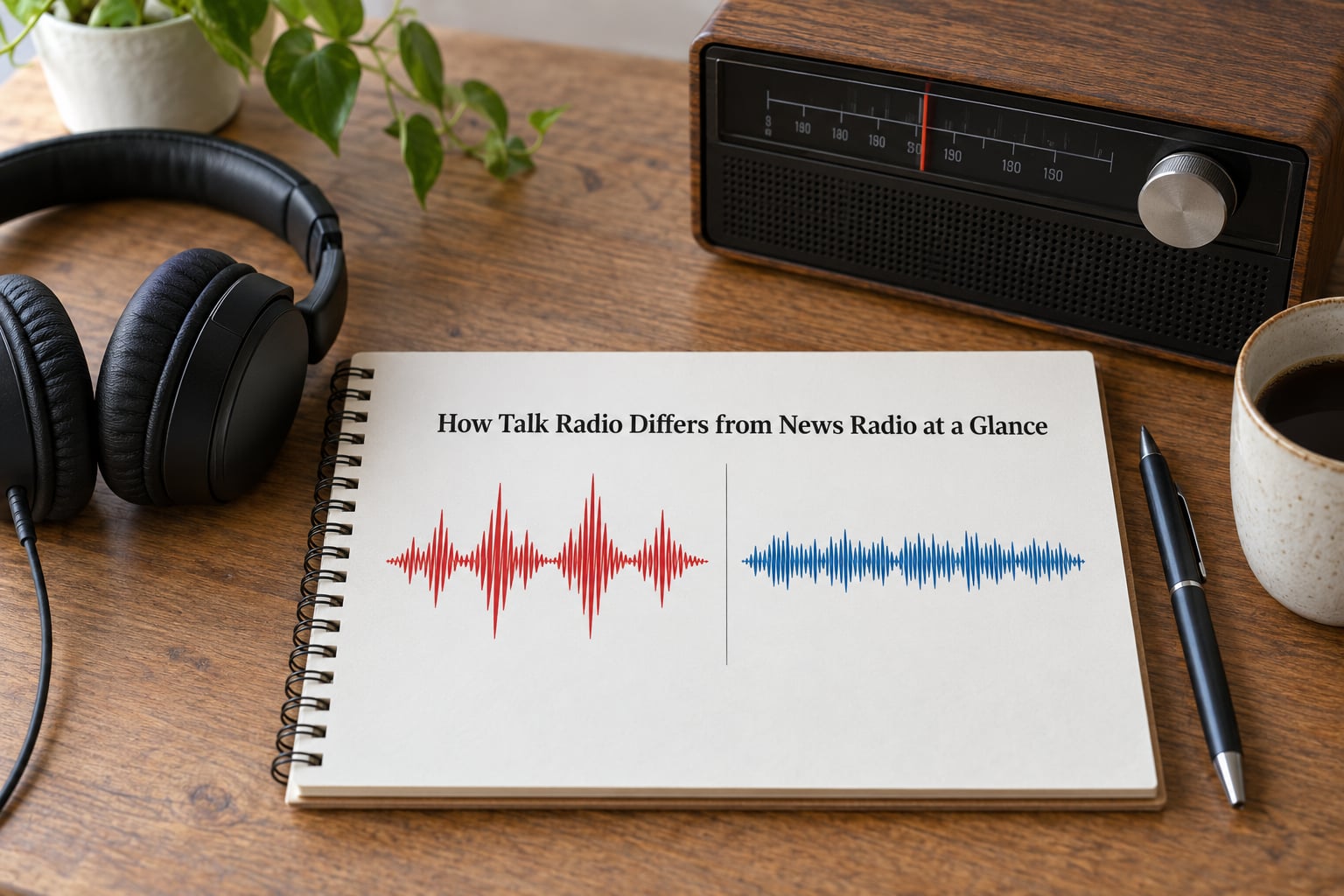
How Talk Radio Differs from News Radio at a Glance
| Point of comparison | Talk radio | News radio |
|---|---|---|
| Core format | Long, host-led conversation in segments | Continuous rotation of bulletins and updates |
| What you hear | Monologues, interviews, arguments, callers | Headlines, reports, traffic, weather, sport |
| Host’s role | The brand, and the opinion holder | Read and verify what reporters found |
| Your role | Participant, sometimes on air | Audience, rarely heard |
| Music | Rare or absent between segments | Short beds to separate items |
| Typical schedule | Two- or three-hour shows with ad breaks | Same items at the same minutes every hour |
| Tone | Informal, persuasive, occasionally heated | Measured, neutral, brisk |
| Typical UK home | LBC, BBC Radio 4 speech output, local AM and FM talk | BBC local radio breakfast shows, LBC News, rolling news networks |
| Typical US home | AM dial, syndicated conservative, progressive, sports talk | FM band all-news and news/talk stations |
What Is the Main Difference?
The main difference is intent. A talk station is trying to persuade you or hold your attention for a whole show, so the host speaks in the first person and owns the opinions. A news station is trying to be trusted and used at a glance, so the presenter reports what has been established and leaves the judgement out.
That difference shows up in the running order. Talk radio is organised as segments with commercial breaks between them, often two hours of a single subject. News radio runs a programming wheel, where the top stories, weather and travel land at roughly the same minutes every hour so a listener can join halfway through and still catch up in ten minutes.
Neither format is better. They answer different questions. If you want to know what happened this morning, news radio serves you. If you want to hear how two people think it should be handled, talk radio serves you.
How Does Talk Radio Use Conversation?
Conversation is the product, not a filler between news items. A typical talk hour might run a host monologue, a short interview with a guest, a caller or two, then the same sequence again after a break.
Callers are the part listeners find most distinctive, and the part that confuses newcomers. In a phone-in show, producers take calls before they go on air and pick which ones suit the discussion, so the airtime does not represent a random sample of opinion. That screening is why a show can feel live while being tightly produced.
Co-host dialogue is another common structure, particularly on drive time shows, where two presenters work against each other a bit so the hour has movement. Guest interviews are usually long-form, often an hour, which is why a talk show rarely breaks for anything that is not an advert or a technical fault.
The result is a format with no obvious end. You can join mid-show and stay for the finish because the argument develops rather than updating.
How Does News Radio Present Information?
News radio is a news wheel with the same items in the same order on repeat. A typical hour might open with headlines, move through a longer report or an interview, add sport, then weather and travel, and start again. Intervals of music sit between items as a separator, not as a feature.
Reports are short by design. A bulletin that runs past a few minutes is usually a signal that something important is happening, and the station will break the wheel to cover it live.
Traffic and weather are treated as first-class content on most UK stations, which surprises people used to formats where they are an afterthought. Sport gets a dedicated slot too, from match reports to full commentary, which is one of the clearest cases where a news station stops updating and starts staying with you.
What you rarely get is depth. In-depth shows were largely abandoned by UK local stations in the 1990s and their audiences shifted with them, so a news station today gives you a very good version of what happened and very little about what it means.
What Are the Hosts and Presenters Like?
On talk radio the host is the station. People follow a named presenter the way they follow a columnist, and when that presenter leaves, listeners tend to move stations rather than shows. That is the normal pattern, not a quirk.
On news radio the anchor is trusted but interchangeable. The job is to read accurately, hand over to reporters, keep to time and stay out of the story. Personality shows, but it is personality in service of delivery.
The practical difference is what happens when something is disputed. A talk host will say what he thinks a story means, and callers will argue with him about it. A news anchor will say what has been confirmed and what has not, and leave the argument to the next programme.
Forum threads about local stations make this concrete. Listeners describe being astonished by the difference when they found a station carrying nothing but news after years of news-and-commentary, and others mourn an all-news station that had been dropped. Both reactions are about format, not about individual stories.
How Do Tone and Pace Compare?
Tone is the quickest way to tell them apart in the first few seconds. Talk radio is informal and can get heated or amused, sometimes within the same sentence. News radio is measured and neutral, and the presenters keep a fairly even pace even when the story is serious.
Sound quality plays a part too. In the UK and US, talk has traditionally lived on the AM band, which is more prone to static and interference, and music has sat on FM. Listeners sometimes blame the station for the sound when it is really the band. Today DAB+ and streaming have largely dissolved that, and plenty of talk now sounds as clean as news.
Drive time: the slot that shapes both formats
Drive time means the morning and afternoon journey hours, usually somewhere between 6am and 10am, and around 4pm and 7pm. It is the most valuable slot on any station because the audience is captive and it knows it.
The formats use it differently. A talk station pulls out every stop and sells long stretches of it, often a guest who is worth the wait and a run of callers. A news station uses it for headline summaries, so a listener who missed the morning can catch everything by 8am and be ready for the day.
If you are choosing what to put on for the school run or a long commute, that difference is the deciding factor, not the station’s branding.
Which Format Better Fits Your Listening Habits?
Match the format to the job you want doing, and the choice usually makes itself.
- You have ten minutes and need today’s headlines. News radio. The wheel means you will not miss the important part by joining late.
- You drive for an hour each way. Talk radio, if you like company. A host who is wrong is still better company than silence.
- You follow one presenter and want their view. Talk radio, and their show specifically rather than the station.
- You work in a room where you need background sound. News radio. It is designed to be listened to partially, and updates mean you are never out of the loop.
- You want local politics, council decisions, transport. Either, but check the format. Local talk is more likely to be argumentative about it, news more likely to give you the figures.
- You want to be at the story when it breaks. News radio. Talk stations get there, but they get there with a take attached.
One practical habit helps more than anything: check the schedule before you commit. A station that runs six hours of talk in the morning and rolls into a news bulletin at six is a different product in each part of the day.
Can One Station Include Both Formats?
Yes, and this is where UK listeners get tripped up most. The clearest example is the distinction between newstalk and rolling news.
Newstalk stations such as LBC are built around presenters and argument, with headlines woven into the show and often delivered by an anchor sitting alongside the talk host. Rolling news stations such as LBC News run a continuous headline service with short bulletins, and the presenters read rather than argue. Same city, same subject matter, different format.
Across the Atlantic the equivalent label is news/talk, and it is the messier category. A news/talk station carries a straight news service in the morning and mid-morning, then hosts with opinions for the rest of the day. From a listener’s point of view that means the reliability of what you hear changes at a fixed hour, and the branding does not always warn you.
Some stations are simply mislabelled. Readers of local forums get angry about this: complaints tend to be about stations that bill themselves as news but carry partisan commentary, and equally about stations that dropped an all-news service and left listeners without one. Both are complaints about the label, not the content.
Formats also switch. A station can move from music to talk, or from talk back to rolling news, usually after an ownership change. If a favourite show disappears, that is often the reason rather than the host retiring.
Which Should You Choose?
Pick news radio if you need facts quickly and often, if your listening is partial, or if you simply find extended argument tiring. Pick talk radio if you want a relationship with a host, if you like having your own view challenged, or if long drives need company. If you want both, use a rolling news station for the headlines and one talk show for the drive home, and stop treating the station as a single thing.
Finding either format is easy these days. On DAB+ and FM, most local stations carry a rolling news or newstalk service at breakfast and switch to talk or music afterwards, so the same frequency changes character through the day. Every station website carries a live stream, and most stations post a weekly schedule, which is the fastest way to confirm a format before you commit to a listen.
One last check worth doing: listen for fifteen minutes and ask whether you have been told anything or invited to think about it. That tells you the format faster than the station’s own description does.
Frequently Asked Questions
Is talk radio the same as news radio?
No. Talk radio is built around hosts who express opinions and take callers, in long show segments. News radio runs a fixed wheel of bulletins, traffic, weather and sport, and its presenters report rather than argue. Both are spoken-word formats with little music, which is why they are often confused.
Which is better for getting breaking news?
News radio, usually. It is built for immediacy, so a major story interrupts the wheel and repeats for hours afterwards. Talk stations cover breaking news too, and a talk host can explain a story faster than any bulletin, but the coverage arrives with an opinion attached to it.
Can talk radio include news updates?
Yes. Many talk stations deliver a short headline summary at set times, and breakfast shows on newstalk stations mix bulletins into the conversation rather than keeping them separate. Plenty of shows run a ten-minute news slot around the hour, so you get updates without changing station.
How can I tell whether a station is mostly talk or news?
Listen for fifteen seconds. Long unbroken speech with a host addressing you by name, and callers being taken, points to talk. Short reports, quick turnarounds between items and a music bed between segments points to news. If it stays the same whatever the hour, that is your answer.
What should I listen to while driving: talk or news radio?
Talk radio, if you want the drive to pass quickly or you like being argued with. News radio, if you want to arrive informed and your journey is short. For a long drive at night, talk usually wins because it does not need your full attention in the way a headline summary does.
Conclusion
Talk radio differs from news radio in intent more than in content. One puts a person in front of a microphone to make a case; the other puts a newsroom behind a presenter to tell you what is known. Everything else, from the music beds to the AM band, follows from that.
Start by pulling up the schedule for two local stations, one labelled news and one labelled talk, and check whether either changes format during the day. Give each fifteen minutes. The one where you are told things is your news station; the one where you are invited to have a view is your talk station.