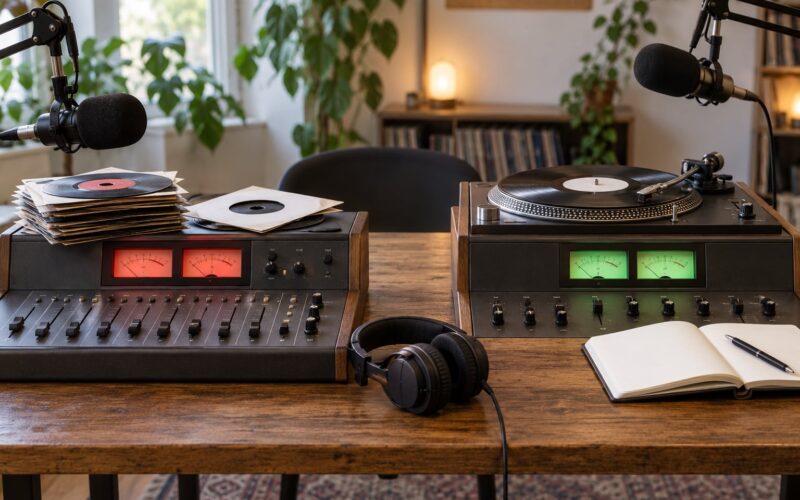
If you have ever wondered how hip hop radio shows are structured, the short answer is that they run on a repeating hourly clock: a cold open, a top-of-hour station ID, blocks of two to four tracks stitched together with short host links, at least one recurring feature such as a freestyle, cypher, rap-up or interview, a news and culture update, one advertising stop-set, and a closing link. The music changes every hour; the shape does not. That fixed shape is what lets you recognise a show after ten seconds of listening.
Understanding the format changes what you notice. You start hearing where the host is earning his slot and where he is filling dead air, why a track you have not heard in a month keeps turning up, and why 6am sounds nothing like 10pm on the same frequency. Updated for 2026, this guide walks through the parts of that structure and how it changes from a New York FM station to an internet stream.
Table of Contents
- What Is a Hip Hop Radio Show?
- How Hip Hop Radio Shows Are Structured by Broadcast Format
- Why the Music Sequence Matters
- The Role of the Hip Hop Host
- How Interviews, Freestyles, and Listeners Fit Into the Show
- How Hip Hop Radio Shows Are Structured Differently by Platform
- How to Listen for the Structure of a Show
- Frequently Asked Questions
- How long is a typical hip hop radio show?
- Do hip hop radio shows play only new music?
- What is the role of the DJ or host on a hip hop radio show?
- Can listeners request songs on hip hop radio?
- How are hip hop radio shows different from streaming playlists?
- Does every hip hop radio show follow the same format?
- Conclusion
What Is a Hip Hop Radio Show?
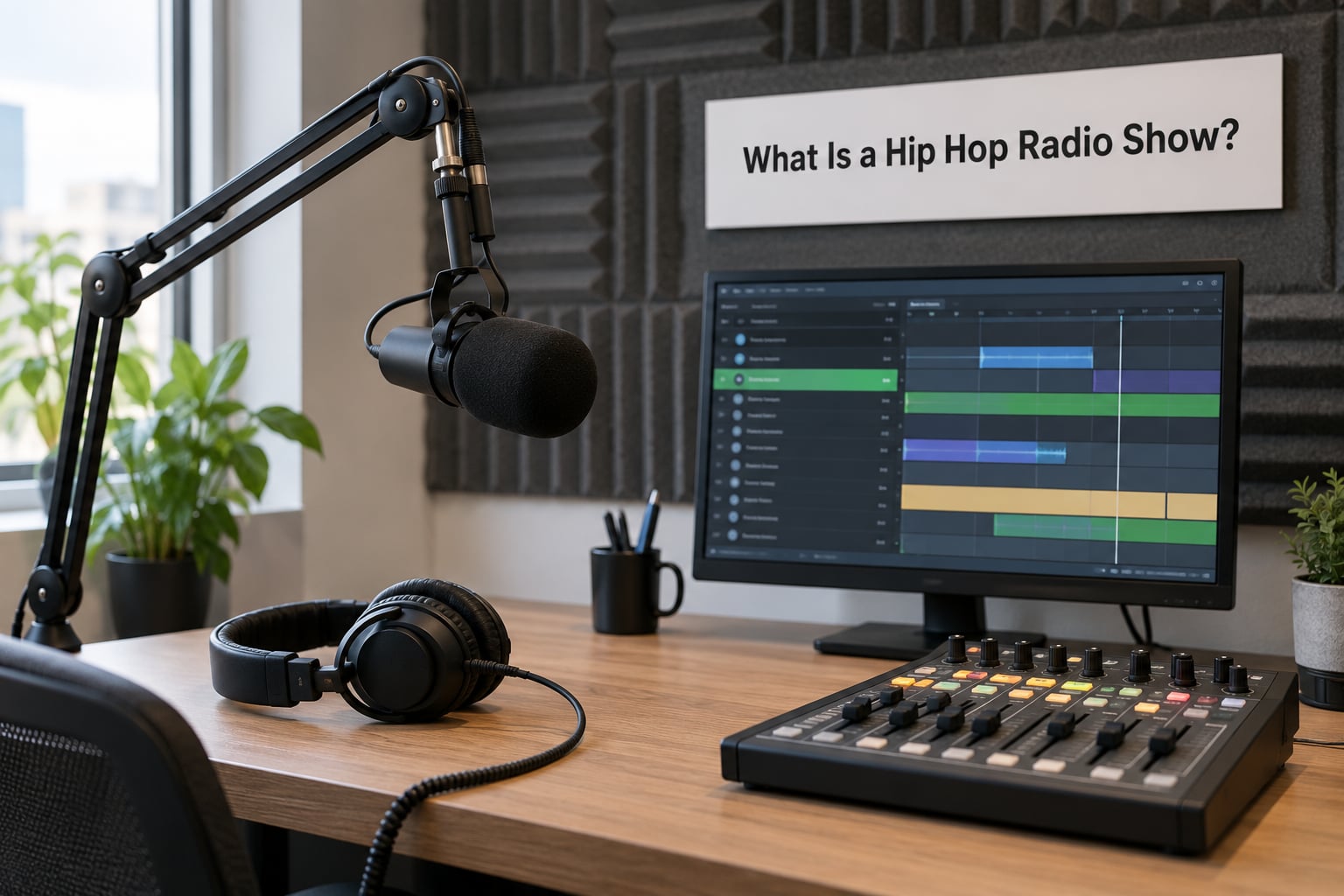
A hip hop radio show is a time-blocked hour of hip hop built on a radio clock. Music programming, host commentary, artist interviews, news, contests and listener interaction are combined into a fixed running order rather than played as a loose list of songs.
That running order is built from seven components, and most shows contain all seven even when the labels differ from station to station:
- Cold open — the first fifteen to thirty seconds, usually a strong track fading up under the station sweep before the host speaks.
- Top-of-hour ID — station identification, legal and promotional, placed on the hour every hour.
- Music blocks — two to four tracks in a row, sequenced rather than shuffled.
- Voice links — ten to twenty-five seconds of host talk between blocks.
- Feature segment — a freestyle, cypher broadcast, rap-up, interview or producer showcase that recurs at a fixed point in the hour.
- Ad stop-set — a cluster of commercials and promos, normally one per hour on a terrestrial station.
- Close and sign-off — a final link that points listeners at the next hour or the next show.
Stations sell that structure, not just the songs. A show that never repeats a segment position gives the sales team nothing to sell and gives the audience nothing to look forward to.
How Hip Hop Radio Shows Are Structured by Broadcast Format
The radio clock is the whole hour mapped out
The radio clock is a document that assigns every minute of a daypart a purpose. A programmer builds one for morning drive, one for midday, one for afternoon drive and one for overnight, because a 6am audience heading to work and a 2am audience at a desk want different things.
Clocks are the reason a hip hop station can sound chaotic to an outsider and completely predictable to a regular. The skeleton holds; the tracks inside it rotate.
A sample 60-minute hip hop show rundown
This is a realistic music-led hour on a terrestrial urban station. Independent and online shows usually stretch the music blocks and drop the fourth block, but the order of the parts is the same.
| Time | Element | What it sounds like | Why it is there |
|---|---|---|---|
| 00:00–00:15 | Cold open | Track fading up, station sweeper, no talk yet | Catches a listener who just tuned in and has not committed |
| 00:15–00:30 | Top-of-hour ID and headlines | Host voice, legal, two or three news items | Identifies the station and serves the audience information |
| 00:30–00:45 | Link into first music block | Ten to fifteen seconds of voice, then four tracks | Moves the listener from talk to music without a gap |
| 00:45–05:00 | First music block | Four tracks, no interruptions | Establishes the record and holds the hour together |
| 05:00–05:25 | Link and feature intro | Host sets up the freestyle or cypher broadcast | Teases the signature segment so listeners stay for it |
| 05:25–08:00 | Feature segment | Live or recorded freestyle, cypher or rap-up | The part of the hour a hip hop show is actually known for |
| 08:00–14:00 | Second music block | Six tracks, sequenced by era and subgenre | Sets up the mid-hour peak the rest of the clock is built around |
| 14:00–14:30 | Ad stop-set | Commercials and promos back to back | Revenue, placed at a predictable point in the hour |
| 14:30–22:00 | Third music block | Seven tracks, heavier rotation front-loaded | Recovers the listener lost during the break |
| 22:00–27:00 | Link, request or call-in block | Host reads requests, takes a call or two | Turns passive listening into participation |
| 27:00–36:00 | Fourth music block | Nine tracks, lighter rotation and older records mixed in | Rewards regulars without losing new listeners |
| 36:00–42:00 | Interview or news block | Pre-recorded guest, or live conversation with a phone feed | Adds a reason to tune in at a known time |
| 42:00–56:00 | Fifth music block | Twelve tracks, the run into the top of the hour | Longest uninterrupted stretch; carries the hour across the boundary |
| 56:00–60:00 | Closing link and sign-off | Host voice over the outro track, next-hour tease | Hands the listener to the next show |
Read the song count and the logic becomes obvious. Five blocks, roughly 38 to 40 tracks depending on their length, one commercial cluster, and a feature that returns every week at the same minute. Four hours of live DJ work usually lands somewhere around 160 tracks, so a mix-show host is selecting one every 90 seconds all afternoon.
Dayparting is how the day is labelled and split
Dayparting is how a station labels and splits the day, and each part carries a different mix of music, talk and features.
| Daypart | Typical hours | Pacing | Content mix |
|---|---|---|---|
| Morning drive | 6am–10am | Fast, high talk percentage | News, traffic-adjacent banter, premieres, interviews, more heavy rotation |
| Midday | 10am–3pm | Relaxed, music-heavy | Longer blocks, fewer links, listener requests, occasional feature rerun |
| Afternoon drive | 3pm–7pm | Energetic, build toward evening | Freestyles and cyphers, rap-up recaps, rising singles, contests |
| Evening and overnight | 7pm–6am | Slowest pacing of the day | Long blends, boom bap and old school weight, specialist features, open-format guests |
Overnight is where the format loosens. A 2am audience is small, loyal and unusually tolerant of an unfamiliar record, so programmers put material there that would never test well at 8am.
Ad stop-sets are capped, not scattered
A stop-set is a cluster of commercials and promos played back to back, and treating it as one block instead of several interruptions is what keeps a hip hop hour from feeling chopped up. Most urban stations allow one per hour, sometimes two, with a floor of about fifteen minutes of music between them. Breaking that rule is the fastest way to lose a listener mid-show, and the complaint you will hear most often from regulars is not too much music, it is too many breaks.
How to build your own hip hop show format
If you are building a show from scratch, work through these five steps in order. The order matters, because the first two decisions constrain everything after them.
- Choose your format and platform. Decide between a music-led mix show, a personality-led talk show, and a specialty format built on one scene or one subgenre. These are different products for the listener.
- Write the clock. Put a duration against every segment before you pick a single track. Decide where the feature lives and where the ad or sponsor read goes.
- Tag your library before the show, not during it. DJs running hip hop shows rely on smart playlists and disciplined tagging by year, subgenre, region and energy. Fumbling through files live is the fastest way to lose a room.
- Set a rotation and stick to it. Give each track a weekly spin target so the same fifty records cannot quietly run the whole month.
- Rehearse the first ten minutes out loud. Say the top-of-hour ID, the headlines and both links aloud with a timer. Most new-show problems show up in the first ten minutes of an hour.
Why the Music Sequence Matters
Two shows playing the same artists can sound nothing alike, and the difference is almost always the running order. Random selection is what makes an automated playlist forgettable; sequencing is what makes a host sound like they are in charge.
Rotation categories and how often a track plays
Rotation is a scheduling system that gives every record a fixed number of plays per week, and the tiers are broadly consistent across commercial radio formats.
| Category | Typical plays per week | What it is for |
|---|---|---|
| Light rotation | 7–14 | New and developing records, testing demand without overspending |
| Medium rotation | 14–28 | Proven tracks building an audience |
| Heavy rotation | 28 or more | Current core records, the sound of the station right now |
| Recurrent and oldies | Rolling, not fixed | Catalog and gold, placed deliberately to add contrast and reward regulars |
Recurrent is where hip hop differs from most formats. A record from any point in the last forty years can be scheduled, as long as it fits the block, and older records often land in the overnight and midday hours where the audience is small enough to absorb them.
Subgenre balance is a structural decision
Trap, drill, boom bap, conscious rap and old school are not mixed at random. A programmer builds a ratio, then adjusts it by daypart: heavier trap and drill on drive, more boom bap and old school late.
BBC Radio 1Xtra’s Rap Show commissioning brief is a rare published example of a formal subgenre position, stating a central focus on UK rap, drill, trap and afro-swing alongside a small selection of US artists. That is a structural decision written into a document, not a mood the host wakes up with. A US station running a different balance, or a London show built entirely on one scene, is following the same logic with different numbers.
Sequencing within a block is the craft part
Once the rotation is set, the sequence inside each block does the work. Producers move between eras, regions and tempos, and the practical tests are simple: does the flow hold, and does the last track in the block make the listener stay for the link after it.
Ends matter more than starts. A block that ends on a record the host has just set up keeps the audience in the room, and that single choice does more for retention than a faster segue ever will.
The Role of the Hip Hop Host
The host’s job is to make the hour make sense: introduce the music, give it context, manage the transitions, book and run interviews, deliver the news, and hand the show on without the listener ever noticing the join.
How much should a hip hop host talk?
Short and purposeful. A voice link of ten to twenty-five seconds is the norm on a terrestrial urban station, with a music bed sitting under it at a level where the words stay clear without the host having to fight the track.
The most repeated complaint from listeners and from other DJs is the opposite problem: too much talk, not enough music. Personality DJs sit well outside that norm and get away with it because the talk is the product. A music-led show cannot afford it.
Imaging, stingers and sweepers
Imaging is the station’s sonic identity, and it is what makes two hip hop shows with identical tracklists instantly separable. A sting is a short production hit placed at a transition. A sweeper is a produced vocal or musical element that bridges into the next element, usually carrying the station name or a line from a track.
The craft rule is restraint. Imaging works because it is rare enough to register, and a station that adds a hit to every link ends up with a show that is technically polished and impossible to follow.
Money, mentions and who pays for the show
Shows earn money from advertising, sponsorship, syndication, platform ad revenue and ticket sales for events, and each of those arrives as a line on the clock. That is why a sponsored read sits at a fixed point with a fixed length, and why a host reading a personal endorsement is a different act from a host reading a paid sponsorship.
Reporting plays the same role. Stations and rights organisations such as BMI and ASCAP log performances through cue sheets and spin reporting, which is the paperwork behind every rotation figure in the clock.
How Interviews, Freestyles, and Listeners Fit Into the Show
These are the elements that turn a playlist with a voice over it into a show people describe to their friends.
The segment library a hip hop show runs on
Common recurring segments include a freestyle or beat battle, a cypher broadcast, a rap-up covering the previous week’s releases, a producer showcase, an artist interview, a news and culture update, a listener request block, a contest or giveaway, and a rap-up of what the host played all week.
The rap-up and the freestyle are the two that read most clearly as hip hop to someone who has never heard the show. A rap-up is a spoken recap of the week in rap, and a cypher is a group MC session recorded and broadcast as a set piece, which gives a show something a playlist cannot produce.
Interviews that earn their slot
An interview works when the guest has something to say that the music alone cannot: a release, a first listen, a legal development, a regional story. Booking is the hard part for a new host, and the practical route is a short pre-record that runs six to eight minutes, placed in the second half of an hour so the music has already established the listener.
Stretch and Bobbito, which began as a New York show in 1990, built its reputation on exactly this pairing: careful music curation plus guests who got real airtime.
Requests, call-ins and contest blocks
Listener requests do two jobs. They give the audience a way in, and they give the programmer a live read on what the audience actually wants, which is often different from what the rotation predicts.
Call-ins are harder to run well than they look. A show with a request line needs a producer on the other end, a host who can end a call without being rude, and a rule about what gets played, otherwise the show becomes a queue.
How Hip Hop Radio Shows Are Structured Differently by Platform
The same programming principles survive the move from FM to a phone, but they get rearranged, because the constraints change completely.
| Format | Where the structure lives | What changes |
|---|---|---|
| Terrestrial FM and DAB | A clock policed by a programme director | Fixed song counts, capped stop-sets, heavy rotation, daypart discipline, on-air legal IDs |
| Internet radio | Same clock, hosted by one person | No legal ID pressure, longer links tolerated, wider subgenre range, chat and request feeds |
| Streaming playlists | Software, not a person | Personalisation replaces curation; no host, no features, no news; catalogue depth over sequencing |
| Podcast-style show | An edited timeline, not a live clock | Everything is pre-built, so interviews and features can run long; no ad cap, no dayparting |
| Short-form and social clips | A single moment lifted from the show | The hook is the whole product: one bar, one freestyle take, one argument |
Terrestrial urban format versus the independent show
Terrestrial urban stations run a tight, documented format. New York stations such as Hot 97 and Power 105.1 publish daypart hours, run morning-drive shows with named personalities, and sell advertising against a defined audience.
An independent or online hip hop show has the opposite trade: far more freedom, far less money and no audience guarantee. What it has is range. A host can run a whole hour of UK drill, build a feature around one local cypher, or take a request from one city, because no format department exists to say no.
Community consensus treats an open-format hip hop show as a structure in its own right rather than a lesser version of a commercial one: hip hop mixing combined with cross-genre programming and live blends, which suits a room that wants to hear something it did not expect.
How to Listen for the Structure of a Show
You do not need a radio log to read a show’s format. The structure announces itself in the first few minutes, and once you know the parts, everything else is detail.
What to notice in the first ten minutes
You are listening for the cold open and the top-of-hour ID. If music starts immediately and the station identifies itself right away, it is a tight commercial clock. If the host talks for several minutes before any record plays, it is a personality-led show, and that is a legitimate format rather than a failure.
Between the songs
Count how many tracks play in a row before the host speaks. Two to four means a music-led clock with discipline. One means a talk show, which on a music-led hip hop hour is a sign the links are running long.
At the end of the broadcast
A closing link that points at the next hour tells you the show has a successor. A hard stop into a song with no handover usually means an automated break, which is normal on a specialist or late-night service.
How shows are measured
Broadcast audiences are counted by ratings panels such as Nielsen Audio, which report cume audience and time spent listening, and by the host mentions that convert into a ranking. Online shows get concurrent listener counts, unique listeners and completion rates instead.
The two numbers that shape programming are minutes spent listening and how long people stay after tuning in. Structure is the tool for both, which is why it is written down before a single record is chosen.
Before you tune in, one last practical note on sound: a show that has been mixed for broadcast sits around 16 LUFS integrated under the EBU R128 or ATSC A/85 conventions, with a ceiling on true peak. Online streams are often louder than that, so switching between the two changes the apparent energy of the same music.
Frequently Asked Questions
How long is a typical hip hop radio show?
Most hip hop radio shows run in fixed-length blocks: a single hour on a terrestrial station, or three to four hours for a live DJ shift, podcast-style episode, or online stream. A syndicated show keeps a set length so it can drop into a station’s clock in the same minute every week. Shorter formats, such as a 30-minute mix show, work on internet radio but rarely on FM, where the hour boundary carries the station ID and the legal inventory.
Do hip hop radio shows play only new music?
No. Light rotation holds the newest material at roughly 7 to 14 plays a week, but every show also draws on medium rotation, heavy rotation, and recurrent or oldies. On hip hop specifically the catalog runs deep, so a record from decades back can be scheduled as readily as a single released that week. Programmers place older records deliberately, usually in midday and overnight hours, to add contrast and reward regular listeners.
What is the role of the DJ or host on a hip hop radio show?
The host sequences and introduces the music, gives records context, moves the listener between blocks, delivers news and IDs, and hosts the recurring features such as interviews, freestyles and rap-ups. On a music-led hour the voice link runs about ten to twenty-five seconds over a music bed. On a personality-led show the talk is the product, and the records are support for the conversation.
Can listeners request songs on hip hop radio?
Usually, and the arrangements differ by station. Terrestrial stations run request lines, apps and social channels, with producers deciding what fits the rotation. Online shows often take requests live from a chat feed, which is faster but easier to overwhelm. A good request block needs a stated rule about what gets played, otherwise the segment turns into a queue of names with no editorial judgment behind it.
How are hip hop radio shows different from streaming playlists?
A playlist serves one listener and personalises from listening history, so it gets more accurate as you use it. A radio show serves everyone at once, so it repeats a structure, rotates records a fixed number of times a week, and cannot respond to what one person just skipped. The show also carries things a playlist cannot: a host, a feature segment, local news, and a sense of where you are in the hour.
Does every hip hop radio show follow the same format?
The skeleton is shared, the proportions are not. Every show has music blocks, links, a feature and a close, but a commercial urban station runs a tight documented clock with capped stop-sets, while an independent online show may play four tracks in a row, talk for two minutes, and carry no advertising at all. Open-format, mix-show, and personality-led hip hop shows each serve a different expectation, so there is one structure rather than one format.
Conclusion
Every hip hop radio show is built from the same short list of parts: a cold open, a top-of-hour ID, sequenced music blocks, short voice links, one recurring feature, a capped ad stop-set and a closing sign-off. The clock holds those parts in place, the rotation decides how often each record plays, and dayparting decides what the hour feels like at 6am versus 2am.
If you are tuning in for the first time, listen to the first ten minutes and count the tracks between links. That single habit tells you more about a show’s structure than any description will, and it is the fastest way to tell a personality-led show from a tightly clocked one.