Here is the short answer: a producer records one show in one studio, then licenses that same show to stations across the country. A syndicator takes the finished audio and delivers it to every station that signed up to air it, usually by satellite, over a digital telephone line, or across the internet, and each station plays it out at the same contracted time.
It is a simple idea that produces a strange result. A host you associate with one station can turn up on a station two hundred miles away, on the same hour, with the same running jokes, sometimes years after you last heard the show. Understanding how syndicated radio shows are distributed explains almost every odd thing about local broadcasting, including why a nationally famous presenter ends up on a small-town frequency and why a syndicated show occasionally starts a few seconds late.
I have spent a lot of time with people who run stations and produce shows, and the surprise is always the same. Listeners assume every station owns its own satellite dish and its own link to the network. Almost nobody does. One originating feed, sent up once, gets picked up by dozens of receiving dishes that cost a station far less than producing a show of its own would.
This guide walks the whole route: studio, syndicator, delivery method, station automation, transmitter, listener. Updated for 2026.
Table of Contents
- How Syndicated Radio Shows Are Distributed
- The Main Parts of a Radio Syndication Network
- What Does the Syndicator Give Each Station?
- How the Show Travels From One Studio to Many Stations
- How Syndicated Radio Shows Are Distributed by Satellite
- How Distribution Works for Streaming and Podcasts
- Why Stations Carry the Same Show
- What Makes a Syndicated Show Successful in Local Markets
- Common Distribution Problems and How They Are Solved
- Frequently Asked Questions
- What does it mean when a radio show is syndicated?
- How do I listen to a syndicated radio show?
- Is a syndicated radio show the same on every station?
- How do radio shows get from one station to another?
- Can syndicated shows be streamed or heard on demand?
- Who pays for the production of a syndicated radio show?
How Syndicated Radio Shows Are Distributed
Radio syndication is the licensing and delivery of one programme to many stations at once, instead of every station producing its own version. The show’s producer sells or licenses broadcast rights to a syndicator or radio network, which then distributes a single master recording, or a live feed, to every affiliate station that has signed an agreement to carry it.
That agreement is the whole trick. A station does not simply download whatever it likes. It signs a contract, takes a slot in its schedule, and receives the audio on a schedule the network has already set.
The delivery chain, end to end, runs like this:
- Record. The show is produced in one studio, usually by an independent production company or an originating station.
- Master and package. The episode is edited, loudness-matched and split into segments, with a format clock showing where adverts and station IDs sit.
- Hand it to the syndicator. The syndicator takes on delivery, sales, traffic and billing for a network of affiliate stations.
- Deliver the feed. Audio reaches affiliates by leased satellite, a digital telephone line, or an internet file transfer or stream.
- Load into automation. Each station’s broadcast automation system schedules the episode like any other file, with local adverts slotted in around it.
- Transmit. When the clock hits the slot, the station’s automation plays the audio through the processing chain and out over FM, DAB, AM or a stream.
That is the whole of it. Everything else is detail, and the detail is where the interesting differences sit.
The Main Parts of a Radio Syndication Network
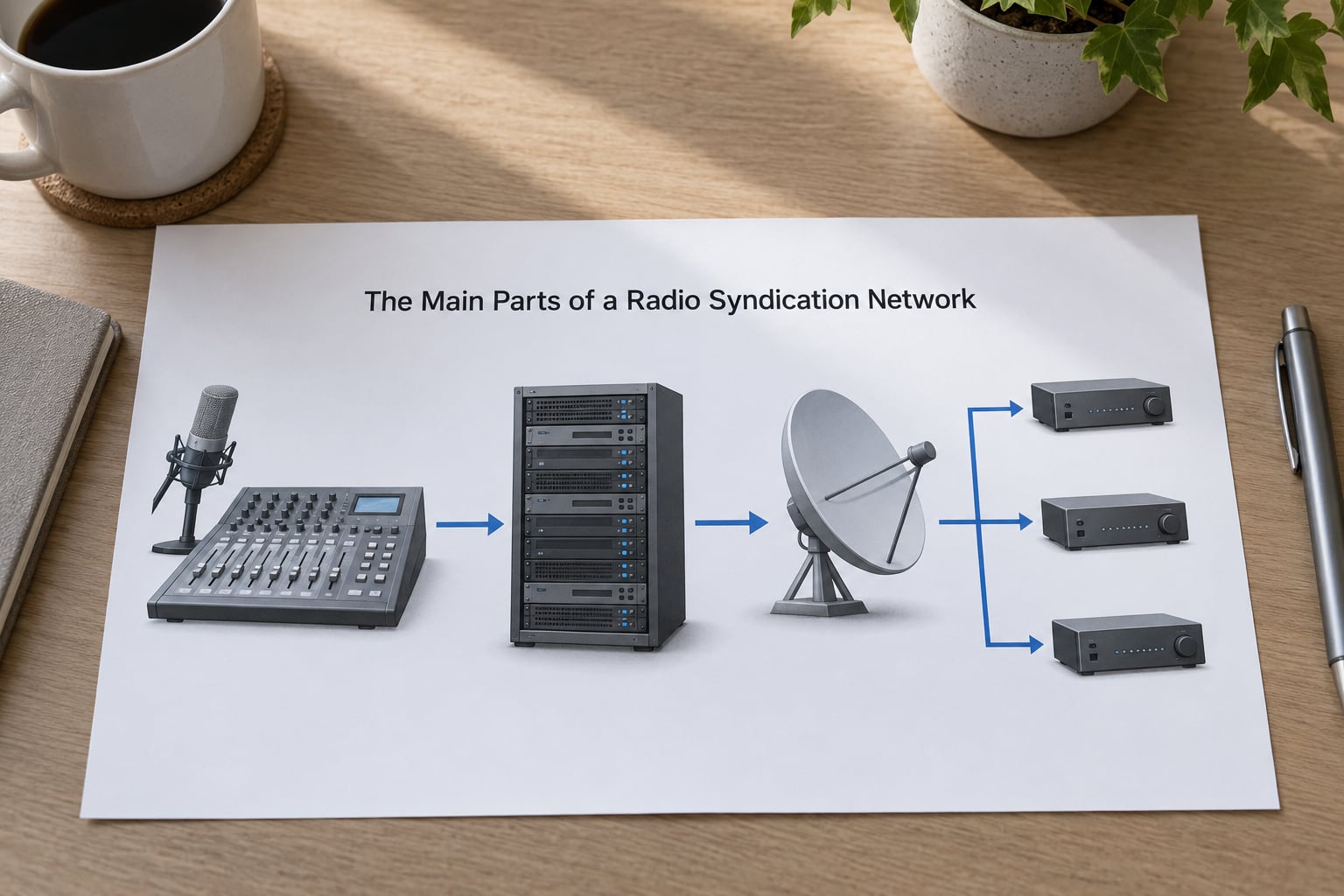
Take a weekly chart countdown as the worked example. A production company in Manchester builds a three-hour music show with a presenter, voice-tracked links, a countdown and a chart. The same show goes out on a network of stations, each with its own local adverts inside it.
- The producer. Owns the show, hires the host, and makes the editorial decisions. Sometimes the same company is also the syndicator.
- The originating studio. Where the audio is actually recorded. It may be a network’s own facility or a hired suite.
- The syndicator or radio network. The middle. It licenses the show out, manages contracts, schedules delivery, supplies the supporting materials and often handles national advertising sales.
- Affiliate stations. The licensed outlets. Each one owns its transmitter, its local advertising and its own legal obligations to its audience.
- The delivery provider. A satellite operator, a telecom carrier or a managed network that carries the audio from the studio to every receiving station.
- The streaming platform. The app or website that puts the same show on a phone, a speaker or a car.
- The advertiser. Buying national spots inside the show, or buying local spots inside the affiliate’s break.
- The listener. The person the whole machine exists for, whether they tune in on a car radio or press play on a phone.
On a Reddit thread over at r/radio, a working host described exactly this arrangement: they upload shows to a repository that stations browse and download from, or serve individual stations directly, and treat download counts as the signal that a station is actually interested. That is a small-scale version of what a network does at scale.
One useful distinction. A network owns or commissions its own programming and runs stations on its own or partner-owned outlets. A syndicator licenses programmes that other people made. The words get used interchangeably on air, which is why half the confusion in search results about this topic exists.
What Does the Syndicator Give Each Station?
Audio is the headline, but it is a small part of what lands in a station’s inbox. A working affiliate package normally includes:
- The show feed itself – either a scheduled file transfer, a hosted stream or a satellite downlink, with a stated delivery deadline for each episode.
- Scripts and a rundown so a presenter can read the links, weather and community announcements in their own voice.
- Talk points, background notes and a release schedule for the coming weeks.
- Ad inventory – national spots already recorded and inserted, plus designated gaps where the station sells its own local advertising.
- Imaging and IDs: sweeps, bed music and a station voiceover ID so the show sounds like it belongs to the local station.
- A program clock, sometimes called a format clock, showing what runs at what point: opening track, links, break, adverts, contest, closing.
- Technical instructions – loudness target, sample rate, required processing and how to handle the feed.
- Contract paperwork: term, exclusivity, fee or barter terms, market clearance rules and affidavits of airtime for the network’s advertisers.
That last group is the part listeners never hear about and it matters more than it sounds. Clearance decides which stations may carry the show and where. A national talk show is usually licensed to stations in defined markets, with rules stopping two affiliates in the same city from airing the same program against each other. A barter deal has no cash invoice but arrives with advertising obligations attached, and the network’s sales team takes the space in the break instead of the station.
How the Show Travels From One Studio to Many Stations
Once you know which parts move, the mechanics stop being mysterious. Here is how a show actually gets from a studio to a transmitter, step by step.
How syndicated radio shows are delivered to a station
1. Origination. The host is live or pre-recorded in one studio. For a live show, only one studio is live at a time. That matters more than anything else on this page, and it is the part most people get wrong.
2. Processing. The show leaves the studio as a clean feed, sometimes with a beep or tone on the hour for cueing. Levels are controlled and compressed once, properly, at the point of production rather than being left to each station’s own chain.
3. Delivery to the network. The studio output goes to the syndicator. Historically that meant a leased satellite transponder or a bank of telephone lines. Increasingly it means a managed internet service with the feed encrypted and the schedule published in advance.
4. Repackaging. The syndicator cuts the show into segments. Each affiliate gets the segments plus a clock that tells it which segment goes where, and where its own adverts live.
5. Scheduling. The station’s automation loads the package against a specific start time. The time is set by the network, not the station, so a show airs simultaneously across the footprint. Files usually have to land well before air, so a transmission delay does not become a broadcast delay.
6. Localisation. During a local break, the station’s own presenter comes on, sells local advertising, and hands back to the network feed. Some stations also insert local content, which is where the localism argument lives.
7. Air. Automation plays the feed through the station’s processing, out to the transmitter and the stream at the same time. The listener hears no seam at all, which is the entire point.
How a live show with callers reaches every station at once
Callers phone one studio, not fifty. The network routes those calls through a single call-screening system, and every affiliate plays the same feed at the same moment, including the same phone conversation.
Stations do not simply rebroadcast the originating station’s over-the-air signal, even though it seems obvious. A listener in one part of the country is too far from the originating transmitter for a clean FM signal, and AM is worse. Relaying a terrestrial signal is an expensive, lossy way of doing something a leased satellite line does perfectly. The air signal is for the originating market; the network feed is for everyone else.
Timing is handled with delay. A show can be deliberately delayed a few seconds on a network feed so an engineer has time to cut a caller or start a track cleanly, and a misfire is stopped before it reaches air. Where a network spans time zones, the schedule is published in local station time for each market, and live shows either go out at the same wall-clock moment in each zone or are shifted so a call-in hour lands when listeners are actually awake.
How Syndicated Radio Shows Are Distributed by Satellite
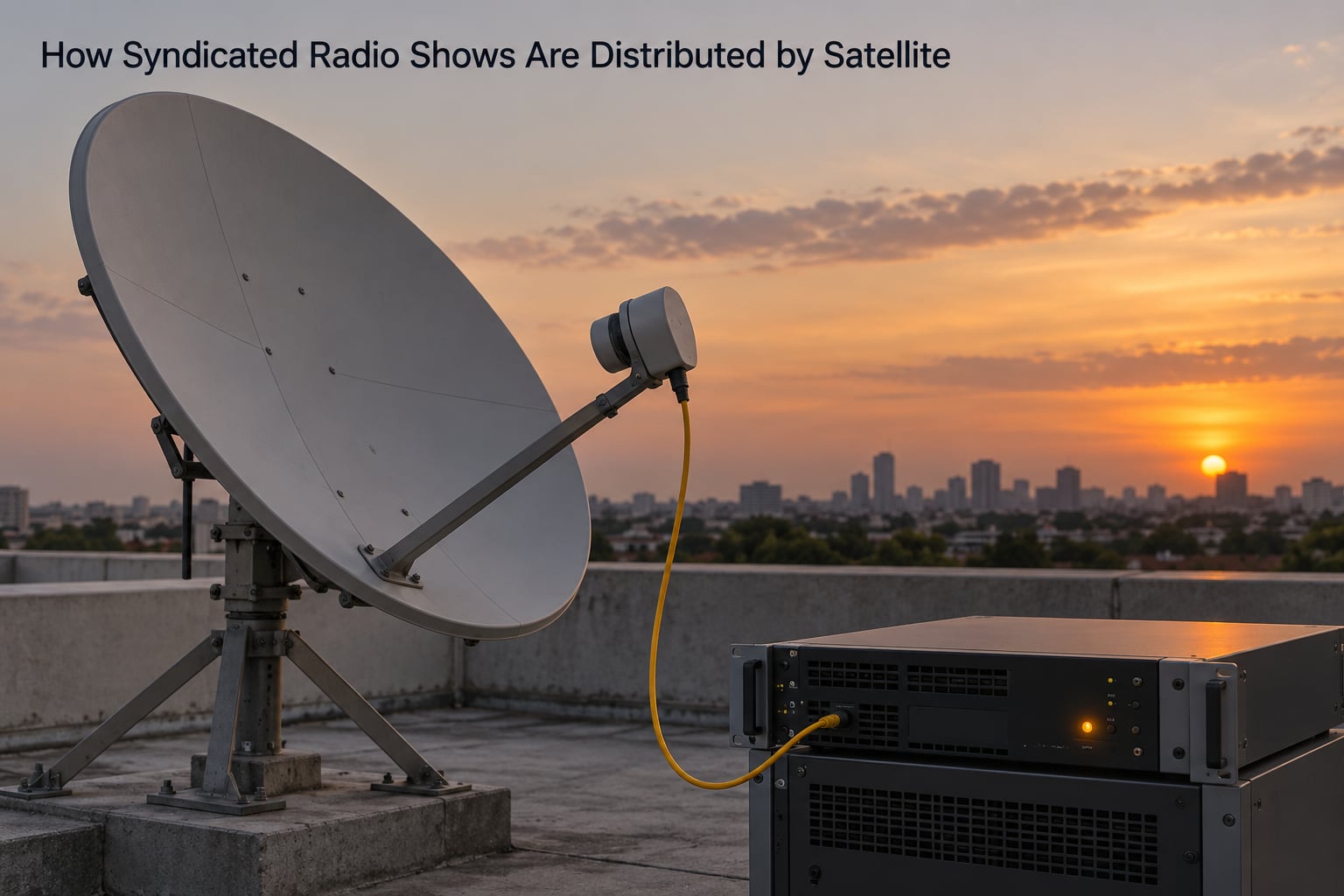
Satellite was the default answer for decades, and it is still a serious method for stations that want an unmetered, always-on feed that does not depend on their internet connection. It is not the only method, and the current industry no longer treats it as the only one.
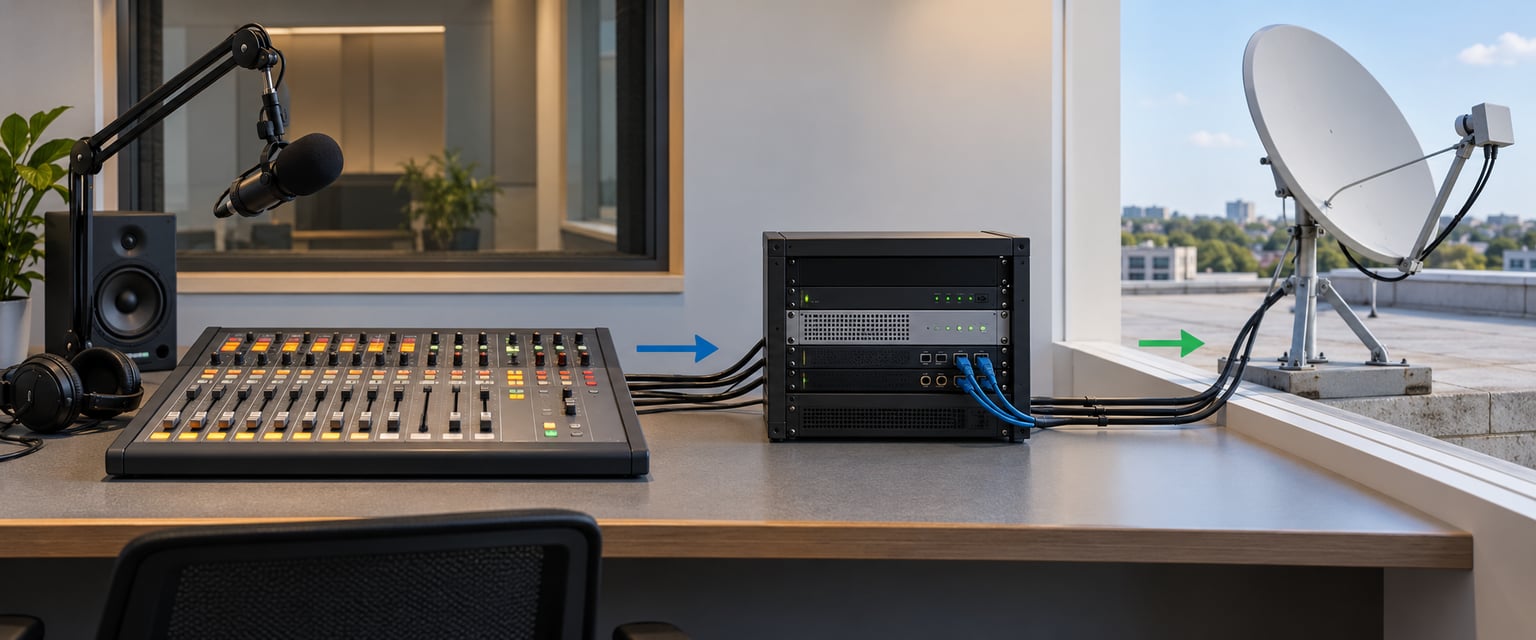
The chain works like this. The originating studio sends its audio to an uplink, a small dish pointed at a communications satellite in geostationary orbit. The signal travels roughly 36,000 kilometres up and back down, and the network leases transponder time on that satellite for as long as the show needs it. A single uplink carries the whole network. Each affiliate has its own downlink dish, usually on the roof or the side of the building, pointed at the same satellite, and pulls one channel out of the transponder with a receiver in the studio.
The cost structure explains why it stuck. The uplink is paid for once, and the expensive part is the leased transponder time. Receiving is cheap, which is why hobbyist satellite listeners in the UK have long been able to pick up unencrypted station feeds off the same birds commercial stations use.
Here is how the three main delivery methods compare.
| Method | How it arrives | Audio quality | Reliability | Typical users |
|---|---|---|---|---|
| Satellite | One uplink, leased transponder time, a downlink dish per station | Clean broadcast quality, no telephone artefacts | Very high, unaffected by the station’s own internet | Large networks, talk radio, 24-hour news services |
| Telephone (ISDN and voice-grade) | Dedicated digital lines using codecs such as MP2 or MP3 | Good but narrower; artefacts appear on difficult material | Good, though a line fault drops the show | Smaller networks, live sports, regional shows |
| Internet (IP) | Encrypted file transfer, or a live stream the station pulls | Highest when the file is delivered intact, as studio quality rather than a squeezed stream | Depends entirely on the station’s connection, with a managed feed as backup | Most new agreements, podcast distribution, streaming-only products |
What listeners hear follows directly from that table. A show delivered as a whole file sounds better than the same show squeezed down a telephone line, because a voice-grade codec throws away the frequencies a telephone network cannot carry, and aggressive encoding removes more. Station-side processing set for locally produced programming can then squash the delivered audio further. Nothing mysterious, and the solution is normally a delivered file at full quality with less processing on playback.
How Distribution Works for Streaming and Podcasts
Digital distribution runs alongside the broadcast feed rather than replacing it, and for a lot of shows it is the way most listeners actually hear the content. The show is uploaded once to a hosting service, and the audio is then republished in several forms.
- Live stream on the station’s own app, mirroring what goes out over the transmitter. Often a delayed feed, not truly live.
- National streaming apps, where a network groups many shows under one app and one account.
- Podcast platforms, where a syndicated show appears as a feed that updates every episode, on its own schedule and often unrelated to any station.
- Smart speakers, which do nothing special: they play whatever the podcast or app service serves, so a syndicated show becomes something you can ask for by name.
- On-demand archives, where a host can send a listener to a back catalogue that no broadcast schedule could ever hold.
Two distinctions matter here. Live versus delayed: a stream labelled live is often a show recorded in the morning and shifted by a few hours so it appears in a drive-time slot. Broadcast versus on demand: the same episode can be on a transmitter on Monday and in a podcast feed on Tuesday, and a listener who wants Tuesday afternoon has to wait for the file rather than find it on a station schedule.
Podcast distribution and syndication share a file and a feed but little else. Syndication is a business arrangement built around broadcast time slots, local advertising slots and licence fees. Podcasting is a free, on-demand feed with no station, no clock and no local break. Plenty of shows do both, and plenty of people use the word for both, which is half the reason this topic confuses people.
Why Stations Carry the Same Show
From the outside it looks like a station giving up its identity. From the inside the arithmetic is straightforward.
Production cost. A three-hour daily show needs a host, a producer, a studio, music rights, a commercial department and someone to handle traffic. A syndicated show moves all of that off the station’s books for a fee or an advertising swap.
Talent recognisability. A national host arrives with an audience. Industry figures quoted in the trade press talk about small and medium market stations growing audience figures sharply over a couple of ratings periods after adding syndicated personality programming, at lower operating cost. Whether that works depends entirely on whether the host fits the market, which is the argument local critics make.
National advertising. A station in a small market cannot sell a national campaign. Through the network it can sell spots that run on forty stations at once, which is how an advertiser reaches a scattered audience at a cost it can plan for.
Local ad inventory. The show brings national spots into the break, and the station sells the gaps around them. The show therefore creates selling space rather than removing it.
Formats a station cannot build. News, specialist farm and commodity reports, chart shows, Christmas specials, gospel and Spanish-language hours. A county station would never build a nationwide news service; it can license one.
Money moves two ways. A cash syndication deal is a straightforward licence fee per station, per week, and the network keeps the national advertising. In a barter deal the station pays little or nothing, and the syndicator takes the advertising space instead, selling it on a national basis and keeping the revenue. Some stations run both: cash for a mid-tier show, barter for a talk hour that fills an entire block.
What Makes a Syndicated Show Successful in Local Markets
The honest truth is that a syndicated show is only successful where the network has left room for the station to sound like itself. That work has a name, and in most markets it comes down to a handful of practical things.
Voiceover IDs. A voiceover ID is a short piece of audio where the network host introduces the local station: the frequency, the local news, the community message. It is the single most effective tool for making a networked show sound local, and it takes seconds.
Local inserts. Designated gaps where the affiliate’s own presenter takes weather, a community interview, a charity appeal or a local business mention. The network sells those seconds to its advertiser, and the station fills them.
Local music choices. Some formats let the affiliate pick part of the music rotation or run its own specials, because the record a station can legally play in one market is not always the record it wants to play in another.
Market size changes the balance. A station in a large city can usually afford local talent all day and use syndicated shows as a backstop. A station covering a rural county with a small team leans much harder on networked hours, because there is nobody in the building to present them.
The criticism deserves a straight answer rather than a rebuttal. When a locally employed presenter loses a slot to a network feed, that is a real loss, and in some markets a station can sound interchangeable with its neighbours for most of the day. The counterargument is equally real: many of those programmes would not exist at all for that station without a network paying for them. The interesting stations are the ones that negotiate the balance deliberately, and a lot of them now ask for custom content, custom teases and sellable local sponsorship reads inside the show rather than a generic read-out of the local frequency.
Common Distribution Problems and How They Are Solved
Most of the odd behaviour listeners report has a boring technical explanation, and in most cases the fix is procedural rather than exotic.
- The same episode airs twice. The station’s clock was mis-set, or a file failed to load and the backup playlist picked the same episode. Stations now reconcile air dates against the network’s published schedule automatically.
- Commercially, the network’s adverts are missing. A segmented file was delivered without the inserted adverts, or the station used a version supplied for a different break structure. Fixed by matching the correct file to the correct break.
- The audio sounds thin or muffled. A telephone-grade delivery instead of a file, or playback processing set too high for an already-mastered show.
- The show starts late. A missed delivery deadline. Deadlines sit hours before air precisely so a late feed does not become a late broadcast.
- It cuts out mid-sentence on a poor internet connection. Networks that cannot depend on the station’s own connection keep a managed feed or satellite as backup.
- A segment is missing after a break. Sometimes the station ran its local break long, or the network deliberately removed a segment for local clearance. Both happen; neither means the feed failed.
- A caller appears on one station but not another. Local rules about what a station may carry during a live phone-in segment, or a station that chose to record the show rather than run it live.
- You cannot tell when it was recorded. Fair. A show can be rerun months later, and the streaming feed and the podcast feed can be weeks behind the broadcast. If the timing matters, the station’s own schedule is the reliable source.
One last practical point for anyone with a show and hopes of syndication. Build a back catalogue first, because stations and networks want proof a format holds up over months rather than a good pilot. Then get listed where stations actually look, which in the UK means directories such as Syndishows, and make the delivery side easy: consistently formatted files, a published rundown, and a feed that does not need a phone call to explain.
Frequently Asked Questions
What does it mean when a radio show is syndicated?
It means the same programme is licensed to several stations instead of each station producing its own version. The producer sells broadcast rights to a syndicator or network, which delivers one recording or live feed to every station holding an agreement to air it. The show airs at the same hour across the network, with each station selling its own local adverts inside the breaks.
How do I listen to a syndicated radio show?
Tune in to any affiliate station at the scheduled time, exactly as you would local programming, and the show plays. You can also find most syndicated shows on the station’s own app, on national streaming apps, and usually as a podcast feed where episodes sit on demand. If a show seems to be missing, check whether your station runs it live or in a repeat slot, and whether an earlier episode is being rerun.
Is a syndicated radio show the same on every station?
Mostly, with differences. The core audio, links and running order are identical, and national adverts are the same everywhere. What changes is the local ad break, the station voiceover ID, any local inserts, and occasionally part of the music rotation or a segment dropped for local clearance. Some stations also run the show live while others record it, which changes the feel more than the content.
How do radio shows get from one station to another?
They do not go from station to station. The show is produced once in an originating studio, then handed to a syndicator who packages it and sends the same feed to every affiliate at the same time. Delivery is usually over the internet, previously by leased satellite or digital telephone lines. Each station loads the audio into its automation system, schedules it, and plays it out over its own transmitter.
Can syndicated shows be streamed or heard on demand?
Almost always, and it is often the easiest way to catch up. The same episode goes out on the station’s own stream, on national streaming apps, and as a podcast feed that keeps every episode in an archive. A stream labelled live is sometimes a few hours delayed rather than truly live. Podcasts remove the time limit entirely, though the feed is usually days behind the broadcast.
Who pays for the production of a syndicated radio show?
Usually the producer pays for the studio, the host and the show itself, then recovers the cost through syndication. Stations pay either a weekly licence fee or nothing at all in a barter deal, where the syndicator keeps the advertising space and sells national spots inside the break. Some larger networks commission and fund shows outright. Either way, the station keeps the revenue from the local adverts surrounding the national ones.
If you take one thing from this, remember that there is no relay race between stations. One studio produces the show, one feed leaves it, and every affiliate plays that same feed at the same hour through its own transmitter. Everything else, including the local breaks, the odd quality issue and the episode you heard twice, sits somewhere in the hand-off between the studio and the automation system.
For anyone trying to get a show onto stations, the practical first step is unglamorous: build a back catalogue, get listed in the directories stations browse, and make the delivery effortless for a programmer who has forty shows to review this week.