Shortwave radio works by bouncing a radio signal off a layer of charged particles high in the atmosphere, so one broadcast can cross an ocean without a cable or a satellite. A transmitter fires the signal into the sky at an angle, the ionosphere sends it back down thousands of kilometres away, and your receiver picks it up by tuning to the same frequency. That is the whole trick, and once you understand it, the rest is practice.
This guide explains the mechanism without the physics degree, then gets you listening. If you want to hear something tonight before spending anything, jump to the web SDR section and open a browser instead of a receiver.
Table of Contents
- What Is Shortwave Radio?
- How Shortwave Radio Works for Beginners
- The Shortwave Radio Signal and Propagation
- Which Frequencies Are Used for Shortwave?
- What Equipment Do You Need to Listen?
- How to Choose a Beginner Shortwave Radio
- How to Tune In and Improve Reception
- Antennas, Noise, and Interference
- How Shortwave Listening Differs Online
- Frequently Asked Questions
- Conclusion: Start With One Receiver and a Short List of Frequencies
What Is Shortwave Radio?
Shortwave radio is the band of the radio spectrum between roughly 3 and 30 MHz, which corresponds to wavelengths of about 10 to 100 metres. Signals in that range travel beyond the horizon by reflecting off the ionosphere, so a station in one country is easily heard in another without any physical connection between them.
It is a different animal from local FM and AM. FM gives you crisp stereo from transmitters within about 50 miles, and AM reaches further but stays local or regional. Shortwave skips that limit entirely, which is why you can pick up a news bulletin from another continent on a set the size of a paperback.
What people use shortwave radio for
International broadcasters are the most obvious use. The BBC World Service, Voice of America, Deutsche Welle, Radio Romania, Radio Japan, Radio Prague and China Radio International all still broadcast on shortwave, mostly aimed at regions where internet access is slow, filtered or expensive.
Beyond news, you will meet maritime and aviation voice traffic, coast station calls, weather bulletins for ships, time signal stations, amateur radio conversations, and shortwave pirate stations broadcasting music for fun. Utility and numbers stations carry unreadable traffic; listening to them is legal in most countries, though publishing what they say is a different matter.
How Shortwave Radio Works for Beginners
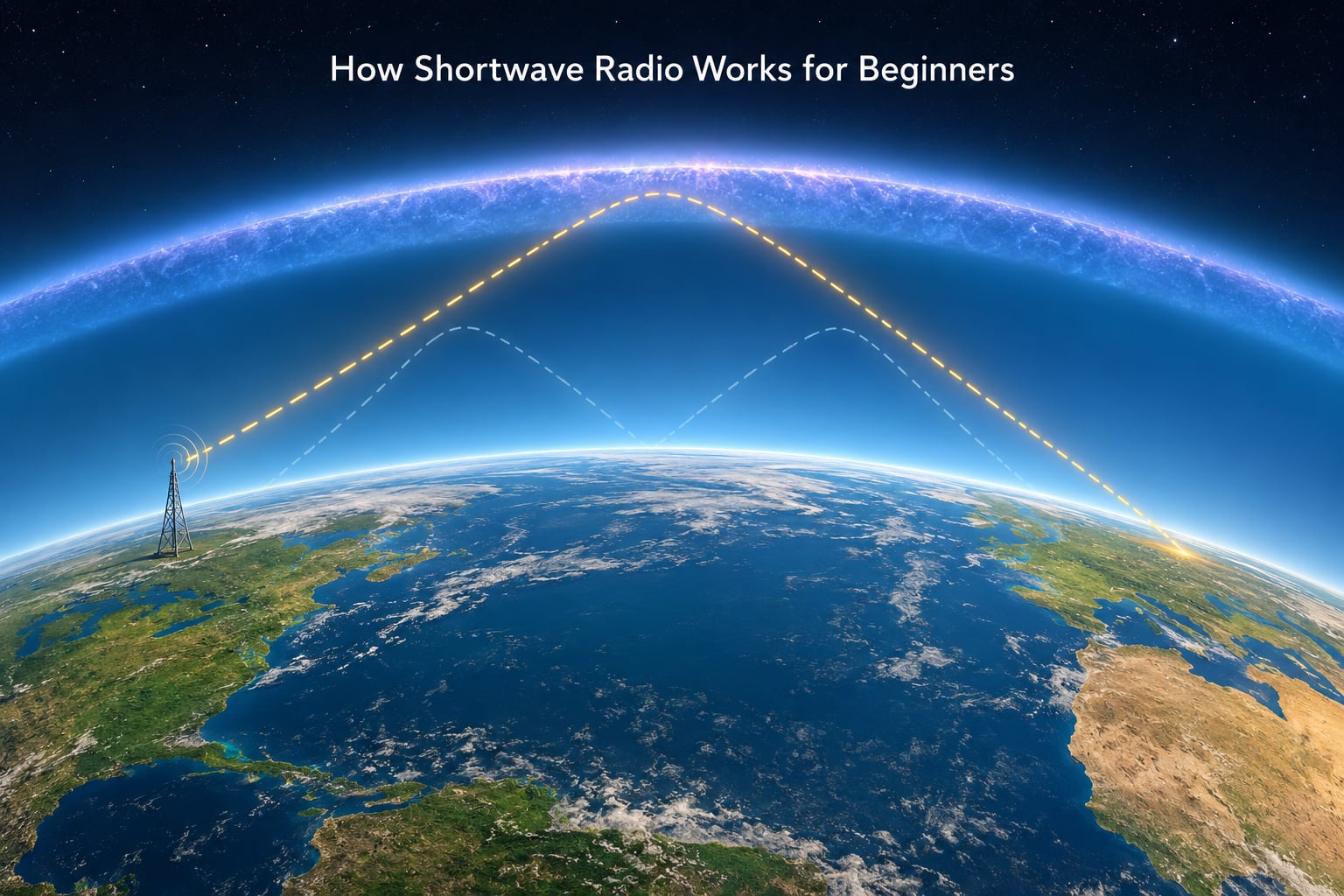
Here is the mechanism in six steps, with no jargon that does not earn its place.
- A station mixes audio onto a carrier. Your voice or music modulates a carrier wave at one fixed frequency, such as 9.580 MHz, and an antenna sends that combination out into the air.
- The signal leaves Earth at an angle. A shortwave aerial cannot fire straight up usefully, so a transmitter aims the signal low and skyward, usually 10 to 40 degrees above the horizon.
- The ionosphere reflects it back down. Between about 60 and 450 km up, solar radiation has stripped electrons from gas atoms. Those free electrons refract the wave and turn it back toward the ground.
- The signal lands a long way from the transmitter. A single hop covers a few thousand kilometres, so a station in Germany can arrive in Yorkshire with no repeater of any kind.
- It may bounce several more times. Each additional hop can carry the signal across an ocean and land it on another continent, with the ground re-reflecting it upward again.
- Your receiver selects that one frequency. Tuning sets a narrow filter around the carrier, the demodulator turns the audio back into sound, and the volume follows how strong the signal is right now.
Nothing about the broadcast is aimed at you. You hear whatever path the ionosphere happens to be offering at that hour, which is exactly why conditions change so much between evening and morning.
The Shortwave Radio Signal and Propagation
Propagation is the word for how radio energy moves between two points. Shortwave uses three main routes, and it helps to know which one you are relying on.
Ground wave hugs the Earth’s surface and dies out within a few hundred kilometres. It is what keeps a local AM station audible across town.
Skywave is the shortwave workhorse. It leaves the ground at a low angle, reflects off the ionosphere, and can cross whole continents.
Scatter happens when a signal hits irregularities in the ionosphere and sprays off at odd angles, giving you long paths at unexpected distances. Sporadic E, a thin patch that appears unpredictably, can briefly open paths far beyond the normal skip distance.
The D, E and F layers, explained simply
The ionosphere is not one layer. It is three, and each behaves differently, which is the whole reason bands work at different times.
- D layer, roughly 60 to 90 km. It only exists in daylight. It absorbs shortwave energy hard, so while the sun is up it swallows the lower bands. At sunset it vanishes almost instantly, and that is the signal to go tuning.
- E layer, roughly 90 to 130 km. Present day and night, but weak at night. It bends and reflects higher frequencies rather than absorbing them, and occasionally forms Sporadic E patches that open up unexpectedly long hops.
- F layer, roughly 130 to 450 km. The layer that does the real work. It absorbs little, reflects broadly, and persists all night, which is why the higher bands stay usable after dark even when the lower bands are at their best.
The part beginners get wrong about how shortwave radio works
The most common mistake is thinking shortwave behaves like a very long-range version of FM. It does not. The signal strength depends on the time of day, the season, the sun’s activity and your own location, so a frequency that is crystal clear at 9pm can be dead by midnight and back again at sunrise.
Another wrong assumption: that a station fades because it switched off. Most fading is the ionosphere reshaping underneath the signal while it is in flight.
Why solar minimum matters to you now
The sun’s activity runs on an roughly 11-year cycle, and we are sitting in the quieter half of the current one. That means lower sunspot numbers and fewer ionising UV bursts. The bands still work, but openings are less frequent, the higher bands close down sooner, and you will have an easier night than you would at a solar maximum.
Which Frequencies Are Used for Shortwave?
Shortwave bands are named by wavelength in metres, so 49m means a wavelength of about 49 metres, which is roughly 6 MHz. Bands are split by wavelength because neighbouring wavelengths share the same propagation behaviour.
| Meter band | Frequency range | Best time to listen | What you will usually hear |
|---|---|---|---|
| 80m / 75m | 3.5 to 4.0 MHz | Night | Amateur voice, slow Morse, some utility |
| 60m | 5.3 to 5.4 MHz | Night | Amateur, experimental |
| 49m | 5.9 to 6.2 MHz | Day and early evening | International broadcasters, plenty of them |
| 41m | 7.1 to 7.3 MHz | Day and evening | Broadcasters, amateur voice |
| 31m | 9.4 to 9.9 MHz | Day, night, best at night | Broadcasters, the most useful band there is |
| 25m | 11.6 to 12.1 MHz | Daytime | Broadcasters, some utility |
| 21m | 13.5 to 14.7 MHz | Daytime | Amateur bands, shortwave broadcasters |
| 19m | 15.1 to 15.6 MHz | Daytime | Broadcasters, variable in a quiet cycle |
| 16m | 17.4 to 18.0 MHz | Daytime, best months | Amateur, a few utility signals |
| 15m | 21.0 to 21.5 MHz | Daytime | Amateur, weak broadcasters |
| 13m | 21.5 to 24.0 MHz | Daytime | Mostly amateur |
| 11m | 24.9 to 28.0 MHz | Daytime | Amateur, CB, very quiet at solar minimum |
Schedules change constantly, so treat the table as a map rather than a timetable. The HFCC publishes a global frequency schedule, and ShortwaveSchedule turns it into a searchable weekly calendar you can filter by country and language.
The three bands to start with
Listeners almost always land on the same three. The 49m band is labelled SW4 on most sets and carries more live stations during UK daytime hours than anything else. The 31m band is the workhorse, open day and night, and the 41m band is a good neighbour when 31m feels crowded.
The rule of thumb underneath all of it: low bands after dark, high bands in daylight. If a band is silent at 11pm it is probably your local time rather than the equipment.
What Equipment Do You Need to Listen?
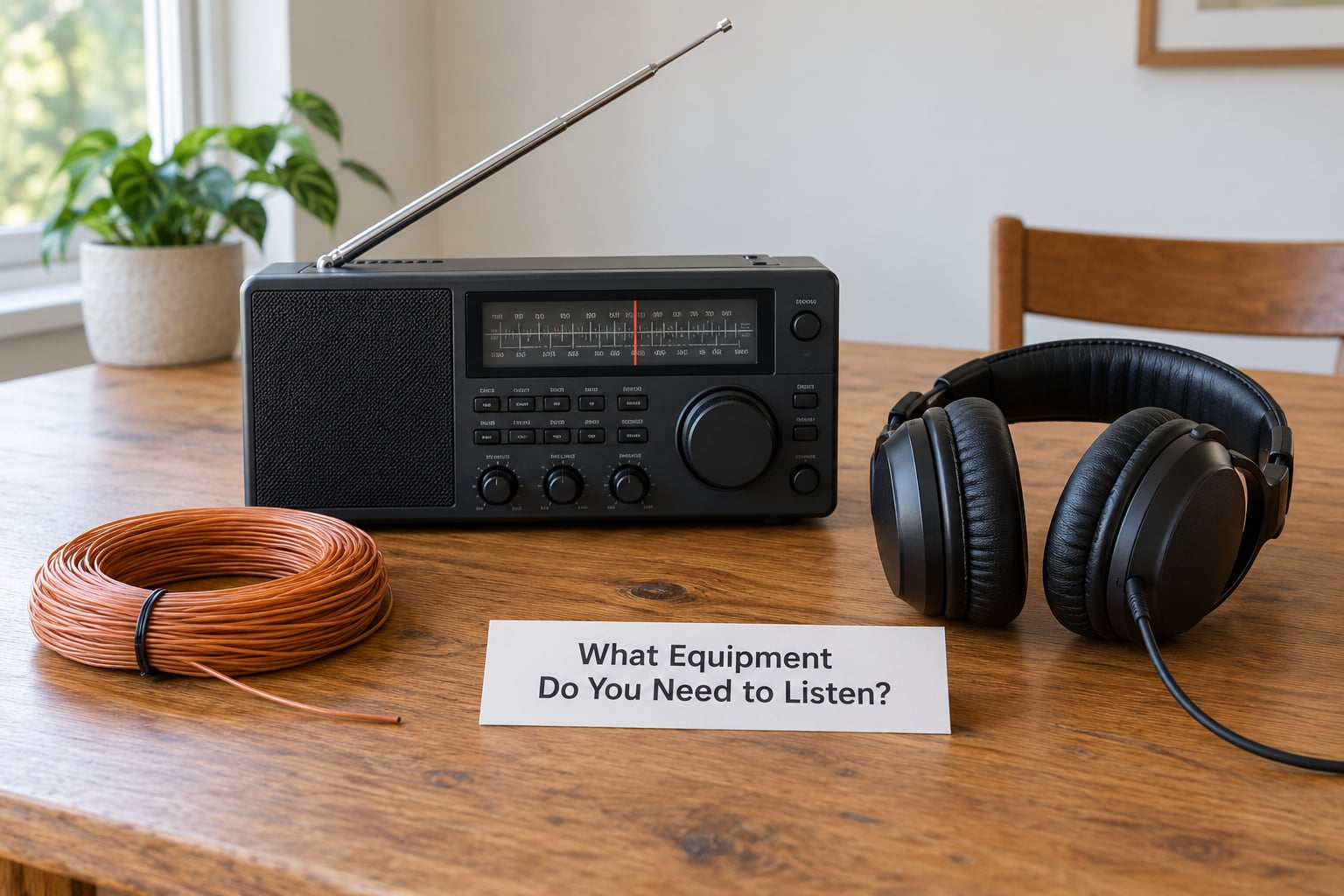
You need one thing that receives shortwave, and you have more ways of getting it than most beginners realise.
| Option | Strength | Weakness | Suits |
|---|---|---|---|
| Web SDR in a browser | Free, instant, wide selection of published frequencies | You are listening to someone else’s antenna, and the site may be busy | Deciding whether shortwave interests you at all |
| Portable shortwave set | Battery powered, fits in a bag, works anywhere | Short whip, modest selectivity | Travel and casual listening |
| Desktop general-coverage receiver | Full band coverage, bandwidth and filter switching, clock and alarm | Mains powered, needs a decent aerial | Regular listening at home, which is most people |
| Communications receiver | Excellent selectivity and SSB handling | Often needs external filters and a good aerial to justify the money | Utility and amateur listening later on |
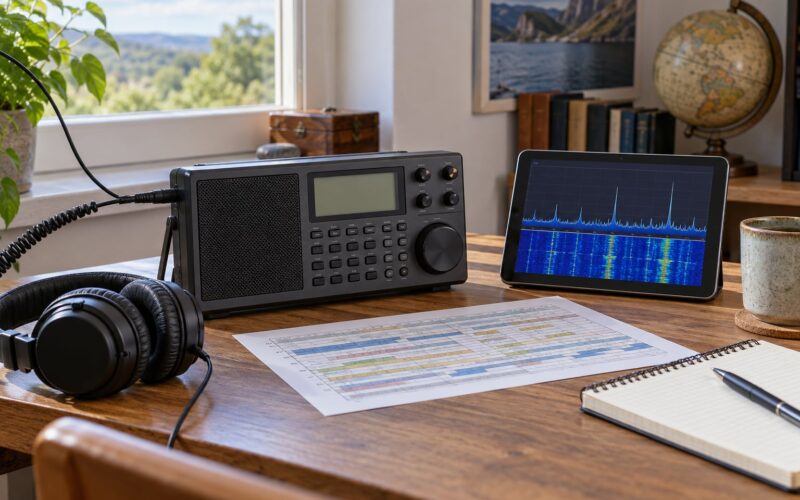
| SDR receiver plus computer | Waterfall display, wide bandwidth view, recordings fall out naturally | Needs a computer, a decent aerial and some patience | Curious listeners who like to see what the band is doing |
A pair of headphones with a mono switch helps more than people expect, because they cut out the electrical noise bleeding through the room. A short piece of thin wire, roughly 5 to 10 metres, with a cheap insulated clip connector is the other useful accessory.
How to Choose a Beginner Shortwave Radio
Judge a receiver on how well it separates one crowded frequency from the next, not on the largest number printed on the box. Here is the order that actually matters.
- Frequency coverage. It must tune 3 to 30 MHz continuously, and the broadcast bands from 49m up are non-negotiable. Digital frequency entry beats a slide rule dial once you pass week one.
- AM plus SSB with a BFO. SSB opens up maritime, aviation and amateur traffic that AM cannot reach at all. A beat frequency oscillator is how you bring SSB voice into intelligible sound.
- Bandwidth and selectivity switching. A wide bandwidth helps you find stations in a noisy band, a narrow one keeps the neighbours out once you have one. Filters beat amplifiers every time.
- Automatic gain control and an attenuator. AGC keeps loud stations from swamping weak ones. The attenuator stops a strong local transmitter nearby from pinning the receiver and blocking everything else.
- Power and practical details. Battery plus mains, a supplied whip, a carry handle, alarm functions and memory presets. An internal clock that logs in UTC saves real confusion later.
What can wait: rooftop aerials, rotators, dedicated communications receivers and external filters. Get the basics right and the log will tell you which limitation is actually holding you back.
How to Tune In and Improve Reception
Tuning shortwave well is a repeatable sequence rather than a lucky sweep across the dial.
- Pick a band for the hour. After dark, start on 31m then 49m. In daylight, try 25m, 19m and 16m.
- Extend the whip fully and move it away from the set. Touching the aerial or the case puts your body into the circuit and adds noise.
- Sweep slowly in AM at the widest bandwidth. Find a voice or a tone first, then narrow the bandwidth down.
- If the voice sounds like chipmunks, switch to SSB and engage the BFO. That noise is not a broken station, it is one sideband of the transmission arriving on its own.
- Use the attenuator if everything is loud. Overload makes weak signals vanish rather than appear, so back the gain down.
- Log it in UTC with a date. Time, frequency, mode and a note on signal strength. Repeat the same frequency a week later and you will start to see patterns rather than luck.
How to identify the station you just found
Start with the voice: language and accent narrow the field fast. Many stations broadcast an interval signal, a short melody or chime before their programmes start, which is often the fastest confirmation you have.
Note the time you heard it and check it against ShortwaveSchedule for the station listed at that frequency, language and transmission window. Checking the schedule is far more reliable than guessing from a voice alone.
Antennas, Noise, and Interference
Veterans in r/shortwave say it plainly and they are right: the antenna matters more than the radio. A modest set with a good external wire beats an expensive set with a stubby telescopic whip.
A whip of about 100 cm is roughly a quarter wavelength at 7 MHz, so it works reasonably well on the lower bands and poorly on the higher ones where you would want a much longer element. A thin wire of 5 to 10 metres is a step up, and it is the first thing I would try if reception feels weak.
Attach that wire to a proper insulated terminal or a cheap clip connector rather than twisting it onto the whip. Clipping bare wire onto the telescopic antenna is the classic rookie error, and it regularly makes reception worse: the extra wire overloads the receiver’s AGC, which blanks out weak stations instead of rescuing them.
Static is not the same as interference
Random crackling that changes constantly is atmospheric noise, and it is normal. A steady buzz, whine or warble that stays put as you tune across the band is electrical interference, almost always from something in your house.
LED lamps, phone chargers, computers, switch-mode power supplies and dimmable bulbs are the usual suspects. A quick diagnostic: run the set on batteries away from the devices for ten minutes. If the noise drops, you have found your culprit and the fix is unplugging it, not buying a better receiver.
Keep long aerials well clear of overhead power lines and mast a rooftop aerial only with proper rigging. Never erect anything near electricity infrastructure.
How Shortwave Listening Differs Online
A web SDR runs a real receiver at a real location and streams its audio to your browser. KiwiSDR is the best-known example, with many similar networks worldwide and plenty of published frequencies to browse.
The practical effect is that a remote antenna in a quieter spot, often outside a city, can hear stations you would struggle to catch on a radio indoors in Yorkshire. It costs nothing, needs no hardware and works on a laptop, which is why plenty of long-term listeners say they started this way and only bought a set later.
The limits are real. The receiver you are using is somebody else’s, it may be busy or offline, and you are hearing what its location and antenna can reach rather than what yours could. Check the site’s rules before you transmit anything to a shared receiver, and treat it as a trial tool rather than a permanent substitute.
Frequently Asked Questions
Does anyone still use shortwave radio?
Yes. International broadcasters including the BBC World Service, Voice of America, Deutsche Welle, Radio Romania, Radio Japan and China Radio International still transmit on shortwave, aimed at regions with slow or expensive internet. Beyond them sit maritime and aviation traffic, coast stations, time signals, amateur radio and utility stations. It is not a large audience, but it is an active one.
How far away can you hear shortwave radio?
A single hop, where the signal reflects once off the ionosphere, commonly covers a few thousand kilometres. Multi-hop paths, where the signal bounces between the ground and the ionosphere several times, routinely carry broadcasts across oceans. Distance is not fixed: the take-off angle, the time of day, the season and solar activity all change how far a given frequency reaches at that moment.
How do I listen to shortwave radio on the internet?
Open a web SDR such as KiwiSDR, pick one of the published public receivers that suits your time zone, and select a frequency from the site’s list. Audio streams straight to your browser and many networks record what they pick up. It is free, needs no hardware, and is the cheapest way to find out whether shortwave interests you before buying a receiver.
Do I need a licence to listen to shortwave radio?
No. Receiving shortwave broadcasts requires no licence anywhere in the world, and owning a capable receiver is entirely legal in the UK. Transmitting is different: that needs a licence under the Wireless Telegraphy Act and an approved call sign. If you later go down the amateur radio route, the Radio Society of Great Britain administers the UK amateur licence.
What is the 3-3-3 rule for radio?
It is an old rough guide among shortwave listeners, meaning you might hear a skip of about 3,000 miles on frequencies between 3 and 6 MHz at around 3am local time. Treat it as folklore rather than a law. Real skip distance depends on frequency, take-off angle, season and solar activity, and a 3am opening on 5 MHz can deliver anything from 1,500 to 4,000 kilometres.
What are good shortwave frequencies for a beginner to try?
Start with the 49m band, usually labelled SW4, which carries a good number of international broadcasters during UK daytime hours. Add 31m, the most useful band there is and open day and night, then 41m as a quieter neighbour. Use AM for broadcast speech, switch to SSB with the BFO for utility and maritime voice, and check ShortwaveSchedule first so you know what should be on air.
Conclusion: Start With One Receiver and a Short List of Frequencies
The mechanism is simple once you see it: a signal goes up at an angle, the ionosphere sends it back down, and your receiver picks out that one frequency. Everything else is patience.
So pick one receiver that covers 3 to 30 MHz with AM and SSB, or open a web SDR tonight and spend half an hour. Learn three bands properly: 49m, 31m and 41m. Try them at different hours, move the antenna around, and note what you hear in a log with UTC times. After a month of that you will know more about propagation than any article can tell you.