Yes, you need a music licence before you stream anything to the public. To get music licensing for internet radio you apply to the rights bodies that hold the music you want to play, pay their annual tariff, then report what you streamed so the royalties reach the songwriters, publishers, artists and labels who own it. Two layers are involved: the musical composition and the sound recording.
The licence covers music you play to a public audience, not the hardware. You do not need a broadcast transmitter licence from Ofcom or the FCC for an internet-only stream, and you do not need a studio. What you need is permission to play the music, and the obstacle is rarely the software. It is paperwork, accuracy and two separate rights layers that most guides never explain clearly.
Getting this right takes a few weeks rather than an afternoon. Most of the time is spent collecting track data and setting up reporting, so the practical way to approach it is methodically: define your station, work out which rights apply, research the right licensors, prepare accurate metadata, apply, and then keep the records.
Table of Contents
- What You Need
- How to Get Music Licensing for Internet Radio: Step-by-Step
- Frequently Asked Questions
- How much does internet radio music licensing cost?
- How much does it cost to get a radio licence?
- Do I need ASCAP and BMI licences as well as SoundExchange?
- What is total listener hours and how is it calculated?
- Can I run a station using only royalty-free or public-domain music?
- Can internet radio make money?
- Conclusion
What You Need
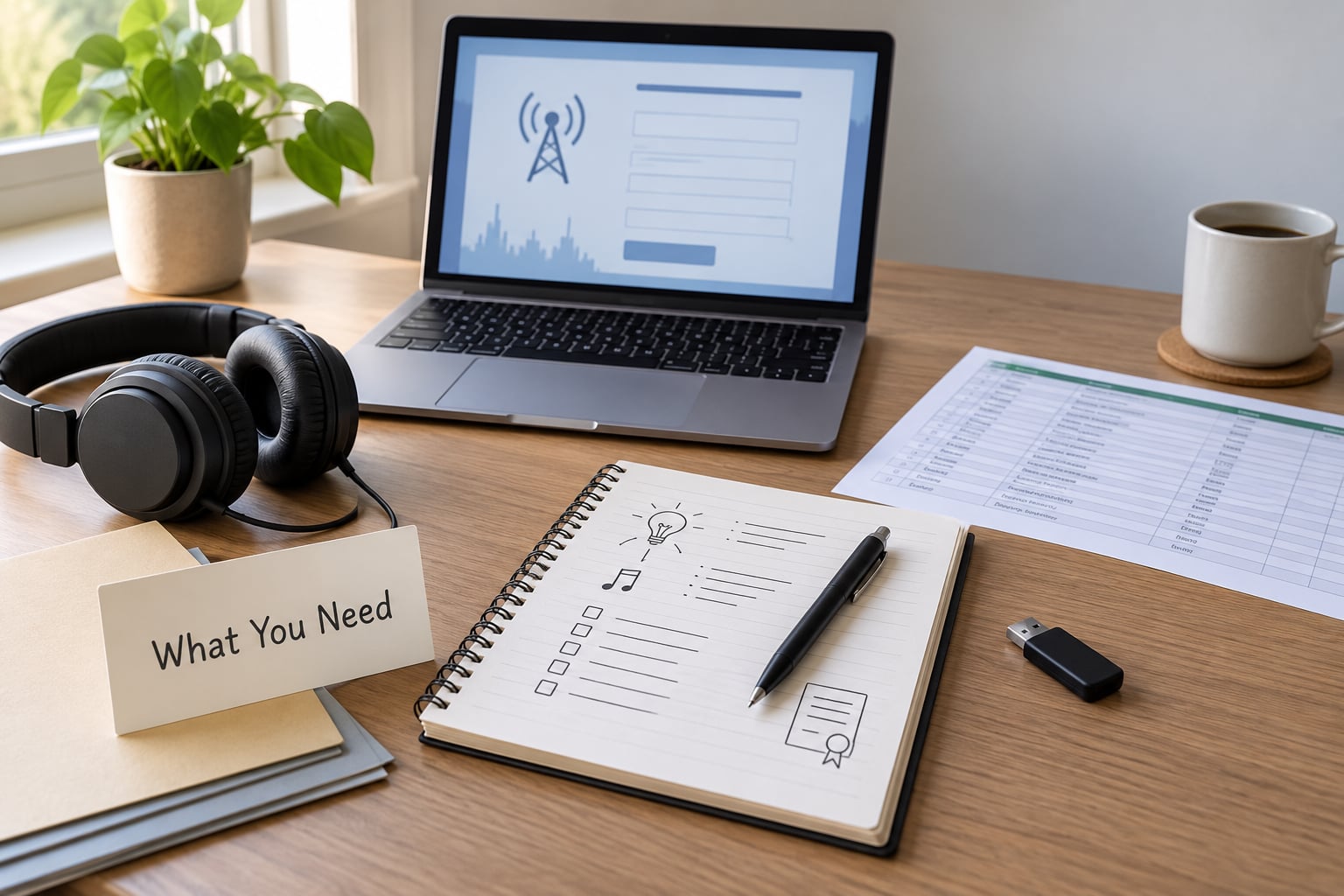
Applications get rejected and delayed far more often over missing paperwork than over anything technical. Have these ready before you contact a single rights body.
A legal entity or a named individual
Rights bodies need to know exactly who is applying. That can be you personally, trading as a sole trader, or a registered company. Community and student stations often apply through a parent organisation such as a university, a local authority or a registered society.
Music-use details
Write down your format, schedule hours, likely audience size, geographic spread, whether the stream is live or on-demand, whether you run video alongside the audio, and whether you accept donations, advertising or subscriptions. Every one of those answers changes which tariff band you land in.
Financial records
Tariffs are revenue-weighted and audience-weighted, so have your expected income and your forecast listener hours ready. Actual historical figures beat estimates once the station has run for a few months, so keep monthly figures from launch day.
Accurate track and station metadata
For each track: title, artist, songwriter or composer, publisher, record label, master right owner, and the ISRC or UPC code where you have it. For the station: legal name, stream URL, server location, and the software you use to deliver audio. Guessing at a rights holder is the single most common reason a return gets bounced.
Streaming or broadcast credentials
Your stream URL, your content management system login and, if you use them, your SHOUTcast, Icecast or Shoutcast server account details. Rights bodies sometimes need to verify you are delivering an actual live stream rather than uploading files.
A reporting tool
You will need somewhere to log plays and listener hours from day one. A spreadsheet works at first; dedicated royalty reporting software is easier once you are logging hundreds of tracks a week. Decide this before launch, because retro-fitting the history is painful.
How to Get Music Licensing for Internet Radio: Step-by-Step
Work through these in order. Skipping the first two is how stations end up paying twice, or worse, playing music they had no right to use.
Step 1: Define Your Station and Music Use
Before anything else, write a one-page description of the station: format, target audience, countries your listeners are in, hours of live programming, whether you archive shows for on-demand listening, and your commercial status. Commercial status matters legally in some territories and commercially everywhere else.
Then fix how you deliver music, because three delivery models carry different rights obligations. A live non-interactive stream behaves like broadcast radio: listeners hear the same programme at the same time and cannot choose tracks. An on-demand or jukebox stream lets listeners pick from a catalogue at will, which is treated far more harshly. A podcast delivers completed episodes after the fact and follows its own rules.
Most hobby stations intend the first and end up drifting toward the second once they add a request line or a track archive. Decide now, and stay on the side of the model you declared.
Step 2: Identify the Rights You Need
There are two rights layers, and they are owned by different people. Getting this distinction right is the whole ballgame.
The musical composition is the song itself — the lyrics and the underlying music written by a songwriter and administered through a publisher. The sound recording is the particular master you play, owned by a label or an artist and licensed separately. Playing a song means performing the composition and using a recording of it, so you normally clear both.
On top of those sit adjacent rights. A synchronisation licence applies the moment you put music into a video, a visual slideshow, a podcast episode or a stream with moving artwork. Mechanical rights cover reproduction and distribution of the recording, which is why MCPS-PRS exists in the UK as a backstop for on-demand use. If you plan to stream video alongside audio, budget for a third layer from day one.
That last point catches people constantly. A station that adds a webcam feed or a YouTube simulcast without clearings moves into a rights regime that a music-only blanket licence does not cover.
Step 3: Research Licensors and Performance-Rights Organisations
Performance rights organisations (PROs) license large catalogues on behalf of songwriters and publishers. In the UK that means PRS for Music for musical works. In the United States the same job is split across ASCAP, BMI and SESAC, which is why US stations need all three. Canada uses SOCAN and Re:Sound.
Sound recordings are handled separately. In the UK that is Phonographic Performance Limited (PPL). In the US it is SoundExchange, which operates the statutory digital performance licence created by the Digital Performance Right in Sound Recordings Act and later amended under the Digital Millennium Copyright Act. MCPS-PRS sits behind both in the UK as the mechanical-licensing backstop for recorded music.
So there are six bodies worth knowing, and what each one actually licenses matters more than the logos:
- PRS for Music (UK) — musical compositions performed on your stream. The main cost driver is revenue, audience size and tariff band.
- Phonographic Performance Limited, PPL (UK) — sound recordings broadcast and made available on demand. Cost again turns on revenue, audience size and tariff band.
- MCPS-PRS (UK) — mechanical reproduction and distribution of recordings. Driven by downloads, on-demand and non-broadcast use.
- ASCAP, BMI and SESAC (US) — musical compositions. All three are needed together, and cost scales with revenue, audience and the number of PROs you license.
- SoundExchange (US) — the statutory digital performance of sound recordings. Billed on total listener hours above the threshold allowance.
- SOCAN and Re:Sound (Canada) — compositions and recordings respectively, priced on revenue and audience.
Two warnings here. First, a blanket licence covers a whole repertoire, but it covers only the territory you bought it in. A UK PRS for Music licence does nothing for listeners in the United States, and a US PRO licence does nothing for listeners in the UK. If your audience is international, you need licences in each territory you can actually reach.
Second, a personal subscription to a streaming service is not a station licence. Several hosts bundle licensing into a monthly fee, and users on radio forums have assumed for years that this removes the obligation. It does not. The licence covers the host’s own service, not your stream, and the liability stays with the broadcaster.
Step 4: Prepare Accurate Music and Station Information
Returns are only as good as the data behind them. Build one row per track per rotation, and get the fields right the first time.
For each track you need the title, the performing artist, the songwriters or composers, the publisher, the record label, and the master right owner. ISRC codes identify the recording and UPC or EAN codes identify the album, and both save a lot of reconciliation work later. Where a rights body already knows the catalogue entry, let it resolve the metadata itself rather than typing an approximation into a form.
For the station, be exact about your stream URL, your server location, your content management system and software, and your reporting contact. Discrepancies between what you told the rights body and what your listener data shows are the fastest route to a query.
Log plays as they happen. Total listener hours is the unit most stations are billed on, and it is calculated from the number of connected listeners multiplied by the time they stayed connected. Retrofitting three months of missing play logs is genuinely miserable work, so build the habit from the first broadcast.
Step 5: Apply, Negotiate, and Keep Records
Apply directly to each rights body for your territory, and expect to complete a short application, an agreement and a tariff return. Applications ask about your format, audience, revenue model and projected hours; accurate answers at this stage prevent reassessment later.
Compare terms before you sign, and check four things specifically. Does the licence cover every territory your listeners sit in? Does it cover on-demand archives, video, podcasts and simulcasts, or only live audio? What is the reporting frequency and format? And what happens to the licence if you stop broadcasting or change format?
Ask for the fee bands in writing. Tariffs are structured by revenue and audience rather than sold as a single published price, so a short conversation with the licensing team about your real numbers is usually more accurate than anything you find in an old forum post. Figures floating around online for the last decade are stale and should be treated as folklore until you check them with the organisation.
Then store everything: signed agreements, tariff confirmations, correspondence, and your reporting returns, in one folder with a date on each document. Set a diary reminder for the renewal date and for any annual declaration. Most stations that get into trouble did nothing wrong — they simply let a renewal lapse while they were busy.
Step 6: Test the Station and Monitor Compliance
Before you advertise the stream, run a private test broadcast and check four things: that the stream plays cleanly to a listener outside your own network, that your play logs are capturing every track, that the metadata shown to listeners matches what you are reporting to the rights bodies, and that your territory covers where your listeners actually are.
After launch, treat reporting as a monthly routine. Reconcile your log totals against your listener analytics, submit the return on schedule, and save the confirmation. When your schedule, format or distribution changes — a new co-host, a video simulcast, a new country in your audience — check whether your licences still cover it, and get the extra clearances you need before you make the change.
Keep a simple compliance record: licence number, territory, covered uses, renewal date, reporting dates. It is unglamorous, and it is the difference between a station that can answer an enquiry in five minutes and one that has to start from scratch.
Common Mistakes
Treating a streaming subscription as blanket permission. A personal Spotify account is a private listening agreement with a commercial platform. It does not extend to a station broadcasting the same music to the public.
Playing music without accurate metadata. Unattributed tracks cannot be paid to their owners, so the royalty simply evaporates. Accurate metadata is not admin tidiness; it is the mechanism the whole payment system runs on.
Assuming one licence covers every platform. A live stream, a YouTube simulcast and a podcast episode are three different uses. Your audio-only blanket licence does not stretch across them automatically.
Failing to clear music for video or podcasts. Adding a webcam feed, a video stream or a podcast introduces synchronisation rights. That is a separate negotiation with the master right owner, and it cannot wait until after launch.
Letting territorial restrictions expire. Licences are bought by country. If a stream becomes popular in a territory you have not licensed, you are broadcasting into a market you have no permission for.
Leaving reporting to the last minute. Unreported plays are unpaid plays, and repeated late returns are a licensing problem in their own right. Fifteen minutes on the first working day of each month prevents all of it.
Frequently Asked Questions
How much does internet radio music licensing cost?
There is no single published price, because UK and US tariffs are calculated from your revenue, audience size and usage rather than sold as a flat fee. Small stations often pay a modest annual sum; stations with commercial backing or large audiences pay far more. The most reliable way to get your figure is to apply and ask the licensing team for the tariff bands that match your projected hours and income, then compare against the current tariff tables each rights body publishes.
How much does it cost to get a radio licence?
An internet-only station does not need a broadcast transmitter licence. Ofcom in the UK and the FCC in the US regulate broadcast spectrum, and you are not using any if your signal travels over the internet alone. The only licence you need is the music permission described in this guide, so the cost is the rights bodies’ fees and nothing else.
Do I need ASCAP and BMI licences as well as SoundExchange?
In the United States, yes — all of them, and SESAC too. ASCAP, BMI and SESAC license musical compositions, and their catalogues overlap but neither replaces the others, so a station needs each one. SoundExchange covers the separate sound recording side through the statutory digital performance licence. Add SOCAN and Re:Sound in Canada, and PRS for Music plus PPL in the UK.
What is total listener hours and how is it calculated?
Total listener hours is the billing unit most stations are measured on. It is the number of listeners connected to your stream multiplied by the number of hours they stayed connected. Two listeners listening for three hours gives six listener hours. Rights bodies often include an annual allowance before charges begin, so check whether your projected usage falls inside it.
Can I run a station using only royalty-free or public-domain music?
Yes, and that is the cleanest route for many hobby broadcasters. If every track is out of copyright, licensed for broadcast use, covered by a Creative Commons licence that permits commercial broadcast, or written and owned by you, you may not need a blanket music licence at all. Public domain status is determined by jurisdiction, and Creative Commons licences vary in what they allow, so check the specific licence rather than assuming.
Can internet radio make money?
It can, but the honest answer is that most small stations do not cover their own costs. Advertising revenue depends on audience size, and a station with a few hundred listeners will not earn enough to offset licensing and hosting. Sponsorships, listener donations and paid subscriptions are realistic with a loyal niche audience, but conversion is low. Budget for licence fees as a fixed cost whether or not anyone tunes in.
Conclusion
To get music licensing for internet radio, the order of operations matters. Define what your station is and how you deliver music, then identify both rights layers: the composition and the sound recording. Research the bodies that hold them in every territory your listeners sit in, which means PRS for Music and PPL in the UK and ASCAP, BMI, SESAC plus SoundExchange in the US.
Then build accurate track metadata before you apply, keep a spreadsheet of every play, and ask each rights body for the tariff bands that match your real numbers. Save every agreement and set a renewal reminder. Once that is done you can test the stream privately, go live, and report monthly without a second thought.
Tariffs and rules change, so check current terms and take advice from a broadcasting solicitor before you commit to a commercial deal. This guide covers general practice and cannot account for your station’s specific situation.