A radio program director decides what a station broadcasts and when: the music, the shows, the talk segments, the specials and the running order of every hour. They also manage the on-air talent, sign off the playlist, use audience data to adjust the schedule, and keep the station inside the rules of its broadcast licence.
That is the short answer, and it hides a lot of work. The job sits between the artistic side of radio (what the station sounds like) and the commercial side (what keeps it on air and profitable), and most of the role happens before a listener ever hears a note.
Table of Contents
- What a Radio Program Director Does
- How a Radio Program Director Shapes the Schedule
- How They Choose Music and Set the Station Format
- How They Manage Presenters and On-Air Quality
- How a Radio Program Director Uses Ratings and Listener Data
- What a Radio Program Director Does in a Typical Workday
- Skills and Qualifications Radio Program Directors Need
- How to Become a Radio Program Director
- Frequently Asked Questions
- What is the main job of a radio program director?
- Do radio program directors choose every song that plays?
- How is a radio program director different from a presenter?
- Do radio program directors need radio experience?
- What skills are most important for becoming a radio program director?
- How much does a radio program director make?
- Conclusion
What a Radio Program Director Does
A radio program director is the senior editorial executive at a station. The PD owns the format, which means the promises a station makes to its audience: this is a station that plays new guitar music, or one that serves a county’s farming community, or one that plays specialist jazz after 11pm. Everything from the music log to the length of each ad break is judged against that promise.
Concretely, a PD will usually spend their time on a mix of planning, editing, managing and reporting. They build the daily and weekly schedules, approve promo and sweep copy, sit in on shows, coach presenters, monitor ratings and research, sit in on music meetings, keep records of compliance, and answer to the station manager for how the programming performs.
How is a program director different from a presenter or station manager?
A presenter is on air. A PD is usually not, and their name is rarely in the credits. What they produce is invisible: the listener just hears the station sounding consistent, which is the point.
A station manager (called a general manager or market manager in the US) owns the business — budgets, contracts, staffing, the transmitter, the commercials operation. The PD runs the editorial side and carries the main share of a station’s on-air risk. On smaller stations one person does both jobs. On a network-owned group, the PD reports up to a regional programming director rather than to the station manager.
| Role | Main focus | Typical next step |
|---|---|---|
| Music Director | Building the music log, category rotations and clock, liaising with record representatives | Program Director |
| Program Director | Format, schedule, talent, promotions and compliance across the whole station | Senior PD or Regional Programming Director |
| Operations Manager | Technical delivery, broadcast systems, studio maintenance, playlists loading | Station Manager |
| Station / General Manager | Revenue, cost, sales targets, contracts, licensing | Regional or group management |
| Presenter | Delivering the show, following the brief, hitting the clock | Producer or Music Director |
The split between PD and music director is the one most newcomers find confusing. The music director handles the mechanics of the log: loading music, keeping categories in order, handling record company requests. The PD has final say on what actually goes into rotation and why.
How a Radio Program Director Shapes the Schedule
Scheduling is where the role becomes a craft. A PD works in dayparts — the named blocks a day is divided into, such as drive time, breakfast or the late shift — and builds each one to serve a different mood and a different audience.
Within each daypart the PD works in quarter hours, because that is how both music and advertising are counted. A typical hour might hold two songs, a sweeper, a promo, some talk and two ad breaks, and the balance shifts depending on the audience: music-heavy at breakfast, more news and talk through the middle of the day, longer music runs late at night.
Three things sit on top of the music clock. Sweepers are the short voiced ids that stitch the hour together. Promos advertise what is coming up next hour, tomorrow, or at the weekend. Voice-tracking is a common practice in smaller markets, where the PD records the links between songs and the station automation stitches them into the playlist, which lets one person present three shows a day.
The PD also works around the traffic and billing system, the software that assigns which advert lands in which break. If a national sales team has bought an extra burst of ads into drive time, the PD has to rebuild the clock so the station still sounds right. That reshuffling is unglamorous and eats into the week.
How They Choose Music and Set the Station Format
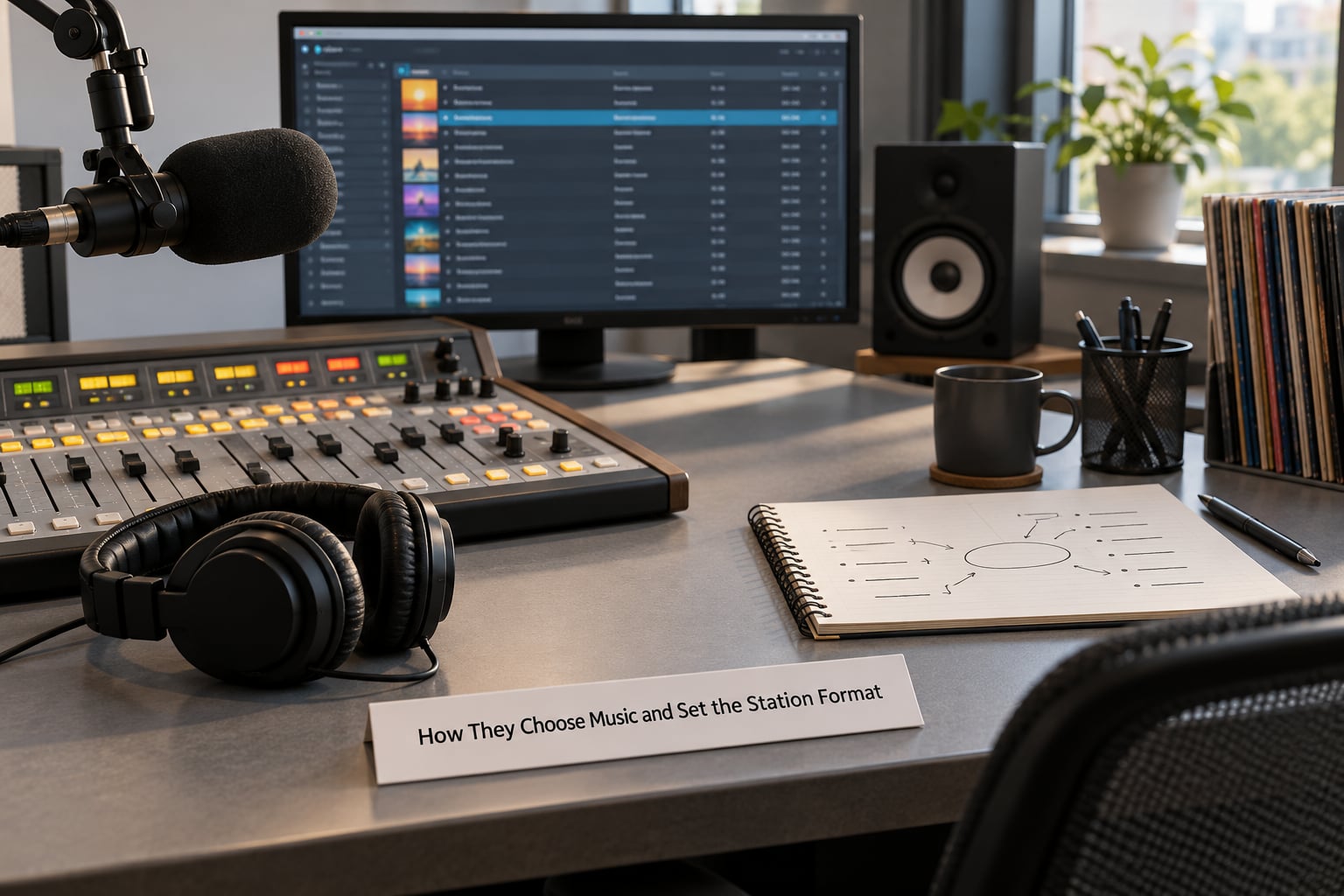
The format comes first. A PD inherits a station, or builds one from scratch, and writes down what it stands for: audience, music mix, tempo, the amount of talk, and what the station will never do. Everything after that is judged against that document.
Music is then scheduled by category and rotation. A category is a type of song — recent releases, established core artists, older tracks, a specific genre — and a rotation decides how often each one plays, with the aim that no two songs in a row sound the same. Category clocks let a PD control the texture of an hour without touching every song.
Currents are the songs getting heavy airplay, and the decision to promote one is a genuine editorial call. PDs test new material carefully, because a bad record played too often annoys exactly the core listeners a music station depends on.
The music itself sits inside a ruleset that most stations call the format rules, and the PD usually defends them. Typical rules cover how many times a song can play in a given period, how many consecutive female or male artists are acceptable, how many unfamiliar titles a day can carry, and how far a tempo or production style can drift from the station’s sound.
At music meetings, the PD and the music director go through the log and the record company promotions together. A poor chart week, an unusual festival release or a flood of one style of song all mean the log has to be adjusted rather than simply played.
How They Manage Presenters and On-Air Quality
Managing on-air talent is often the hardest part of the job. Presenters are creative people working live in a room where a cough goes straight to air, and the PD’s job is to make them consistent without flattening them.
In practice that means writing a brief for each show, setting the topics and the shape of the hour, and agreeing what the show will cover and what it will not. A beginner presenter needs a hard list of numbers, names and links to read. An experienced one needs more of a steer than that.
The PD checks recorded and live work. Backing vocals, phone calls and pre-recorded bits get listened back, and so do the shows themselves, usually the day after. Problems show up as missed cues, links that promise something the show never delivers, or a break that runs long and leaves the next presenter short.
Language and compliance are where a PD can put a station at real risk. In the US the FCC sets the rules stations have to follow; in the UK the Ofcom Broadcasting Code and the terms of the licence govern what may be said. On top of that sit contesting rules, disclosure requirements and the two practices of plugola and payola — accepting something of value in exchange for airplay, which is exactly what stations are required to police.
When something goes wrong on air, the PD usually handles it: take the complaint, check the recording, decide whether the station was wrong, and decide whether the presenter needs a word and a written note. Handling it badly is more expensive than the original mistake.
How a Radio Program Director Uses Ratings and Listener Data
Audience measurement tells a PD whether the changes they made worked. In the US that largely means the panel-based ratings system run by Nielsen, where a sample panel meters its listening and the results are weighted to the market. Portable meters and diary studies came later and now sit alongside it.
PDs watch several numbers rather than one. Average quarter-hour share shows how the station holds listeners through an hour. Cumulative reach shows how many different people tune in across a day. Time-shifted listening shows how much of an audience tuned in later or on demand, which matters a great deal now that a missed breakfast show can be caught at lunchtime.
Research beyond the numbers does just as much work. Stations run listener panels, focus groups, telephone surveys and station social channels, and the PD reads all of it looking for the sentence that explains a dip: a missing presenter, a repetitive record, a news story that did not land, or a competitor’s new breakfast show.
Streaming and podcasts change what the data even means. A station with a strong broadcast number and a weak podcast download figure is losing its audience between shows, and a PD in 2026 is expected to know that. On a smaller scale, competitors now compete for the same hours on phone speakers and smart speakers, and the schedule has to work when someone joins halfway through.
Ratings are a measure of audience, not of worth. A well-run public service station can be doing serious work and post modest commercial figures, and a programme with a small but fiercely loyal audience can hold a slot in a schedule that a bigger number would not justify.
What a Radio Program Director Does in a Typical Workday
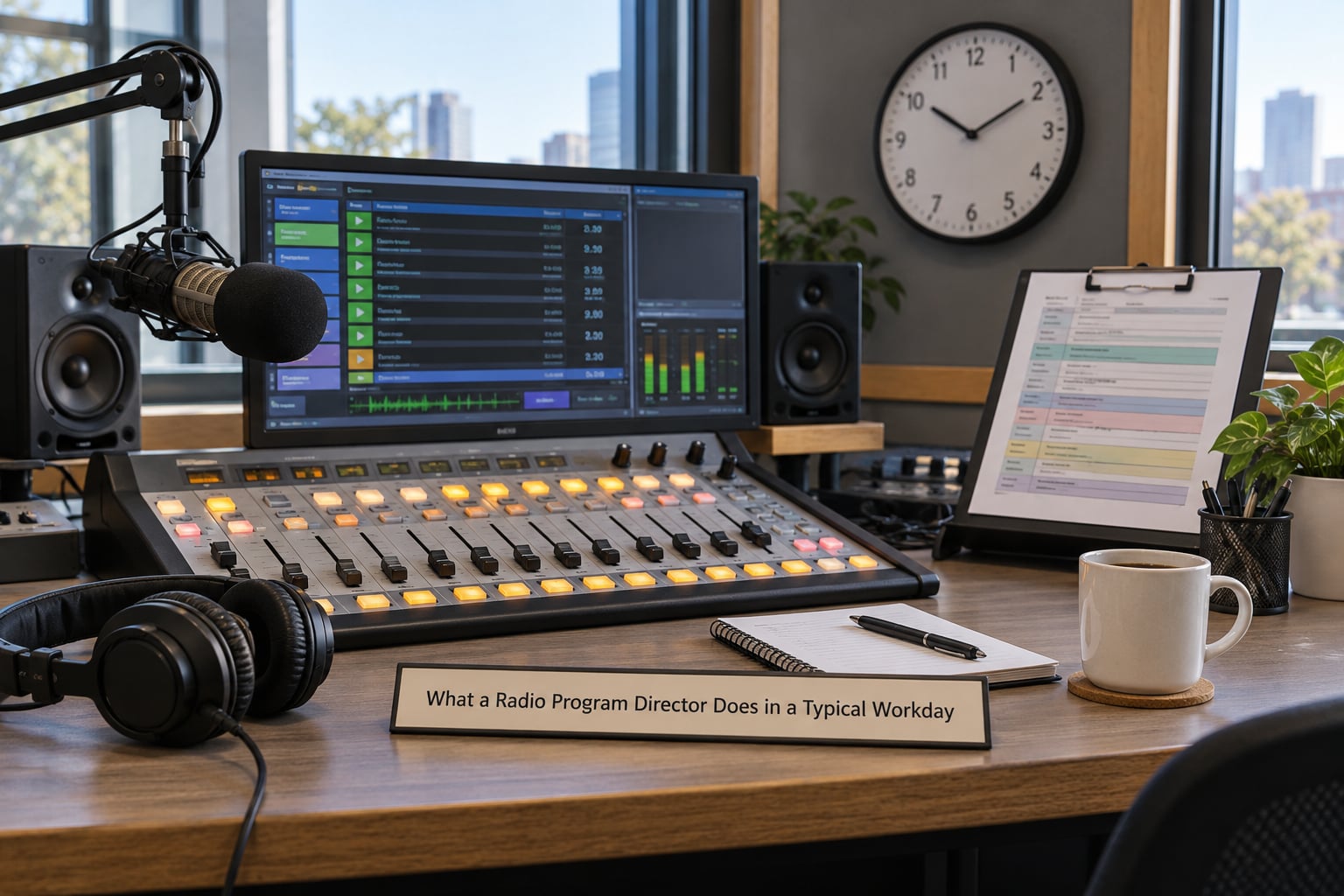
Nobody’s day looks the same, but the shape is usually recognisable. Early starts and late finishes are normal, and if a show needs covering at short notice the PD is often the fallback.
Early morning is listen-back. The PD listens to the previous day’s shows as a listener would, catching links, timing problems and anything that should not have reached air. Alongside that goes the ratings and streaming data for the previous daypart, plus overnight listener email and social messages.
Mid-morning is usually the planning block. This is when the schedule gets built or rebuilt: dayparts, clock variations, ad breaks, promo placement, specials and any coverage of a big news story. The PD also answers the sales team’s requests and signs off copy that has come back from promotions.
Midday tends to be music. A music meeting with the music director, a stack of new releases, and decisions about which songs get added, which get pulled, and how the log holds up if a big artist drops a surprise single.
Afternoon is people. Talent meetings, coaching sessions, a presenter running a show from another studio, or a live show the PD sits in on to hear how it is really going rather than how it sounded in the report.
Evening is looking forward. Promotions planning for next week, writing or approving the promos that go out tomorrow, and a last pass over the clock before it goes live. If anything has broken, this is when the PD finds out and decides whether tomorrow’s schedule survives it.
Skills and Qualifications Radio Program Directors Need
The useful thing about the role is that nobody arrives with all of it. Employers mostly look for a mix of editorial taste and operational rigour, and the balance varies sharply between a community station and a commercial network.
On the editorial side, PDs need real knowledge of the music or subject their station serves, and enough taste to know why a record works. They need editorial judgment, meaning they can tell the difference between a schedule that sounds busy and one that sounds right. People moving up from the music director route usually have this covered already.
On the operational side, they need scheduling discipline, comfortable audio production skills, and enough technical understanding of playout and automation to brief an engineer precisely. They need to read ratings and audience research without being fooled by a single number, and they need to write promo copy and briefs that a stranger can follow.
On the human side, coaching presenters, giving difficult feedback early rather than late, and staying level when a live show goes wrong in front of a whole market. It is a job that blends deadline pressure with a lot of small negotiations.
What software a radio program director actually uses
The toolkit is more specific than most career pages suggest. The scheduling and playlist side is dominated by music scheduling software such as WideOrbit and MusicMaster, which build the clock from the format rules and print the music log. Playout systems run the audio on air. Traffic and billing software decides which advert sits in which break.
On the analysis side, PDs work in ratings dashboards, usually Nielsen’s in the US and RAJAR in the UK, plus whatever streaming analytics the station’s platform provides. Production usually means a digital audio editor, and voice-tracking means a microphone in a treated room and a few rules about level and room tone.
A degree in broadcasting, communications or media helps and is common, but it is not the gate. Plenty of working PDs came up through community or student radio, and plenty through the music director route, where the playlist skills were already there.
How to Become a Radio Program Director
The route is long and there is no shortcut, but the ladder is real. The shortest path to a job application is having actually run something that went out on air.
Start at a community, hospital, university or online station where the entry bar is low and the volunteering is real. Ask for the unglamorous jobs first: producing a show, writing a music log, loading playlists, running a community event and taking the numbers afterwards. That work teaches you whether you like the pressure before you find out the hard way.
Learn the craft deliberately. Take a course in radio production or journalism if you can, then learn one scheduling system properly enough to build a clock from scratch rather than copying a template. Sit with a ratings panel for a day if you ever get the chance. You will understand the numbers faster than any article can teach you.
Build a specialism people can name. A PD who came up as a specialist jazz or classical music assistant is easier to place than a generalist. Owning one recurring show, or a podcast with a real archive behind it, gives you something concrete to point at.
Then take on work beyond your own show. Produce another presenter, run the playlist for a weekend, write the promotion for a station event. A PD is someone who has already been doing the job in pieces before anyone gave them the title.
Take the unglamorous route too. Music director, assistant PD and promotions roles are where most PDs are actually hired from, and they teach the parts of the job a presenter never sees.
Frequently Asked Questions
What is the main job of a radio program director?
The main job is deciding what the station broadcasts and when. A program director owns the station’s format, builds the schedule hour by hour, approves music and promotions, manages the on-air talent, reviews ratings and research, and makes sure everything on air meets the rules set by the regulator and the station’s licence.
Do radio program directors choose every song that plays?
Not individually, and rarely at smaller stations. The PD sets the format, the categories, the rotation rules and the hourly clock, and then approves songs for rotation. A music director builds the actual music log from those rules and handles record company requests. On large stations the PD approves and signs off; on small stations the same person does both jobs.
How is a radio program director different from a presenter?
A presenter delivers the show from a microphone and is judged on what they say on air. A program director is usually off air and is judged on whether the whole station sounds consistent and holds its audience. The PD writes the brief the presenter works to, checks the recorded show afterwards, and decides the running order the presenter fits into.
Do radio program directors need radio experience?
Almost always. Career guidance in the sector puts a minimum of around ten years of radio experience behind a program director role, usually built up through presenting, reporting, engineering, music directing or producing. A degree in broadcasting or communications helps but is not required, and employers weigh a proven track record of running a show or a log far more heavily.
What skills are most important for becoming a radio program director?
Editorial judgment and music knowledge come first, then scheduling discipline and comfort with audio production and playout software. A PD also needs to read ratings and audience research properly, write briefs and promo copy that a presenter can follow, coach people through difficult feedback, and stay level while a live broadcast goes wrong in front of the whole market.
How much does a radio program director make?
It varies more than most salary guides suggest. UK commercial radio sits in a mid five-figure band, and moves higher for programme controllers and group heads; US market directors typically earn more than UK equivalents, with the top of the range in major markets. Public service and community stations pay less, and group-wide senior programming roles pay more than single-station PDs.
Conclusion
A radio program director is the person who decides what a station sounds like and how it is scheduled, and who carries the consequences when that decision does or does not work. The role combines editorial taste, scheduling craft, talent management and compliance, and it is judged by an audience that can hear a bad decision within a week.
If you want to know whether it suits you, listen to a station for a week with a schedule in front of you and track how the hour is built. Then go and run something small that goes out on air, however small. That is the step most people skip, and it is the one that actually gets you in the room.