Learning how to pitch your band to a radio station comes down to three things: find the person who actually chooses the music, send them a private streaming link they can open in one click, and keep the message short enough to read between records. Everything else — the press kit, the follow-up, the spreadsheet — supports those three moves. Send quality music to the right name, respect the station’s submission policy, and follow up once. That is the whole job, and it is why most bands never get played: they do the opposite in all three places.
The rest of this guide breaks the process into the order that actually works, with the email written out so you can copy it. It also covers the part nobody mentions in music school, which is what a programmer is doing during the ten seconds they decide whether to keep reading. Budget about two hours for the first pitch, once your assets exist. Most of that time goes on research, not writing.
Table of Contents
- What You Need
- How to Pitch Your Band to a Radio Station: Step-by-Step
- 1. Find the Right Contacts by Matching Stations to Your Music
- 2. Choose the Best Song and Format Your Introduction
- 3. Build a Complete but Easy-to-Use Press Kit
- 4. Personalize the Email for Each Station
- 5. Send the Pitch Through the Correct Channel
- 6. Follow Up Once, Briefly, and Professionally
- 7. Track Responses and Improve the Next Pitch
- Common Mistakes
- Frequently Asked Questions
- How do I pitch a song to a radio station?
- Should I send a private streaming link or an MP3 attachment?
- Can an unsigned or independent band get airtime?
- How do radio stations decide what to add to their playlists?
- How long should I wait after submitting a demo?
- What should I do if a radio station says no?
- Conclusion
What You Need
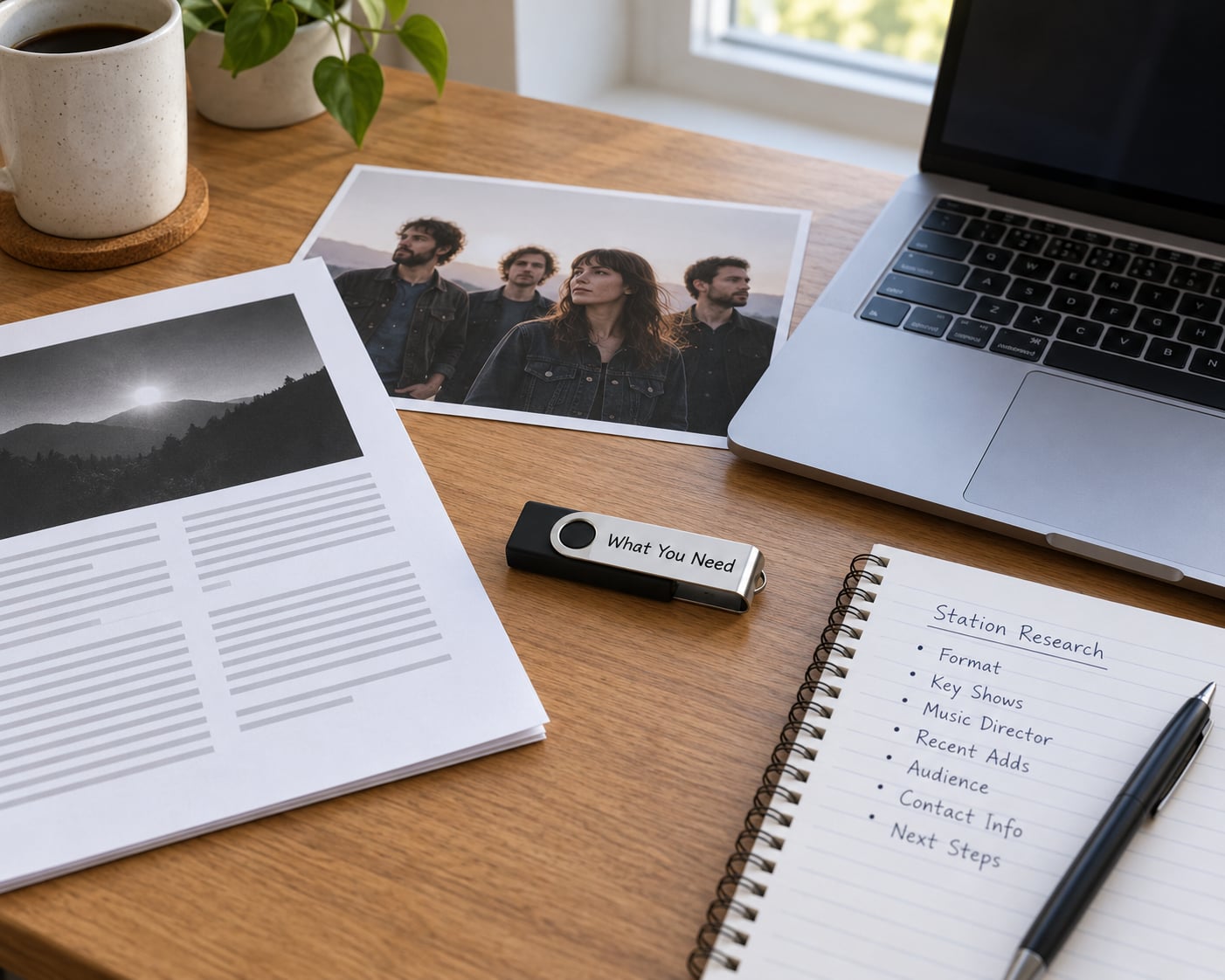
Before you contact anyone, get these finished. Incomplete material is the single most common reason a pitch dies in the first second.
- A finished, released track. Mastered, with correct metadata — artist name, track title, songwriter credits — filled in at your distributor. A programmer who plays a song on air has to log it, and a track called FINAL_v3_REAL.mp3 breaks their logging software.
- A private streaming link. Unlisted on SoundCloud, a private link on your own site, a hidden Spotify or Apple Music playlist, or a private SoundCloud upload. It has to open without a login or a request.
- A one-paragraph biography. Written in the third person, under about sixty words. Genre, location, what the band does, one fact a listener can hold onto.
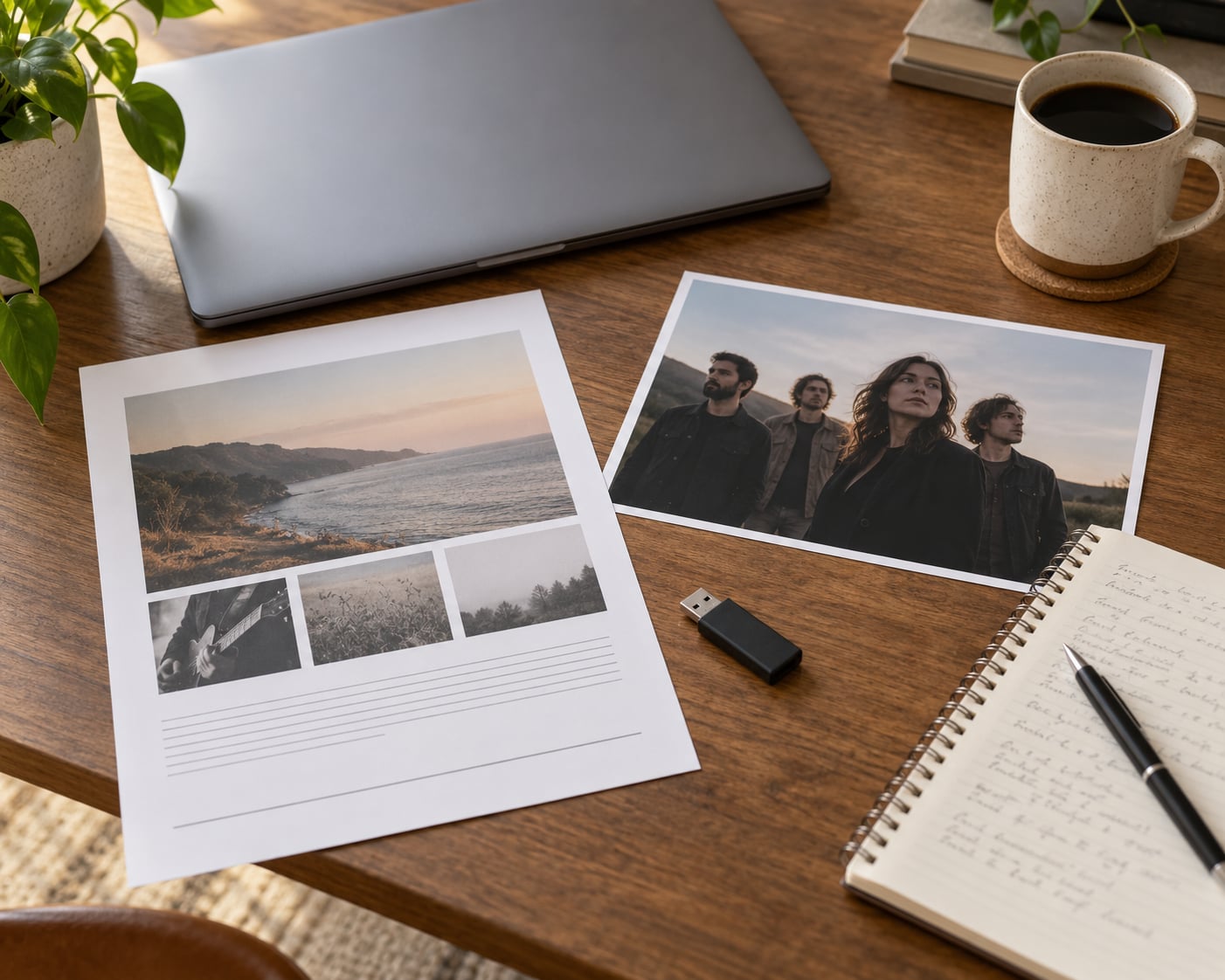
- Two or three press photographs. Landscape and square, high resolution, credited, with the photographer’s name. Landscape prints better on a mixing desk or in a show folder.
- A press kit page. A single web page containing the bio, release date, streaming links, credits, photos, live dates, and a downloadable one-sheet as PDF.
- One-sheet. One page. Same content in print form for anyone who asks for a physical copy.
- Clean contact details. A reply address on your own domain or a tidy professional address — not a Gmail with numbers in it.
- A pitch spreadsheet. Station, format, contact name, address, date sent, date followed up, response, outcome. Columns further down in step seven.
If you want a reference for how these assets are normally presented on a station’s own site, our station review coverage is a decent place to see the format and genre vocabulary individual UK stations publish.
How to Pitch Your Band to a Radio Station: Step-by-Step
1. Find the Right Contacts by Matching Stations to Your Music
Start by picking stations that already play music like yours. Format first — a station running current guitar music will not play a drum and bass record, however good it is, and that rejection is not personal. Listen to two hours of each station’s output and write down three actual songs you could sit next to yours on a playlist. If you cannot name three, move on.
Then find out who chooses the music. On smaller and community stations that is often the music director, working with the presenter. On larger commercial stations the program director makes the final call, sometimes with an assistant handling the inbox. A label’s plugger may already be pitching you without you knowing, so check before you send anything yourself.
Three terms get confused constantly, so define them once. A spin is the track played once. Rotation means the track comes back regularly inside a show or a daypart. A specialty feature is a slot built around one artist — an hour of your music, a guest mix, an interview. Spin first, rotation second, feature much later.
Find the address from the station’s own website. Look for a music submission page, an artist page, or a “contact” page that names a person with a role. Many stations publish a single submissions inbox precisely so they can manage volume. If the site says “no unsolicited music”, believe them and stop. Avoid bought email lists: the addresses are usually stale, and sending to the wrong person at a station is a fast way to be filtered.
2. Choose the Best Song and Format Your Introduction
Send one track. Not the whole EP, not three songs, not a link to your entire back catalogue. A programmer listens to what they can work with this week, and one good track with a clear reason beats a folder every time. Pick the song that most represents you and that you would defend on air yourself.
Open your message by identifying yourself and what you are sending, in the first two sentences. Say the band name, where you are based, the track title, and why this particular station. Then the link. Keep the whole email under about 150 words. Here is the skeleton:
Subject: [Track title] by [Band] for [Show or station name]
Body: Hi [Name], I’m [your name] from [Band], a [genre] band from [town]. We’ve just released [track] and thought of [show] because [one specific, real reason]. Here’s a private link: [link]. No attachments, no sign-up. If it’s not right for the show I completely understand — and thanks for listening.
Add one line with something human: a local festival slot, a support slot, a first airplay elsewhere, or a genuinely heavy streaming number. Keep the sign-off to a sentence and your name. Do not describe the song’s meaning. Programmers can hear it in ninety seconds; telling them what to feel rarely helps.
3. Build a Complete but Easy-to-Use Press Kit
The press kit is what they open after they decide they like the track, so it has to answer every follow-up question before they ask it. Put it on one page, on mobile, with no video autoplay and no pop-ups. Radio production departments work fast and usually on a small screen at a desk.
Include the bio, the release date, streaming links for the track, songwriting and production credits, two or three press photos with credits, live dates, and any support slots or press coverage you have already earned. A one-line press quote from anywhere you have been played looks better than an empty “endorsements” heading, so leave the heading off until you have something to put there.
Use the same release metadata everywhere — distributor, streaming services, your website, your socials. Inconsistency is the fastest way to get a track bounced back for correction, and correction costs you days.
4. Personalize the Email for Each Station
This is the step that separates a pitch from a mass submission. One real sentence about that station’s show is enough: a track they played recently, a guest you liked, a local artist they championed. Not flattery. A specific observation proves you listened, and it is the only thing in the email that a programmer cannot mass-produce from their own template.
Connect your strongest song to the format and the audience. If the show runs new unsigned guitar music at ten on a Sunday, say the track fits that slot. If the station serves a specific town or region, mention where you are from and any real tie to it. Match the framing to the station rather than pasting the same paragraph and swapping the station name.
For the subject line, use the track title, the band name, and the show or station. Specific beats clever. A subject reading “Song for your rotation” reads like the four hundred other emails sitting behind it.
Skip sending songs and shows by email. If you want an interview, a guest mix or a live session, pitch that as its own idea: one paragraph on the proposed feature, one sentence on why that presenter, one link. Ask for the slot rather than asking for a spin, because the decision-maker for a feature is usually the presenter.
5. Send the Pitch Through the Correct Channel
Use the channel the station specifies. That means an official submission portal or submissions inbox where one exists, a named music director’s address where one is published, or the business address listed for artist submissions. Some stations run a Formspree or similar upload form for demos; if it is there, it is there for a reason.
Skip a few habits. Do not attach audio, because large attachments get filtered before a human sees them. Do not send the same email to every presenter at one station; they talk, and a duplicate pitch reads as spam. Do not pitch to a station you have no plausible connection to, and do not use a free webmail address on a first approach to a commercial station.
Send from a real address, ideally on your own domain, with a plain-text-friendly body. Track every send the same day in your spreadsheet. If you are pitching ten stations in one afternoon, send them in batches of two or three rather than a single burst, and vary the wording — identical text is easy for filters to spot.
6. Follow Up Once, Briefly, and Professionally
Wait seven to fourteen days, then send one short follow-up. Two or three sentences: a reminder, a link again, a thank-you. No complaint, no “just checking in” guilt, no second attachment. If there is still no reply, stop. One follow-up is persistence. A second is noise.
Sample follow-up:
Hi [Name], just floating this back to the top of your inbox in case it got buried. The link is still here: [link]. If the timing is wrong for [show], no problem at all — I appreciate your time either way.
Silence is usually one of four things: the track did not fit, the inbox is genuinely full, someone else already owns that show, or it got filtered. None of them are personal judgements of your band, and none of them are fixed by sending again. Take it as one closed door and move to the next name.
When someone does reply, read what they asked for. A request for a different mix, a radio edit, a clean version with no vocal, or metadata in a specific format is normal production work, not a rejection. A pre-record or an interview request means you are being taken seriously. Answer quickly and precisely, and keep the tone friendly rather than relieved.
7. Track Responses and Improve the Next Pitch
Ten pitches with no record-keeping teaches you nothing. Keep a spreadsheet with these columns: station, format or genre, town, contact name and role, address, submission policy URL, date sent, follow-up date, response, outcome, notes. After twenty sends, the numbers tell you what to change.
A reply rate of a few percent across a well-chosen list is normal, not a sign your music is bad. One clear piece of feedback — a song too long for the show, a mix too dense for the format, a genre mislabel — is worth more than twenty silent inboxes, because you can act on it. Write that feedback into a column and re-use it in the next pitch.
Improve targeting rather than resending unchanged material to the same stations. If a tier consistently ignores you, look at whether your genre tag, your location or your subject matter is the mismatch. Pitching ten more stations in a tier that never responds is not persistence, it is the same mistake in a bigger envelope.
Set a Google Alert on your band name plus the station name, and check your streaming and download dashboards for a bump after any spin. When a play lands, capture the date, time and station, post about it honestly, and mention it in your next pitch to nearby stations. That is the only leverage a spin really gives you.
Common Mistakes
Almost every stalled campaign traces back to one of these, and each has a quick fix.
- Attaching audio files. Large attachments are filtered or dropped unread. Send a private streaming link and a compressed preview only if the station asked for one.
- Blasting unrelated stations. Mass emailing reads as spam and gets a sender domain blocked, taking your legitimate pitches with it. Work from a researched list of thirty, not three thousand.
- Writing generic praise. “Love your music” is noise. One specific, accurate observation about the show is worth more than three lines of compliments.
- Pitching before the music is ready. Unmastered demos and songs with no release date usually get a polite delete. Wait until the track is live and the metadata is correct.
- Sending too many songs. Four tracks means the programmer picks for you. Send the one you would fight for.
- Ignoring the submission policy. Some stations publish exact rules on genre, file type and frequency. Following them exactly is the cheapest credibility available.
- Following up repeatedly. One polite follow-up after seven to fourteen days. Then move on and keep pitching fresh names.
- Packing the first email with your biography. Nobody reads it. Sixty words in the press kit, and use the first paragraph for who you are and why this station.
One more worth naming: anyone guaranteeing a spin for money is describing something that does not exist as a legitimate transaction. Stations are not selling airplay, and there is no fee that buys a play. Payment to a third party buys access to a mailing list, at best. If someone promises placement, ask which stations, in writing, with recent dates, and check whether those spins ever actually happened.
Frequently Asked Questions
How do I pitch a song to a radio station?
Find a station that already plays your kind of music, identify the music director or program director, and email them directly with a private streaming link to one finished track. Say who you are, where you are from, and one specific reason that station suits the song. Keep it under about 150 words, send from a professional address, attach nothing, and follow up once after seven to fourteen days.
Should I send a private streaming link or an MP3 attachment?
Send a private streaming link. Email systems routinely filter large attachments, so an MP3 often never reaches the inbox. Use an unlisted or hidden link that opens without a login, and test it in a private browser window first. Only attach a file if the station’s submission page specifically asks for one, and keep it compressed.
Can an unsigned or independent band get airtime?
Yes. Community, college, student and online stations exist partly to play unsigned and independent music, and many indie stations take submissions from anyone. Commercial stations are harder but not closed, especially when a track has evidence behind it such as streams, local support slots or press. Start at the smaller tiers, where decision-making is faster and the barrier is much lower.
How do radio stations decide what to add to their playlists?
A programmer usually picks from a mix of label-distributed releases, new independent music, local artists, and records that arrive unsolicited. They filter first on genre fit and audience, then on whether the track suits the show’s sound and length. Practical proofs help at the margins: streaming numbers, past spins at similar stations, live support slots and press coverage.
How long should I wait after submitting a demo?
Wait seven to fourteen days before following up once. Silence past two weeks is common and usually means the track did not fit, the inbox was full, or the email was filtered. One short, friendly follow-up is fine. A second follow-up is noise, so close that door and concentrate on the next thirty names on your list instead.
What should I do if a radio station says no?
Thank them briefly, ask nothing, and log the answer. Then read any specific reason they gave, because a note about mix, length or genre is a free lesson for the next pitch. Do not re-pitch the same station with the same track. Use the refusal as data: adjust your targeting, or move to a station at a different tier that fits better.
Conclusion
Radio pitching is not clever. It is a research task, a short email and honest follow-through, repeated at thirty well-chosen stations rather than three thousand careless ones. Most bands stall because they send finished music to the wrong person, with no reason attached.
So start small today. Choose one station whose playlist you could describe from memory, find one name who chooses the music there, pick the one track you would defend on air, and send a five-line pitch through the channel that station publishes. Log the date, then go build the next row of the spreadsheet while you wait.