A radio dedication is a request you send to a station asking a presenter to play a particular song for a named person, then read a short personal message out loud on air. You send it by phone, text, WhatsApp, an app or a studio visit, a producer logs it, and a presenter picks it during a request slot — sometimes hours later, sometimes the next day.
Most people picture a caller squeaking into a live microphone while the DJ leans over a mixing desk. That is a 1970s memory. In 2026 the request goes in as a text or a form, sits in a queue with dozens of others, and waits for a presenter to fit it around the playlist.
Nobody has to play it. Stations treat dedications as discretionary, which is why this guide spends as much time on why requests get declined as on how to send one.
Table of Contents
- What Is a Radio Dedication?
- How Radio Dedications Work from Request to Air
- Do Stations Have to Play Every Dedication?
- Why Might a Presenter Decline or Change a Request?
- The Difference Between a Dedication and a Song Request
- What Information Should You Include When Making a Dedication?
- How to Write a Radio Dedication Readers Will Hear
- Can You Dedicate a Song to Someone Who Has Died?
- What Restrictions Apply to Radio Dedication Messages?
- How Online and DAB Stations Handle Dedication Requests
- Frequently Asked Questions
- Can I request the same dedication on every radio station?
- Will a radio station play my dedication if I send it?
- Can I dedicate a song and include the complete lyrics?
- How far in advance should I make a radio dedication request?
- Do radio stations charge for song requests or dedications?
- Why did a presenter change the song or wording in my dedication?
- Conclusion
What Is a Radio Dedication?
A radio dedication is a named song plus a short message, requested from a station and read aloud by a presenter before or after the track plays. The listener supplies the song and the words. The station decides whether to air it, when, and in what form.
Four things get lumped together under the same word, so it is worth separating them. A song request is just the track, no message attached. A greeting is a birthday shout-out with no song attached. An outside message is a public appeal or notice, which almost every station restricts. A dedication is the combination: the track and the personal message, tied together in one breath on air.
Listeners associate dedications with both FM and DAB, and with online stations, because the same queue of requests feeds all three. A show on a Yorkshire local station runs on FM and DAB and streams on an app, and the requests come into one place regardless of how the audience is listening.
How Radio Dedications Work from Request to Air
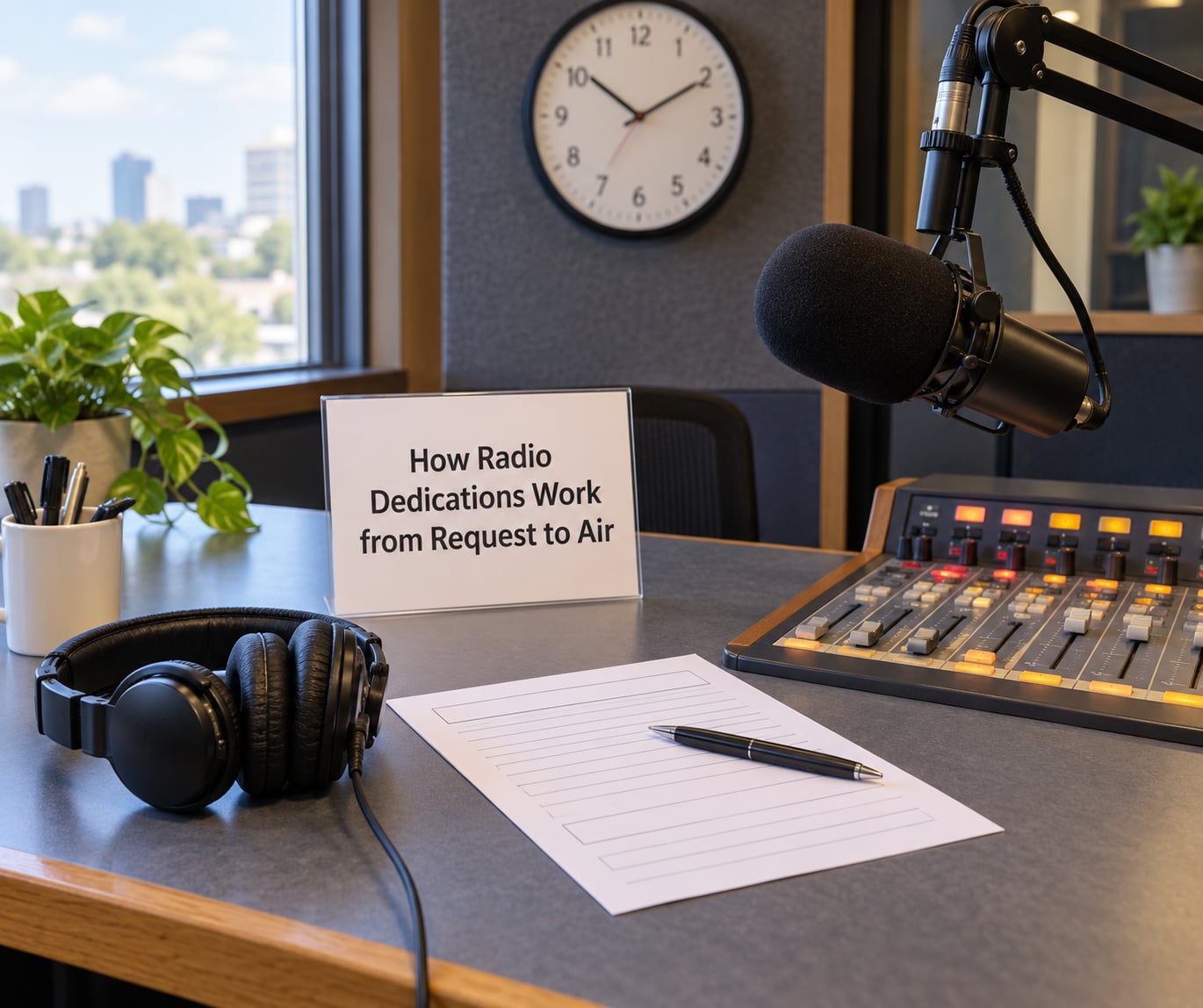
Here is the whole chain, from your phone to the transmitter. Six steps, no mystery.
- You send the request. That means calling the request line during the show’s stated hours, texting the station’s short code, sending a voice note, or filling in the request form on the station’s site or app.
- A producer logs it. Every request is typed into the station’s traffic system or request log with the song, the name and the message. If your spelling of a name is wrong at this stage, it stays wrong on air.
- It gets checked. Someone reads it against the station’s policy and the broadcaster’s legal obligations. Anything with profanity, abuse, political messaging or commercial content usually stops here.
- A presenter selects it. Requests compete for space with the playlist, the day’s news, adverts and the clock wheel. Shows with dedicated request hours take far more of them than general shows do.
- The song is cued. The track has to exist in the station’s music system. Back catalogue, live versions and clean edits that were never released as singles are the usual reason a request dies quietly.
- It airs, and sometimes comes back to you. The presenter reads the message, plays the track, and some stations repeat the request later or shout out that it went out. If you never hear confirmation, check whether you gave a way to reach you.
That is the entire machinery. The emotional part is a different matter, and it starts after the microphone switch goes off.
Do Stations Have to Play Every Dedication?
No. A dedication is a request, not a booking, and stations have no obligation to broadcast anything a listener sends.
Availability comes first. Some songs are not licensed for broadcast in the UK, and others exist only as a download or a regional release. A station simply cannot play what it does not have.
Audience demand shapes the rest. A song requested four times in one morning will get played; a song requested once in a fortnight competes with dozens of others for the same two minutes.
Programming policy matters as much. A station running a specialist genre show may treat a mainstream pop request as off-format. Advertising breaks and news bulletins take chunks of the hour out, so a busy schedule leaves less room for talk.
Licensing and legal rules have the final say. Music royalties are handled through blanket licences, which is why stations play licensed recordings rather than anything sent in privately. Personal messages are checked against advertising, discrimination and harassment rules before they go near a microphone.
Why Might a Presenter Decline or Change a Request?
Presenters do not hold dedications personally. They choose from what survived the checks and what fits the hour. These are the reasons you will see, and what to do about each.
| Reason | What to change |
|---|---|
| The details were unclear | Spell out the recipient’s name phonetically, and say the station and show you sent it to. |
| Language not suitable for broadcast | Remove profanity, insults and anything a listener with children in the car would find awkward. |
| Political or campaign messaging | Keep it to the person and the occasion. Stations will not carry campaigning on a request line. |
| Commercial or promotional content | Do not advertise a business, product, website or fundraiser, and do not ask for sales or donations on air. |
| The recording was not available | Accept the version the station has, or ask whether a different track from the same artist would work. |
| Off-format for the show | Try a different show or a station whose music matches the artist. |
| Repeated requests | Presenter discretion stops the same song being played twice in a short window. |
| Explicit track or unavailable edit | Ask for the clean version, or ask what the station can play instead. |
The Difference Between a Dedication and a Song Request
The two look similar in a request box and behave differently in the studio. A request is one line. A dedication is a request with a name and a reason attached, and it takes up real airtime.
| Song request | Dedication | |
|---|---|---|
| Message style | Title and artist, nothing more | A sentence or two of personal context |
| Personal detail | None | Recipient name, relationship, occasion |
| Time on air | Song length only | Song plus roughly 10 to 20 seconds of talk |
| Likelihood of alteration | Low, apart from availability | Higher, because the message gets read and may be trimmed |
| Usual subjects | Anything in the playlist | Birthdays, weddings, anniversaries, new jobs, graduations, grief, long-distance encouragement |
If you only want a track played, ask for a request. If you want words read out about a person, write a dedication.
What Information Should You Include When Making a Dedication?
Most failed requests fail on missing detail rather than on policy. Before you send, check you have these:
- The station and the show. Names get shared between presenters, and the station name saves a producer guessing.
- Artist and exact song title. Include the version if it matters, such as live, acoustic or a cover.
- The recipient’s name, spelled out. If it is unusual, give the spelling in brackets.
- The occasion. One line is plenty.
- A short message. Fifteen to thirty seconds read aloud is plenty for broadcast.
- Timing. If the day matters, say the date and the window.
- A way to reach you. Some stations read out a message and then call or text you back to say it aired. Only give contact details if you want that.
How to Write a Radio Dedication Readers Will Hear
Write for someone who has never met you, hearing it once, in a car, on a station playing at 6am. Short sentences, concrete detail, no background story.
Message examples by occasion
Birthday. “This is for my mum, Diane, who turns 60 today. She’s in Skipton, she’s been told to listen, and she’ll deny every word of this.”
Wedding anniversary. “Twenty-five years today for Alan and Susan, married in Manchester. Susan chose this one, and she’ll tell you she didn’t.”
Long distance. “This is for my brother Tomas in Vancouver, for my dad in Leeds. Neither of them has seen the other in fourteen months, and both of you know why this one.”
New job. “Congratulations to Priya, who starts as a consultant in Leeds on Monday. Your mum is pretending to be calm. She’s not.”
Graduation. “For Ethan, who graduated in Sheffield this summer. You said you wouldn’t make it. Here you are.”
Thank you. “This one’s for Kev, who drove four hours each way to sit with Dad in hospital for a fortnight, and never once mentioned it.”
Community milestone. “Congratulations to everyone at the Rodley tap room, ten years open this Friday. The band are playing. Someone buy Kev a pint.”
Tribute. “This is for George, who died in March at 71. He drove a red Capri and he would have hated this being said quietly.”
Notice what these have in common. Each names one person, gives one piece of place or detail, and ends on something that sounds like a human being rather than a greeting card. That last detail is usually the part a listener repeats to the person in the passenger seat.
Can You Dedicate a Song to Someone Who Has Died?
Yes, and it is one of the most common uses of a dedication. Stations handle memorial requests routinely, and presenters read them more carefully than anything else on the log.
Keep the message brief and gentle. Say who the person was, the relationship, and one memory. Avoid medical detail, family conflict or anything that would be painful to hear read aloud by a stranger.
Take care where you send it. Some people want the dedication kept private, and most stations will treat a message marked as private rather than announcing it. Do not put a memorial message into a public social post to reach a wider audience; a studio that has agreed to a private request has not agreed to a broadcast one.
Expect a gap. If it matters that it airs on a particular date, send it well in advance and say so clearly.
What Restrictions Apply to Radio Dedication Messages?
Every station has its own rules, and the underlying legal framework in the UK leaves little room. The recurring ones are:
- Profanity and abuse. Swearing gets a request cut, and repeated offenders get no requests at all.
- Discrimination or harassment. Anything targeting someone’s identity, religion, disability or sexuality is a hard no.
- Political or campaign messaging. Broadcasting standards rules treat requests as advertising, and stations will not run them.
- Copyrighted lyrics. Sending full lyrics to be read out is a copyright problem, so presenters will not do it.
- Commercial solicitation. No promoting a business, website, product, gig or service.
- Fundraising and financial claims. Stations cannot endorse a charity appeal or repeat a claim about money from the public.
- Medical and legal claims. Health advice and legal advice on air are exactly what broadcasting rules restrict.
- Station-specific rules. Some stations accept only text requests, some cap message length, and some do not take requests at all in certain shows.
How Online and DAB Stations Handle Dedication Requests
Every station sets its own policy and its own submission route, but the methods themselves are consistent enough to compare.
| Method | Cost | Best for | Typical wait |
|---|---|---|---|
| Request line call | Free, standard call rates | Long messages, voice notes heard live by the presenter | Same show to a couple of days |
| Text line | Normal network rates, billed by message | Short dedications, sending on the move | Usually within a few shows |
| WhatsApp or voice note | Free over Wi-Fi, normal data otherwise | Reading your message in your own voice | Varies by station; often 1 to 3 days |
| Station app or web form | Free | Sending a precise message at any hour, with a receipt | Queue-based, frequently within 24 hours |
| Social media post or comment | Free | Reaching the presenter directly, but never private messages | Unpredictable |
| Studio visit | Travel only | Local stations that hold open studio sessions | Depends on the open day schedule |
DAB and online stations use the same queue as their FM output, so a request sent to one reaches the same producer. The difference is how many people are listening: a national online audience is far larger and far less likely to be in the room.
Frequently Asked Questions
Can I request the same dedication on every radio station?
You can send it to more than one station, but each one treats it as a separate request and decides independently. Sending to four stations does not improve your odds at any single one, and presenters who spot a message crossing several outlets tend to skip it. Pick the station the recipient actually listens to, mention the station name in the message, and give yourself time for one or two genuine alternatives.
Will a radio station play my dedication if I send it?
There is no guarantee, and any station promising one is misleading you. A dedication is a request that competes for a small amount of airtime against the playlist, the news and the adverts. The realistic outcome is that a well-written, clearly spelled request on a show with dedicated request hours has a fair chance, while anything off-format or badly written usually disappears without explanation.
Can I dedicate a song and include the complete lyrics?
No. Sending full lyrics to be read out creates a copyright problem, and presenters will not do it. They can quote a short line occasionally, or play the recording, which is already licensed. If a particular verse matters to you, say which verse in your message and leave the words to the track itself.
How far in advance should I make a radio dedication request?
For a birthday or anniversary that falls on a specific date, send it several days ahead and name the date and the window you need. Same-day requests can work on shows with heavy request traffic, but you are competing with everything logged that morning. For anything with a fixed date, earlier is safer, because the track also has to exist in the station’s music system.
Do radio stations charge for song requests or dedications?
Listener requests are free at nearly every station. The small exceptions are specialist request shows, which sometimes ask for a token payment under charity or event rules, and stations that run paid-for outside messages for businesses, which is a different arrangement with different rules. If a station asks you for money for a personal dedication, treat it with care and ask what it is paying for.
Why did a presenter change the song or wording in my dedication?
It is usually one of three things: the version you asked for was not available to broadcast, the wording did not fit broadcast standards, or the track did not suit the format of the show and another was substituted. Presenters also shorten messages to fit the break. None of it is personal, and sending a fresh request through another channel usually works.
Conclusion
Check the station’s request policy first, because the route and the hours matter more than anything you write. Identify the exact song and version, spell the recipient’s name, and keep the message to a sentence or two about the occasion.
Then send it through the method that station actually uses. If it goes out, you will know because you asked to be told. If nothing happens within a day or two, resubmit once through a different route rather than chasing the original.