
Some hits never get radio play because nobody at the station ever put them in the running. A song has to be chosen by a music director working from a small, tightly rotated pool that matches the station’s format, tested against that station’s own listeners, and pushed by a label or promoter who knew where to send it. Chart success and radio airplay are two separate systems.
That is the whole answer, and it is more mechanical than most listeners expect. Nobody is sitting there disliking your favourite song. There is simply a funnel, the song has to fit through it, and a lot of records never get near the bottom.
Table of Contents
- How Radio Stations Decide What to Play
- 9 Reasons Some Hits Never Get Radio Play
- 1. It does not fit the format the station plays
- 2. Weak testing, which is why some hits never get radio play after a bad result
- 3. Nobody who owns music at that station knows it exists
- 4. It arrived at the wrong moment
- 5. The chorus takes too long to arrive
- 6. There is no story to attach it to
- 7. Nobody promoted it to the right people
- 8. The category is already full
- 9. It is on the list, but rotation is a fixed budget
- Why Some Hits Never Get Radio Play: Format and Audience Fit
- How Artists, Labels, and Stations Test Songs
- Does Commercial Success Make a Song More Likely to Get Airplay?
- Why Ownership, Relationships, and Genre Crowding Matter
- How Often Do Radio Stations Play New Music?
- What Can an Artist Do to Improve Radio Chance?
- Frequently Asked Questions
- What to Do First
How Radio Stations Decide What to Play
Stations do not pick songs one at a time while a record is spinning. The chain runs: listening research narrows thousands of new releases down to a few hundred, a music director picks a few dozen, a programme director approves the balance, the format network signs it off, scheduling software places each spin, and the presenter on air presses next.
The pool is deliberately small, because small pools produce predictable, familiar listening. Veteran UK broadcaster Kevin McDempster, writing for Louder, put Hot AC stations at around 150 tunes a week and Adult Contemporary stations drawing on 500 or more, with roughly 12 songs assigned to every hour of the day. Those are his figures for his world rather than a universal standard, but the shape of it holds.
Repetition is not laziness. It is the product the station is selling: a listener who knows roughly what is coming is more likely to stay through an advert break and come back tomorrow.
9 Reasons Some Hits Never Get Radio Play
1. It does not fit the format the station plays
A song has to sound like the station’s neighbours. If it is too slow, too heavy, too unfamiliar or aimed at a different age group, it fails on fit before anyone argues about whether it is any good. This is the most common reason by a distance.
2. Weak testing, which is why some hits never get radio play after a bad result
Stations run new music past panels of their own target listeners, sometimes in a room and sometimes by telephone. Songs that score poorly can be shelved before a music director ever argues for them. A polished production will not rescue a song that nobody in the test group reacted to.
3. Nobody who owns music at that station knows it exists
Major stations receive thousands of submissions a week. The ones that get serious consideration usually arrived through a label promotion team or a plugger with a direct line. A track released quietly into the world has no route in at all, however good it is.
4. It arrived at the wrong moment
Release dates cluster around big events, and a song launched the week another artist drops a major album is competing for the same news coverage and the same playlist slots. Timing matters just as much at the industry end as it does in a chart race.
5. The chorus takes too long to arrive
Radio schedules by the clock, not by taste. A song that takes forty seconds to reach its payoff occupies more of a given hour than a tight, immediate one, and schedulers do keep an eye on average song length. Producers hear this more often than artists expect.
6. There is no story to attach it to
Stations need a reason to play something outside the ordinary rotation, and that reason is usually a hook: an interview, a guest slot, an anniversary, a competition, a charity tie-in. A song with nothing attached to it simply waits its turn.
7. Nobody promoted it to the right people
Labels service new music to music directors with a shortlist and a story. Independent artists do this work themselves, usually without a budget, which is why a genuinely strong record can go nowhere and a mediocre one can go everywhere. Promotion, not talent, is the deciding factor here.
8. The category is already full
When a station already runs three tracks that sound like yours, a fourth gets very little rotation no matter how good it is. Genres fill up, and new entries get squeezed into whatever space is left, which may be very little.
9. It is on the list, but rotation is a fixed budget
Being approved is not the same as being played often. A station’s weekly spins are capped, so a record sitting at low rotation can stay there for months. Plenty of listeners have assumed a song was completely ignored when it was actually playing quietly and steadily.
Why Some Hits Never Get Radio Play: Format and Audience Fit
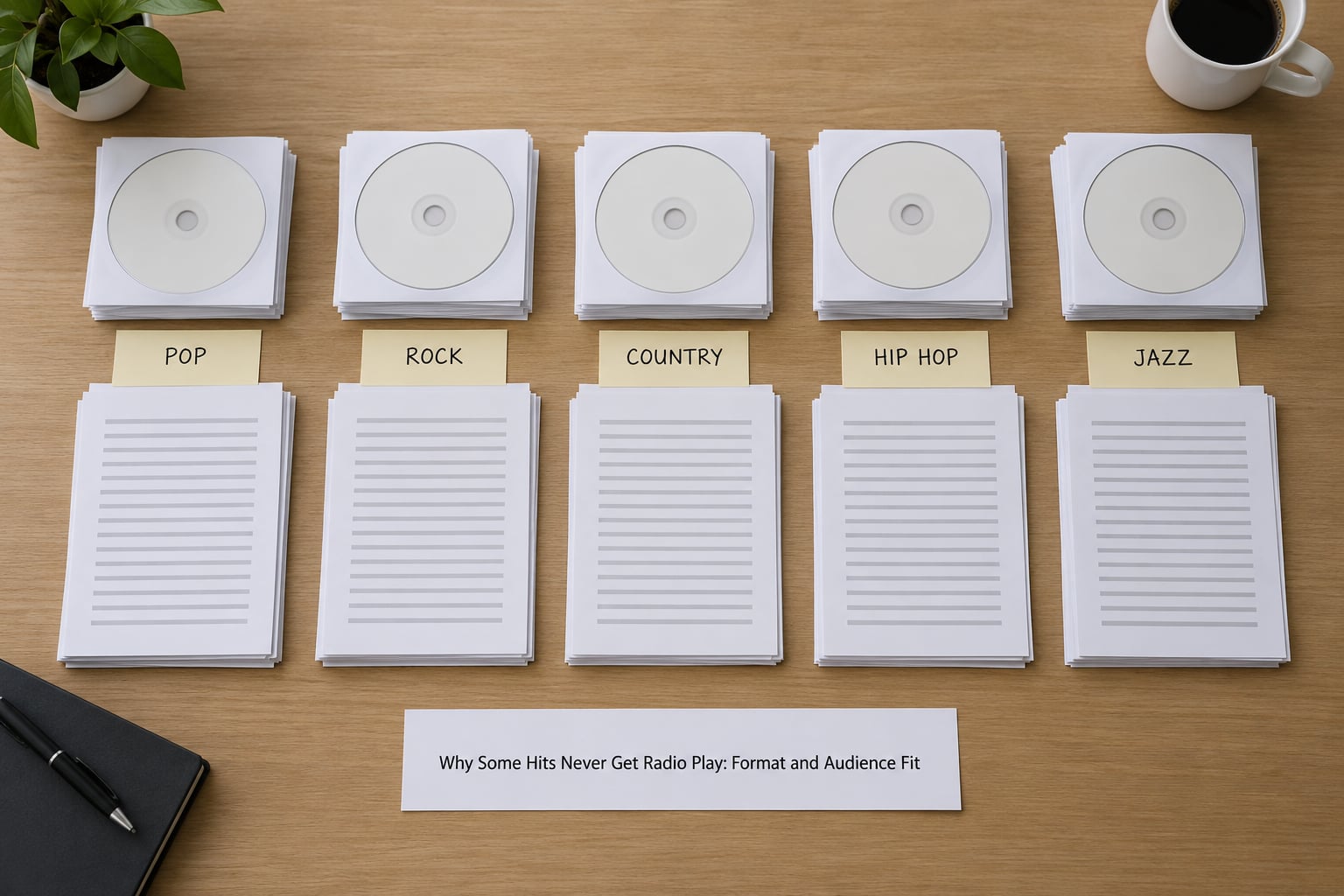
Format fit is the idea that trips most people up, so it is worth being concrete. A country song does not get airtime at a jazz station, not because it is bad, but because the audience for one has no interest in the other and the station’s whole identity is built on that gap. The same applies in reverse: an unfamiliar ballad handed to a rhythmic-leaning pop station competes against a playlist full of confident uptempo records.
Neither rejection is a judgement on the song. It is a judgement on the overlap between the song’s audience and the station’s audience, and in a fragmented market that overlap is narrower than it was twenty years ago.
Some records get squeezed out of everywhere at once. Beatles fans have long complained on Reddit about “Helter Skelter” getting no radio play: it is too harsh for pop stations, and metal stations find it too dated to run. It falls between two formats, which in practice means neither of them.
How Artists, Labels, and Stations Test Songs
No single test decides a spin. A new release might be picked up by airplay monitoring services first, which track what is already running where. From there it can go to a panel in a room where listeners rate songs after hearing them without knowing what they are, or to a call-out study where people describe a familiar song in their own words.
Music directors also read expert reviews, look at streaming and social signals, and weigh everything against what is already working in the market. A song that fails a panel test can still be added by a director who believes in it. What almost never happens is a song with no data and no advocate getting through purely on quality.
Language is a separate practical obstacle. Regulators in both markets expect broadcasters to handle offensive material, so an explicit track either gets a clean edit or gets left out of daytime rotation entirely. That is not a ban; it is a scheduling decision with a compliance footnote. A handful of songs have also been deliberately withheld by their own label or artist for editorial reasons, which is a choice rather than a ruling.
Does Commercial Success Make a Song More Likely to Get Airplay?
Not reliably. Streaming and radio reward different things, and confusing the two is the biggest source of frustration for listeners who assume a chart-topper must be everywhere.
| Signal | What a station takes from it | Does it guarantee airplay |
|---|---|---|
| Heavy streaming | Evidence of a committed fanbase, useful for pitching | No, and often the opposite, because the fans are not the station’s audience |
| Strong sales | Marketing momentum, mostly at pitch stage | No, since sales figures cover only a fraction of releases |
| Passed a station test | A direct response from the exact target listeners | Usually, at that station and its sister stations |
| Uneven audience fit | Almost nothing the station can act on | No, and this is where most enormous songs quietly stop |
The distinction that matters is between a song that is huge because a broad audience found it, and a song that is huge because a narrow audience streamed it hard. The first travels well through radio. The second often does not, because radio needs a song that a casual listener will tolerate on repeat, not one they will seek out.
Why Ownership, Relationships, and Genre Crowding Matter
The UK and the US are structured differently, which is why advice often travels badly between them. In the UK, the BBC runs its own playlist committees for Radio 1 and Radio 2, working from submissions and research rather than commercial promotion. Commercial stations sit under large groups such as Global, Bauer Media Audio and The Wireless Group, and a content controller chooses music for a cluster of stations at once, so one decision reaches several sets of listeners.
In the US, ownership is even more concentrated, with groups such as iHeartMedia, Cumulus Media and Entercom holding large portfolios. A song added by a national network lands on dozens of stations in one move, which is why chart trends in America can feel so sudden. Smaller groups and public stations make their own choices and can be far more open.
Two claims need care here. It is fair to say that familiar labels and pluggers get listened to sooner, and that a station with three similar tracks already in rotation has less room for a fourth. It is not fair to treat every under-played record as evidence of payment. Historical payola scandals are real and shaped the rules stations now follow, but the everyday explanation for most silence is programming, not bribery.
How Often Do Radio Stations Play New Music?
Rotation is the term for how often a track is allowed to recur. Stations separate songs into tiers rather than promising a fixed number of spins, because the aim is variety and predictability rather than a published schedule.
| Rotation level | What it is for | What you are likely to notice |
|---|---|---|
| High | Current singles the station is actively pushing | The track keeps returning through the day |
| Medium | Supporting singles and established current songs | You hear it a few times a week |
| Low | Album tracks, debuts and songs still being judged | It appears occasionally and may fade away |
| None | Held back, outside the format or never added | You will not hear it, and it may resurface much later |
Dayparting shapes this further. Overnight and weekend programming is often more relaxed, so songs that would not survive a morning drive test can still find a home there. That is how a fair number of records enter a station’s life, months after everyone assumed they had been ignored.
What Can an Artist Do to Improve Radio Chance?
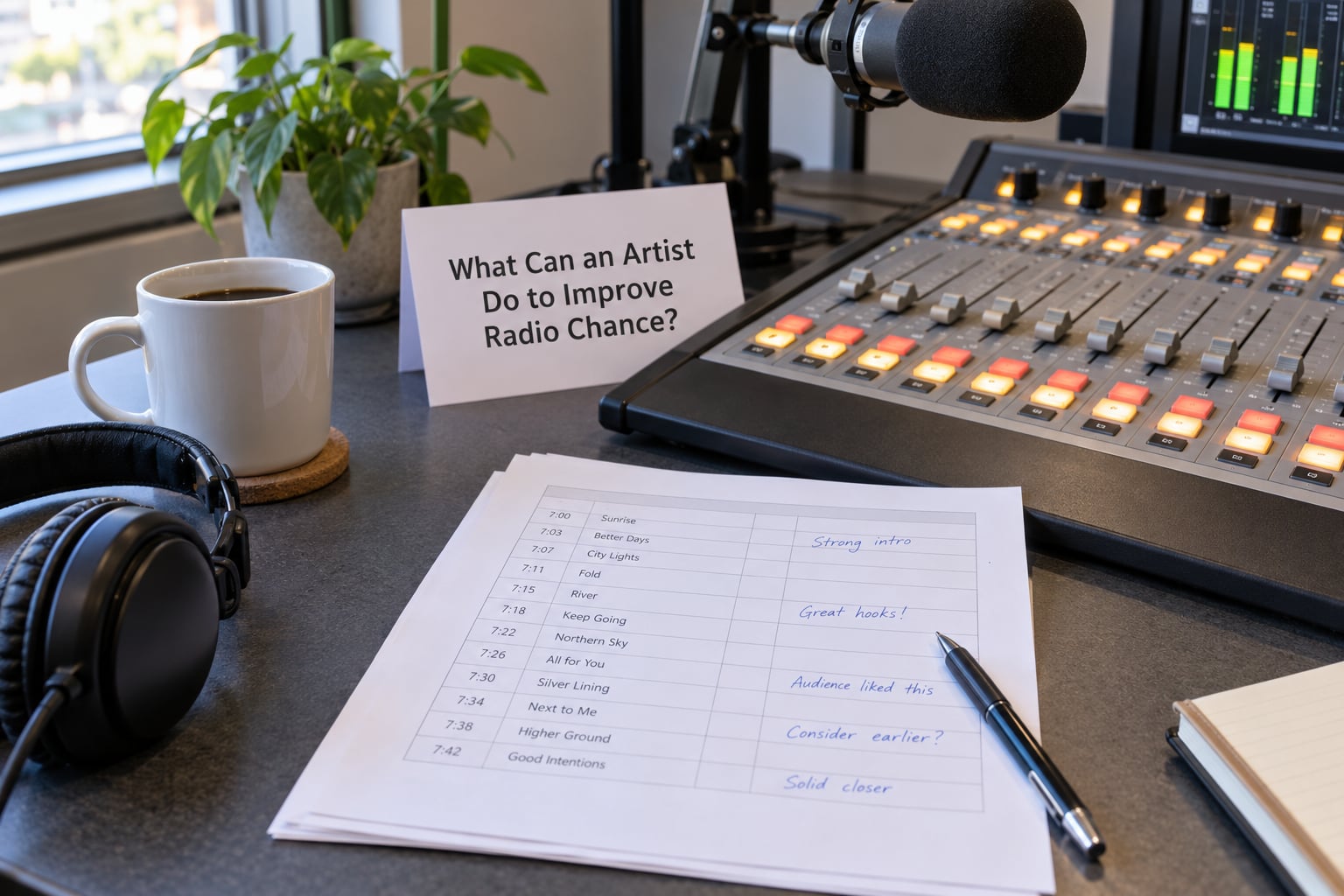
The odds are not as bad as the silence suggests, but they reward preparation over optimism.
- Work out which formats genuinely suit the music, then pitch to stations in those formats rather than every station that exists.
- Prepare a radio edit with clean language and a proper length, and check it does not depend on a producer’s intro.
- Get the metadata right: a correct song title, credited artists, an ISRC, split sheets confirmed and artwork that matches the release.
- Service the music director rather than the programme director, since that is the person who actually adds songs.
- Follow each station’s stated submission rules exactly, and use the request route that station has actually set up.
- Build something local first, because stations can justify a spin far more easily when there is a story attached to it.
- Time the release away from major industry events, and accept that silence is the normal first response.
Community, college and specialist stations remain the most accessible entry point for unsigned artists, followed by regional stations and the internet, where a genre format costs nothing to run.
Frequently Asked Questions
Can a song be a hit without getting radio airplay?
Yes, and it is far more common than the charts suggest. A track can climb streaming charts and sell well purely through playlists and social discovery, then never enter a single station’s approved pool. Those songs succeed because a genre audience found them online, not because a music director put them into rotation.
Why do popular streaming songs receive little radio play?
Streaming rewards songs that already have a committed fanbase, while radio needs something a broad, mostly casual audience will tolerate on repeat. A track can climb because a small group streams it heavily and still fail the test a station runs with its own listeners. Add a crowded category and limited rotation slots and the result is a huge song that stays off the air.
Do radio stations only play songs that already have large sales?
Sales and airplay are related, but neither guarantees the other. Labels routinely pitch radio before a release lands, and many stations take a chance on new music with no sales history at all. What counts for more is whether the track tested well with the station’s audience and whether it fits the format, which is why plenty of modest sellers get steady airplay.
Can independent artists get their music played on radio?
Yes, though the route is narrower than most artists expect. Community, college and specialist stations stay the most accessible, followed by regional and independent stations in markets that fit the sound. Service the music director rather than the programme director, follow each station’s stated submission rules, and expect silence as the normal response.
How many times a day does a radio station play a song?
It depends on the rotation level. A current single at high rotation may return several times across the day, a recurrent appears a few times a week, and a song at low rotation may come round every few days. Stations keep those numbers deliberately modest so the playlist stays fresh and predictable rather than exhausting.
What to Do First
Nobody decided to keep your song off the radio. It sat outside the format, or it lost its test, or it never reached the music director, and a small pool moved on without it.
If you are a listener, the fastest fix is to find the formats that suit the music rather than waiting on the one station you already have on. If you are an artist, start by listing the stations whose existing playlist your song genuinely belongs on, and pitch those. Understanding why some hits never get radio play is mostly a matter of accepting that the decision happened long before you ever heard the song.