A voice tracked radio show is one where the presenter records the spoken links between songs on their own, ahead of broadcast, and the station’s playout software slots those recordings into the schedule later. The voice is the presenter’s own, nothing is faked, and what changes is only the timing.
In short:
- The talking breaks are recorded in a studio with no music playing, sometimes days before you hear them.
- Automation drops each recording into the schedule between songs and mixes it with adverts, jingles and sweeps.
- Most shows mix this with live parts, so a single hour of radio is rarely all tracked or all live.
If you have heard the phrase and wondered what it means for the presenter you listen to every morning, the rest of this guide breaks it down piece by piece, starting with the actual definition.
Table of Contents
- What a Voice Tracked Radio Show Is
- How Voice Tracking Works in a Radio Show
- What Happens During a Voice-Tracked Broadcast
- What Does Voice Tracking Sound Like?
- Why Do Radio Stations Use Voice Tracking?
- Is Voice Tracking the Same as Automation or Auto-Jocking?
- Can Voice Tracking Go Wrong?
- Frequently Asked Questions
- Conclusion
What a Voice Tracked Radio Show Is
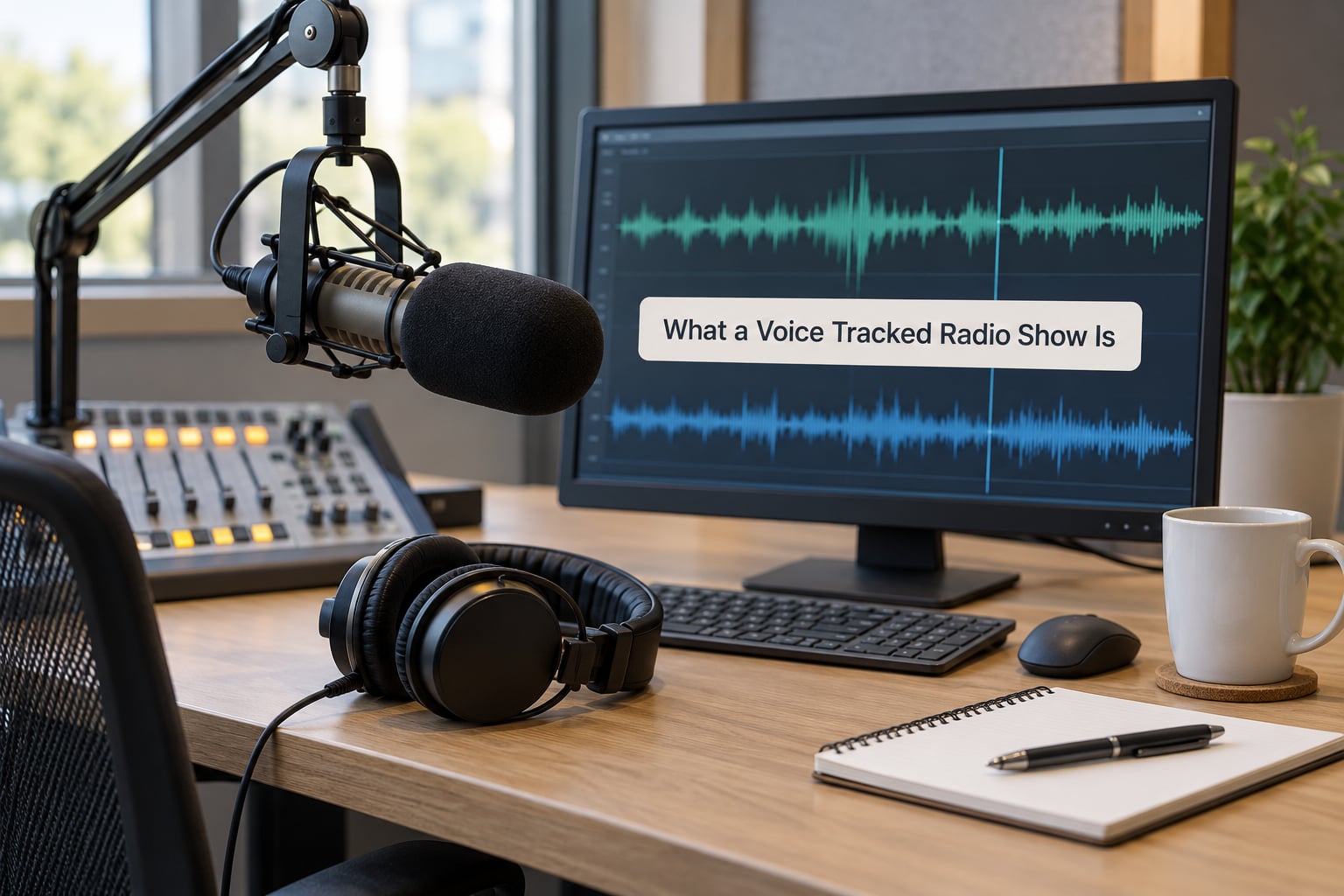
The trade description you will find in radio glossaries runs like this: voice tracking is the process of cutting a jock break for a station at some time other than when it airs. A jock break is simply the chunk of talking a presenter does between two songs, and cutting it means recording it as a separate audio file rather than speaking over the music live.
So what a voice tracked radio show is, in practice, is a show where the presenter walks into a studio, talks to a microphone while nothing else is playing, and stops. They do not have to hit the exact moment the previous song ends, because the music has not started yet and they cannot hear it.
That single detail explains most of what listeners notice about tracked radio. Without the music in the headphones, a presenter cannot time a link to a specific intro or land a joke on a specific lyric. They record against a rough idea of how long the break needs to be, and the automation places it later.
What a voice tracked radio show is not
It is not the same as a fake presenter, a cloned AI voice or a jockless station. A voice tracked show still has a real person behind every link you hear. It is also not a fully pre-recorded show: the music is scheduled, the adverts are booked, and the tracked links are stitched between them.
Four terms worth knowing
- Voice link — one recorded piece of talking, saved as an audio file and labelled with where it should sit.
- Jock break — the spoken run between songs, including the intro to the next one.
- Playout — the automation system that plays music, adverts, jingles and voice links on schedule.
- Sweeper or imaging — the station’s short branding stingers that glue a break together.
How Voice Tracking Works in a Radio Show
The mechanical process is straightforward once you see it as six steps.
- Prep. The presenter checks the running order, the music logs and the advertising breaks for that daypart, then marks each point where a link is needed.
- Record in isolation. They speak into a microphone with no music in the headphones. A red light tells them when they are on air to listeners; in a tracked session that light is a recording light.
- Tag the file. Each take gets named for the songs it sits between, so the playout system knows what to fire and when.
- Upload. The files go to the station’s automation, either from a studio in the building or from a home setup if the presenter tracks remotely.
- Place and mix. The playout system loads the link at the scheduled point, ducks the music level under it and blends across the seam. Nothing is played live.
- Keep control. The presenter can still trigger the next item, jump a break or cut out of a link manually if something needs to change.
Two things make the whole thing possible: the station runs on a clock, so every song and advert has a fixed slot, and the music scheduler logs song lengths, so the system knows how much room a link has.
That last point shapes the talking too. Presenters talk at a comfortable pace knowing the surrounding songs are long enough to give the break breathing room, which is why tracked links rarely sound rushed.
What Happens During a Voice-Tracked Broadcast
Take a three-hour music show on a weekday morning and look at what a listener hears. Most of it is music, because music is most of what a music station exists to play.
At the top of the hour there is an ad break, and then the presenter is there with a link. That link was recorded earlier in the week, in a silent room, and it has just been dropped between the last advert and the first song.
Roughly forty minutes later, a sweeper fires and a second link goes out, this one naming the contest and reminding listeners how to enter. Behind it, the music scheduler has already queued the next three songs, so the segue into the hour is timed to the second.
An hour in, the station drops into local news, travel and weather. That segment is usually live, because the information in it changes by the minute. So a single hour of a voice tracked show is a patchwork: recorded links, live presenter bits, booked adverts and timed music.
The overnight version of the same show is usually far more heavily tracked, since there is no local news to read and fewer listeners to serve.
What Does Voice Tracking Sound Like?
When a tracked show is done well, it does not sound automated at all. The links arrive on time, the tone matches the station, and the presenter has written for the songs that surround each one. You hear a natural link followed by a song, not a machine firing a file.
When it is done badly, two things give it away almost immediately. The first is delivery: a link recorded over and over for perfection loses the small hesitations and level changes that make speech sound like a person in a room. It comes out flat and slightly too clean.
The second is the seam. A live presenter times the music in their ears, so the first line often lands exactly on the beat out of the intro. A tracked link lands where the schedule says, which is usually close but not quite musical.
There is a third tell that listeners mention more than any other: content that cannot be current. A recorded weather line or traffic update is wrong the moment it airs. On a bright afternoon you can hear a link announcing rain.
Why Do Radio Stations Use Voice Tracking?
Stations use it for practical reasons, and most of them come down to staffing and cost.
More hours from one person. A presenter covering two stations can record links for both in one session and let each station run its own schedule.
Consistency. Every link is played at the same quality and the same length, with no rushed breaks and no tired fourth hour. For a network of simulcast stations, the same show can run on several frequencies with local adverts swapped in.
Overnight and holiday cover. Few stations have a live presenter on air at 3am. The overnight show is largely tracked, which is why the music radio you find at night tends to have fewer links.
Remote production. Presenters can track from home or from another studio, upload the links and have them on air the same day. Voice tracking is what makes remote production practical at all, since the links do not need the station’s studio.
Ad-heavy shows. When a daypart carries a lot of adverts, the presenter’s job shrinks to reading them and making the links around them work. Tracking keeps that work to a session rather than a live hour.
Is Voice Tracking the Same as Automation or Auto-Jocking?
Not quite, and the difference matters. Voice tracking responds to a recorded script timed against a schedule. Automation is the wider system that plays everything: music, adverts, jingles and those links. Auto-jocking, sometimes called jockless operation, is when a station removes the presenter from a daypart entirely and lets the schedule run with no human links at all.
Here is how the five setups you will hear about actually compare.
| Setup | Who records | How far ahead | What varies live |
|---|---|---|---|
| Voice tracked show | The presenter | Hours to days | Little; links are fixed, music is fixed |
| Live show | Nobody, it happens live | Not applicable | Everything, including timing and length |
| Syndicated show | One network, aired by many stations | Days or weeks | Only the adverts and local inserts |
| Remote voice tracking | The presenter, off site | Hours to days | Same as tracked; only the location differs |
| Jockless daypart | Nobody | Not applicable | Nothing |
One more piece of station jargon causes confusion. A hosted show has a presenter whose voice is the show. A jockless show has no presenter voice at all, only music, adverts and imaging. Voice tracked shows sit between the two: they have a presenter and they are not live.
Can Voice Tracking Go Wrong?
Yes, and when it does it is usually obvious. Presenters on listener forums and industry forums describe the same handful of failures.
The most common problem is audio that does not match. A tracked link recorded hot and squashed against a mastered track makes the station sound like two sources spliced together. Levels set for a live studio microphone will not suit a file that plays back at a fixed level.
Next come timing errors. A link fires early and cuts into the last line of a song, or fires late and leaves an awkward silence. Presenters also hit links where two pieces of audio land on top of each other and one has to be muted quickly.
Content errors are the ones listeners complain about most. A recorded traffic or weather callout that is out of date, a contest entry that closes before the final mention, or a back-sell for a song everyone already knows instead of something worth hearing.
None of this is beyond control, though. A presenter watching a live rundown can trigger items by hand, skip a link, jump the break or drop straight into the next song. Studios keep manual control for exactly this reason, and a well-run station treats tracking as the default with a human override, not as a hands-off process.
Frequently Asked Questions
What is voice tracking in radio?
Voice tracking is when a presenter records the spoken links between songs separately, usually in advance, instead of speaking over the music live. The station’s playout software then mixes each recording into the schedule at the right moment. The presenter is real and the voice is their own; only the timing is fixed rather than live.
How can you tell if a radio show is voice tracked?
Listen for small seams. Links that land just after a song ends, weather or traffic lines that are no longer accurate, links about a contest that has already closed, delivery that sounds unusually polished, and adverts that arrive in slightly different order each hour. A quiet giveaway is the same link repeating with only one or two words changed.
Does voice tracking mean the presenter is not real?
No. The person behind the links is a genuine presenter who recorded them themselves in a studio. Voice tracking changes when the talking is recorded, not who recorded it. Stations that use cloned or synthetic voices are a separate and much smaller practice, and those are worth asking about directly.
What is the difference between voice tracking and radio automation?
Automation is the whole system that keeps a station running: music, adverts, jingles, news and voice links. Voice tracking is one job done inside that system, where the presenter’s recorded speech is placed into the schedule. A station can be fully automated and still have a live presenter, or fully automated with no presenter at all.
What does tracking vocals mean?
In radio, tracking vocals means recording the presenter’s spoken part on its own so it can be placed later, which is different from tracking a singer recording a music performance. The term comes from film and television post-production, where an actor’s dialogue is recorded separately from the picture. The same idea was applied to radio speech.
Is it hard to become a radio personality?
Getting on air is the hard part, and voice tracking has widened the door. Presenters can record links from a home studio rather than a city-centre booth, and a network can pick up a show made anywhere. Studios still expect clean audio, correct local pronunciation and the ability to write tight links to a clock.
Conclusion
Voice tracking means the presenter’s talking is recorded on its own and dropped into the schedule later, so one person can cover more hours and more stations while the station keeps a predictable, repeatable show. It is a production method, not a trick, and most radio you hear is part live and part recorded.
If you want to hear it for yourself, listen for one thing first: the moment a presenter’s line appears to cue a precise, coordinated change in the audio around it. That click into a song is the technique doing its job.