A listener contest is run legally when the broadcaster tells listeners every material term of the promotion before they enter, runs the contest the way it was announced, and hands over the prize on the schedule it published. In the US that means disclosing eligibility, entry method, odds, prize value and deadlines, keeping the written rules available for at least 30 days after the contest closes, and pulling state registrations where a game of chance requires one.
This guide is written for station operators, podcasters and brands running promotions, and for listeners who want to know what the paperwork actually says. It is general information, not legal advice, so have your own promotion reviewed by a qualified lawyer in each state you plan to cover.
Table of Contents
- How listener contests are run legally
- What legal rules apply to radio listener contests?
- How to write official rules that are clear and enforceable
- What eligibility and entry requirements should a contest include?
- How should stations promote the contest without misleading listeners?
- How are winners selected fairly?
- How are prizes, taxes, and fulfillment handled?
- What should a station do if a dispute or complaint occurs?
- A practical pre-launch compliance checklist
- Frequently Asked Questions
- Do radio contests need written official rules?
- Are radio listener contests legal in every US state?
- What is the difference between a sweepstakes and a contest of skill?
- Can a radio station require listeners to be 18 or older?
- Does a listener contest winner automatically have to pay taxes?
- Can a radio promotion use social media or online entries?
How listener contests are run legally
The first question any promoter has to answer is what kind of promotion this is, because the law changes with the answer. A contest is won on skill, a sweepstakes is won on chance, and many states treat the chance-based version as a game of chance with its own registration paperwork.
What counts as a listener contest
A broadcast contest is any promotion where a listener has to do something to win: answer a trivia question correctly, time a cue-to-call call, finish a task tied to the skill involved. A radio sweepstakes needs no skill at all, only a valid entry into the drawing.
Publishers call that chance-based version a game of chance, and that is the phrase state law cares about. Entries that require the listener to submit something creative, to guess a number or price, or to describe why they deserve the prize usually count as skill, which keeps the promotion outside most game of chance registration rules.
| Promotion type | Winner is decided by | How it is treated legally |
|---|---|---|
| Contest of skill | Knowledge, accuracy or performance | No game of chance registration in most states |
| Sweepstakes | Random drawing from valid entries | Often treated as a game of chance at state level |
| Game of chance | Random drawing | May need registration, bonding and reporting with the state |
| Skill plus chance | A mix of both | Analysed closely, so keep the skill element meaningful and documented |
From announcement to award, a compliant run has six moving parts. The station announces the promotion and directs listeners to the full rules, runs the entry period on the stated dates, verifies eligibility at close, selects the winner by the published method, contacts the winner within the published window, and delivers the prize after verification paperwork comes back.
Any listener can check those six things against the rules. If the announced closing date does not match the rules page, or the winner is announced but never contacted, that is the gap to ask about.
What legal rules apply to radio listener contests?
US broadcasts sit under the Federal Communications Commission’s Contest Rule, 47 CFR 73.1216. It requires a station to broadcast the material terms of a contest at least once a day on air, or instead to post them on a website that is announced daily on air and kept up for 30 days after the contest ends.
Material terms means anything a listener would need in order to decide whether to enter and to have a fair shot at winning: who is eligible, how to enter, the entry deadline, the selection method, the odds, the prize and its approximate retail value, and the claim deadlines.
Three further layers sit on top of it. The Federal Trade Commission treats prize descriptions and the fact that entry is free as advertising claims that must be truthful, the state attorney general can act on unfair or deceptive promotion practices, and individual states license random promotions directly.
State rules bite hardest above a value threshold. New York, for example, requires registration with the Department of State and a bond where aggregate prizes exceed 5,000 US dollars, and treats unregistered operation as a criminal offence. Other states set lower or no registration bars but still demand a free way to enter.
Two UK notes for listeners here in Yorkshire and anyone running a promotion across the pond. Competition law is not the same, and a station or brand promoting to UK consumers falls under the CAP Code for non-broadcast marketing and the BCAP Code for broadcast marketing, with the Advertising Standards Authority handling complaints. Neither replaces the US framework above.
How to write official rules that are clear and enforceable
Write the rules as a numbered document a tired person can read on a phone. Plain language is not a legal risk here, but vagueness is, because every unclear clause becomes a dispute you did not plan for.
Cover the sponsor identity and who is actually running the promotion, the promotion name, start and end dates with times and time zone, the eligibility rules, the geographic limit, the exact entry method for every permitted channel, how a winner is selected, the prize and its approximate retail value, the odds of winning, how a winner is notified and how long they have to claim, and the sponsor’s right to cancel, suspend or modify.
Then add the clauses that protect the sponsor without hiding anything: a no purchase necessary statement with an alternative free method of entry, tampering and fraud disqualification, release of liability and indemnification, a publicity release for the winner’s name and likeness, taxes and who is responsible for them, prize forfeiture for an unclaimed prize, an alternate winner clause, void where prohibited and governing law, and a contact point for questions.
If you change anything after the rules go live, announce the change on air within 24 hours and keep announcing it periodically for the rest of the promotion. Quiet edits are the single most common reason a listener complaint turns into a regulator complaint.
| Rules clause | Where the requirement comes from |
|---|---|
| Material terms broadcast or posted for 30 days | FCC Contest Rule, 47 CFR 73.1216 |
| Website address announced periodically on air | FCC Contest Rule, 47 CFR 73.1216 |
| Rules changes announced within 24 hours | FCC Contest Rule, 47 CFR 73.1216 |
| Accurate prize description and no purchase necessary | FTC promotion and advertising guidance |
| Free alternative method of entry | FTC guidance and state sweepstakes law |
| Game of chance registration and bond above a value threshold | State gaming law, for example New York |
| Tax reporting on prizes of 600 US dollars or more in a year | IRS rules for non-employee prize awards |
| Winner release and affidavit of eligibility | Private contract terms, drafted and enforced by the sponsor |
What eligibility and entry requirements should a contest include?
Eligibility clauses do the heavy lifting, because they decide who is in the pool before anyone wins. Be specific about age, residency, household limits and staff exclusions rather than leaving them to a general disclaimer.
A workable clause set usually names the minimum age, whether parental consent is needed for younger entrants, the states or countries eligible, whether employees of the station, the sponsor, their parent companies and immediate family members are excluded, and whether one entry per person, per household or per device is allowed.
Entry rules need matching detail for online promotions. Say whether the entrant must be the authorised account holder, whether entries need a valid email and a smartphone app, and whether the entry is complete only when the whole form is submitted. For text and keyword entries, state the keyword, the cost of each text including any carrier charges, the text frequency limit and the consent language for marketing messages.
Entry limits are legitimate as long as they are published and enforced consistently. Automated or bulk entries, entries generated by a script or a third-party service, and entries from accounts linked to a single household all belong in the disqualification clause.
Ambiguous entries need a written decision rule rather than an argument. Decide in advance how you treat entries from disqualified locations, entries arriving after the deadline according to the official time-keeping device, entries with missing fields, and entries that arrive through an unlisted channel.
How should stations promote the contest without misleading listeners?
Every channel has to tell the same story. The on-air spot, the website rules, the social post, the paid ad and the email should agree on dates, eligibility, prize, odds and claim deadline. Mismatched copy is what turns a satisfied winner into a complaint.
Put the material terms where a listener can reach them before entering. If you use the website option rather than reading terms on air, announce the address daily, keep the page up for 30 days after the close, and make sure the rules are reachable in one click rather than buried three links deep.
Watch the call-to-action language. Phrases that imply better odds for loyal listeners, VIP club members or advance callers need to be disclosed if they are real, because undeclared preference for certain listeners is exactly the kind of skew the FCC has acted on.
For prize promotions on social platforms, say plainly that the platform is not the contest sponsor, that the account must be authentic, and that station staff are not eligible. If you ask listeners to post photos or videos, say what happens to that content and where it may appear before they post it.
How are winners selected fairly?
There are four common legal methods and each one needs a record behind it. A random drawing from all valid entries is the simplest and the easiest to audit. A cue-to-call contest awards the prize to the first eligible caller who connects after the cue. A skill contest uses a panel of judges against stated criteria. And some promotions draw first, then run a tiebreaker such as a trivia question among the remaining finalists.
Whichever you use, the rules should say who selects, what device or system records the result, and what happens if the result cannot be verified or the winner does not claim. A documented time stamp from an official time-keeping device settles most cue-to-call disputes.
Document the selection while it happens. A staff member other than the on-air talent should record entries, and for skill contests you want the scoring sheet with each judge’s marks retained. Supervising the draw separately from running the promotion is a small step that removes most allegations of a rigged contest.
State the odds. A single prize among 5,000 valid entries is one in 5,000, and for a cue-to-call prize with a stated number of eligible callers the odds are 1 in that number. Publish how the figure was reached, and publish a winner list when the rules promise one.
How are prizes, taxes, and fulfillment handled?
Describe the prize accurately and give its approximate retail value. The FCC has penalised a station for calling a multi-year car lease three cars, so the description in the rules and the reality delivered have to match. If a prize is no longer available, the rules should say whether you substitute an equivalent prize of equal or greater value, and you should tell the winner before they sign anything.
Set a claim deadline and stick to it. Most promotions give a winner 10 to 14 days to return an affidavit of eligibility, a liability release and a tax form, and forfeit the prize to an alternate winner after that. Tell listeners the deadline on air and in the rules.
On taxes, non-employee prize winners generally owe tax on the value of the prize, and the sponsor has reporting duties once a person’s prizes reach 600 US dollars in a calendar year, with a Form 1099 issued for reportable awards. Some states require withholding at source on prizes, so check the treatment in each state you are offering the prize in. These are general points only, so take the specifics to an accountant or tax adviser.
Ticket prizes bring their own conditions: redemption deadlines, third-party ticketing accounts, transfer rules and whether the winner must attend in person. Write those into the rules before the promotion runs rather than after a winner asks.
What should a station do if a dispute or complaint occurs?
Have a written process ready before you need it. When a dispute lands, keep the entry records, the announcement log and the selection documentation, then review the disputed entry against the published rules only.
Work through it in order: acknowledge the complaint, pull the records for the entry in question, compare the entry against the eligibility and disqualification clauses, have someone other than the original decision-maker review the outcome, then respond with the decision and the reasoning in writing.
On the listener side, the escalation routes depend on who ran the promotion. An unlicensed US broadcaster falls under the FCC, which handles complaints about broadcast content. A sponsor-run sweepstakes may sit with the state attorney general or a gaming regulator instead. And a brand promotion aimed at UK listeners falls under the CAP or BCAP scheme, where the Advertising Standards Authority makes a ruling on the code as written.
Whatever the route, no one can promise a particular outcome. What you can do is respond quickly, show the rules that were live on the entry date, and document the decision.
A practical pre-launch compliance checklist
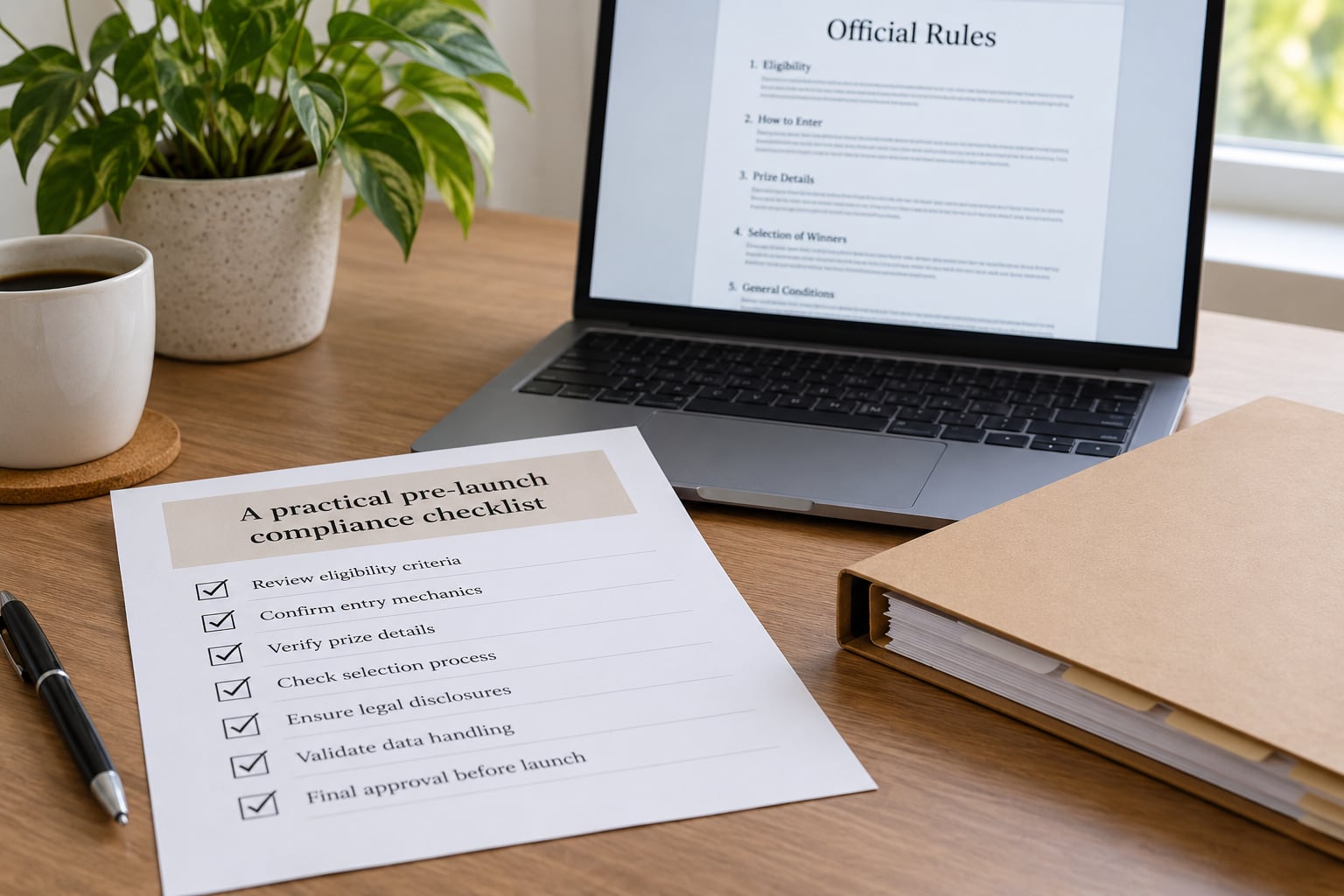
Run this list before the first cue rather than after a complaint. It covers the review, the disclosures and the records you will need afterwards.
- Classify the promotion as a contest of skill or a chance-based sweepstakes.
- Check the state registration and bonding threshold for every state in the eligibility list.
- Draft the official rules with every clause in the list above, in numbered order.
- Confirm the prize exists, the approximate retail value is accurate, and any ticket or travel conditions are written down.
- Align on-air copy, website page, social posts and any paid ads so dates, eligibility, odds and prize match exactly.
- Test the entry path end to end, including a test entry for each permitted channel and the alternative free method of entry.
- Brief the staff running the promotion on eligibility checks, disqualification handling and the 24-hour change rule.
- Publish the privacy notice covering what entrant data you collect, why, and how long you keep it.
- Agree the documentation plan for selection: who records entries, who supervises the draw, and where the time stamps live.
- After the close, keep the rules page up for 30 days and retain entry, selection and winner records for as long as your state and tax advisers recommend.
Frequently Asked Questions
Do radio contests need written official rules?
Yes, and the FCC treats them as the reference point for the whole promotion. The Contest Rule at 47 CFR 73.1216 requires broadcasters to disclose all material terms of a contest either on air or on a website page announced periodically on air, and that page has to stay available for at least 30 days after the contest ends. Listeners should be able to read the same document a judge or regulator would read.
Are radio listener contests legal in every US state?
Generally yes, but the paperwork changes with the state and the prize value. Most states allow skill-based contests and sweepstakes freely, though some require registration, a bond or a reporting return once aggregate prizes cross a threshold. New York is the most commonly cited example, requiring registration and a bond for larger games of chance. Confirm the position in every state listed in your eligibility clause.
What is the difference between a sweepstakes and a contest of skill?
A sweepstakes awards the prize by random drawing, so a valid entry is enough. A contest of skill requires the entrant to do something that determines the outcome, such as answering trivia correctly, guessing a number or timing a call. That distinction matters because many states treat random promotions as games of chance with registration and bonding duties, while pure skill promotions usually avoid them.
Can a radio station require listeners to be 18 or older?
It can, provided it says so clearly before entry in the on-air copy, the written rules and every other promotional channel. Minimum age limits are routine, particularly for alcohol-related prizes, travel prizes and online entries. What a station cannot do is apply an age rule in the written terms while advertising the promotion to a general audience without mentioning the restriction anywhere.
Does a listener contest winner automatically have to pay taxes?
Not always immediately, but non-employee winners generally owe tax on the value of a prize they receive. The sponsor normally issues a Form 1099 once a person’s prizes total 600 US dollars or more in a calendar year, and some states also require the sponsor to withhold at source. Rates and thresholds differ by state, so a winner should ask a tax adviser rather than assume the prize is tax free.
Can a radio promotion use social media or online entries?
Yes, and most major promotions now offer web, keyword text and social routes alongside cue-to-call. The rules need to state the entry method, any entry limit, the cost of a text entry including carrier charges, and that the entrant must be the authorised account holder. Keep the written rules on the station website too, announced on air and live for 30 days after the contest closes.
Start with classification and the written rules, because everything else follows from them. Get the material terms right, publish them where listeners can actually find them, and run the promotion exactly as announced. If you only do those three things well, most of the legal risk disappears before it arrives.