Free music streaming and radio sound like the same thing until you try to choose a song. Streaming lets you pick every track yourself and plays it the second you ask, while radio hands you a continuous schedule chosen by a station and you simply tune in. That single difference shapes everything else: ads, data use, control, discovery and how much effort each one takes.
Neither format is free in the way most people mean it. Ad-supported streaming is free to start but pays for itself in adverts and upgrade prompts. Radio costs nothing at the point of listening, though the signal, the internet stream or the smart speaker comes from somewhere.
I’ve used both on the same commute for long enough to stop arguing about which is better. The honest answer is that they do different jobs, and the right one changes depending on the hour.
Table of Contents
- How Free Music Streaming Differs From Radio at a Glance
- Music Choice: On-Demand Tracks Versus Curated Stations
- Ads and Commercial Breaks
- Personalization and Listening Control
- Sound Quality and Listening Experience
- Music Discovery and Programming
- Availability, Cost, and Offline Listening
- Where to Listen to Free Radio Online
- Which Should You Choose?
- Frequently Asked Questions
- Conclusion
How Free Music Streaming Differs From Radio at a Glance
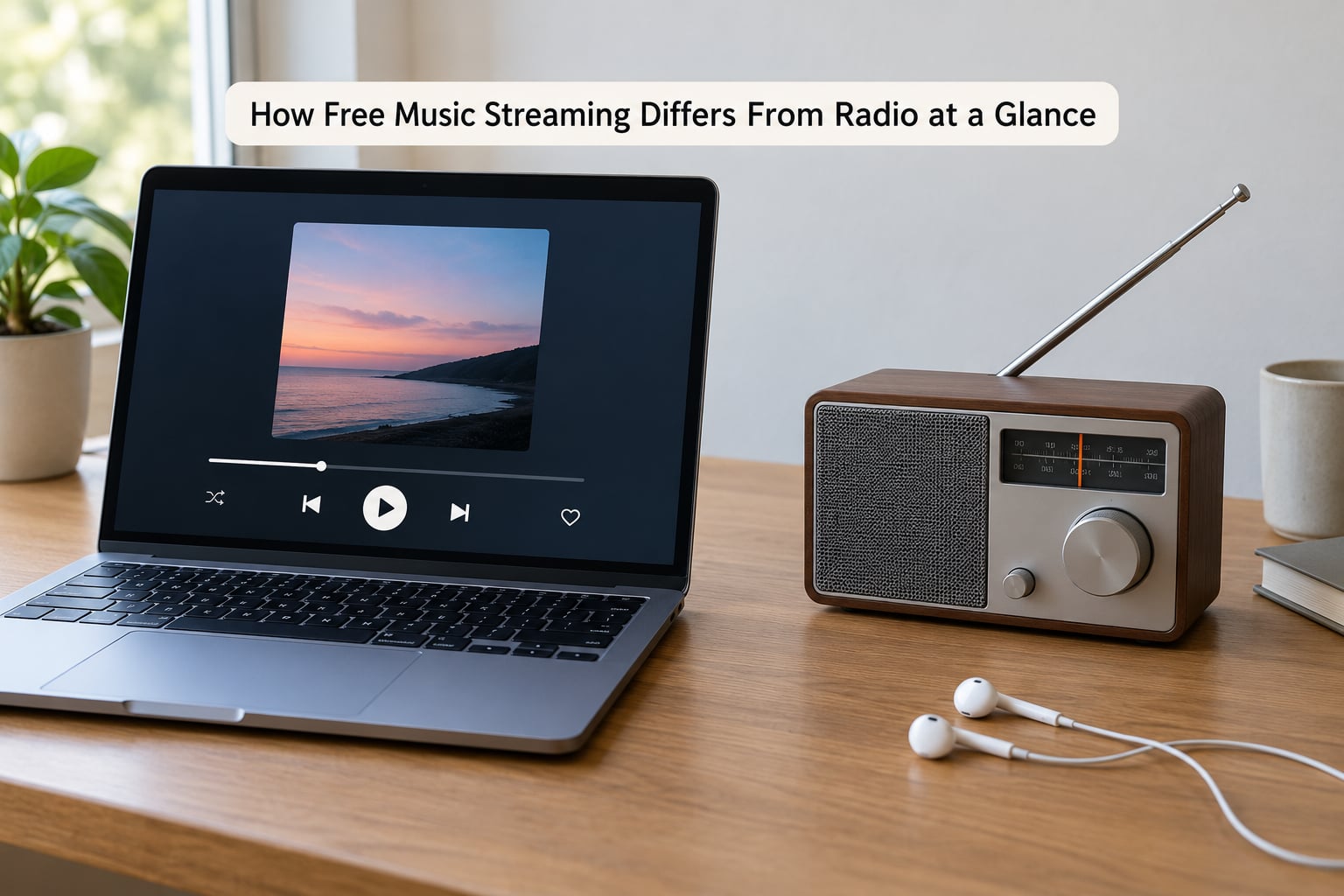
| Dimension | Free music streaming | Radio (broadcast and online) |
|---|---|---|
| Who picks the music | You do, one track at a time | A station’s DJ or automation does |
| Personalisation | Algorithm builds playlists from your listening | Set by the station’s format and music policy |
| Advertisements | Short audio ads and on-screen panels between tracks | Sweep adverts, host reads, and ad-supported stations |
| Listening control | Skip, repeat, search, shuffle, queue | Change station or turn it off |
| Sound quality | Usually 96 to 320 kbps compression | FM, DAB or a 128 kbps internet stream |
| Discovery | Recommendations, editorial playlists, artist radio | Rotations, presenters, interviews, local programming |
| Data use | Roughly 55 to 145 MB per hour | Zero for broadcast; similar to streaming online |
| Best use | Deliberate listening to specific music | Background listening and surprise |
One more distinction matters before the detail: “radio” now means two different things. Broadcast radio arrives over FM, DAB or a satellite signal and costs nothing to receive. Online radio is a continuous stream sent over the internet, which means it behaves like a very long track rather than like a station on your dial.
Music Choice: On-Demand Tracks Versus Curated Stations
Free music streaming is on-demand. You search for an artist, tap a song, and it plays immediately. Skip it, go back, shuffle the queue, or ask for the album version instead of the radio edit. That control is the whole point of the format.
Radio is continuous. A station plays a schedule, and what reaches you in the next four minutes is decided by a presenter’s choices, a software rotation, or the deal the station has with a label. You can leave, but you cannot ask for the next track.
The lines blur more than they used to. Services like iHeart and global internet station directories run continuous music channels inside an app, and Spotify and Apple Music both ship radio-style modes that generate an endless stream from an artist or a mood. Those sit between the two: the track is chosen for you, but the queue is generated on your device from your history.
One difference persists underneath that blur. A station has a musical identity and is answerable to it, which is why it repeats a small pool of tracks. A generated radio mode has no identity to lose, so it drifts toward whatever you already tolerate.
Ads and Commercial Breaks
Ad-supported streaming inserts a short audio advert between tracks, usually every ten to fifteen minutes, plus banner panels and constant reminders about the paid tier. On the free tier, skipping is often limited too, so a track you dislike may have to play out.
Radio’s advertising is different in shape rather than in quantity. Broadcast stations run sweep adverts every fifteen to thirty minutes around programme breaks, plus host-read sponsorships that feel personal because a person says them. Online-only stations may run ad breaks every fifteen minutes with nothing else between them.
Paid subscription streaming removes audio adverts, unlocks unlimited skips and adds offline downloads. Free radio removes adverts entirely in a different way: it has none, because it is not selling you a subscription. That is the practical reason radio feels free and streaming often does not.
Personalization and Listening Control
Control is where streaming wins outright. You can skip, repeat a line, search a lyric, queue an album ahead, shuffle by mood, or duck everything for podcasts. On a free tier the skip limit softens this, but the underlying interface is still built around your choice.
Radio gives you two controls: turn it up, turn it down, or tune away. That sounds limiting until you notice what it removes. No menus, no decisions, no screen. It keeps working with the phone in your pocket, which is why drivers rate it so highly.
Recommendation engines add a second layer of personalisation that radio cannot match and listeners often resent. Play one album by one artist and the playlists that follow tend to stay close to it. Skip limits and autoplay extend the session with more of the same rather than steering you somewhere new.
Sound Quality and Listening Experience
Compression is the practical difference. Streaming tiers commonly deliver 96, 160 or 320 kbps, and paid plans at the top end compress far less. FM broadcast is roughly comparable to a mid streaming tier, DAB is usually a little cleaner than FM, and many online stations stream at 128 kbps because that is what keeps their bandwidth bill down.
For most listeners in a car or a kitchen, none of that matters. On decent headphones in a quiet room, the gap opens up, particularly between a 128 kbps internet station and a high-quality stream.
Buffering is the difference people notice first. Streaming needs a steady connection, and a weak signal means stuttering or silence. A broadcast signal is local and consistent until you drive out of range. Online radio sits in between: it is an internet stream, so it drops like any other stream does.
Music Discovery and Programming
Algorithms discover predictably. They predict what you have already shown you, which is efficient and increasingly repetitive. A recommendation engine is very good at finding the next album by an artist you love and poor at finding the one you would never have searched for.
Stations discover by selection and repetition. A programmer picks a limited rotation, plays a track often enough to stick, and hands off to a presenter who introduces it, chats around it, and plays something adjacent. The repetition that annoys people online is the same repetition that makes a station recognisable.
The human part is what no algorithm reproduces. Presenter voice, dedications, local news and traffic, interviews with artists, and a request line give a station texture. Community and student stations in the UK lean into this hardest, and the appeal is as much to who is running it as to what they play.
Availability, Cost, and Offline Listening
Free streaming needs a connection and, for anything beyond a trial, a free-tier account. That account brings adverts, limited skips, and usually no offline downloads. Paid plans unlock downloads, and those are the feature people miss most on holiday or on the Underground.
Broadcast radio needs no account, no card details and no data. It also has no offline mode to configure, because the tuner in your device or car is always there.
Data is the hidden cost people ask about most. A 128 kbps stream uses roughly 55 to 60 MB an hour; a 320 kbps stream runs to about 140 to 145 MB an hour. An online radio station at 128 kbps costs about the same as a low-bitrate streaming session. Broadcast FM and DAB cost nothing in data at all, which is why radio still wins on a long drive through poor coverage.
Battery follows the same logic. A phone held awake decoding an internet stream for hours will flatten itself faster than a phone sitting idle next to a working radio.
Where to Listen to Free Radio Online
If radio is the part you want, it is easier to reach than most people assume. A few routes cover almost everything.
- Radio directories such as Radio Garden show every public station on a map, so you can find one from a city you have never visited.
- Aggregator apps including TuneIn pack thousands of stations into one app with search by genre, country and language.
- BBC local radio and community stations in the UK cover news, weather and local music, and most are reachable through the BBC Sounds app or an aggregator.
- Student and community stations run by universities and local groups are the most likely to play something you would never find on an algorithm.
- Smart speakers play most stations without an app, either through a built-in radio skill or by asking for a station by name.
One caution on station directories. Licensing rules mean many stations are geo-restricted, so a station that streams perfectly at home may refuse to play abroad.
Which Should You Choose?
Match the format to the situation rather than declaring a winner.
- Commuting with poor mobile coverage: broadcast radio. No buffering, no data cost, nothing to tap.
- Long drives and travel: broadcast radio or downloaded music. Data adds up and reception drops off in exactly the places you most want sound.
- Working or studying with music on in the background: online radio. It runs for hours without a screen and without you having to keep choosing.
- Deliberate listening to a specific artist or album: streaming. It is the only one of the two built for that.
- Finding music you would not have searched for: radio, especially a station outside your usual genre.
- Workouts: either. Radio wins when you want the pace to stay up; streaming wins when you want a specific running playlist.
- Stretching a mobile data allowance: broadcast radio, or online radio only on an unlimited plan.
The combination works better than either alone. Most listeners I know use radio as the default background source and switch to streaming when they want to hear one specific thing properly.
Frequently Asked Questions
Is radio better than streaming for discovering new music?
Usually yes, and the reason is repetition. A station has to play a limited rotation of tracks often, so you hear each one enough to recognise it, and the songs sit next to each other in someone else’s order. Recommendation engines optimise for what you have already played, so they stay inside a narrow taste. If discovery is your goal, station rotations and smaller community stations beat autoplay.
Does free music streaming use a lot of mobile data?
Less than people expect, but not nothing. A 128 kbps stream uses roughly 55 to 60 MB an hour, and a 320 kbps stream about 140 to 145 MB. Most people treat that as modest until they leave a stream running all working day. Broadcast radio uses no data at all, and a downloaded album uses none once saved. On a metered plan the difference decides how often you stream.
Is free internet radio actually free?
Yes, at the point of listening. Most stations run adverts or sponsorship reads, and some accept listener support, but none ask for a card or a subscription the way an ad-supported streaming tier does. The trade is different rather than absent: you give up control of what plays and you hear adverts you cannot skip. Some stations also geo-block their stream outside the country they broadcast to.
Why do radio stations play the same songs over and over?
Because a station runs a limited rotation. Research on audience testing shows most listeners recognise a track after hearing it a few times, and repeated plays raise recall of the song and the station itself. Repetition is a deliberate programming choice, not a failure to update. It is also the main thing listeners complain about when they compare a station to an endless personalised queue.
Can I listen to radio on a smart speaker without an app?
Usually yes. Most smart speakers can play a station by name or by asking for a genre, and they call the directory themselves rather than needing your phone. Coverage varies by station and country, because some streams are restricted or only listed inside a particular app. If the speaker cannot find your station, searching for it in a directory app on your phone first usually adds it to the list.
Conclusion
The difference in one line: streaming gives you control over specific music, and radio gives you a schedule that surprises you.
Start by putting a station on when you are driving or working, and see whether the discovery and the lack of screen appeal to you. If you want one specific album heard properly, open the streaming app and pay for it if the adverts bother you. Most people end up doing both, and that is not a compromise. It is just the two formats doing the jobs they were each built for.