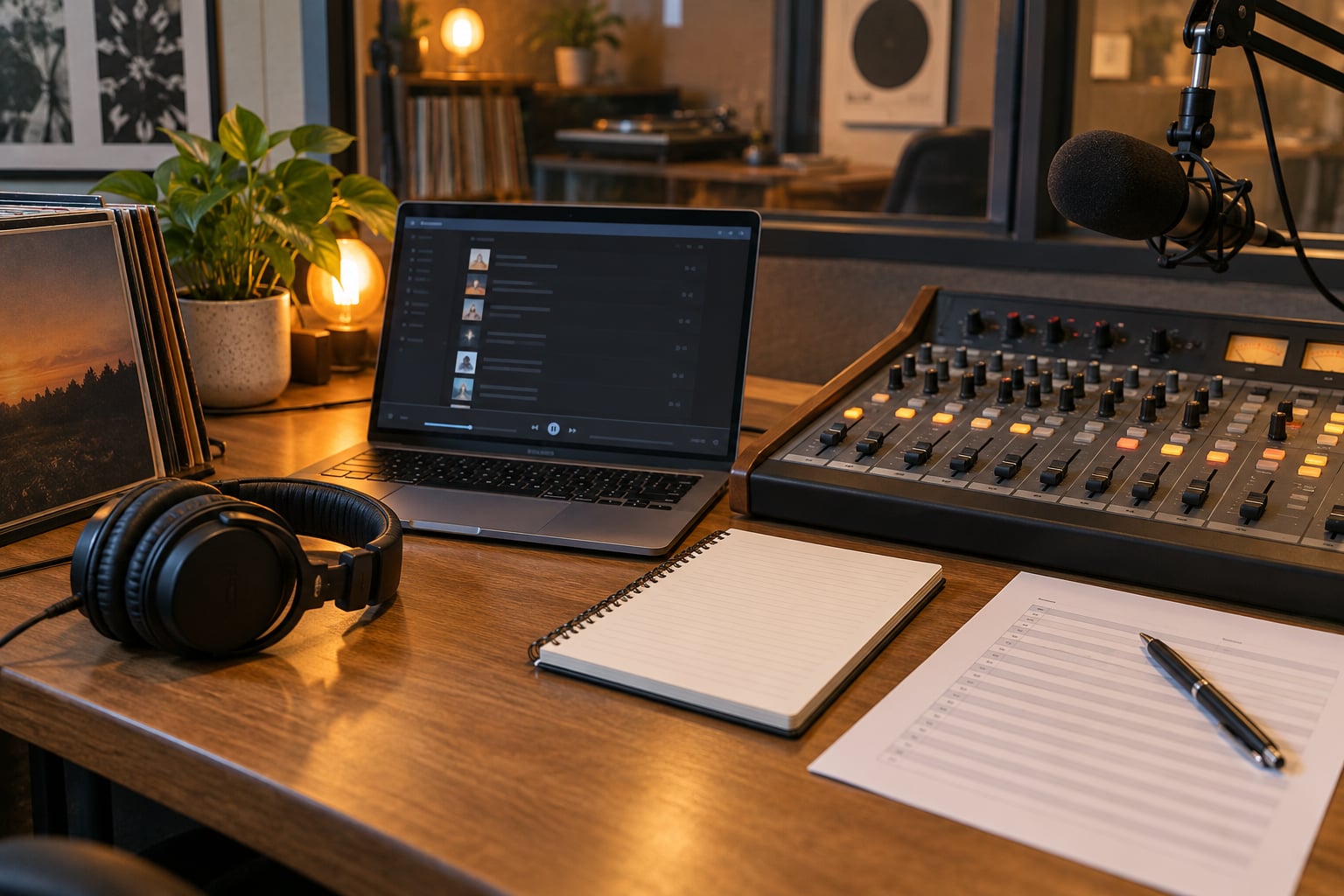
How college radio breaks new artists is a question that confuses most musicians, because the visible part is just a song playing once at 2am on a stream nobody seems to be listening to. The invisible part is a chain. A music director triages a mountain of submissions, listens to the handful that fit the format, gives the track a rotation add and its first spin, logs that spin on a public chart, and gives other programmers a reason to try the song themselves. The spin is the smallest unit of college radio, and it is where an artist earns a verifiable reason for someone else to pay attention.
People who listen to college radio describe it as the main way they find music a streaming algorithm would never hand them. That is not nostalgia, it is curation. When a person with taste picks your song out of three hundred others, the picking itself carries weight that a playlist placement never manages.
Table of Contents
- How College Radio Breaks New Artists: A 60-Second Overview
- What Role Does College Radio Play in Music Discovery?
- How Do Student DJs Find Music Worth Playing?
- How Does a New Artist Get on the Radio Schedule?
- Why Can One Campus Airplay Lead to a Bigger Break?
- What Can Artists Do to Improve Their Chances?
- How Can Listeners Support Artists They Discover on Campus Radio?
- Frequently Asked Questions
- Can any artist submit music to a college radio station?
- Does college radio pay performers when it plays their music?
- Should an artist send the same demo package to every college station?
- How long does it take for a college station to review a music submission?
- Does college radio airplay guarantee streams or a record deal?
- How should an artist find college stations that fit their genre?
- Conclusion
How College Radio Breaks New Artists: A 60-Second Overview
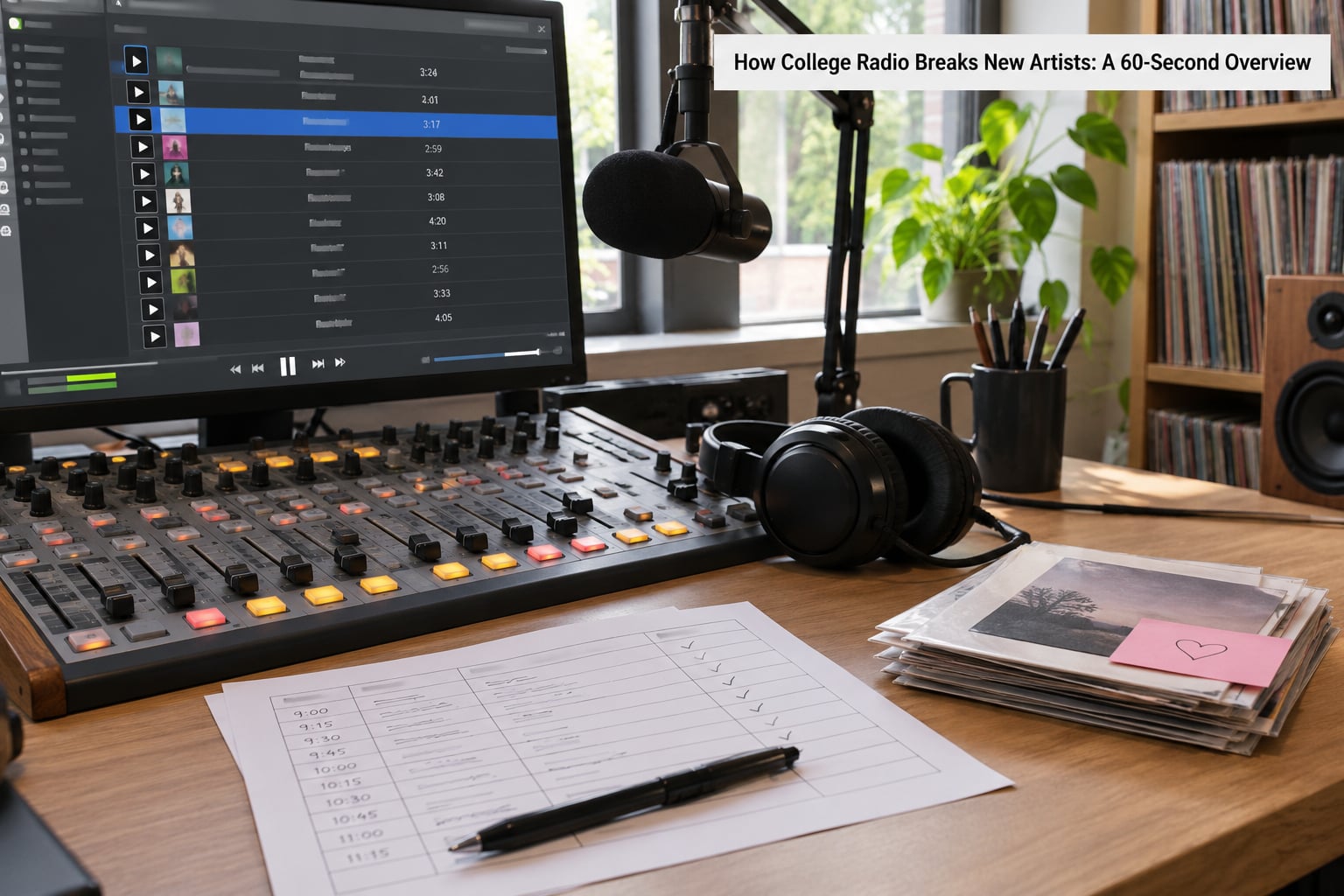
Here is the whole mechanism in one paragraph. A track reaches a music director, either by submission, campus showcase, label mail, or a DJ who already likes you. The director triages the pile and picks the few tracks that fit the station, then a spin gets logged, and that log is visible to other programmers. The song travels from rotation to rotation, and listeners turn airplay into streams, ticket sales, and press coverage.
None of those steps is a promise. A spin is not a contract and usually not worth much money on its own. What it is worth is exposure you could not buy and credibility you could not manufacture, which is usually the entire point for an unsigned artist putting out a first single or an EP.
What Role Does College Radio Play in Music Discovery?
A college radio station has no advertisers and no label deals. Nobody buys an hour of airtime on it, and no major label has a contractual quota of spins. What fills that gap is a small budget, a student staff, and far more freedom than a commercial programmer gets about what goes into the microphone.
That freedom is why college radio occupies ground commercial radio cannot. A commercial station playing to adults in cars has to play it safe on every pick. A station playing to twenty-year-olds who will tell their friends about what they just heard has nothing to lose by playing something nobody has heard of. That is the structural reason the format suits new music.
Scale is the catch. A campus station in a small town might have a few hundred regular listeners, while a well-funded city non-commercial station with a big music department can reach deep into a metro audience. So how much college radio is worth depends almost entirely on which station you are talking about.
Local scenes matter too. Campus outlets often host or partner with on-campus showcases, and that is where a first spin turns into a first room. The progression artists describe most often runs like this: a listener hears the song on the stream, comes to the show, and now forty people in that room already know the chorus before the band plays it.
How Do Student DJs Find Music Worth Playing?
The honest answer is that most student DJs are not sitting around waiting for submissions. They are consuming music constantly through streaming platforms, playlists built by other students, recommendations from friends, and whatever lands in the station inbox. From that constant feed, a few songs get pulled out for a show.
Some DJs lean on label mail and publicists, which still works but puts you behind a queue. Some lean on campus events and scene ties, which is why a band that shows up and plays a campus bar has a shot at a spin that an email from another state does not. Others use submission services that deliver music for a fee, and they are popular for a practical reason: the station gets a clean, playable file with correct metadata instead of a private streaming link that expired last month.
This is the part artists usually misread. A DJ adding your song to a personal playlist for a specialty show, or passing it to a friend, is discovery. It is not airplay and it is not a commitment from the station. Airplay happens when a track enters the logged rotation and gets counted as a spin.
Music directors also say the artists who get played repeatedly are usually the ones who engage with the station as people rather than as a submission machine. Play the campus show. Answer the email. Show up at the event. The music gets you in the door, and behaving like a local act is what keeps the door open.
How Does a New Artist Get on the Radio Schedule?
Every college station runs the same sequence, whether it is a small campus outlet or a large city non-commercial station. What changes is how many weeks the wait takes, not whether the steps exist.
Research the station before you send anything
Listen to a full hour of the station’s archive before you email anyone. You will learn what they play, who they have already added recently, and where they post their submission rules, which is usually somewhere obvious that nobody has read. Artists who skip this step are the ones getting a reply that says wrong station. If the station has a specialty show that fits your sound, that host is often a better first contact than the music director.
Send something the station can actually play
This is where most submissions die, and it is rarely about talent. A station needs a file its software can load and metadata its software can read, so the artist name shows up correctly on the chart and in the log. Send the format the station asked for, not the one you prefer. Include a short bio, a press photo, and streaming links, and keep the email short enough to read between shifts.
Wait a few weeks before following up
Artists tell a very consistent story: submit, hear nothing, assume the music was bad. More often the submission was never usable. Once a track is genuinely in the queue, a decision can take anywhere from a few days to several weeks depending on the volume. One polite follow-up after three or four weeks is fine. Repeated unaddressed emails are not, and they are the fastest way to be treated as spam.
Let the song earn its follow-up
The first spin is a test, not a verdict. Programmers watch how a track sits with listeners, whether requests come in, and whether it holds up in a show surrounded by other songs. A song that gets added twice in a week is telling the station something. Artists who pile on with a thank-you marathon the night after one spin tend to get less airplay than artists who let the work keep happening quietly for a month.
Charts are the other piece most people miss. The North American College and Community Radio chart is a public record of what is being played across member stations, and the tracking software many stations use logs spins automatically. When a track shows a consistent pattern of spins across multiple listings rather than a single spike, other programmers can see it is working. That visibility is the one genuinely compounding part of the whole system.
Why Can One Campus Airplay Lead to a Bigger Break?
A single spin is small. What it does is start a set of side effects, and this is the part where listeners help most. A student who hears a song and then goes and finds it, saves it, and tells three friends generates a small spike in streams that the artist can point to. A local blog covering the story gets a quote they can use for months. A booking agent sees a campus date sell out and starts treating the act as a draw rather than an experiment.
Charts create the second effect. Stations check what peers are adding, partly to stay current and partly because programmers trust the collective signal. A track appearing across a dozen station listings looks, to another station considering it, like a safer pick than something with no data at all. That is how one campus play turns into play on a station three states away.
Press follows, usually slowly. College and community outlets cover local shows and emerging names, and a radio add gives a writer a specific, checkable fact to open a piece with. Festival bookers pay attention to the same chart data. So the order is usually streams first, then shows, then press, then festival interest. It can also stall at step one. Airplay opens doors, it does not walk through them.
What Can Artists Do to Improve Their Chances?
Research pays better than volume. A focused list of forty stations that genuinely fit your sound beats blasting eight hundred submissions built from a directory, because the stations that matter hear from artists who listened first. Artists in the r/collegeradio community consistently say the same thing: relationships and local presence count as much as the audio itself.
Being findable matters as much as being good. A working streaming link, correct metadata, a current one-sheet, and a clean email address are unglamorous, and every one of them removes a reason for a volunteer with no time to skip you. If a paid submission service genuinely saves you weeks of admin, that is a defensible expense. If you are paying for a promise of airplay, that is a different proposition, and it is worth asking exactly which stations receive your music and whether anyone there has ever heard of the service.
Play the room. Campus bars, student showcases, open mics, and a local scene slot do more for your radio prospects than another hundred cold emails, because the DJs are also the people who book those rooms. An artist who becomes a familiar face in a scene is playing to stations that already know the name.
Then keep the direct relationship with listeners. Airplay reaches a few hundred people, and those people decide what happens next by whether you gave them somewhere to go. A post that thanks a specific show and a specific DJ goes further than a mass announcement, and it makes the station look good for having helped you.
How Can Listeners Support Artists They Discover on Campus Radio?
Going back and actually listening to the song is the first job, and the one a station can see in its numbers. A spin that produces a save, a follow, and a replay is worth more to a programmer than a spin that passes by, and programmers do adjust when they notice that pattern.
Show up. College stations book small rooms, and the audience for a first show is often a dozen friends of the band plus whoever the DJ told. Filling that room changes how the station and the local bookers think about the act going forward. After the show, stay for the other bands. Scene ecosystems only work if the audience behaves like one.
Share the song where you actually listen, and tell the station you did. Artists say, over and over, that a genuine message from a listener carries further with a music director than a polished campaign from the artist. Requesting the song on a show is equally direct, and shows notice. None of this is about begging for a spin. It is about being the person in the room who cared, which is the entire basis of how college radio has always worked.
Frequently Asked Questions
Can any artist submit music to a college radio station?
Any artist can submit, and many stations accept music from unsigned acts with no prior connection. The catch is that most stations now take submissions only through their own published guidelines, and many require a specific file format, correct metadata, and streaming links. Send exactly what they ask for, research the station’s format first, and expect a decision in days or weeks rather than hours. There is no fee for the ordinary submission path.
Does college radio pay performers when it plays their music?
Almost never directly. A college station that plays your song has not bought a licence from you; non-commercial stations run on grants, donations, and underwriting, and that money goes to operations, not performance royalties. When your track is logged on a public chart, a performing rights organisation may track it and royalties can eventually be collected, but the amounts are small and irregular. Treat radio as exposure and credibility, not as income.
Should an artist send the same demo package to every college station?
The core package can be the same, the targeting cannot. Every station needs the file in its required format, the correct metadata, a short bio, a press photo, and streaming links, and that part is reusable across the list. What changes is the pitch. Mention the specific show, the local show, or the recent local artist the station added, and trim anything that does not apply. A generic blast reads as a blast, and music directors recognise one instantly.
How long does it take for a college station to review a music submission?
Expect days to several weeks, and longer during busy periods such as the start of term or just before a festival season. The queue length depends on how many submissions the station receives and how many hours its volunteers have for listening, and many DJs are students with exams. A single polite follow-up after three or four weeks is reasonable. Repeated emails after that tend to get you flagged, and silence is usually about volume rather than about your music.
Does college radio airplay guarantee streams or a record deal?
No, and anyone who guarantees it is selling something. A spin can generate streams, press, better ticket sales, and other station plays, and the credibility is genuine, but the size of the effect depends on the station’s audience and on whether you keep the momentum going afterwards. The bands that got noticed did far more than receive one spin. Treat airplay as the opening move in a longer campaign, and set your expectations for the first few months accordingly.
How should an artist find college stations that fit their genre?
Start with the specialty shows rather than the station as a whole. Most stations run shows dedicated to specific styles, and those hosts have more freedom to add unfamiliar music than a general rotation does. From there, check the station’s recent chart, which usually lists what it has added in the past few weeks, and cross-reference that with public charts to see which stations are most active in your genre. Email the host directly, and keep the material specific to what you have heard on their show.
Conclusion
College radio is an early-discovery and relationship channel, not a machine that manufactures success. A spin gets logged, other programmers see it, listeners decide what happens with it, and from that point the outcome depends almost entirely on what the artist and the audience do next.
Start by picking a small number of stations that genuinely fit your sound. Listen to their archives, find the specific show and host, and send a short professional submission in exactly the format they asked for. That is a day of work, and it is the only first step worth taking.