An electronic dance radio show is a scheduled slot of dance music with a presenter who talks over it, plays tracks in a planned order and takes requests from listeners. Understanding how electronic dance radio shows work comes down to four moving parts: a music rotation, a broadcast schedule, a voice that links the tracks, and a delivery system that carries the show to FM, DAB or an app.
There is more to it than a playlist left on shuffle. A dance show has a shape, a clock and a team behind it, and once you can see those parts, the format stops being mysterious. This guide walks through the whole thing, from the planning meeting to the stream landing on a phone speaker in a kitchen.
Table of Contents
- What Is an Electronic Dance Radio Show?
- How Are Electronic Dance Radio Shows Planned?
- How Does an Electronic Dance Radio Show Work During a Broadcast?
- How Are Tracks Selected and Scheduled?
- What Happens During a DJ Set?
- How Do Presenters and Producers Work Together?
- How Do Listeners Interact With the Show?
- How Is the Show Delivered and Recorded?
- Frequently Asked Questions
What Is an Electronic Dance Radio Show?
An electronic dance radio show is a branded block of programming built around electronic dance music. It has a name, a host or resident DJ, a regular slot in the schedule, and a music policy that tells the presenter what does and does not get played.
What makes it different from a continuous online station is the human layer. An automated internet radio service plays whatever a scheduler has loaded and nobody speaks. A show has a person attached to it who opens the slot, signs off, answers messages and takes responsibility for what went out.
Dance shows tend to be longer and more talkative than mainstream music radio. A specialist show might run one or two hours, and the presenter might be talking for five or six minutes of every half hour, which is a far higher speech-to-music ratio than a chart show would use.
How Are Electronic Dance Radio Shows Planned?
Planning starts with a concept, not a tracklist. A producer or station manager writes a one-paragraph brief: who the show is for, what the show sounds like, and what a listener should feel after twenty minutes. Warm-up house for a Monday morning slot looks nothing like a Friday night peak-hour show.
From that brief come the recurring parts. Most dance shows have some combination of a fixed intro and outro, a weekly feature such as a track premiere or an artist interview, a request or shoutout segment, and a set amount of advertising time. Anything that appears every week becomes a habit listeners wait for.
Next comes the music policy. A show usually works from a genre tree, a hierarchy that groups tracks by style and sub-style so everyone agrees where a track belongs. Without one, a resident DJ ends up playing what they fancy and the show drifts.
Live, recorded and hybrid editions all exist and each has a different prep routine. A live slot means a presenter in a booth at a set time. A recorded show is built in advance, which is more reliable but less spontaneous. Hybrid shows record the voice links and music separately and assemble the finished hour, keeping the personality while removing the timing pressure. Promotion is planned too: social posts announcing the next edition, a guest lineup, or a track premiere usually go out a day or two ahead.
How Does an Electronic Dance Radio Show Work During a Broadcast?
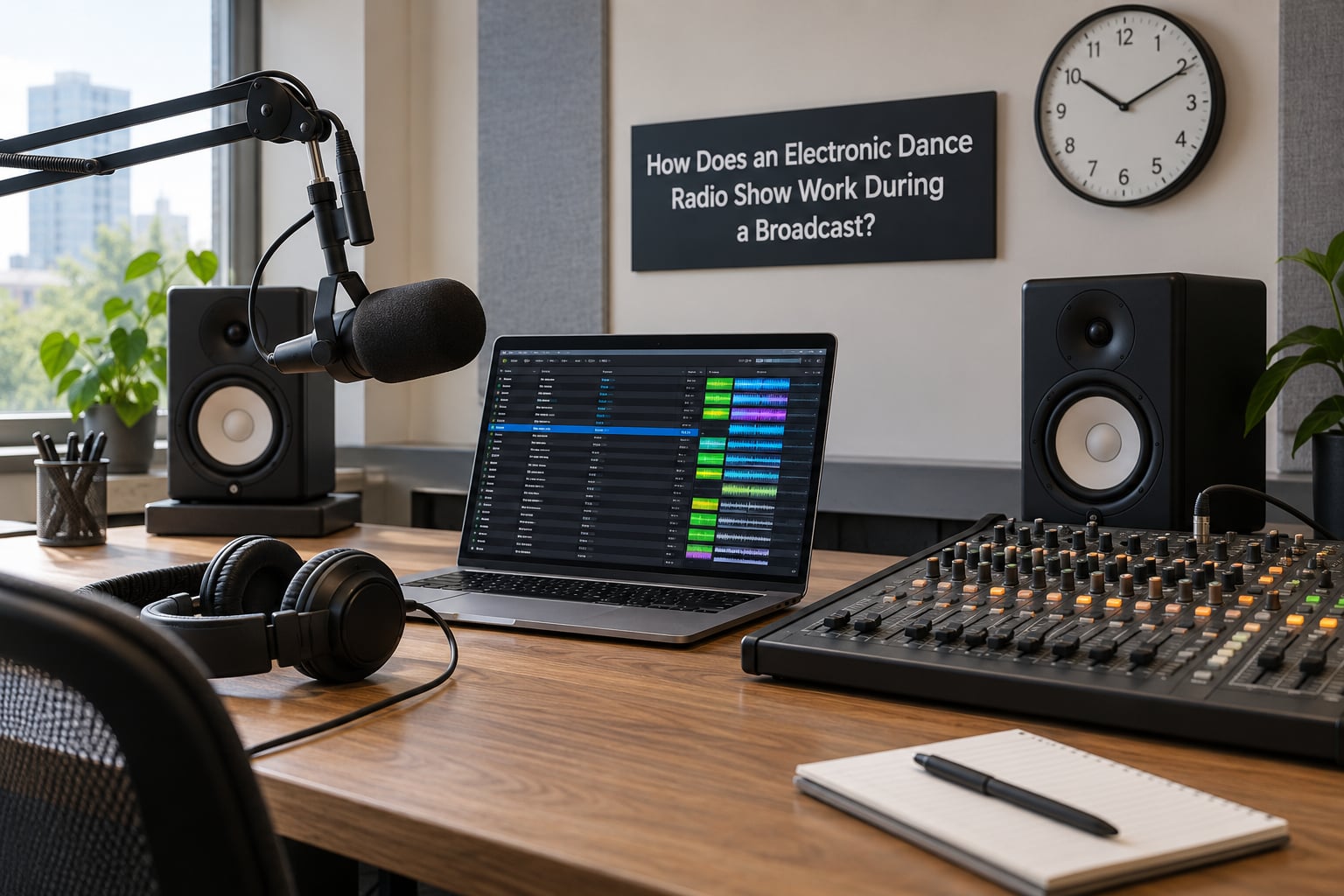
A live dance show runs on preparation, cueing and a running clock. The presenter has the hour mapped out in advance, the audio is played out through a system that cannot be fumbled, and anything that goes wrong has a fallback ready.
How Electronic Dance Radio Shows Work Step by Step
Here is the workflow most live dance shows follow, in order.
- Pre-show preparation. The presenter arrives, checks the news and music feeds, confirms the running order, and reads anything the producer has flagged for the slot.
- Level check. Microphone levels are set, playback is matched to the studio chain, and a couple of minutes are recorded and played back before the red light goes on.
- Opening. The intro and station ident play, the presenter signs the show on, names the theme and mentions what the slot covers.
- First music block. Tracks are cued back to back. The presenter either lets a long blend run or talks over the intro of a track that has room for it.
- Speaking over transitions. Links are delivered in the gap between tracks, not on top of a vocal. Presenters usually learn the timing so the next track starts under the last word.
- Monitoring. Levels are watched rather than touched. A sudden jump or a clipping light is the only reason most shows touch the desk mid-hour.
- Handling surprises. A track will not load or a caller will not connect. The playlist usually has a spare ident or bed ready so the silence never runs longer than a few seconds.
- Closing. The feature is acknowledged, requests are thanked, the outro runs, and the stream is left to hand back to the scheduler.
How Are Tracks Selected and Scheduled?
Selection is a blend of judgement and software. The presenter picks the tracks, and scheduling software decides the order and enforces the rules that keep a dance station sounding like itself.
Energy progression matters more in dance music than in most radio formats. A common pattern is a slower warm-up, a lift through the middle, a peak, and one high-energy hour followed by a controlled outro. Tempo sits close to a target for each block, and a track well outside the target gets moved or left for a different show.
Rotation rules stop the same artist appearing twice in a short window, and they set how often a new track is recurred. Most dance stations also mark a handful of tracks as recurrent, meaning they return often because they test well rather than because they are new.
Radio edits change the shape of a track. A long club version with a nine-minute breakdown will not fit a schedule, so an edit with the intro trimmed or the break shortened is used instead. Extended mixes get held back for the longer shows where the format can breathe. Track IDs, bed music and sweepers are placed at fixed points in the hour rather than left to the presenter.
The clock is the last layer. A clock break is a scheduled gap in the music at a fixed point every hour, where station IDs, news, weather or adverts sit. Programming software builds the hour to fit around those breaks, so a show that overruns does not push the adverts off schedule.
What Happens During a DJ Set?
A radio DJ set is not a club set. The pleasure of a club set is uninterrupted music; the job of a radio set is music with a voice threaded through it, and that changes every decision the DJ makes.
On air you rarely play a track end to end without talking across it, which rules out long instrumental sections. You keep the station ID audible and the voice links tight. Transitions are shorter and cleaner than club blending because something has to be said at the end of them.
Song length works differently too. Most dance radio tracks are edited down for broadcast, and a set built from full club mixes will drift past its slot. Branding matters: intros, idents and a sweeper between blocks are what make a set recognisable on a station that plays a hundred shows a week.
Moderation is the part outsiders never think about. A presenter taking calls or reading messages is running live radio, and the station runs the checks in the background. Material can be held back and the show moves on, which is why you will not hear every request on a family-facing station.
How Do Presenters and Producers Work Together?
Behind every good show there is a small team, and the roles rarely overlap much.
The host owns the voice and the running order on the day. The resident DJ owns music taste and the track choice. The music director sets the genre tree, approves new artists and settles arguments about where a track belongs. The producer handles the technical build, the recording or live routing, and the handover notes. At a larger station a producer also assembles recorded shows so the host can turn up and record rather than perform live.
Rehearsal happens once, and it is short. The two things worth rehearsing are the timing of the first link after the intro and the emergency fallback, because that is what people notice when it goes wrong.
During the broadcast the communication is deliberately minimal. A message on the studio screen is usually an instruction, not a conversation, and the producer will not talk to a presenter on air unless something has to be stopped.
How Do Listeners Interact With the Show?
Interaction is what separates a show from a stream, and most dance shows run several channels at once: a request line, a submissions inbox, social posts during the slot, voting through a station app, guest interviews, and contests tied to a release or a club night.
Requests come in through whatever channel the station has promoted. A caller gets on mid-track, a message gets read out, a comment gets a shoutout. The reading of individual names is the cheapest and most effective segment a new show can add.
Nothing from a listener goes straight to air. Producers and presenters screen for availability, rights, tone and anything that identifies someone who has not agreed to be named. Music submissions go through the same filter on a longer timescale, and a track usually needs to fit the genre tree and have usable rights before it is considered.
Contests are the one area where the legal side bites hardest, and stations that run them follow a documented process rather than improvising.
How Is the Show Delivered and Recorded?
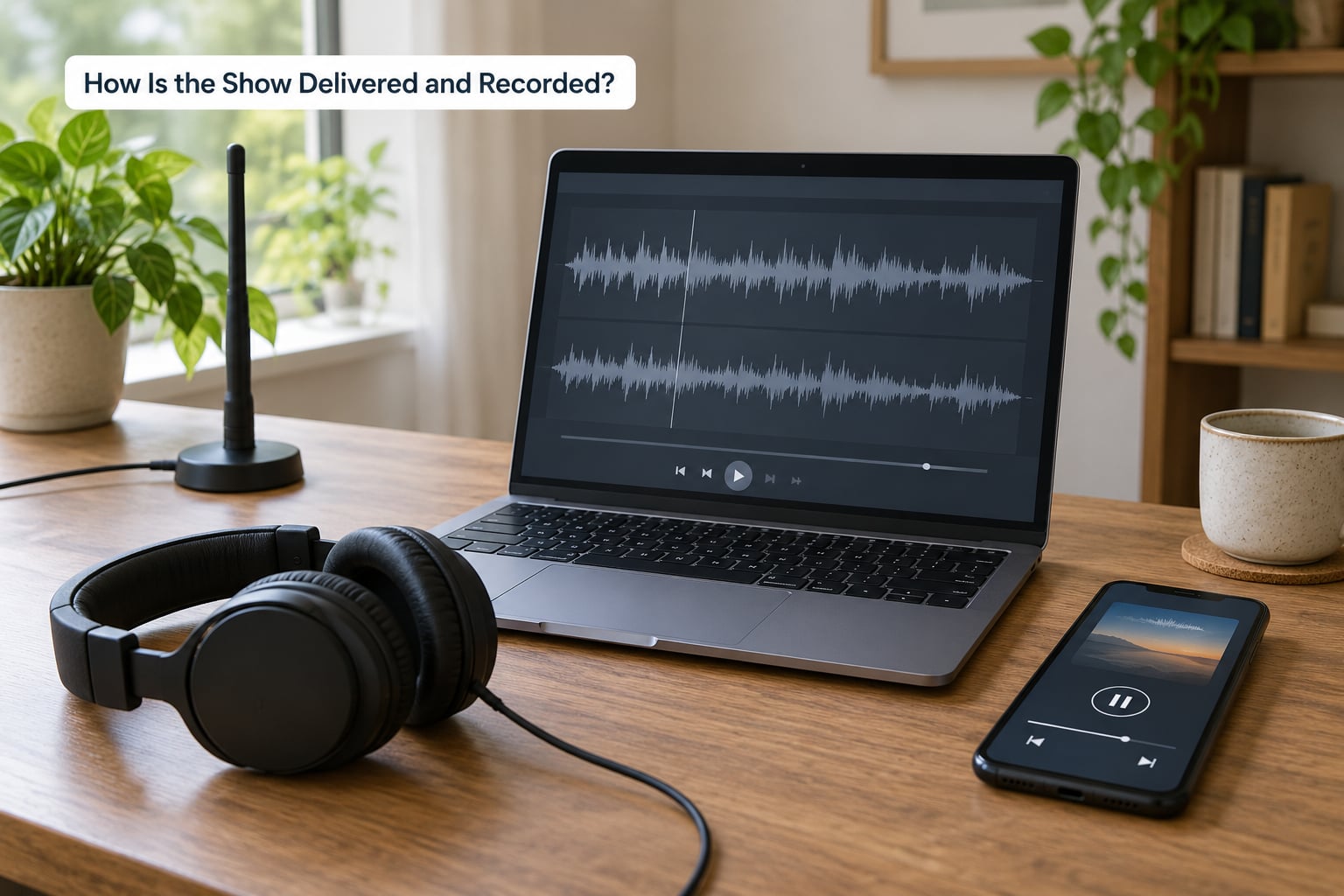
The same show can exist in four places at once, and increasingly that is the plan rather than the exception. It goes out on FM and DAB for local listeners, streams online for anyone with the link, appears in the station app, and is published on demand so people who missed the live slot can catch it later.
Underneath, four pieces of equipment do the work. The playout system is the automation that holds the playlist, the ids, the adverts and the clock breaks, and it is the reason a live show survives a bad moment. The encoder turns the studio audio into a stream. The streaming platform carries it and reports back what played. Recording software captures the finished hour, either live or from the assembled files.
Listeners notice the difference. FM and DAB compress audio to fit the format, so a busy low end gets flattened and quiet passages get lifted. An unprocessed online stream sounds wider and cleaner, and many players display the track title and artist as it plays, which a broadcast signal cannot do.
Frequently Asked Questions
Are electronic dance radio shows always live?
No. Some are broadcast live, while others combine a live DJ with recorded links or use a fully automated schedule. Hybrid shows are common because they preserve a live personality while allowing the show to be built in advance. A resident who cannot make the Tuesday slot can hand a recorded edition to the scheduler, and listeners rarely notice the difference.
How do radio DJs choose dance music?
Presenters usually follow a show theme, station sound and a planned energy curve rather than playing whatever they want. On top of that, the rotation brings in new releases, established tracks, label exclusives and audience requests, with rules that stop an artist repeating too soon. A good music director can tell you why any given track was played on a given night.
Can listeners request a specific song on electronic dance radio?
Yes, if the station accepts requests. Listeners may call, message the station, comment on social media or vote through an app. Editors and producers generally review requests first, checking that the track is available, cleared for broadcast and right for the slot, so a request is not always a guarantee. Shoutout segments fill the gaps where a request cannot be honoured.
Do radio DJs mix tracks like club DJs?
Not usually. Radio DJs may make smooth transitions and use effects, but the station ID, voice links, news and timed segments have to stay clear. Tracks are often shortened or edited to fit the schedule, which means long beatmatched blends in the style of a club set rarely appear. The craft is closer to sequencing than to mixing.
How does internet radio work for dance stations?
A station plays out its schedule through a server, and the audio is encoded and streamed to a listening platform. Listeners connect through a website, an app or a smart speaker rather than a transmitter. The platform reports back what was played, which is how stations log tracks for royalties and build listening figures. Nothing about it is on demand, because the schedule is fixed and shared by everyone listening.
Do dance radio stations pay for the music they play?
Stations pay for music, but not usually per track. A station holds a performance licence covering its broadcast and streaming use, and the licence body collects money from the station and distributes it to performers, writers and publishers. The track logs the platform provides are what make that distribution possible. Stations without a licence cannot legally broadcast music, and that applies online as much as on FM.
Start with the four parts. Find a dance show with a named host and a regular slot, listen to the intro and the first fifteen minutes of music, and notice where the voice sits between tracks. That single listen explains most of how electronic dance radio shows work, and once you have the shape of it, the rest is rotation rules, a clock and a delivery chain doing their jobs quietly in the background.