Distant AM stations arrive after local sunset because the ionosphere stops absorbing medium-wave signals once the sun goes down, so waves that died out a few dozen miles from the transmitter in daylight now skip hundreds of miles and come back down. That is the whole trick behind how to pick up distant AM stations at night: a radio with a real AM band, an antenna actually connected to it, and a quiet spot well after local sunset.
Last updated: October 2026
One correction first, because it trips up almost everyone. AM does not stop working after dark. Your local station loses its groundwave coverage at sunset and fades out, which feels like the band dying, while stations hundreds of miles away fade in and are suddenly there. The band gets busier, not worse. In US terms the sun sets on the transmitter before it sets on you, so the window opens at your local sunset, not theirs.
You can get decent results from a cheap portable set. The catch reports on hobbyist forums prove it, with the antenna and where you put it counting for far more than what you paid for the radio. I would not buy anything until you have tried the free steps below and moved the radio around the house.
Table of Contents
- What You Need
- Step-by-Step
- Frequently Asked Questions
- Why does AM radio seem to stop working at night?
- How far can an AM station be heard at night?
- What is the best antenna for picking up distant AM stations?
- How do I know if I am hearing a real distant station or interference?
- What time of night is best for picking up distant AM stations?
- Are AM radios being phased out?
- Start With the Free Fix Tonight
What You Need
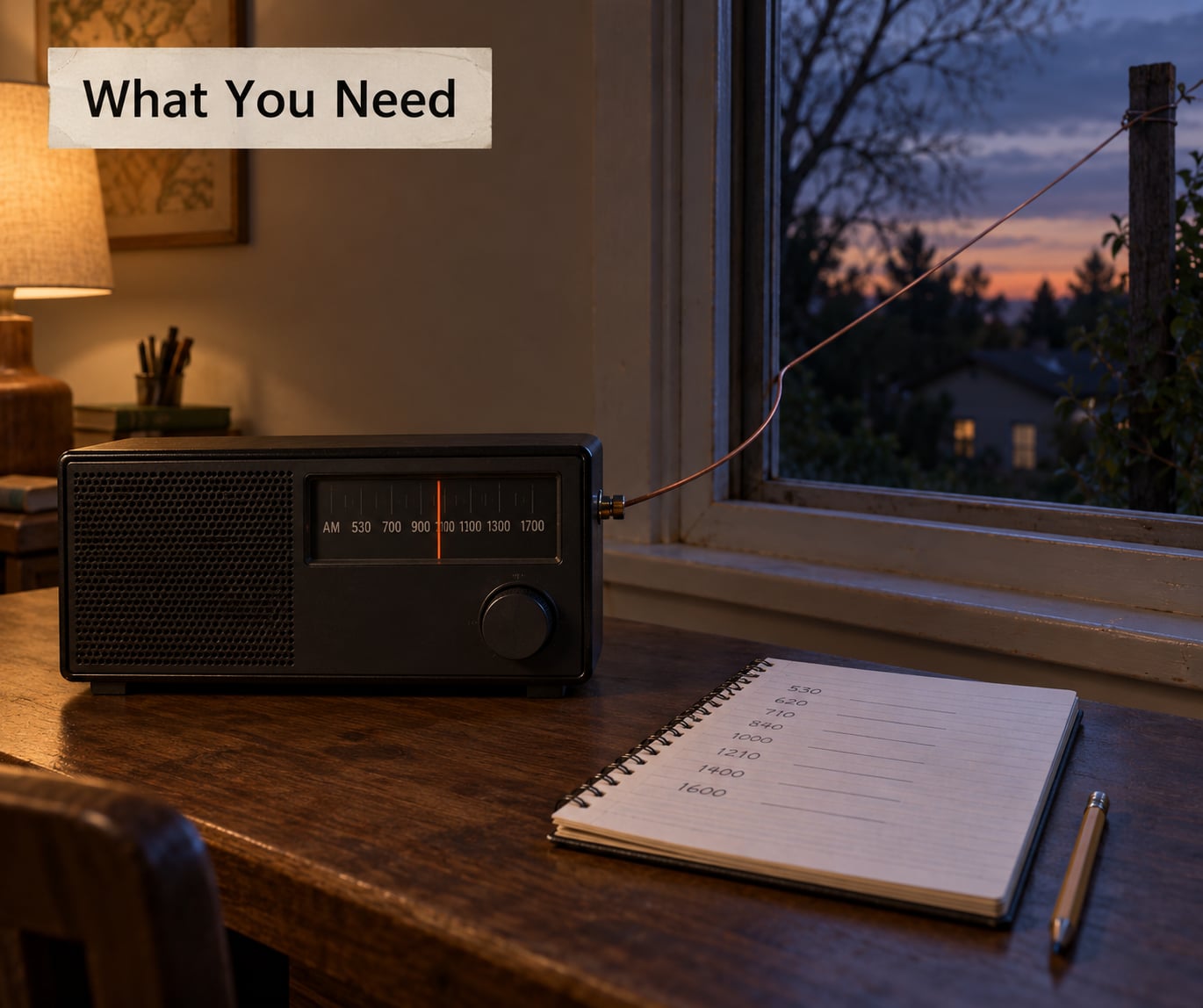
A basic portable setup is a small AM/FM radio, a length of wire for an outdoor antenna, and a pen. That is genuinely enough to work stations a few hundred miles away on a good night, and hobbyists have copied transcontinental calls on a transistor set with nothing else added.
The more sensitive home setup is a tabletop receiver with an external antenna terminal, an S-meter, and a bandpass filter wide enough to pass AM but narrow enough to reject the neighbours. A software-defined radio paired with a cheap wideband receiver handles the hard identification cases, but it is a second step, not a first one.
Beyond the radio, you need somewhere quiet. Ground conductivity does much of the work here, so a rural or coastal location beats a city block, and height beats both. A room with no dimmer switches, no LED nightlight and no big television is worth more than a receiver upgrade.
For reference information, keep a notebook with frequency, time and outcome on every page. Write down the call letters you hear, even the half-heard ones. Later you will want to check a frequency against the FCC AM Query facility search in the US, or your national regulator’s database, and a log is the only thing that makes that possible.
Optional extras that genuinely earn their place: an AM loop antenna designed to plug into a receiver, a coil of thin wire for a long-wire antenna, a short copper pipe or ground rod for a real earth ground, a ferrite rod antenna for a set with a broken internal one, and a pair of headphones so you can hear weak stations without neighbour noise.
Two things to have on hand before you run any wire outside. You need something insulated to grip, because a bare wire in wet weather is a genuine shock risk, and you need to know where every utility line and overhead cable on your property runs. Never run an antenna wire parallel to or above power lines, never near a mast or chimney edge, and if the route from your window to a good ground point is anything other than obvious, leave the outdoor part until you have looked properly.
Step-by-Step
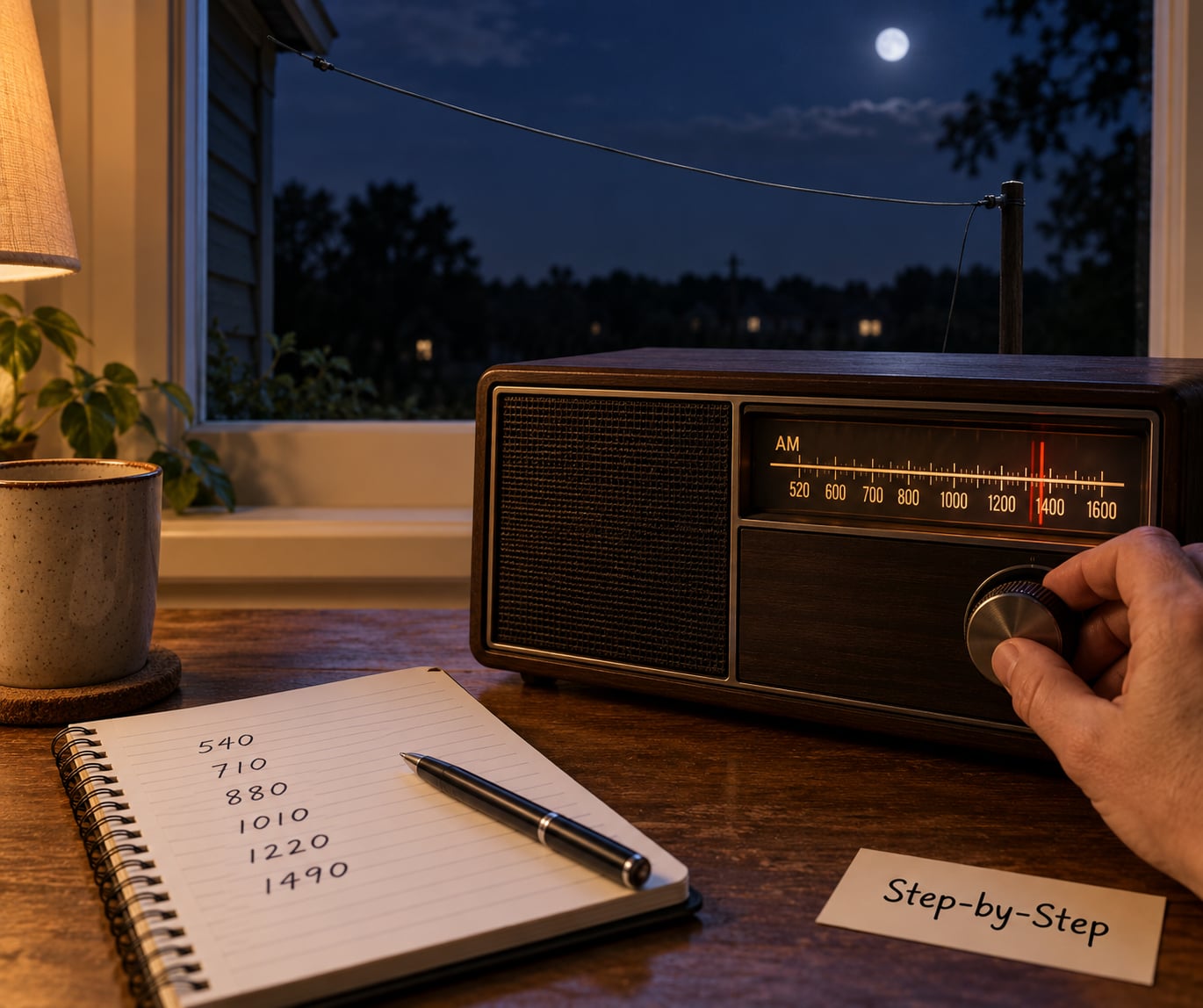
Work through this in order after dark, and give it an hour. Each step builds on the last, and skipping ahead to the tuning is why most people conclude their radio is faulty.
Choose a Radio with Useful AM Reception
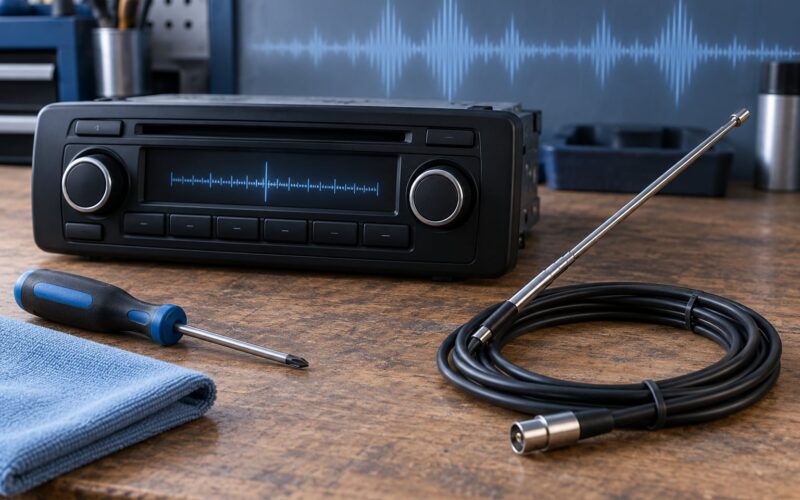
Check three things before anything else. Does the radio cover the AM broadcast band, ideally 530 to 1700 kHz in North America or 531 to 1602 kHz in Europe and the UK? Does it have an external antenna socket, marked something like ANT or EXT, rather than only a built-in ferrite rod? And is the tuning continuous rather than digital with preset buttons?
That last point matters more than most buyers expect. Digital tuners with rotary encoders jump in steps, and a step of 1 kHz means you can never sit on the exact carrier to null out a het, because you cannot tune between the channels. A set with a proper analog tuning capacitor lets you creep across a carrier, which is often the whole difference between a station and a mess.
Look for a 9 kHz IF offset switch, or a wide and narrow bandwidth setting. North American AM channels sit on a 10 kHz grid with carriers offset 4.5 kHz up or down, so two stations on adjacent channels bleed into each other unless the receiver can shift its filter or narrow it. Some sets do this automatically. If yours has a bandwidth or IF offset control, learn where it is before your first night out.
Sensitivity and selectivity are separate qualities and you need both. Sensitivity is how faint a signal the radio can pull out of nothing. Selectivity is how well it refuses the loud station sitting on top of your target. Many inexpensive sets are sensitive with poor selectivity, which means they hear a lot and copy very little. A signal-strength meter helps, because you can watch a distant station rise slowly to full quieting instead of guessing.
RF gain or an attenuator control is worth having too. On a crowded night, backing the gain off keeps a strong local from swamping the front end and lets a weak station alongside it come up. That is the same trick as turning down the volume on a television to hear the quiet part, and it works on AM too.
The old 3-3-3 rule of thumb for receiver performance, from the years when radios were graded by committee, was 3 kHz bandwidth, 3 millivolts sensitivity, 3 units of dynamic range. It is not a shopping standard any more, but the shape of it survives: bandwidth you can narrow, sensitivity you can measure, and enough dynamic range that a strong neighbour does not flatten the band.
Set Up the Antenna
The built-in ferrite rod antenna is a small coil wound on a ferrite stick, often hidden behind the speaker grille. It picks up by far the weakest signals when the whole stick is oriented at 90 degrees to the direction of the transmitting station, so rotate the radio slowly by degrees rather than sliding it across the table. The first station you find while rotating is a good compass reference for everything that follows.
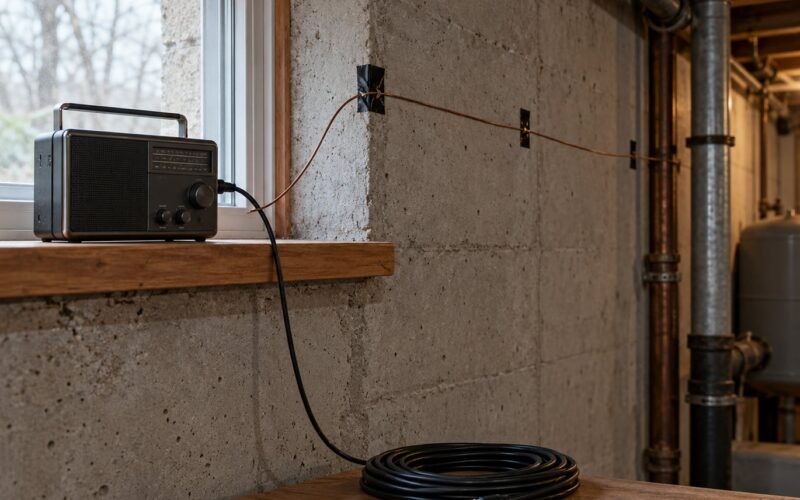
A long wire antenna beats almost everything for medium wave. Run 40 to 100 feet or so of thin wire as high and as far from buildings as you can manage, with a clear run to the antenna terminal or the ground terminal on a set that has both. The gains come from length and height, not from some magic material, and the forum consensus is blunt about that: use the longest wire you have room for.
If you want a wire ground, a length of copper pipe driven into damp soil, or a proper ground rod, does more than a cold water pipe or a length of mains earth. Keep the ground connection short and keep it well away from utility lines. A long run of mains earth back to the socket is a noise antenna, not a ground, and it will feed interference into the set along with everything else.
Now the correction that saves more beginners than anything else. A loop antenna has to be electrically connected to the radio, with both ends of the loop going to the receiver terminals, and it has to be tuned. A loop sitting on a table next to the radio, not connected to anything, picks up almost nothing. Hobbyists on the AudioKarma forum make the point constantly: passive proximity coupling is not an antenna, it is a rumour. The same applies to a long wire that you have run out of the window and left unconnected because you ran out of terminals.
Loops do have real disadvantages, so treat them as a choice rather than an upgrade. They are narrow in bandwidth, which means you retune them when you change frequency. They couple to nearby metal, so a radiator, a window frame or a steel desk can spoil the pattern. And a small loop near a desk lamp picks up the lamp as readily as a station. Buy the loop, plug it in, and turn the radio’s own ferrite rod off if the set allows it.
Outdoors, a counterpoise works if you cannot reach a real ground: a run of wire acting as the return path, laid out below the antenna rather than left dangling. It is not as good as earth, but it is far better than nothing. And whatever you build, the outdoor wire needs its own mechanical support and strain relief so wind does not pull the connection out of the radio.
Scan During the Best Nighttime Conditions
Start an hour after local sunset, and expect the band to keep changing until roughly two hours after that. The first arrivals are the big 50 kW clear-channel stations. Later in the night, as the ionosphere cools, skip distances lengthen and smaller stations appear from further out.
Where you tune inside the band matters as much as when. The bottom and the top behave like different bands, because the wavelength at 1700 kHz is roughly three times the wavelength at 530 kHz. Below about 1000 kHz the groundwave dominates and you catch the strongest nearby stations. Through 1000 to 1400 kHz you get a mix. From about 1400 to 1700 kHz skip dominates, so that is where long-distance catches live, and where sparse, low-power stations show up from a long way off.
Start at the top of the band and work down slowly. Spend real time on 1230, 1240, 1340, 1400, 1450 and 1490 kHz. Those local channels have the widest channel spacing left in the band, and the stations on them are mostly low power, so their receivers have the least strong local carrier to fight. Daytimers, the stations licensed to broadcast only in daylight, switch on at dawn and switch off at dusk, so they appear in those gaps and nowhere else.
Tune slowly, one small step at a time, and listen to the character of the noise. A het is two carriers on the same frequency beating against each other, and it warbles or pulses at a rate you can set your watch by. Music or talk riding on top of that is a real signal underneath, often another station. A steady tone with nothing under it is a carrier with no audio, which in North America usually means a station operating on reduced power, a translator, or someone testing.
Season and latitude shift the window. A listener on the radiodiscussions forum pointed out that in summer it does not get dark until 8pm, and most people are not sitting by an AM radio then. In June at northern latitudes you are chasing a short evening slot that barely exists, and in winter you get a long stretch from early evening through the small hours. Pick the season before you pick the weekend.
The expanded band from 1610 to 1700 kHz is worth the attention too. In the US it carries low-power stations and traveller information services, and those signals travel the same hundreds of miles by night skip. The catch rates are poor, but when one comes in it is usually unambiguous.
Record and Compare the Results
Write six things for every catch: frequency, date and time to the minute, signal strength if the set has a meter, the call letters, the antenna position, and the weather. Add whether the signal held steady or faded, and whether anything electrical was running in the house. Ten minutes of logging after a session is worth more than a month of tuning without notes.
Then confirm the station rather than assuming it. A het from two co-channel stations roughly 25 miles apart can sound remarkably like a single distant station, and the pattern repeats in a way that disguises it. The check is simple: the FCC AM Query facility search lists every licensed AM station with its class, power and city, and radio-locator.com draws day, night and critical-hours coverage maps for that transmitter. Look up the frequency, check which stations share it, and see whose service contour covers you after dark.
You will also hear a call sign. Stations give it at or near the top of the hour, often buried under the news intro, and a mixed-up recording of two call signs heard over a few nights tells you a lot. Reception reports and QSL cards are the formal version of that: write to the station with your frequency, time, location and signal notes, and many will send a verification card back. A QSL card from a station 800 miles away is a piece of paper you earned.
Keep a few real catches in mind as your benchmark. A listener in Kansas City copied WWL 870 from New Orleans on a car radio and still had it half an hour later outdoors. Someone in the San Francisco Bay Area pulled WCBS 880 from New York on an eight-transistor pocket set, and a listener in central Texas worked WWLS 640 from over 300 miles away on a crystal set with no power at all. Another, in the Bay Area reading a single forum post, had a Calgary station at S9 on a truck radio from an estimated 1,300 miles. Your own radio is probably better than you think.
Common Mistakes
The loop antenna is not plugged in. This is the most repeated build error on every hobbyist forum, and the fix is simple: both ends go to the receiver terminals, and you tune the loop for each frequency band you use.
The radio is backed against a wall. Concrete, brick and metal mesh are poor for medium wave. Move it to a wooden surface, near a window, and rotate the whole set in slow degrees rather than nudging it sideways.
You tune through a het too fast. The beat note drops to zero as you cross the exact carriers, and that is your cue to stop. Split the frequency in half, back off by a hertz or two and listen underneath.
You started before local sunset. The transmitter side goes dark before your side does. Tuning at 7pm in midsummer means waiting two hours for nothing.
You logged a het as a station. If the audio warbles at a regular pulse and never settles, or if two stations’ programming overlap and swap places as the beat moves, you have two carriers, not one station. The FCC check settles it in a minute.
Your antenna wire runs near mains cabling. Parallel runs act as a transformer and put noise into the set. Route the antenna away from power lines, phone lines, roof aerial cables and the smart meter box.
Tips for More Reliable Reception
Try different times before you blame the equipment. A station that fades by 2am may be rock solid at 10pm, and the reverse happens just as often. The band changes through the night, so the log becomes a map of when each frequency works for you.
Kill household noise first, because modern homes are the main reason indoor AM reception is bad. LED bulbs, dimmer switches, LED nightlights, cheap USB chargers, plasma televisions and smart meters all radiate noise. Switch off the lights in the room, unplug the charger, and listen again. The difference is often immediate, and it costs nothing.
Move the radio to a different room. A bedroom often beats a living room, and a kitchen beats both, because the metal and the electronics differ. This is the zero-cost fix that most people never try.
Use the car radio, seriously. A modern set in a dashboard is often more sensitive than a home receiver, and the roof or window antenna has a clear view. Park somewhere open and away from overhead cables. Keep in mind the digital tuners in newer cars step in fixed increments, so an older vehicle with analog tuning is more useful for fine work.
Check the local channel schedule and the daytimers. Knowing which stations in your region are daylight-only, and which are on a reduced night power pattern, explains most of the fading that looks like a hardware fault.
And keep the baseline log. Without it you cannot tell whether tonight was better than last month, and improvement on the AM band is almost always invisible week to week.
Frequently Asked Questions
Why does AM radio seem to stop working at night?
It does not stop, it changes. After local sunset the ionosphere’s lowest layer thins out and stops absorbing medium-wave signals, so your local station’s groundwave coverage collapses while distant skywave signals appear on the same dial. The band is busier after dark, not worse. Everything arriving with a long station ID at 2am is evidence the band opened, not that something broke.
How far can an AM station be heard at night?
By power class, roughly: a 50 kW clear-channel station is routinely logged 500 to 1500 or more miles after dark, 5 kW regional stations often 200 to 600 miles, and 1 kW or local stations 50 to 250 miles, with transatlantic and trans-Pacific catches exceptional. Terrain, season, solar activity and your antenna move those numbers a long way, so treat them as ranges rather than promises.
What is the best antenna for picking up distant AM stations?
A long wire antenna, as high and as far from buildings as you can safely manage, beats everything else on medium wave. A ferrite rod is the weakest option. A loop antenna is the best indoor choice, but it must be electrically connected to the radio and tuned, not just placed nearby. Whichever you use, an earth ground through copper pipe or a ground rod, kept away from utility lines, adds real gain.
How do I know if I am hearing a real distant station or interference?
Listen for the beat. Two stations on the same frequency produce a warbling or pulsing tone that crosses zero as you tune, with a second programme underneath once you sit on it. A distant station holds one call sign and steady audio. Confirm it by looking the frequency up in the FCC AM Query facility search, or your national regulator’s database, and checking coverage on radio-locator.com.
What time of night is best for picking up distant AM stations?
Start an hour after your local sunset, because the far side of the path goes dark first. Big clear-channel stations arrive first, then the band keeps changing for another two hours or so. In summer at northern latitudes it is not properly dark until late evening, so the window is short. In winter you get a long run from early evening through the small hours, which is when daytimers also switch on at dawn and off at dusk.
Are AM radios being phased out?
AM broadcasting is shrinking in the US and several European markets, with stations moving to FM and many going dark, but the band is not being switched off. The practical limiter for listeners is digital sideband audio, which adds noise to adjacent channels and makes weak distant signals harder to pull out. That is a technical ceiling rather than a switch-off, and night skip conditions still deliver long-distance stations every week.
Start With the Free Fix Tonight
Move the radio to a window, turn off every light and charger in the room, then start tuning an hour after local sunset and work down from 1700 kHz. Log what you hear, and only think about wire or a better receiver once you know what your current setup already pulls in.