Short answer: radio helps because it hands you hours of free, unscripted native-speaker audio every day, which is the one thing a textbook chapter cannot do. Listeners get natural speech speed, real accents, vocabulary in context and a reason to keep going, as long as the material stays close enough to your level to stay comprehensible.
There is a catch worth stating early, because the forums are full of people arguing about it. Radio on its own will not take you from nothing to conversational. What it will do is supply the hours of input that make the rest of your learning work: the ear gets used to real speed, the mouth picks up rhythm, and phrases you have heard three times turn up in a shop, a meeting or a phone call.
Most coursebooks give you five to ten hours of recorded material a week, and then it is finished. A station is on all day, costs nothing, and never asks you to book anything. That makes it the easiest source of daily listening practice most learners will ever find, whether you are tuning in from Yorkshire, learning French from Yorkshire, or studying a language with very little written material online.
Table of Contents
- How Radio Helps Language Learners Build Real-World Skills
- What Kind of Radio Is Best for Language Learners?
- How to Choose a Station That Matches Your Level
- A Practical Radio Listening Routine
- How to Turn Radio into Vocabulary Practice
- Common Problems and How to Fix Them
- Frequently Asked Questions
- What radio station is best for learning a language?
- Do language learners benefit from listening to native accents?
- Should I use radio transcripts while practicing a language?
- Can I improve my vocabulary by listening to music?
- How long should I listen to the radio each day to learn a language?
- Is background listening enough to improve language skills?
- Conclusion
How Radio Helps Language Learners Build Real-World Skills
Radio is useful because nobody wrote it for you. A presenter is not pausing to explain an idiom, a newsreader is not slowing down for beginners, and two people on a phone-in show will interrupt each other. That small amount of messiness is exactly what you need, because it is what the people you will actually talk to sound like.
Here is what you get when you listen regularly.
- Authentic accents. One station teaches one accent. Two or three stations teach you the range, which matters if you will travel or deal with people who did not grow up near a capital city.
- Natural speech rate. Native speakers link words together and drop short ones. Books hide this. Radio does not, so your decoding speed catches up faster than it does from printed dialogue.
- Repeated exposure. The same presenter, the same stock phrase about the weather, the same sign-off every evening. Repetition is how vocabulary sticks.
- Vocabulary in context. You meet words attached to a topic and a mood, not in an alphabetical list. Idioms and phrasal verbs turn up constantly in speech, which is where textbooks are thinnest.
- Culture and current affairs. Local references, jokes, references to songs and news stories. This is the background knowledge that makes conversation possible later.
- Low friction. No login, no subscription, no scheduling. It plays while you cook, walk or drive.
- Motivation. A show you actually like is worth more than a textbook exercise you tolerate.
The catch: radio trains your ear, not your mouth or your writing. It gives you no correction and nobody to ask when a sentence does not make sense. Pair it with speaking practice and a dictionary and it becomes a strong tool. On its own, treat it as the daily half of your learning rather than the whole of it.
Which Parts of Language Learning Does Radio Support?
Strongly supported: listening comprehension, pronunciation and rhythm, vocabulary recall, accent awareness, and the habit of spending time in the target language without a lesson in front of you.
Supported but limited: speaking, because you rehearse silently rather than aloud, and grammar, because you hear structures repeatedly but rarely see them explained.
Not supported at all: writing accuracy, exam-specific phrasing, and anything requiring feedback. If you need correction, radio will not give it to you.
What Kind of Radio Is Best for Language Learners?
Different formats train different things. The table below covers the main ones, how hard they are, and what each is actually good for.
| Format | Difficulty | What it trains | Best use |
|---|---|---|---|
| Learner-supported shows | A2 to B1 | Core vocabulary, slow clear delivery, confidence | Starting point and daily warm-up |
| Radio drama and audio fiction | A2 to B2 | Listening for plot and emotion, long stretches of tolerating gaps | The best on-ramp below B1 |
| Music | A1 upward | Pronunciation, vocabulary recall, idiom | Side practice, not a substitute for speech |
| Talk radio and phone-ins | B1 to C1 | Natural speed, hesitation, accents, idiom | Intermediate learners with a transcript on hand |
| News and current affairs | B2 to C2 | Formal vocabulary, accents, subject terms | Stretch material once the base is solid |
| Business and finance bulletins | B2 to C2 | Numbers, jargon, formal register | Specific workplace needs |
One point on music, because it comes up constantly. Learners often notice that they understand a song but not a talk show using the same words. That is not a strange talent. A song is repetitive, slowed and stretched by melody, and you have heard it before you sit down to study it. Speech is none of those things. Music is useful for pronunciation and recall; it just makes listening look easier than it is.
How to Choose a Station That Matches Your Level
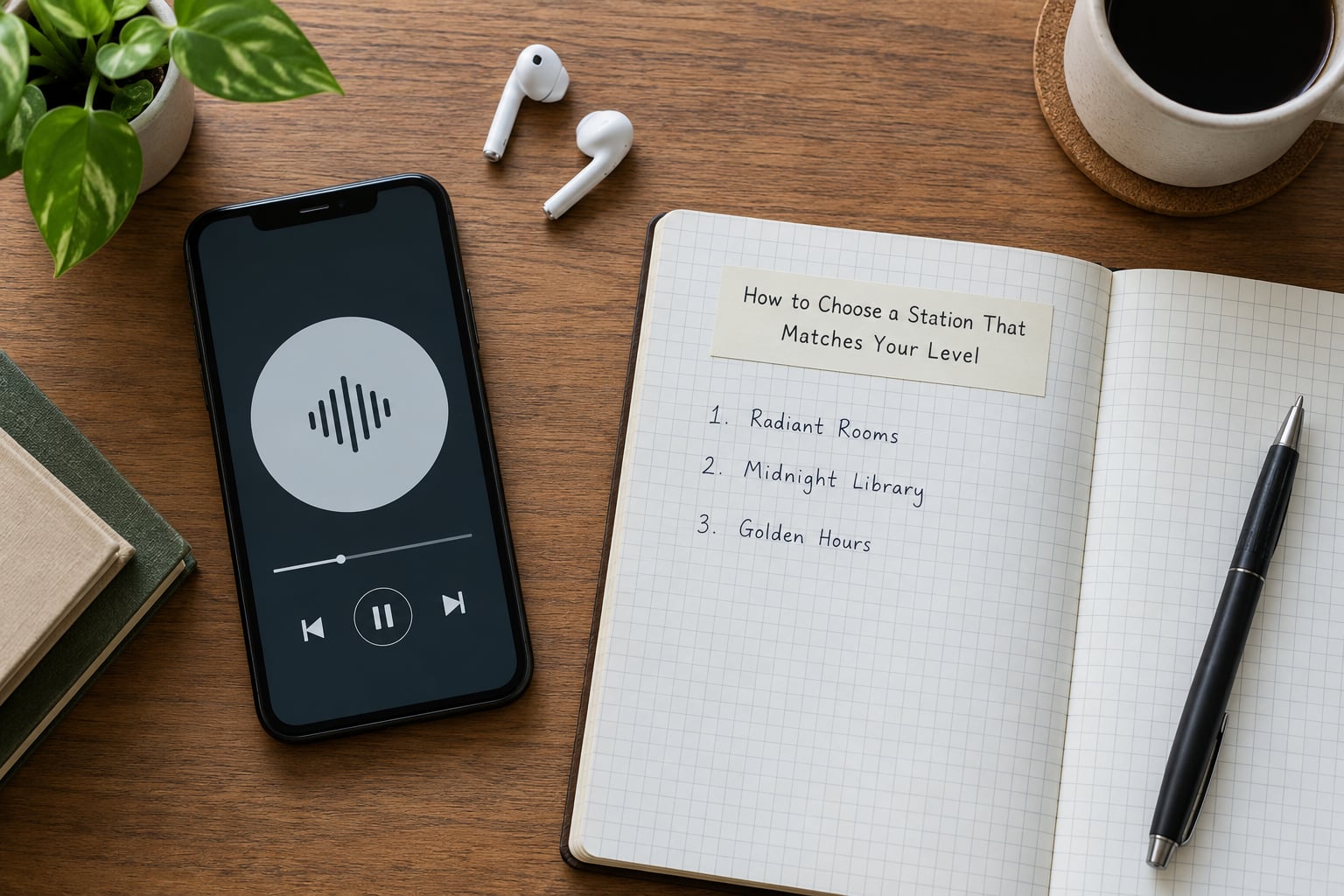
Do not trust a level label on a website. Test it yourself with a three-pass check on the first five minutes of any show.
Pass one, gist. Listen once with no notes. Can you say what the segment was about in one sentence? If you cannot, the material is too dense and you need to move down a level, not try harder.
Pass two, detail. Listen again and try to catch individual sentences. Catch maybe half and it is roughly right for your current stage.
Pass three, stretch. Listen a third time with a transcript. If you now understand most of it, the show sits just above your level, which is where you want to spend your time.
If pass one leaves you blank every time, work down. If pass three feels easy and you finish a whole show without the transcript, work up. Changing stations is not cheating and it is not giving up; a show you cannot follow teaches you far less than one you nearly follow.
Keep a mix. One comfortable show, one slightly harder show, and one you listen to purely for pleasure even if you follow none of it. Over a few weeks, move the harder one up as the comfortable one stops being comfortable.
A Practical Radio Listening Routine
Twenty minutes with the same method beats two hours of switching channels. Here is the routine, and the order matters more than the length.
1. Predict before you press play. Glance at the show title, the time slot and the date. Weather segments promise numbers, interviews promise opinions. Ten seconds of prediction makes the first minute far less foggy.
2. Listen for gist without stopping. No pausing, no notes, no dictionary. Unfamiliar words are expected. Treat them like a noise in the room and let the sentence continue.
3. Listen again and take short notes. Jot a few words, not sentences. Four or five key words per segment is plenty.
4. Check a transcript if one exists. Compare your notes against the written version and mark what you actually missed. This is where the learning happens, because it turns a vague feeling into a specific problem.
5. Revisit tomorrow. Same show, same episode. The second and third passes are where speed improves, and they take ten minutes rather than twenty.
Listening for Meaning Instead of Every Word
Stopping the audio for every unknown word is the most common way learners turn listening practice into a frustrating guessing game. Instead, run three passes with different goals: gist first for the overall picture, then detail for the parts that matter, then close listening for anything you genuinely need to use.
Most of what you miss on the first pass is not vocabulary at all. It is speed, reductions and accent. You will hear the same sentence ten times and catch it on the ninth, which is normal and not a sign you are bad at this.
How to Use Radio Transcripts and Repeat Playback
Transcripts are for checking, not for reading along. Read one first and you will build a reading habit with an audio habit attached, which feels productive and teaches almost nothing.
Use them in this order: listen twice, open the transcript, highlight the lines you missed, then play those lines again while speaking along. That last step is shadowing, and it is where pronunciation and rhythm improve fastest because you copy the timing rather than guessing it.
Real transcripts are rare outside English and learner shows, which is a genuine limitation. When none exists, write your own rough version from memory after three listens, then correct it against the audio.
How to Turn Radio into Vocabulary Practice
Collect phrases, not words. Make sense of it teaches more than sense, and run out of more than out, because the chunk carries its own grammar with it.
Give every entry three things: the phrase, one line of where you heard it, and the sense you want. Ten minutes of this once a week will build a useful bank faster than a dictionary app used daily, because you only save what you actually met.
Then sort them. Group by function rather than topic: ways to disagree, ways to be vague, ways to end a call. Function groups are far easier to recall mid-conversation than a random list of nouns, because you reach for them by what you want to say.
Review on a spacing schedule rather than cramming. A phrase you collected on Monday gets looked at again two days later, then a week later. Each successful recall takes a second and locks the chunk in; each failed recall takes ten and gets added to the next session.
Common Problems and How to Fix Them
Everything is too fast. Move down a level before you assume your ear is broken. Learner-supported shows and radio drama are the usual fix, and once those feel easy, move back up.
You stop listening after two weeks. The content is probably too hard, or too dull. Pick something you would happily watch but cannot yet follow, and accept a low comprehension rate for a few weeks. Enjoyment is what carries a daily habit.
The audio is muddy. Bad streaming and poor speakers cause more lost hours than learners realise. Fix the signal before blaming your ability: use a decent app, wired earphones or a small speaker, and avoid low-bitrate streams.
You are only listening passively. Background listening works best as warm-up, not as the main session. Twenty focused minutes beat two hours of radio as atmosphere.
Dialect anxiety. Start with one regional accent and get comfortable, then add a second. Hearing three unfamiliar accents at once trains nothing well.
You have no time. Commute time counts. Most learners who stick with this long term use the walk, the drive or the kitchen, not a dedicated study block.
How Radio Helps Language Learners Who Understand Almost Nothing
When comprehension sits near zero, the instinct is to conclude the whole idea is a waste of time. It is not, but the material has to change. Start with audio drama or a story you already know the plot of, because narrative gives you something to hold on to when the words slip away.
This is what worked for one upper-intermediate French learner describing a Tintin story adaptation: the same rough percentage of words understood as her news listening, but engaging enough to replay three times because each part ended at a natural stopping point. Add short breaks, characters and a known plot, and a beginner or A2 learner gets comprehension they can actually feel.
Then step up to learner-produced radio, where hosts slow down and repeat themselves. Move to unscripted talk radio only when the drama has stopped feeling useful.
Frequently Asked Questions
What radio station is best for learning a language?
The best station is the one just above your current level, and that differs from person to person. Test any show in five minutes: listen once for the gist, again for detail, and a third time with a transcript. If the first pass leaves you blank, move down a level. For a starting point in English, learner-supported shows from BBC Learning English and Voice of America Learning English sit lower than unscripted talk radio.
Do language learners benefit from listening to native accents?
Yes, and hearing more than one is better than hearing only one. Native speech is where reductions, rhythm and intonation live, and no textbook reproduces them properly. Start with a single accent until it feels familiar, then add a second so the sounds stop feeling like separate systems. Learners who travel or work internationally get the most from this, but even at home the ear is being calibrated.
Should I use radio transcripts while practicing a language?
Use them after listening twice, not before. Reading along while the audio plays trains reading and lets you feel fluent without improving your ear. The productive order is: gist listen, detail listen, open the transcript and mark what you missed, then play those lines again while speaking along. Outside English, real transcripts are scarce, so write your own version from memory and correct it against the audio.
Can I improve my vocabulary by listening to music?
Music helps, but not in the way most learners expect. Melodies slow words down, repeat them and let you hear them before you study them, which is why a song can feel easier than a talk show using the same vocabulary. That is a memory effect rather than a comprehension one. Use music for pronunciation, recall and enjoyment, then keep speech practice separate.
How long should I listen to the radio each day to learn a language?
Twenty focused minutes daily is a realistic minimum, and it beats an hour of background noise. Most progress comes from repeating the same show rather than from volume, so keeping a short routine matters more than long sessions. Many learners attach it to an existing habit such as a commute or cooking. Give it three months before judging, and test progress by replaying an episode from month one.
Is background listening enough to improve language skills?
Not on its own. Background listening works as warm-up and exposure, and it does help your ear get used to the sound of the language while you do something else. But comprehension, vocabulary and accent need attention, and that means stopping, replaying and taking notes. Treat background radio as a bonus on top of a short focused session rather than as a replacement for one.
Conclusion
Pick one station slightly above your current level and run the twenty-minute routine three times a week for a month. Replay the same episodes rather than hunting for new ones, log a handful of phrases each time, and judge it by whether an episode from month one suddenly sounds easier.
That is what makes how radio helps language learners a daily habit rather than a nice idea: free audio, no scheduling, and repetition that slowly makes the language feel less foreign.