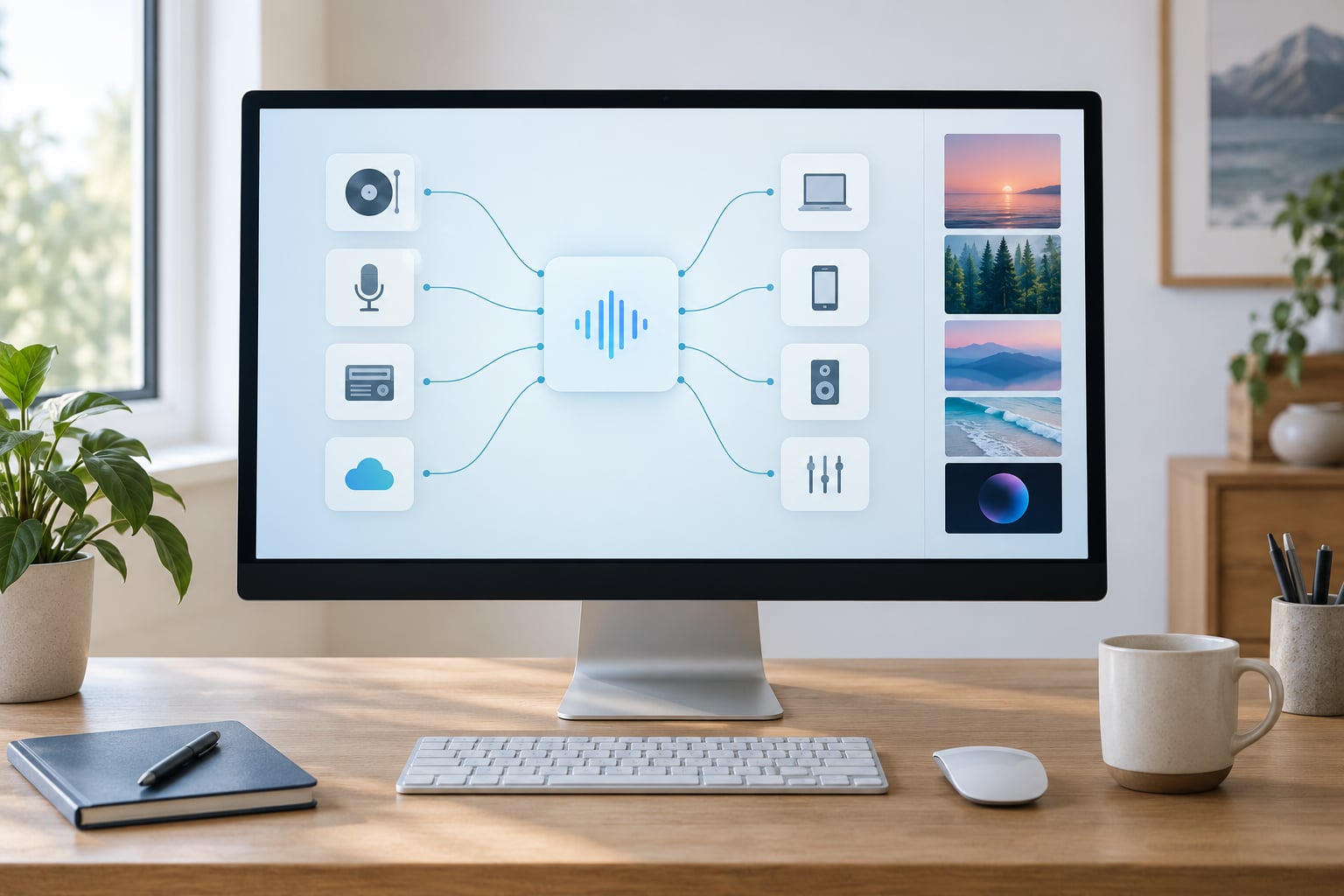
Radio aggregator apps do not simply grab whatever stream URLs they can find. They collect audio from broadcasters under individual written distribution agreements that define which platforms, countries and devices may carry the signal, plus the rules on advertising and listener data. How radio aggregator apps license streams comes down to that paperwork, and a public stream URL on its own grants nothing.
That is the part most listeners never see. From the outside, a radio directory app looks like a long list of presets. Underneath it sits a stack of contracts, each one answering the same handful of questions: who owns the audio, who may retransmit it, where, and for how long. Get one of those answers wrong and the station either disappears from the app in your country or gets pulled altogether.
This guide walks through the whole chain. It is written for three groups: station owners weighing which directory to sign with, developers building a radio aggregator app who need to understand their own obligations, and listeners trying to work out why a favourite station is missing where they are. Updated for 2026.
Table of Contents
- Key takeaways
- How Radio Aggregator Apps License Streams
- What Rights Does a Radio Station License?
- Who Negotiates the License?
- What Does a Stream-License Agreement Cover?
- How Music and Syndicated Programming Affect Licensing
- How Apps Comply With Territory and Platform Restrictions
- How Royalties, Revenue, and Reporting Work
- How Aggregators Prevent Unauthorized Stream Redistribution
- How to Check That a Station’s Stream Is Properly Licensed
- Frequently Asked Questions
- Can a radio aggregator add a station just because its stream URL is public?
- Do internet-radio royalties automatically let an app rebroadcast every station?
- Does a licence for a mobile app cover a website or smart speaker?
- Why do licensed radio streams still show geo-restrictions or unavailable messages?
- Which radio station rights holders usually need to approve redistribution?
- How can a developer verify that a stream licence is genuine?
- Conclusion: Start with the Rights Chain
Key takeaways
- Technical access and legal permission are separate. Being able to fetch a stream does not entitle anyone to rebroadcast it.
- Each station is licensed individually. An aggregator holds a signed agreement per outlet, not one blanket deal with “the internet”.
- Territory is written into the contract. A stream licensed for the UK can be correctly blocked in Australia.
- Music rights sit in a separate layer. Station affiliation does not clear the underlying recordings or compositions.
- Hiding a URL is not a licence. Tokenised endpoints and allowlists reduce theft; they do not create permission.
One more thing worth setting straight early: aggregator apps and station-owned apps are different products with different legal footprints. A directory relays somebody else’s stream under that broadcaster’s permission. A station app carries only one station’s audio and has a much simpler rights position. Most of the confusion in this area comes from mixing the two.
How Radio Aggregator Apps License Streams
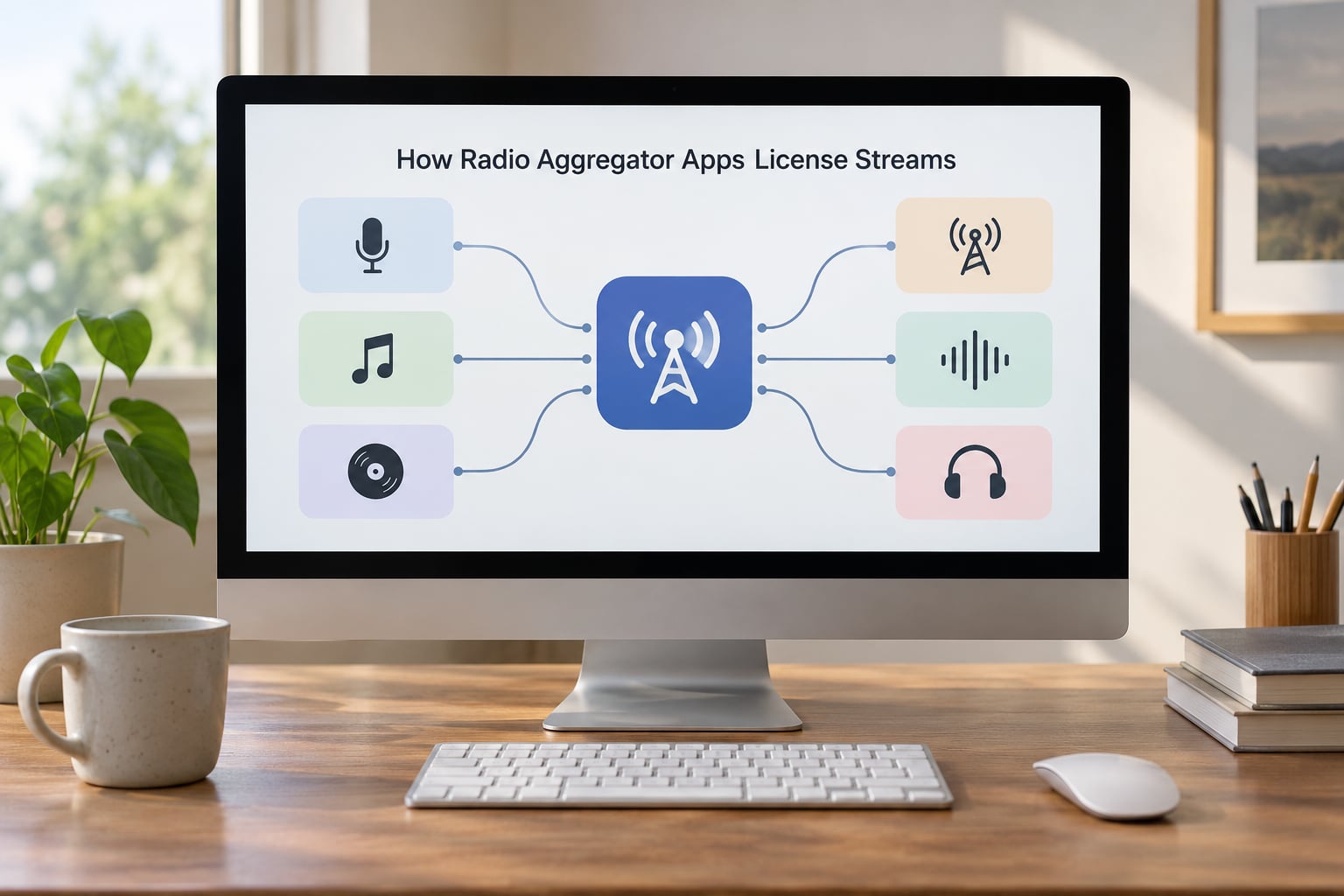
Aggregators obtain written rights to redistribute or embed a station’s audio, limited by territory, platform, format, advertising rules and time. A stream URL on its own grants no redistribution rights at all, which is why a station that has never signed a distribution agreement cannot simply be added to an app.
That 50-word answer is the contract in miniature. Notice how much of it is restrictive rather than permissive. The aggregator is not buying the station’s signal in general; it is buying a narrow set of permissions, and the broadcaster keeps everything else.
In practice the permission chain runs in one direction. The broadcaster signs with a rights representative or handles the deal directly. The aggregator then requests an approved stream endpoint, tests playback, and lists the station against the specific territories named in the agreement. When a licence expires or a territory is not covered, the app is obliged to stop serving the stream there.
Community forums fill up with confused listeners long before anyone reads a contract. The recurring question on radio discussion boards is simply “why did my station vanish from the app”, and the answer is almost always territorial or contractual rather than technical.
What Rights Does a Radio Station License?
A station usually licenses a bundle of specific rights rather than “the stream”. Knowing which ones are in the bundle tells you exactly what the aggregator is allowed to do.
The core rights look like this:
Public transmission. Permission to send the live audio out to the public over the aggregator’s own delivery infrastructure. Without this, the aggregator may not relay the station at all.
Rebroadcast. Permission to carry the audio simultaneously with the terrestrial or satellite feed, typically with the aggregator inserting its own commercial breaks. Some broadcasters grant simultaneous play without ad insertion.
On-demand access. Permission to record programmes and make them available later. This is a separate right and radio-style agreements almost never include it, which is why radio directories are not podcast libraries.
Embedding. Permission to place the live player on a third-party page, as a widget or an embedded frame. This is narrower than public transmission and often priced separately.
Artwork and metadata. Permission to display logos, station images, genres, descriptions and now-playing information. Aggregators routinely need a written branding licence because logos are trademarked assets, not just pictures.
Listener data. Permission to collect play counts, unique listeners, geography and device data, and usually agreement on who may see it. Stations that sell their own advertising rarely want their audience numbers visible to a competitor.
Three boundaries sit underneath all of these. Owned programming is usually straightforward to license. Syndicated shows frequently carry separate distribution terms, and a station with an exclusive syndication deal may be barred from carrying that show on any third-party platform.
Music is the third boundary, and it is where most of the complexity lives. We look at that layer next.
Who Negotiates the License?
Five kinds of party can sit on either side of a stream licensing negotiation, and knowing which one you are dealing with tells you how long the conversation takes.
Broadcasters and station owners sign for their own audio. If a station is owned by a small local trust or an individual operator, that person negotiates directly and can often decide terms in a single email.
Rights representatives act on a station’s behalf for national and international distribution. Several UK and Irish station groups are represented by a single organisation, which means one approval covers a large portfolio rather than one outlet.
Performance rights organisations such as ASCAP, BMI, SESAC and GMR in the United States, or PRS for Music in the UK, license the public performance of music. They do not license the station’s stream, and they are not parties to the aggregator agreement.
Labels and publishers matter when a deal is direct rather than compulsory. A broadcaster playing music under a blanket licence usually needs no label permission, but syndication deals and content-licensing agreements often do.
Aggregators negotiate on the distribution side. A large directory can put commercial terms across a whole portfolio in one master agreement with per-station annexes, then let individual stations sign up under it.
Here is the part that trips people up. An aggregator may sign a master distribution agreement covering hundreds of stations, but that agreement only binds the stations whose owners signed it. Where the scope is exclusive, a broadcaster that has signed with one aggregator may need permission from that aggregator before appearing in a competitor’s directory.
The same logic applies in reverse. A broadcaster with an exclusive representation deal with one partner cannot list elsewhere until that partner releases it, which is why some stations appear on one platform and not another for no visible technical reason.
What Does a Stream-License Agreement Cover?
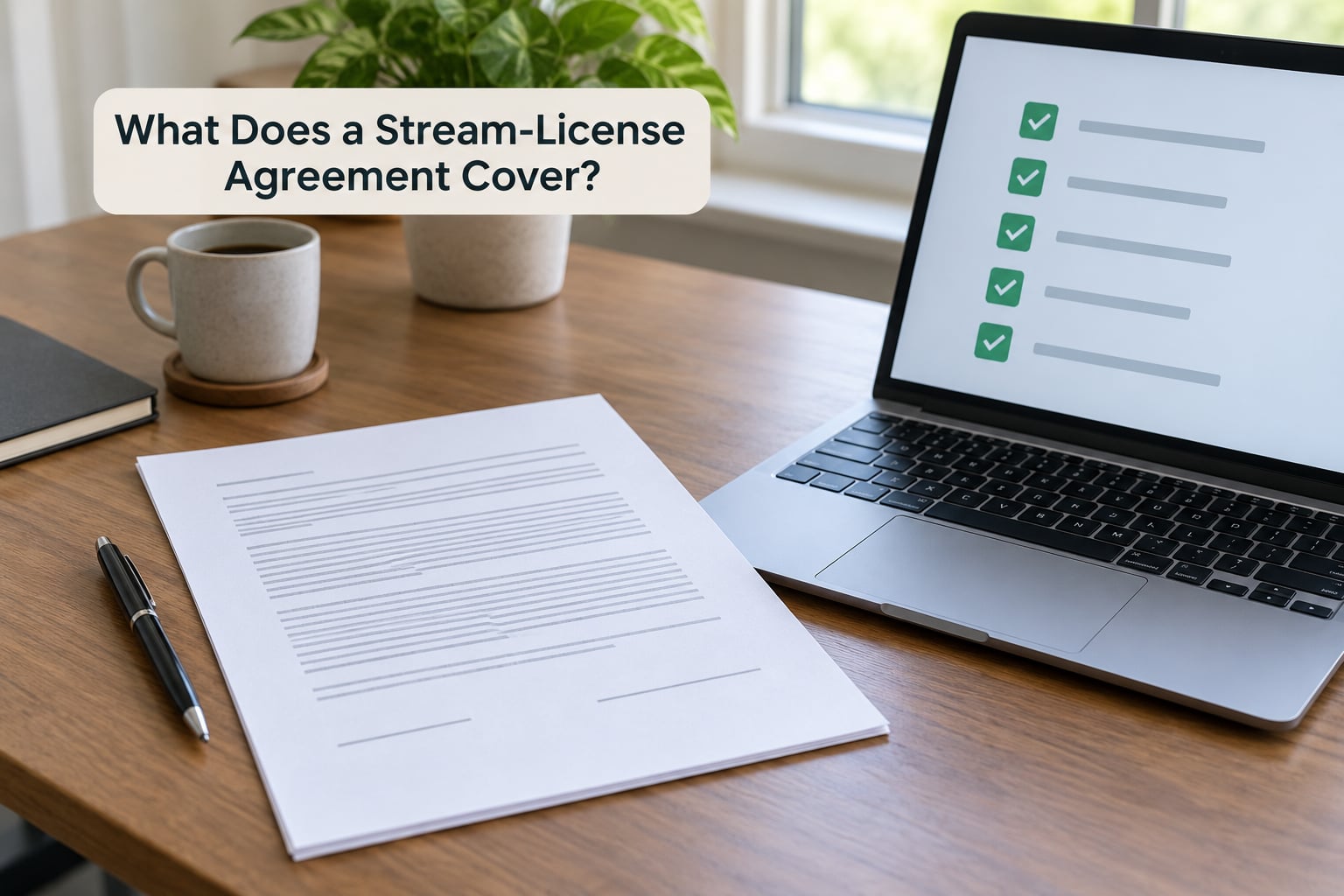
A stream licence is a short document with a long list of attachments, and every clause answers a question an aggregator’s engineers or lawyers will otherwise have to guess at.
The clauses you should expect to see:
- Authorised stream URLs. The exact endpoints the aggregator may use, with any replacement process spelled out for when the station changes encoder.
- Permitted apps and websites. Which platforms count as covered. A licence naming an iOS app does not automatically cover Android, a web player, a smart speaker skill or an in-car app.
- Countries and territories. A list, or an explicit “worldwide”, plus any exclusions where music rights or broadcast rules differ.
- Concurrent users and bandwidth. Caps on simultaneous listeners, or a defined CDN allowance with a charge above it.
- Caching and recording. Whether the aggregator may store segments locally, and whether it may retain audio beyond live playback.
- Advertising rules. Who may sell against the stream, whether the broadcaster’s own commercials are preserved, and any minimum advertising commitment.
- Data collection. Which listener data may be gathered, how long it is kept, and whether it may be shared with advertisers or used to build profiles.
- Attribution and branding. How the station must be named and displayed, and rules on logo use.
- Exclusivity. Whether the station may appear in competing directories, and whether the restriction is by platform, territory or both.
- Term, renewal and termination. How long the deal runs, what notice period applies, and what happens to cached files and playlists if either side exits.
- Audit and reporting rights. What records the aggregator must keep, for how long, and what the broadcaster can ask to see.
- Warranties and indemnity. Each side states what it controls, and who carries the cost if a third party makes a claim.
The most-negotiated clause in practice is territory. It is the one that produces the most listener complaints and the fewest station complaints, because the station believes its rights are “worldwide” until an aggregator checks the music position country by country.
How Radio Aggregator Apps License Streams in Practice
The acquisition path runs through six steps, and the paperwork from each one should end up in a single file per station.
- Outlet submission. The broadcaster applies through the aggregator’s onboarding form, supplying the stream URL, bitrates, codecs, artwork, genre, language and a technical contact.
- Rights verification. The aggregator checks whether the applicant actually owns or represents the audio, and whether the claimed territories match the music licences the station holds.
- Term negotiation. Platforms, territories, advertising treatment, data access, exclusivity and revenue share are agreed, usually under a master agreement with a station-specific annex.
- Integration. Approved endpoints are added to the catalogue, the player is tested for stability, and now-playing metadata is confirmed to arrive correctly.
- Compliance check. Any geo-restrictions are configured against the licensed territory list before the station goes live, not after listeners report failures.
- Documentation. The signed agreement, the metadata confirmation, the test timestamps and the territory configuration are filed together.
What evidence should that file contain? The executed agreement, the licence or registration that shows the station’s own music rights, the written confirmation from any rights representative, the approved endpoint list, and a dated playback test from each permitted territory.
Forum traffic is a decent early-warning system here. Community broadcasters describe stations that go live on their own site and then fail silently in an app when the stream endpoint changes, typically around a licence renewal. Agreed endpoint-change notice periods prevent most of that.
How Music and Syndicated Programming Affect Licensing
Being a licensed broadcaster does not mean every work in your schedule is clear everywhere. Station affiliation covers the broadcaster’s own arrangements; it does not automatically extend to third-party content carried on that station.
Music splits into two distinct rights. The composition right covers the song itself and is administered by a performance rights organisation. The sound recording right covers the specific master recording and in the United States is collected by SoundExchange on behalf of recording artists, with rates set by the Copyright Royalty Board.
In the UK the equivalent bodies are PRS for Music for compositions and PPL for the broadcast of sound recordings, with MCRO handling the making of records and tapes of broadcasts. Online-only stations in the UK can fall under a statutory scheme administered through the registered online-only body, with Ofcom as the regulator. A broadcaster’s licence covering the UK does not travel to the United States, and an app serving both markets needs both positions covered.
Aggregators inherit this complexity rather than removing it. Most directories require the broadcaster to warrant that its music rights cover the territories the aggregator will serve, and many will ask for proof before approving a new country.
Syndicated programming is a separate risk. Shows carried under a syndication deal often carry distribution restrictions, and sports calls or rights-holder-supervised programming can be tightly limited. Where a broadcaster knows a programme is exclusive to another outlet, the agreement should say so explicitly rather than leaving the aggregator to infer it from metadata.
The practical test is simple. For every significant block of programming, ask which contract makes it legal in the country you want to serve. If there is no answer, that territory stays off the list.
How Apps Comply With Territory and Platform Restrictions
Geo-blocking on a licensed stream is a compliance feature. The app is doing exactly what the agreement requires when it refuses to serve a listener outside the licensed territory.
Enforcement is layered. Aggregators resolve listener location at the network level, apply allowlists and deny lists per station, and combine that with device-level signals. Where a station is restricted, the app typically shows the station as unavailable rather than removing it entirely, so the listing stays discoverable in the stations that do have rights.
Some of the most common breakages happen on the edges. VPN traffic can present a UK IP address to a service that would otherwise see an Australian one. Connected cars are a frequent source of surprise, because an in-car app often resolves location through the vehicle rather than the phone. Smart speakers sit in between: many voice platforms maintain their own catalogues and require a separate integration agreement rather than inheriting the mobile app’s terms.
App store distribution adds another layer. Both Apple and Google require a different privacy declaration, and a directory app that collects listener identifiers needs a policy that matches what the licence permits. A licence that forbids data sharing for advertising does not survive contact with an app whose business model is advertising.
Platform terms usually also prohibit recording or redistributing the stream, which is why most free directory apps offer live playback only. A listener asking whether they can record a station for offline listening is usually asking something their station’s own terms already answer.
How Royalties, Revenue, and Reporting Work
Money in this market moves in three directions, and mixing them up is the source of most bad assumptions about how much a station earns from an app.
First, the broadcaster pays music royalties through its own licences. Second, the broadcaster and aggregator split advertising and sponsorship revenue generated by the stream. Third, the aggregator may charge for delivery infrastructure beyond a defined bandwidth allowance, or take a share of subscription revenue where a paid tier exists.
Common commercial models:
- Revenue share on advertising. The aggregator inserts or sells ads and pays the broadcaster a percentage of net revenue.
- Fixed monthly fee. A flat payment per station regardless of listening, popular with stations that want predictable income.
- Minimum advertising commitment. The broadcaster guarantees a number of ad breaks per hour or a minimum revenue figure, with the aggregator making up shortfalls.
- Subscription share. Where the app has a paid tier, a proportion of subscription revenue is split across stations based on listening share.
- Free listing. Some directories carry stations at no charge in exchange for catalogue position or exclusivity.
Reporting runs alongside the money. Broadcaster-side obligations typically include logging play counts, unique listeners and the music metadata played, then reporting that to the relevant rights bodies on their schedule. Aggregators holding their own blanket licence for the audio they relay will report their own listening figures instead.
That last point is worth stating plainly, because it is the most searched question in this area and the least clearly answered anywhere online. Whether a directory app needs its own music licence depends on how it is characterised. A pure relay of a licensed broadcaster’s signal, carrying that broadcaster’s ads and metadata, is generally treated as a distribution service rather than a performer. An app that substitutes its own audio, inserts its own content, or offers recordings for later access is much more likely to need its own blanket licence.
Whichever side reports, the records have to survive an audit. Stations are commonly asked to produce listener logs and metadata logs on request, and an aggregator that cannot reconstruct what it served and where is exposed on both the royalty and contract side.
How Aggregators Prevent Unauthorized Stream Redistribution
Every stream an aggregator carries is technically copyable, so the practical goal is to make theft inconvenient and detectable rather than impossible.
Common controls include tokenised URLs that expire, HTTPS delivery, referrer restrictions, domain allowlists on the source feed, source authentication such as FTPS or IP-locked ingest, and access controls on admin endpoints. On top of that sit watermarking, continuous monitoring for stream-ripping sites, formal takedown requests, and prompt removal of feeds whose licence has expired.
Two of these are frequently mistaken for the rest. A URL buried inside an app binary can be extracted in minutes by anyone patient. And a token that expires every few hours stops sharing; it does not stop redistribution by a party who is scraping in real time. Both reduce casual copying. Neither creates a licence.
When a takedown does go out, US takedown notices run under the DMCA process, while European platforms tend to work under the Copyright and Related Rights Information Database, known as IPRED. Broadcasters can also issue takedowns directly to the aggregator if the station has withdrawn consent, which is usually faster than going through a formal notice process.
The obligation to remove an expired feed is contractual and it matters more than it sounds. An aggregator that keeps serving a station after the licence lapsed is redistributing without permission, and that exposure sits with the platform.
How to Check That a Station’s Stream Is Properly Licensed
You can check a good deal of this yourself, whether you are a listener, a partner or a developer signing your first distribution deal.
What listeners can look for:
- Does the station’s own website name the platform and confirm its presence there?
- Does the app show a station in every country, or only some? Consistent gaps usually mean territory, not a fault.
- Is the stream marked as unavailable rather than broken when restricted?
- Does the app state whether recording is permitted? Most do not.
What developers and partners should request before listing any station:
- The executed distribution or stream licensing agreement naming the specific platforms.
- Proof of the station’s own broadcast licence, and confirmation that it covers each territory requested.
- Written confirmation from any rights representative where the station is not self-representing.
- The approved stream endpoint list and a replacement process for endpoint changes.
- A named contact who can authorise takedown requests, with a response window.
- The artwork and metadata usage permission, including trademark usage rules.
A concrete example: a station in Leeds wants to appear in a US directory. The station’s licence covers UK terrestrial and online broadcast. The music position for the United States is unconfirmed, and one syndicated weekend show carries a distribution restriction. The correct outcome is a listing limited to the UK with the restricted show flagged, not a global launch with a support ticket waiting for the first complaint.
Frequently Asked Questions
Can a radio aggregator add a station just because its stream URL is public?
No. A reachable stream URL is a technical fact, not a permission. An aggregator needs a signed agreement with the broadcaster or their rights representative before it may rebroadcast, embed or rebrand that audio. Adding a station without one exposes the operator to takedown notices and, in the United States, copyright claims under the DMCA process. Reachability never substitutes for written authorisation.
Do internet-radio royalties automatically let an app rebroadcast every station?
No. Royalty arrangements cover the performance of music, not the right to distribute a station’s whole signal. Broadcasting a station also involves the broadcaster’s own programming, syndicated shows, trademarks and advertising arrangements. A directory that relays a licensed live stream and preserves its metadata is usually treated as a distributor, but any app that substitutes its own content or offers recordings needs its own blanket licence.
Does a licence for a mobile app cover a website or smart speaker?
Usually not. Stream agreements normally name the permitted platforms explicitly, and mobile, web, in-car and voice-assistant surfaces are listed separately. Smart speakers can require a further integration agreement with the voice platform, which maintains its own catalogue rather than inheriting the mobile app’s terms. If a surface is not named in the agreement, treat it as unlicensed until the broadcaster confirms it in writing.
Why do licensed radio streams still show geo-restrictions or unavailable messages?
Because the licence itself is territorial. Music rights, broadcast rules and programme rights differ by country, so a station may be cleared for the United Kingdom and not Australia. Apps show the station as unavailable rather than hiding it, which keeps the listing discoverable where rights do exist. The behaviour is a compliance feature working as intended, not a technical fault or a broken stream.
Which radio station rights holders usually need to approve redistribution?
The station owner or operator, or the rights representative acting for them, always signs the distribution agreement. That alone may not be enough: syndicated shows can carry separate terms, and a station covered by an exclusive representation deal needs a release from its existing partner first. Performance rights organisations do not approve stream redistribution, but their territorial position determines where the station can be cleared at all.
How can a developer verify that a stream licence is genuine?
Ask for the executed agreement naming your specific platforms and territories, plus proof of the station’s own broadcast licence covering the same countries. Check for a named authorising contact and a documented takedown process, then confirm the artwork usage permission separately because logos are trademarked assets. Finally, run a playback test from inside each claimed territory and record the timestamp; a licence for a country that cannot be reached is not a licence.
Conclusion: Start with the Rights Chain
The first action is always the same, whether you run a directory or run a station. How radio aggregator apps license streams begins and ends with the rights chain: identify every rights holder involved, define the exact distribution scope you need, and obtain written authorisation before you integrate anything.
Technical access and legal permission are separate requirements, and conflating them is the single most common mistake in this space. A working stream proves that a server is responding; it proves nothing about who is allowed to pass that audio on, to whom, or on which device.
Get the rights chain right first and the technical integration is straightforward. Get it wrong and you are relying on an app store’s takedown process to fix it later, which is an expensive way to learn a lesson the paperwork would have taught you for nothing.