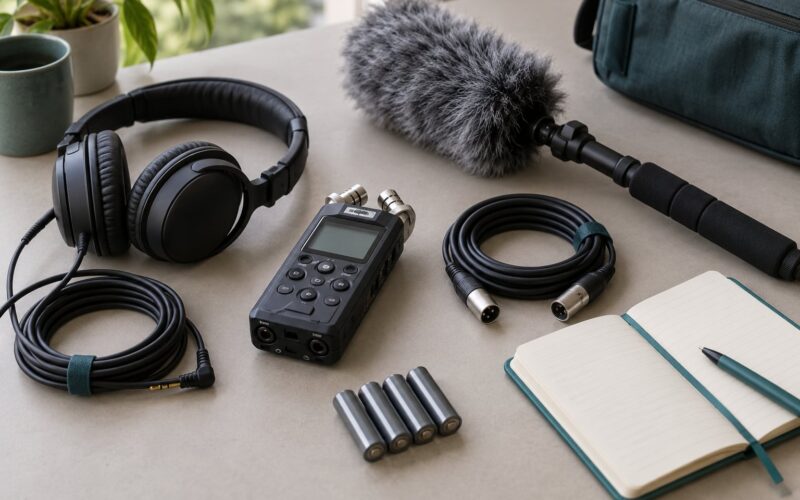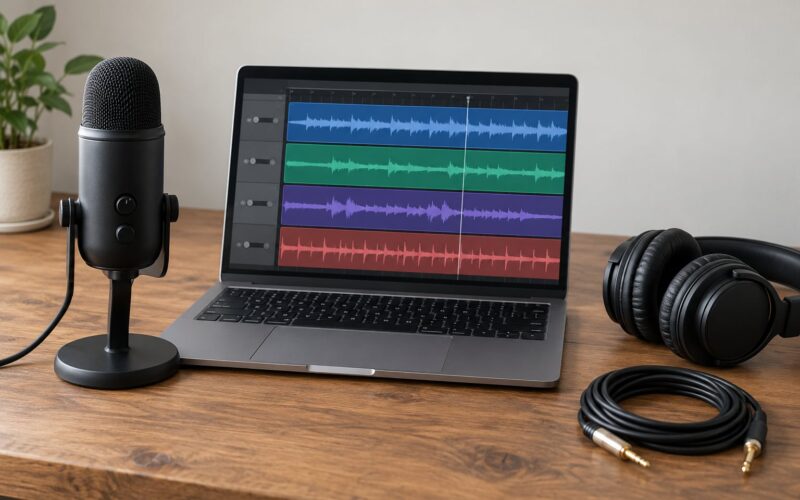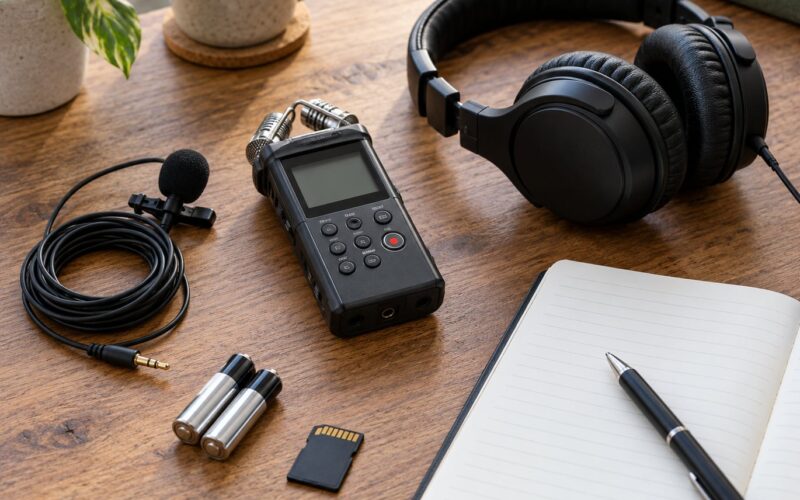
A sound bite in radio journalism is a short clip of speech, usually ten to fifteen seconds, cut from a longer interview and dropped into a news package so a listener hears the speaker’s own words instead of only the reporter’s summary. The Random House Unabridged definition, carried by dictionary.com, calls it “a brief, striking remark or statement excerpted from an audiotape or videotape for insertion in a broadcast news story.” The phrase itself comes from visual media, where a “bite” is the single shot a producer cuts to, but on radio the bite is the audio doing that job alone.
That sounds obvious once you hear it. It is not, because listeners routinely use the phrase for any sound on the radio, including stingers, idents and sound effects. Getting the definition straight matters if you are learning to make packages, and it matters even more if you simply want to understand what you heard at 6am.
Table of Contents
- What a Sound Bite Is in Radio Journalism
- How Radio Journalists Create a Sound Bite
- Sound Bite vs. Full Quote vs. Pull Quote
- Why Radio Sound Bites Matter
- Examples of Effective Radio Sound Bites
- Weak Sound Bites and How to Improve Them
- When Is a Sound Bite Manipulative?
- How to Listen for Sound Bites in a Radio Report
- Frequently Asked Questions
- How long should a sound bite be in radio journalism?
- Is a sound bite the same as a full interview quote?
- Can radio journalists edit interview answers into a sound bite?
- Why do radio sound bites sometimes sound dramatic?
- How can a listener tell if a sound bite is being taken out of context?
- Should every radio interview include a sound bite?
- Conclusion
What a Sound Bite Is in Radio Journalism
Three things separate a sound bite from any other piece of audio. It is speech, recorded live or by phone, rather than narration or a read from a script. It is selected and edited from a longer answer rather than spoken for the microphone as a single take. And it is placed inside a package where a reporter supplies the framing around it.
The idea is not new. Broadcasters have been lifting a memorable line out of an interview and dropping it into a news story since the era of recorded tape, and the term itself was first recorded in 1980, emerging from late-1970s American television and political coverage. What shrank over time was the bite itself. Research by Robert Lichter, cited widely in journalism training, put the average sound bite at 42.3 seconds in 1968 and 7.8 seconds by 2000.
Radio inherits all of that. A bite is short because radio is linear and unforgiving: a listener driving to work cannot rewind, and anything over about twenty seconds starts to feel like the reporter has lost the plot.
What a Sound Bite Is in Radio Journalism, Precisely
A sound bite is not a shortened quote in the sense of a printed excerpt with an ellipsis. It is a rebuilt clip. The editor takes an answer, strips the false starts and the throat-clearing, closes the gaps, and lands on a sentence that stands on its own. Sometimes the speaker’s whole answer runs ten seconds and the edit is almost invisible. Sometimes the editor joins the top and bottom of a two-minute answer with a clean cut, and the listener hears a thought that was framed, qualified and then qualified again in the original.
That second case is where the ethics questions start, and it is why the Society of Professional Journalists code of ethics holds that journalists should never highlight incidents or remarks out of context. More on that later.
How Radio Journalists Create a Sound Bite
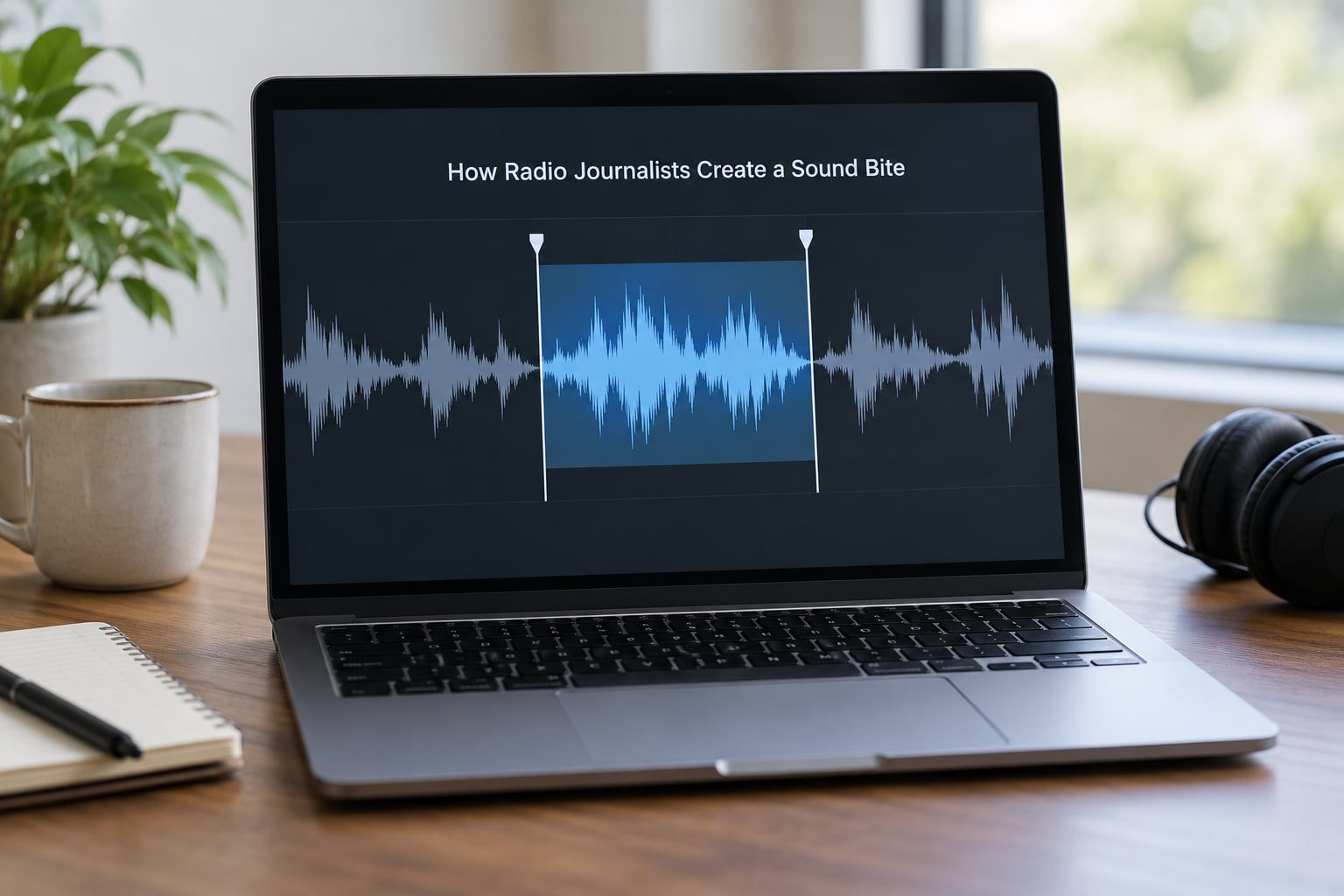
The craft sits in the edit, not in the interview. A reporter who records forty minutes with a council leader and comes back with one usable ten-second line has done something wrong at the interview stage, usually by asking a compound question or by letting the answer wander.
The usual sequence runs like this. The reporter logs the interview and listens for the line that states the position plainly, without hedging or filler. That clip is marked as the main actuality. Other usable moments are marked as supporting actualities, which may end up in the package or be held for a later bulletin.
Next comes the clean-up: “um” removed, hesitations closed, breaths either kept as rhythm or cut where they drag. Levels are matched to the narration so the speaker sits in the same acoustic space as the reporter’s voice. A short piece of natural sound, a doorway, a bus, a machine hall, fades in underneath and out again, so the clip does not arrive from nowhere.
Broadcast delivery pace does much of the arithmetic. Three words per second is the rough working figure, so fifteen seconds buys about forty-five words. Keeping the bite inside that budget is usually a matter of preparation: the reporter tells the speaker the length before the recorder is switched on, and the speaker repeats the answer shorter.
Sound Bite vs. Full Quote vs. Pull Quote
The confusion here is genuinely widespread, and a lot of search traffic arrives from people mixing up four different things. This table sorts them out.
| Element | What it is | Typical length | Where it appears | Main risk |
|---|---|---|---|---|
| Sound bite | An edited excerpt from an interview, carrying the speaker’s position | 5 to 15 seconds | Radio and TV news packages, online audio stories | Losing the qualification around it |
| Full quote | A complete answer, uncut apart from technical clean-up | 20 seconds to several minutes | Long-form interviews, podcasts, features | Losing the listener, who has to sit through it |
| Pull quote | A line lifted from a written article and set larger on the page | One sentence | Newspapers, websites, magazines | Printing something the article never argued |
| Vox pop | Several brief opinions from different people on one question, run back to back | 3 to 8 seconds each | News and current affairs segments | Framing the topic through a choice of responders |
| Nat sound / actuality | Ambient sound from a scene, sometimes with no speech at all | 5 to 30 seconds | Packages, bulletins, sport | Ambience that tells the listener nothing |
| Sound effect or stinger | A recorded production sound, not a person’s voice | 1 to 8 seconds | Between items, under promos, idents | Being mistaken for a bite, which it is not |
The last row matters for anyone who searched this topic expecting a list of good radio sound effects. Those exist, and they are useful, but a stinger is punctuation rather than reporting. One commenter in a radio forum thread put it neatly: those sounds work like punctuation between songs, ads, traffic and weather.
Why Radio Sound Bites Matter
Because a radio package runs about ninety seconds to two minutes, the bite carries most of the story. Narration sets up and explains; the bite gives it a voice, an opinion and an emotion. Without one, the item is two people reading at each other.
There is a practical rhythm to it too. Bites work at the top of a package to hook a listener, in the middle to explain, and at the end to leave something behind. In a drive-time bulletin, a strong reaction line from a passer-by is often the only thing that stops someone reaching for the dial.
| Format | Typical bite length | Words at three per second |
|---|---|---|
| American network TV, 1968 | Around 42 seconds | About 125 words |
| American network TV, 2000 | Around 8 seconds | About 24 words |
| Local radio news package today | 8 to 15 seconds | 24 to 45 words |
| Breaking-news live update | 5 to 8 seconds | 15 to 24 words |
| Sport reaction after an event | 10 to 20 seconds | 30 to 60 words |
| Podcast or long-form interview | Rarely edited to bite length | Whole answers run instead |
None of these is a rule, and the useful thing about a target length is that it forces an editor to choose. Too short and you get a fragment; too long and the reporter’s own thread disappears.
Examples of Effective Radio Sound Bites
These are illustrative lines of the kind that survive an edit desk, written to show the shape rather than to quote anyone real.
A public-service announcement bite
A hospital trust spokesperson, after being asked how many people are waiting in A and E: “We are seeing more patients than we ever planned for, and we need the public to understand that.” It is under ten seconds, it is self-contained, and a driver hearing it once understands the situation without the reporter explaining it again.
A local issue bite
A councillor on a road closure, asked whether residents had been told first: “Nobody told us anything until the signs went up on the Monday.” Specific, plain, and it sets up the rest of the item without the bite having to do the arguing.
A sports reaction bite
A manager twenty minutes after a defeat, asked about the second half: “We were a different team out there, and not in a good way.” Short enough to run straight into a link, and the pause in the middle is where the mood lives, so an editor would keep it rather than close it up.
A breaking-news bite
A witness or passer-by, recorded on a phone within minutes of an incident: “The whole front of the building was gone in about a minute.” This one earns its place through directness. It needs attribution and a timestamp immediately before it, but it carries something narration cannot.
What all four share is that each one answers a question a listener would have asked anyway. That is the test. A line that raises a question the reporter never resolves is a hook, not a bite.
Weak Sound Bites and How to Improve Them
Most unusable clips fail for a small number of repeatable reasons.
A sentence that dangles is the most common. The speaker starts an answer and the edit cuts before the verb, so the line plays as a fragment and the listener does the work of finishing a thought they cannot hear. The fix is editorial discipline: never leave an edit point inside a clause.
Jargon is the second. A council officer saying “we are progressing through the gateway review” has said nothing a listener can hold. Ask the question again, in plain words, and let the same person answer it twice. The second answer is usually the usable one.
Missing context is the third, and it is the one that generates complaints. If the bite is the only thing a listener hears because the item is short or the bulletin is fast, then the attribution and the question have to be built into the reporter’s narration around it, not implied.
Abrupt edits are the fourth. A clip that starts or ends on a hard cut sounds like a machine made the decision, and it loses the speaker’s rhythm. Bookending with a moment of natural sound and trimming at a breath usually fix it.
Manufactured emotion is the fifth and the sneakiest. Selecting the loudest ten seconds out of a calm answer produces a sound bite that is technically accurate and practically misleading. It is the sort of edit that gets screenshotted and posted, which tells you it worked as media even when it failed as reporting.
When Is a Sound Bite Manipulative?
A bite is manipulative when the edit changes what the speaker would recognise as their own answer. That usually happens in one of four ways.
Sequencing does most of the damage. Playing two answers in an order the interview did not produce makes a contradiction look like a position, or a position look like a contradiction. Changing the order back fixes it.
Altered meaning comes from joining a qualification to the wrong claim. A speaker who says a plan is affordable, then says in the next breath that it depends on a funding decision nobody has made, sounds certain once the second half is cut.
Missing answers is the subtlest version. The speaker was asked a direct question and the clip runs the flinch rather than the reply. There is nothing false in it, which is exactly why it travels well.
Emotional provocation, usually through selection rather than editing, is the fourth. A genuine quote lifted to imply the opposite conclusion is still an accurate quote, and the fix is contextualisation.
The standard editors work to is not complicated: the clip should leave a listener with an impression the speaker would recognise. Where that is not possible, the reporter’s narration should carry the correction, and that is not an admission of failure. It is the job.
How to Listen for Sound Bites in a Radio Report
There is a five-check routine that works on the car radio, and it takes about ten seconds.
Listen for the introduction. A properly built package names the speaker before the clip plays, so you know who you are hearing and why they matter.
Listen for attribution after the clip. If nothing comes back to the reporter’s voice, the bite may be standing alone without a frame.
Listen for chronology. Radio news repeats through the day. A line you heard at 7am appearing at 9am may be from something that has since changed.
Listen for the question that was never asked. Because you did not hear the question, you cannot judge whether the answer fits it. When a bite seems oddly complete or oddly partial, that missing question is usually the reason.
Listen for what came immediately after. The sentence the speaker used to finish their thought is the thing an honest edit would have included. Its absence is a signal.
Threads on r/Journalism and r/NoStupidQuestions keep returning to the same grievance, that clips appear stripped of the answers that followed them. The checks above are how a listener makes that judgement rather than guessing.
Frequently Asked Questions
How long should a sound bite be in radio journalism?
Most local radio news bites run between eight and fifteen seconds. Broadcast delivery pace of roughly three words per second puts that at about 24 to 45 words. Breaking-news updates usually sit at the shorter end, while sports reaction allows a little more. Length is a working target rather than a rule, and an editor will often cut a clean ten seconds out of a thirty-second answer.
Is a sound bite the same as a full interview quote?
No. A full quote is the speaker’s answer left essentially intact, which is normal in podcasts and long-form interviews. A sound bite is rebuilt and shortened for a news package, with fillers removed and pauses tightened, so it carries one point and lands quickly. Both come from interviews, but a bite only works because it is compressed.
Can radio journalists edit interview answers into a sound bite?
Yes, and it is the normal way packages are built. Editors remove false starts and filler, close hesitations, match levels to the narration, and add natural sound underneath the clip. What they should not do is change the meaning by joining unrelated parts or dropping the qualification that followed a claim, which is where the ethical complaints about sound bites come from.
Why do radio sound bites sometimes sound dramatic?
Several reasons combine. Delivery on a live or phone interview is more animated than written speech. Editors select the strongest moments, which are often the emotional ones. A tight edit removes the pauses that would have made the moment look ordinary. The result is usually an accurate clip, but the drama is partly an editing effect and listeners should hear it that way.
How can a listener tell if a sound bite is being taken out of context?
Check whether the reporter named the speaker before the clip, whether they returned to the question afterwards, and whether a qualification or follow-up answer seems to be missing. Because the question is never broadcast, you also cannot tell from audio alone whether the answer fitted it. That gap is exactly why a single clip without narration around it deserves suspicion.
Should every radio interview include a sound bite?
No. Bites suit stories where a position matters and emotion helps, such as politics, sport or local disputes. For a service announcement or a straightforward factual item, narration and natural sound may do the job better. Forcing a bite into every item produces the weak clips that make people tune out, and a reporter with no usable quote should sometimes say so on air.
Conclusion
A sound bite in radio journalism is a short, edited clip of a speaker’s own words, cut from a longer interview and framed by the reporter’s narration inside a news package. That is the whole idea, and everything else is craft or argument about it.
Next time a clip lands mid-bulletin, run four quick tests on it: is it accurate to what the speaker said, can you understand it in one hearing, does it actually tell you something, and has the reporter given you enough frame to judge it? A bite that passes all four is doing the job radio does well. One that fails the last two is the reason so many listeners have stopped trusting broadcast quotes altogether.