To listen to radio in another language to learn it, pick one station a notch below your current level, listen to it every day at the same time, and write down what you understood before you look anything up. That simple loop — choose, listen, capture, repeat — is what turns a live broadcast from noise into study material.
The honest bit: this is the cheapest practice in language learning, because the material is free and hands-free, but it is not the easiest. Most beginners understand almost nothing for the first two to four weeks. That is normal, not a sign you picked the wrong station, and it is the stage where the habit either takes root or quietly dies.
A realistic routine is 15 to 30 minutes a day, most of it attached to something you already do — a bus ride, a walk, washing up. Difficulty sits in choosing the right audio, not in forcing yourself to concentrate harder.
Table of Contents
- What You Need
- Step-by-Step: How to Listen to Radio in Another Language to Learn It
- Common Mistakes
- Frequently Asked Questions
- How do I listen to radio in another language to learn it?
- Can you learn a foreign language just by listening to the radio?
- How long should I listen to the radio a day to learn a language?
- How can I listen to foreign radio stations?
- Do I need subtitles or transcripts when learning by radio?
- Which type of internet radio is best for beginners?
- Where to Start This Week
What You Need
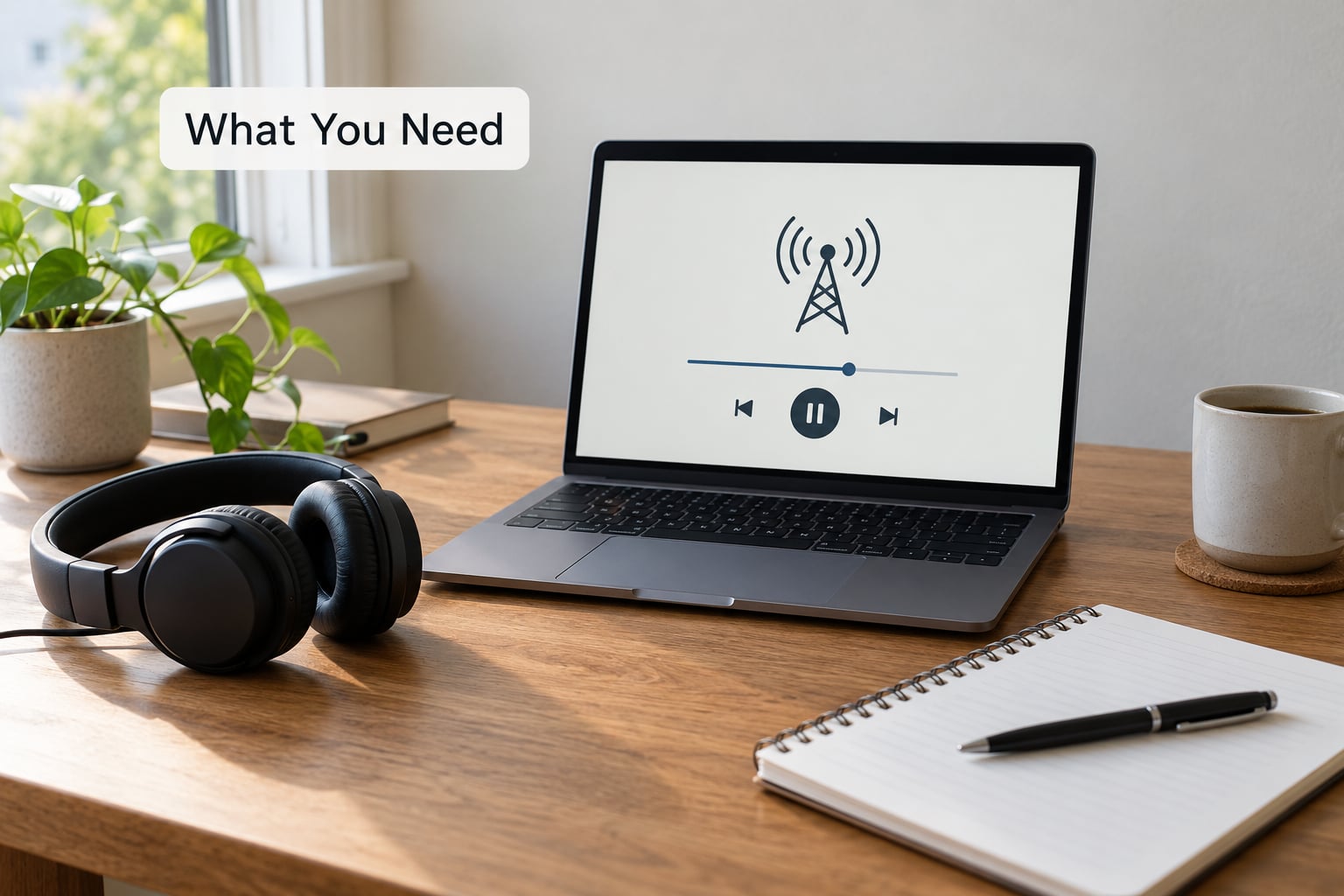
Six things, and none of them expensive. That is the point of radio as a study method.
- A target language and an honest level. Pick one language. Know roughly where you sit: beginner with no sentences, lower-intermediate, or upper-intermediate and fluent-ish. Guessing high is the single most common reason beginners quit in week three.
- A reliable way to receive audio. A smartphone with any radio directory app covers most languages. A receiver matters only for local terrestrial stations, and honestly most learners never need one.
- A shortlist of two or three stations. More than that and you will browse instead of study. Choose them once and stay put.
- Headphones or a speaker. Earbuds let you listen on a bus without disturbing anyone, and they keep the broadcast close enough that you catch quieter linking words.
- A capture tool. A notebook, a voice-memo app for clipping 30 seconds of audio, and a dictionary with audio. The dictionary matters more than it sounds — see the lookup problem in step 4.
- A progress log. One line per session: date, station, what the programme was, roughly how much you understood. Without it you cannot tell slow progress from none.
One optional extra: a spaced-repetition app such as Anki, Quizlet or Memrise. Useful, not required. Plenty of learners on r/languagelearning report getting through months of commute listening with a phone dictionary and no flashcards at all.
Step-by-Step: How to Listen to Radio in Another Language to Learn It
Pick a level you can tolerate, find a station that repeats and explains, listen once through without pausing, then replay and annotate the useful parts. Return to the same broadcast across several short sessions, and gradually strip the support away until you can follow general entertainment programming.
1. Choose a Radio Level That Matches Your Language
Match the audio to four things you actually know: your vocabulary range, comfortable speaking speed, the accents you can handle, and what you already understand about the topic. Newsreaders in most languages sit around B1 to B2. Everyday talk radio and unscripted drama are C1 territory.
Judge by listening, not by the label. Play 90 seconds of a candidate station and count how many complete sentences you catch. Ten percent is roughly right for a beginner — frustrating, but you can still follow who is talking about what. Zero percent means the material is too hard right now.
Do not pick a station because it comes from a country you love or because its schedule looks interesting. You will end up tuned to entertainment formats at A2 and concluding the language is impossible.
| Station type | Speech rate | Register | Best stage |
|---|---|---|---|
| Language-learning broadcasts | Slow, deliberate | Formal | Absolute beginner |
| Public-service international news | Medium, clear | Formal | Early beginner |
| Local news and current affairs | Medium | Formal to neutral | Beginner to intermediate |
| Talk radio and interviews | Fast, informal | Neutral, slangy | Intermediate |
| Call-in shows | Fast, unrehearsed | Colloquial | Upper-intermediate |
| Comedy and panel shows | Fast, playful | Slang, references | Upper-intermediate |
| Radio drama (unscripted) | Natural, no redundancy | Everyday | C1 and above |
| Music radio with announcer talk | Medium | Casual | Any level |
Beginners on a tight budget get the most out of international public-service broadcasters such as the BBC World Service, Radio France Internationale and Deutsche Welle. Their news is produced for non-native listeners, with slower delivery and simpler headlines.
2. Find Stations That Repeat and Explain
Repetition is what makes audio stick, so favour formats that say the same thing again in different words. Learner broadcasts explain themselves. News recycles the same story across bulletins. Music radio repeats artist names, city names and station jingles dozens of times a day.
Directory apps worth trying:
| Tool | What it does | Best for |
|---|---|---|
| Radio Garden | Globe of live stations positioned in real cities | Browsing countries and finding one city to commit to |
| TuneIn Radio | Huge live directory with country and language filters | General world radio browsing |
| radio.net | Large station directory with a clean player | Finding local talk and music stations |
| 50Languages | Curated streams aimed at learners | Your first ten sessions, when nothing else looks approachable |
| Multilingual Books | Library of short radio programmes and stories | Deliberate study with defined lengths |
| Omniglot | Language courses with audio, plus radio links | Building a base before live stations |
For Dutch, French and other languages with national platforms, the broadcaster’s own app usually gives you better metadata and steadier streams than a third-party directory. Learners on the internet-radio community forum mention Radio Netherlands for Dutch and Radios France for French by name for exactly that reason.
Spend 20 minutes choosing, then stop choosing. The station is not the interesting part of this method.
3. Listen Without Pausing First
This is where most learners sabotage themselves. They press pause every four seconds, hunt for a word, lose the thread, and drift away from the broadcast entirely. On the first pass, your only job is to follow the shape of it.
Do this instead:
- Listen straight through with no dictionary and no transcript.
- Write the topic in one sentence — “a report about a train strike”, “a phone-in about noisy neighbours”.
- Jot words that kept coming back. Three to eight is a normal haul.
- Note how you felt about your comprehension: nothing, fragments, most of it.
Fragment-level understanding is genuinely useful. Learning to parse a broadcast with holes in it trains the ear far better than pausing to smooth every gap, and it is closer to how real conversation sounds anyway.
One warning from community experience: try to grasp the whole message, not every word. Chasing a single word in the first minutes of a programme is the fastest route to abandoning it.
4. Replay and Annotate the Important Parts
Now go back over the same broadcast with support, but partial support. Full subtitles in your own language turn listening into reading, and you stop training your ears.
Run it a second time with a timestamp pad. Every time you catch a phrase, note the second and write it out. Afterwards, clip a handful of 30-second moments and listen to them repeatedly — that is where rhythm, intonation and word linking actually land.
Build a small glossary: recurring words, fillers you keep hearing (um, uh, eh, and whatever your language uses), and one or two phrases per session. Ten words a day beats forty you never revisit.
Transcripts are a tool, not a crutch. Learner broadcasts and some podcasts publish them; live talk radio usually does not, which is why radio suits advanced practice. A talk-show transcript can tell you whether you misheard a single consonant or missed three words entirely — those need different fixes.
Here is the lookup problem forum members raise constantly: you hear a sound, you want the word. In French, Spanish, Italian or Turkish the sound maps fairly predictably to spelling, so a dictionary search usually works. English is the exception — its spelling does not track its sound, and several languages have dropped or merged sounds entirely. For those, transcribe by sound and search for candidates, or use a dictionary with audio input.
Send the words you collect into a spaced-repetition deck if you have one. If not, a weekly review of the week’s notebook page still beats nothing.
5. Repeat the Same Broadcast in Short Sessions
A 45-minute programme is not a 45-minute task. Break it up and revisit it across several days. That spaced return is what turns exposure into memory, and it also keeps daily sessions realistic on a working day.
Three methods, roughly in order of usefulness:
- Repeat listening. Same show, different days, no notes after the first session. Straightforward and boring, which is why it works.
- Shadowing. Play a clip, pause, and say it out loud half a second behind the speaker. Copy rhythm and stress, not just sounds. Ninety seconds at a time is plenty.
- Dictation. Write down four or five sentences word for word, then compare with a transcript. Painful and extremely effective for connected speech.
For the dead hours where reading is impossible — standing on a bus, walking the dog, folding laundry — put on a repeat of the same episode and let it play. Learners describe radio as natural spaced repetition: the same words recur across broadcasts and eventually stick without deliberate memorisation.
Dose matters less than consistency. Fifteen focused minutes daily beats an hour on Sunday. A learner in a long-running thread on the LingQ community put it plainly enough: the total hours add up, but they only add up if they are spread across weeks.
6. Gradually Reduce Support
Every few weeks, remove one crutch. That is the whole ladder.
- Stop the glossary. Listen with nothing but a notebook for new words.
- Drop the transcript. Trust the second pass.
- Nudge playback speed up slightly, around 1.1 to 1.25 times, if your player allows it.
- Move to a station from a different region: one French channel to another, one Spanish network to a different country.
- Swap news for talk radio, then talk radio for panel shows or radio drama.
Accent rotation is a deliberate step, not an accident. Listening only to one city teaches you one accent and makes every other speaker sound broken. Two countries give your ear the variety real conversations have. Advanced learners often aim a radio play at themselves as a deliberate C2 test, since unscripted drama offers no visual cues and no repetition.
Common Mistakes
Choosing native-speed content too early
Popular entertainment radio in a language you have not studied is a wall of noise. Start one or two levels down. You can always move up in a month; you cannot come back from a month of frustration.
Translating every single word
Looking up everything turns a broadcast into a dictionary exercise and kills comprehension practice. Aim for under 10% lookup on a first pass. If you need every word, the material is too hard, not your method wrong.
Listening for hours without a task
Background audio trains your ear slowly, but three aimless hours a week will not move you. Give each session one job: follow the topic, catch repeated words, shadow ninety seconds, or dictate five sentences.
Ignoring pronunciation, rhythm and fillers
Beginners focus on vocabulary and ignore everything else. The gain sits in stress, intonation and linking words — the parts that make speech sound fast. Note how filler sounds work in your language; they mark hesitation and boundaries, which is genuinely useful decoding information.
Starting with only entertainment programming
Comedy and call-in shows are jokes about shared context. You will spend your energy decoding references instead of words. News and learner broadcasts give you structure and repeated vocabulary to hold onto.
Changing station every session
Browsing feels productive and teaches nothing. A fixed routine with one or two stations builds the familiarity that makes fast speech feel slow. Commit for a month before you judge anything.
Streaming on a phone plan you cannot afford
Radio burns through mobile data fast, especially video channels. Stick to audio-only streams, use wifi where you can, or download a short programme at home for the commute. Streaming abroad is a real expense, so check roaming before you fly.
Expecting progress in a week
The first month feels flat because your ear is calibrating. A more useful measure: at week one you catch nothing, at month one you catch headlines and weather, at month three you follow a current-affairs segment with gaps. Write the log and let it show you the curve.
Frequently Asked Questions
How do I listen to radio in another language to learn it?
Pick one station a level below your ability, choose two or three and stop browsing, then listen 15 to 30 minutes a day at the same time. Make your first pass without pausing, write the topic and the words that recurred, then replay with a timestamp pad and clip the useful 30 seconds. Send new words to a spaced-repetition deck. The loop is choose, listen, capture, repeat.
Can you learn a foreign language just by listening to the radio?
Not on its own. Radio alone trains your ear to unfamiliar sound, timing and accent, which nothing else replaces, but it rarely builds vocabulary or grammar by itself. Pair it with deliberate work: a glossary, dictionary lookups, shadowing and spaced repetition. Passively listening is a useful background layer, not the whole method.
How long should I listen to the radio a day to learn a language?
Fifteen to thirty focused minutes a day is enough for steady progress, and consistency matters far more than length. Split a longer programme into sections across several days and return to the same show, because spaced repeats are what convert exposure into memory. Attach the slot to a commute or chores so it never competes with your evening.
How can I listen to foreign radio stations?
Use a directory app such as Radio Garden for the visual map of live stations, TuneIn Radio or radio.net for a searchable country-and-language list, and a learner-focused service such as 50Languages when you want material pitched at non-native listeners. Most national broadcasters also publish their own free apps. Any of these will play live stations on a phone over wifi or mobile data.
Do I need subtitles or transcripts when learning by radio?
Use them, but not on the first pass and not in your own language. Listen through without support to train comprehension, then replay and check the uncertain parts against a transcript or show summary. Transcripts show whether you misheard one consonant or missed several words, which need different fixes. Native-language subtitles quietly switch your brain into reading mode.
Which type of internet radio is best for beginners?
Start with language-learning broadcasts or international public-service news from services such as the BBC World Service, Radio France Internationale or Deutsche Welle. They are made for non-native listeners, with slower delivery and simpler headlines. Move to local news around B1, then to talk radio, call-in shows and radio drama once you are following everyday speech at speed.
Where to Start This Week
Do one thing today: open a directory, sample three stations at ninety seconds each, and commit to the one where you caught the most sentences. Then listen to the same programme at the same time for the next five days.
Day one, find the station. Day two, listen without pausing and write the topic. Day three, replay with timestamps and clip 30 seconds to shadow. Day four, add three words to your deck. Day five, listen again with nothing but a pen. Day six, try a second station from another region of the same language. Day seven, write two honest sentences about how much you got.
Radio stays free, hands-free and endlessly available as 2026 moves on, which is why it survives as a study habit long after the novelty of a textbook app wears off. The tools listed here work the same way as of 2026, and the technique itself has not changed in decades — the difference is only how long you keep showing up.