Short answer: speaker wire gauge affects sound through electricity, not through tone. A cable does not have a signature. What gauge changes is how much resistance sits between your amplifier and your speakers, and that resistance eats power, drops voltage and softens the amplifier’s grip on the cone. On a long run with 4 ohm speakers you can hear it. On a 3 metre run with 8 ohm bookshelves, you almost certainly cannot.
This guide works through how speaker wire gauge affects sound in plain numbers: what AWG actually measures, where the loss shows up, and which gauge to buy for the run you actually have. If you have already been told you need expensive cable, read the audibility section first.
Table of Contents
- What Speaker Wire Gauge Means
- How Speaker Wire Gauge Affects Sound
- Resistance, Power Loss, and Amplifier Load
- Choosing the Right Gauge for Your Speakers
- 16 AWG or 18 AWG: Which Should You Use?
- Does Copper, CCA, or Oxygen-Free Copper Matter?
- Other Factors That Can Change the Sound More
- How to Install Speaker Wire Safely and Correctly
- Frequently Asked Questions
- Conclusion
What Speaker Wire Gauge Means
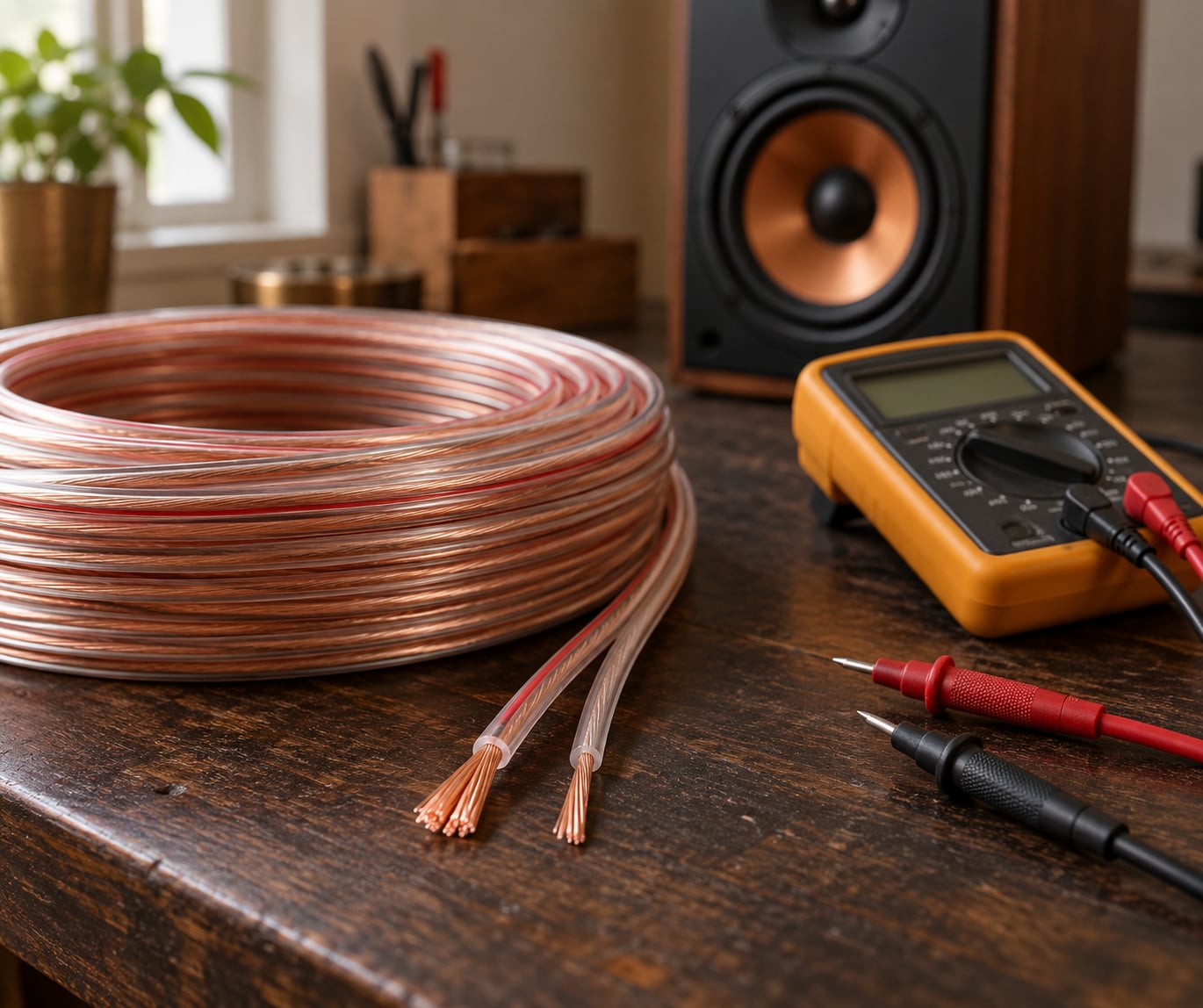
AWG stands for American Wire Gauge, and it measures the cross-sectional area of a single conductor. The confusing part is the direction: the number counts backwards. 12 AWG is thicker than 16 AWG, and 18 AWG is thinner again.
Because the scale is inverse, a lower number means more copper per metre of cable, which means less electrical resistance. That is the whole reason gauge gets discussed at all.
It helps to separate three things people mix up. The conductor is the bare copper inside. The insulation is the plastic coating around each conductor, and it has no electrical effect worth worrying about at audio frequencies. The jacket is the outer sheath holding the two conductors together, plus any filler or braid. Only the conductor’s area matters for resistance.
| Gauge | Area | Conductor diameter | Resistance (ohms per 10 m) |
|---|---|---|---|
| 18 AWG | 0.82 mm² | 1.02 mm | 0.21 |
| 16 AWG | 1.31 mm² | 1.29 mm | 0.13 |
| 14 AWG | 2.08 mm² | 1.63 mm | 0.08 |
| 12 AWG | 3.31 mm² | 2.05 mm | 0.05 |
Those resistance figures are for solid copper at 20°C. Real cable sits slightly higher because most speaker cable is stranded, and copper gets a little less efficient when warm.
One more measurement to know, because it catches people out constantly: cable resistance is quoted for the whole loop. A 5 metre run means 5 metres out and 5 metres back, so you look at 10 metres of cable.
How Speaker Wire Gauge Affects Sound
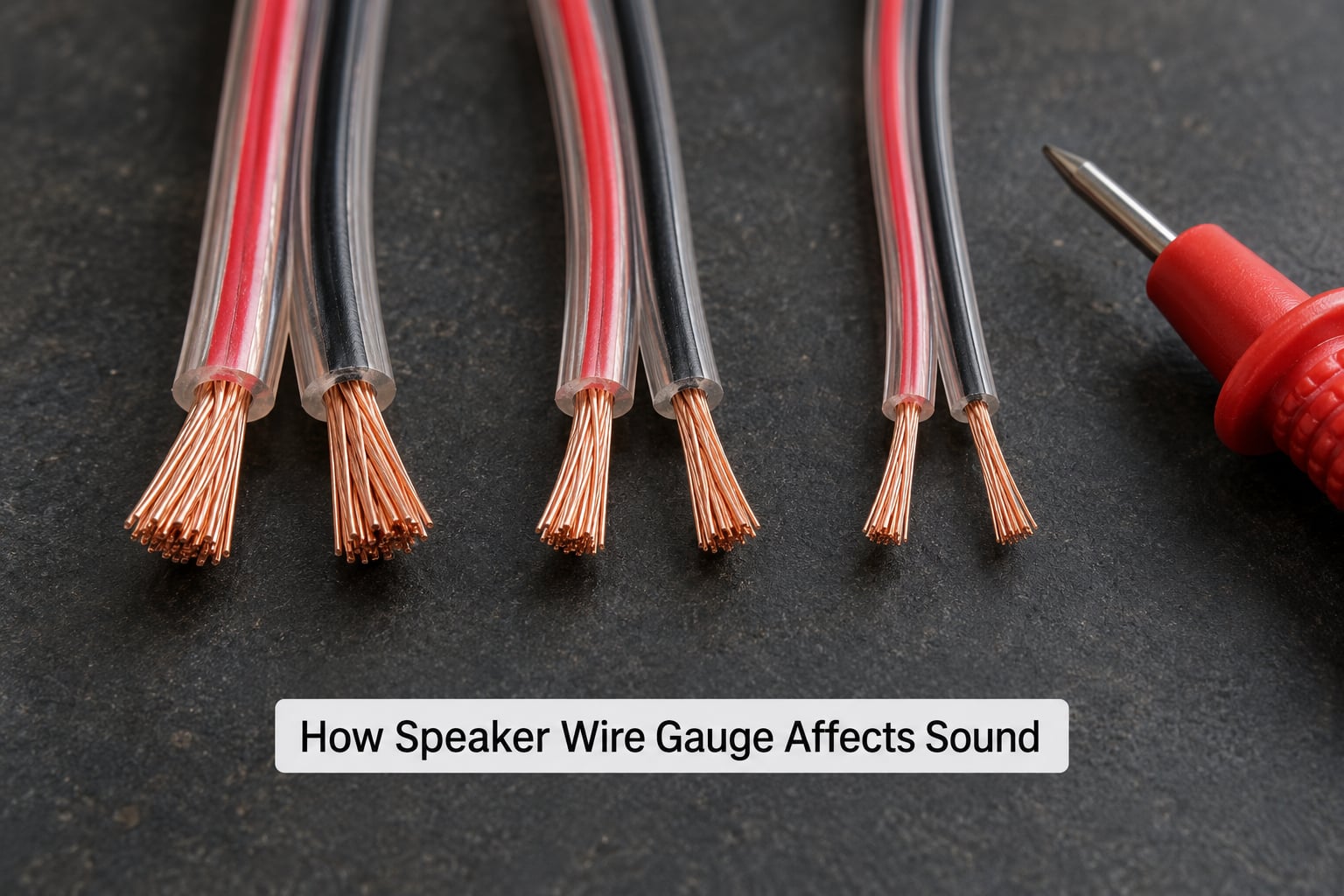
Six effects, ranked by how likely you are to actually notice them in a normal room:
- Power loss and volume. Some of your amplifier’s output is burned as heat in the cable. Thin wire over a long run simply delivers less power to the speaker, so the music plays quieter.
- Bass control. Cable resistance adds series resistance to the speaker, which changes how tightly the amplifier can stop the cone moving. The result is looser, less disciplined bass.
- Dynamic headroom at low volume. With less power reaching the speaker, quiet passages in a film or a night-time listening session run out of clean headroom sooner.
- High-frequency extension on very long runs. The inductance of a cable rises with length. On a 30 metre or longer run the cable and speaker together form a mild low-pass filter, so treble thins out slightly.
- Channel-to-channel consistency. If the two runs differ in length or gauge, the channels no longer match electrically and the centre image can drift or sit off-centre.
- Connection quality. Thick cable is easier to terminate properly. A loose or corroded connector makes far more difference than the difference between 12 and 16 AWG.
That last point is not a footnote. Forum consensus across r/audiophile and AVForums repeatedly lands on the same explanation: listeners who swapped expensive cable and heard a big improvement had loose or dirty terminations before, not a magic conductor.
Resistance, Power Loss, and Amplifier Load
Resistance in the cable and impedance in the speaker form a voltage divider. The louder the amplifier tries to play, the more current flows, the bigger the drop across the cable, and the more power is wasted in it.
Here is a real calculation. A 5 metre one-way run of 16 AWG copper gives about 0.13 ohms of loop resistance. Paired with a 4 ohm speaker, the total series resistance is 4.13 ohms, so the cable accounts for 0.13 divided by 4.13, which is roughly 3.2 percent of the power. With an 8 ohm speaker on the same cable, the loss drops to about 1.6 percent.
| Setup | Loop resistance | Power lost in cable | Level difference |
|---|---|---|---|
| 5 m of 16 AWG into 8 ohm | 0.13 ohm | 1.6% | 0.07 dB |
| 5 m of 16 AWG into 4 ohm | 0.13 ohm | 3.2% | 0.14 dB |
| 10 m of 16 AWG into 4 ohm | 0.26 ohm | 6.1% | 0.27 dB |
| 20 m of 16 AWG into 4 ohm | 0.52 ohm | 11.6% | 0.53 dB |
| 20 m of 12 AWG into 4 ohm | 0.21 ohm | 4.9% | 0.22 dB |
Now the damping factor, which is the least intuitive effect and the most persuasive one. Damping factor is the ratio of the speaker’s impedance to the total impedance in series with it. A good amplifier delivers a high number; a long thin cable drags it down hard.
Take an amplifier rated at 500:1 damping with a 4 ohm speaker. Its output impedance is 0.008 ohms, which sounds negligible until the cable gets involved. With 0.5 ohms of cable in the loop, the damping at the speaker terminals works out to (4 plus 0.5) divided by (0.5 plus 0.008), which is about 8.9:1. With 0.13 ohms of cable, the same amplifier delivers roughly 30:1 at the speaker.
That is the real argument against thin cable on a long run. The same amplifier stops holding the cone back as firmly, which is exactly what people describe as softer or sloppier bass.
Speaker impedance is not a fixed number, either. An 8 ohm floorstander often dips to 3 or 4 ohms in the bass region, and that is where current demand peaks. So the worst case for a marginal cable is a deep bass passage at high volume, which is precisely when you least want the amplifier losing control.
Choosing the Right Gauge for Your Speakers
Work from two numbers: the one-way distance from amplifier to speaker, and the speaker’s nominal impedance. Then read the table and choose the thickest gauge that keeps total loop loss under 5 percent. For demanding systems or bi-amping, tighten that to 1 percent.
| One-way run | 4 ohm speakers | 8 ohm speakers |
|---|---|---|
| Up to 3 m | 16 AWG | 18 AWG |
| 3 m to 8 m | 14 AWG | 16 AWG |
| 8 m to 15 m | 12 AWG | 14 AWG |
| 15 m to 30 m | 12 AWG | 12 AWG |
| Over 30 m | 10 AWG | 10 AWG |
For most living rooms with 8 ohm bookshelf or floorstanding speakers, that table lands on 16 AWG up to about 8 metres, which is what experienced members on AudioGon recommend as a rule of thumb: 14 AWG up to 8 feet, 12 AWG for 8 to 12 feet. Members on AVSForum make a similar call for 40 to 50 foot surround runs with 8 ohm nominal speakers, saying 16 AWG is generally fine with 14 AWG for margin.
On the 5 percent rule versus the 1 percent rule: 5 percent is the loose industry default and it is fine for ordinary listening at normal volumes. Under 1 percent loss is stricter, and worth aiming for when the speakers are sensitive enough that you run them quietly, when you bi-amp, or when the run is genuinely long. To hold 1 percent on a 4 ohm speaker you need total loop resistance under 0.04 ohms, which at 16 AWG is only about 1.5 metres of run. That is why 1 percent forces thicker cable on anything but the shortest hops.
The point to hold onto is that thicker is not automatically more accurate. Once voltage loss is already negligible, moving up a gauge buys you nothing audible, and heavy 12 AWG is stiff, awkward to route behind skirting boards, and harder to terminate into spring clips.
16 AWG or 18 AWG: Which Should You Use?
Use 18 AWG for short runs to 8 ohm speakers, and nothing longer. For 4 ohm speakers, treat 18 AWG as a floor rather than a choice: 10 metres of 18 AWG into a 4 ohm speaker gives 5.1 percent loss, right at the limit, and worse once the impedance dips in the bass.
16 AWG is the sensible default for a normal room. It handles 8 ohm speakers comfortably out to 10 metres and 4 ohm speakers to about 5 metres, and it is easy to handle and terminate. If your run is under 3 metres with 8 ohm speakers, the difference between 16 and 18 AWG is not something you will hear, so pick whichever is easier to work with.
Handling matters more than people expect. 18 AWG is the gauge most often sold as lamp cord, and it is cheap, but it frays easily and struggles with banana plugs that expect a thicker barrel. 16 AWG fits most banana plugs and spades without fuss, which matters more for long-term reliability than any conductor refinement.
On the lamp cord question that keeps coming up on forums: for average runs up to about 10 feet, standard lamp cord is usually 16 or 18 gauge stranded pure copper, and members on r/vintageaudio confirm that is fine for typical use. What lamp cord is not is fire-rated for in-wall or in-ceiling installation, and that is a safety question, not a sound one.
Does Copper, CCA, or Oxygen-Free Copper Matter?
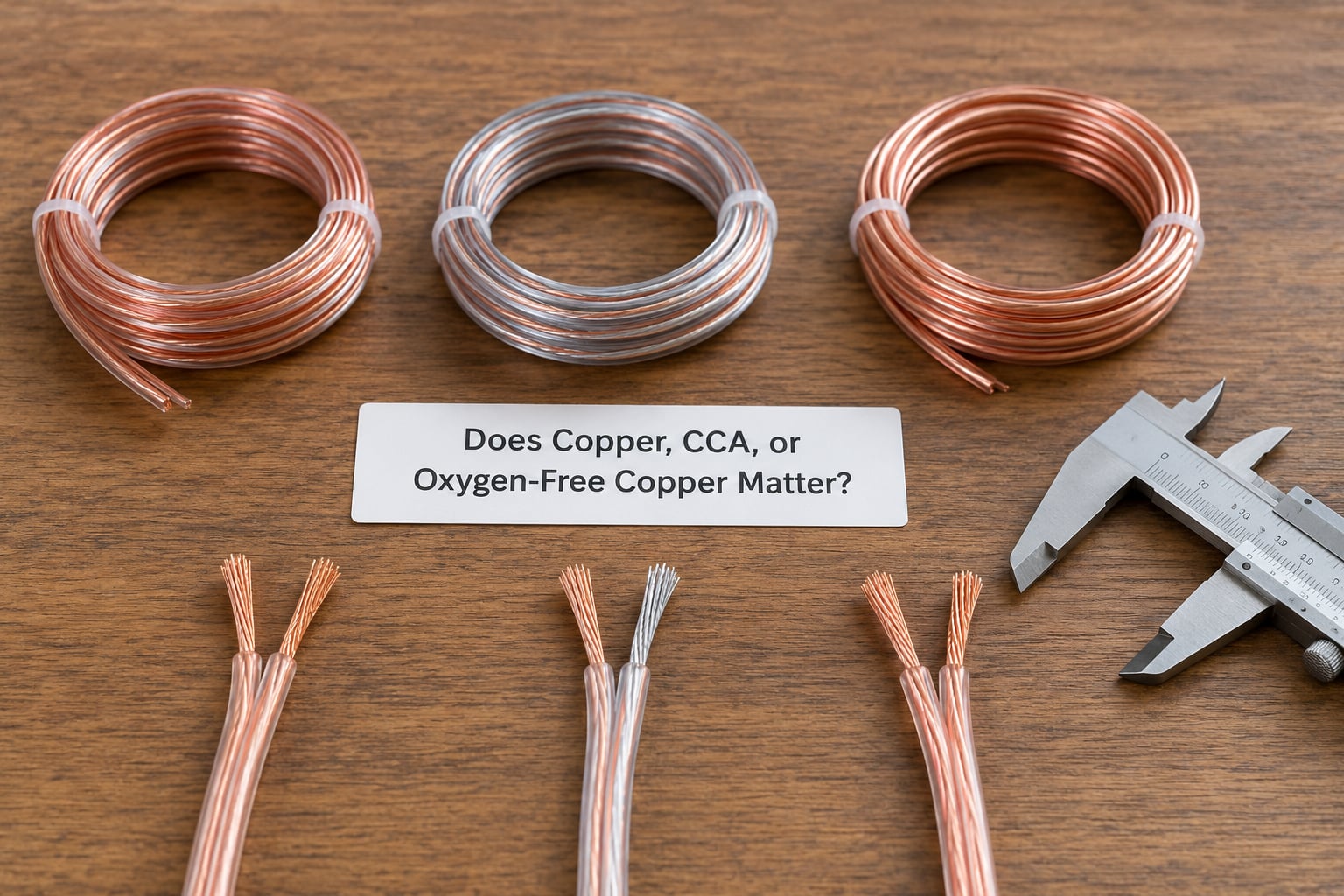
Conductor material matters in four practical ways: DC resistance, how well the cable takes a connector, corrosion behaviour, and price. That is the honest list.
CCA, copper-clad aluminium, is genuinely resistive. The aluminium core carries most of the current, and aluminium resistivity is around 60 percent higher than copper. A CCA cable advertised as the same gauge as a copper one will have roughly 1.5 times the resistance. It is fine for short runs and inexpensive, and it is a poor choice for long runs or 4 ohm loads.
Oxygen-free copper is worth a sentence, not a paragraph. Refining copper to reduce oxygen content improves ductility and fatigue life. It does not measurably change DC resistance, and there is no credible evidence that it changes the frequency response of a passive cable in a way a listener can detect in a room. Paying a large premium for OFC on the strength of a sound claim is spending on marketing, not on audio.
Solid versus stranded is a more interesting split than copper versus OFC. Stranded wire is more flexible and easier to terminate, which makes it the sensible default. Solid wire has marginally lower skin-effect loss at very high frequencies, a difference that sits far below audibility for a speaker cable.
Tinned copper resists corrosion and oxidation on bare ends, which is a genuine long-term reliability win in a humid house or a garden run. The tin adds a negligible amount of resistance.
Other Factors That Can Change the Sound More
Plenty of changes will move the sound further than a step in gauge. If you have the budget, this is where it goes.
Placement. Speaker position affects bass response and stereo imaging more than any cable decision you will make. An hour moving stands 20 cm usually beats a cable upgrade.
Room treatment. Bass peaks and nulls from room modes swamp cable-level differences. Soft furnishings, a rug and sensible speaker-to-wall distance do more for the low end than conductor purity ever will.
Terminations. Matching connectors on both ends, tight terminal screws and bare conductor scraped clean, add up to less than 0.1 ohm. A dirty or loose joint can add more than the entire resistance of a good cable.
Polarity. One speaker wired backwards cancels the low bass and blurs the image. Check it with a polarity tester or a low-frequency test track. Nothing about gauge fixes a reversed connection.
Amplifier output impedance. A cheap amplifier with high output impedance interacts with cable resistance in a way that can genuinely dull the bass. The cable is the least of the variables there.
Equal channel lengths. Keep both runs the same length and gauge. This is free, and it matters more for a consistent centre image than any conductor choice.
Bi-wiring and bi-amping. With bi-amping, the cable resistance also sits in the crossover path, where it can interact with the crossover components. Thinner cable makes the interaction worse, which is another argument for adequate gauge rather than minimum gauge.
How to Install Speaker Wire Safely and Correctly
Work to the instructions supplied with your amplifier and speakers, and take particular care if cable is going into a wall, a ceiling void or near mains wiring.
Measure the run first, and add roughly 0.5 metre of slack at each end for dressing and strain relief. Mark the polarity at the amplifier end before you start, because both conductors in a two-core cable look identical when stripped.
Keep speaker cable away from mains cable, and never run them in the same conduit or chase in parallel for long distances. If they must cross, cross at a right angle. A few centimetres of separation does more to prevent hum than any cable construction.
For in-wall or in-ceiling runs, use cable rated for the job, such as Class 2 or Class 3 speaker cable marked for in-wall use. Ordinary lamp cord and general-purpose cable are not fire-rated, and in some jurisdictions using them in a wall breach is a legal and safety problem. If the run is complex, crosses a ceiling void or involves anything near the electrical installation, get a qualified electrician to advise.
Do not run speaker cable through the same conduit as mains circuits, and keep it clear of any route where it could be clipped by a nail or a drill bit. Avoid pinching the cable under a staple, a clamp or a tight bend; a crushed conductor is a resistance fault waiting to happen.
Strip only enough insulation to reach the terminal, and keep the two conductors apart so they cannot touch. Terminate firmly, check each connection by hand, and take a few minutes to label both ends of every run while you are there.
For outdoor and garden runs, budget for 12 AWG or heavier, use gel-filled or waterproof connectors, and add a drip loop at each end so water runs off rather than into the connector. Those runs easily exceed 30 metres, which puts them at the top of the table above.
One last forum question worth answering: coiling a few metres of surplus speaker cable into a tight loop. It adds inductance, and in a long run it can pick up radio-frequency interference. Coil it loosely if you must, and hide it rather than compressing it into a small bundle.
Frequently Asked Questions
Does thicker speaker wire sound better?
Only indirectly. A passive cable has no tone of its own, so thickness cannot change timbre. What a lower gauge does is cut DC resistance, which cuts power lost as heat, holds more voltage at the speaker and keeps the amplifier’s damping factor high. On a 5 metre run with 8 ohm speakers that difference is around 0.07 dB and effectively inaudible. On a 25 metre run with 4 ohm speakers it can exceed half a decibel of level loss.
What is the best gauge for home speakers?
For 8 ohm speakers within about 8 metres, 16 AWG is the practical default. For 4 ohm speakers, step up to 14 AWG for the same distance. Past 15 metres, use 12 AWG regardless of impedance. The guiding rule is that total loop resistance should stay under 5 percent of speaker impedance, and under 1 percent if you listen at low volumes or bi-amp. Buy the gauge that meets that threshold, not the thickest spool on the shelf.
Is 16-gauge speaker wire good enough for an 8-ohm speaker?
Yes, comfortably. A 5 metre one-way run of 16 AWG presents about 0.13 ohms of loop resistance, which is 1.6 percent of an 8 ohm load and roughly 0.07 dB of level. That is well inside the threshold of audibility. You would need a run of around 30 metres before 16 AWG started to matter much with 8 ohm speakers, and even then 14 AWG gives useful margin.
Does speaker wire length affect sound quality?
It affects the electrical load on the cable, so yes, indirectly. Every extra metre adds resistance, which increases power loss, voltage drop and the effective damping factor at the speaker. Length also raises cable inductance, and on runs of 30 metres or more that starts to trim the top end. Keep both channels the same length and gauge, and you remove the main length-related problem, which is channel imbalance.
Is oxygen-free copper speaker wire worth buying?
Not for sound. Oxygen-free copper is refined to improve ductility and fatigue life, not conductivity, and its DC resistance is effectively the same as standard copper. There is no good evidence that it changes frequency response in a way anyone can hear in a room. Spending heavily on it is spending on the packaging. Judge cable on gauge, run length, fit of the connectors and how well you can terminate it.
Conclusion
Start by measuring the one-way run from amplifier to speaker, then check the nominal impedance printed on the back of the speaker. Those two numbers plus the table above give you the gauge, and most ordinary living rooms land on 16 AWG for 8 ohm speakers and 14 AWG for 4 ohm ones.
Beyond that, judge cable on resistance rather than marketing. The gauge question resolves itself quickly: pick the thickest wire that keeps loop resistance under 5 percent of the speaker’s impedance, and your speaker wire gauge is no longer the limiting factor in the system.