Break in new speakers by playing varied music at moderate volume for roughly 20 to 50 hours, spread across several days rather than one long block. The surround and spider on a factory-fresh driver start stiff and loosen as the cone moves, which is why bass sounds tight and slightly thin in the box. This guide covers the setup, the volume, the music, a day-by-day schedule, and the point where you should stop playing and check your wiring instead.
Table of Contents
- What You Need
- Step-by-Step
- Common Mistakes
- When to Stop the Break-In Process
- Frequently Asked Questions
- How many hours does it take to break in new speakers?
- How loud should I play speakers during break-in?
- Can I break in speakers in multiple sessions?
- Is pink noise good for breaking in speakers?
- Do new speakers need to break in, and does it change them permanently?
- How does amplifier matching affect speaker break-in?
- Conclusion
What You Need
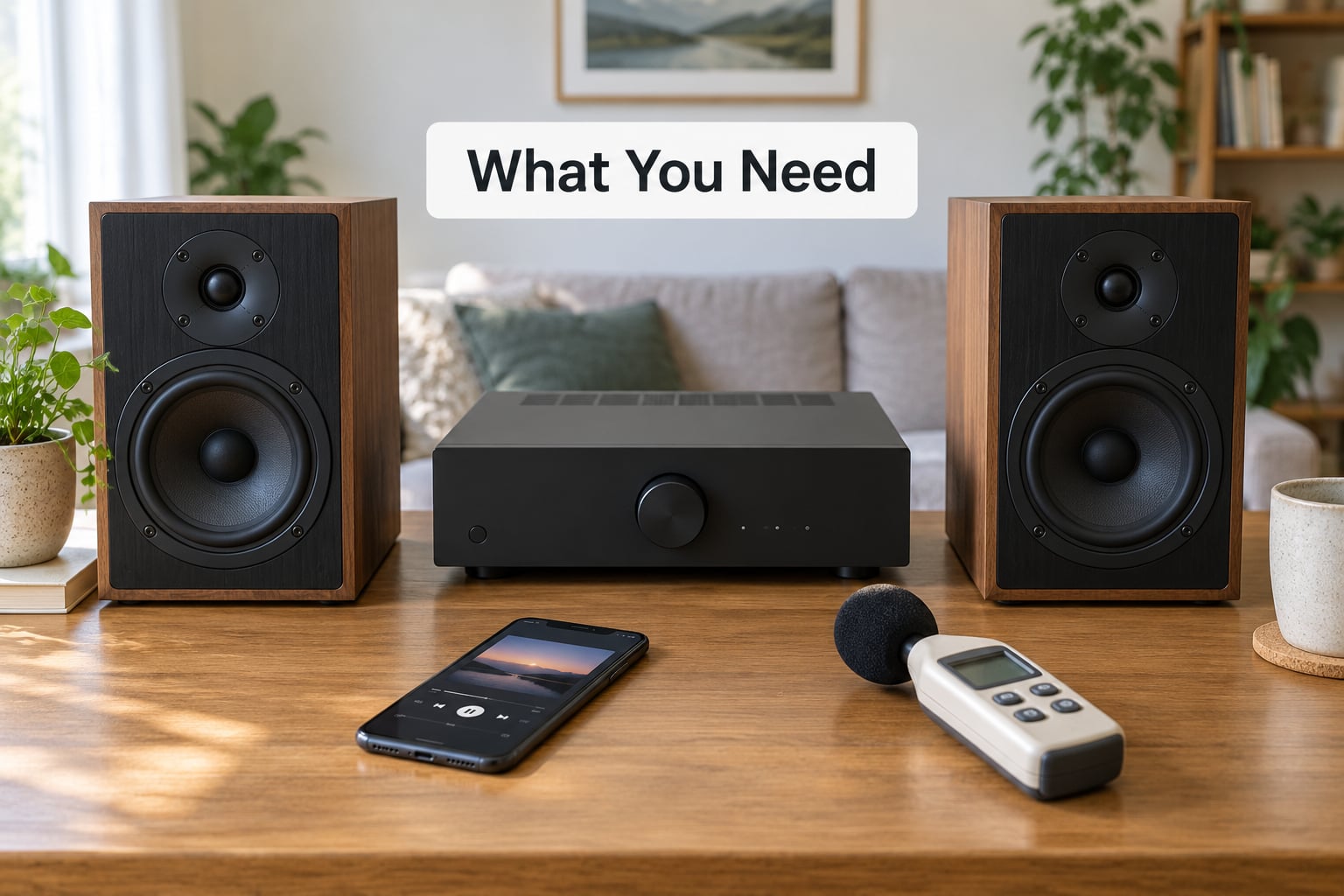
Gather four things before you press play. Without them you are guessing, and guessing is how people end up with a speaker that got pushed too hard on day one.
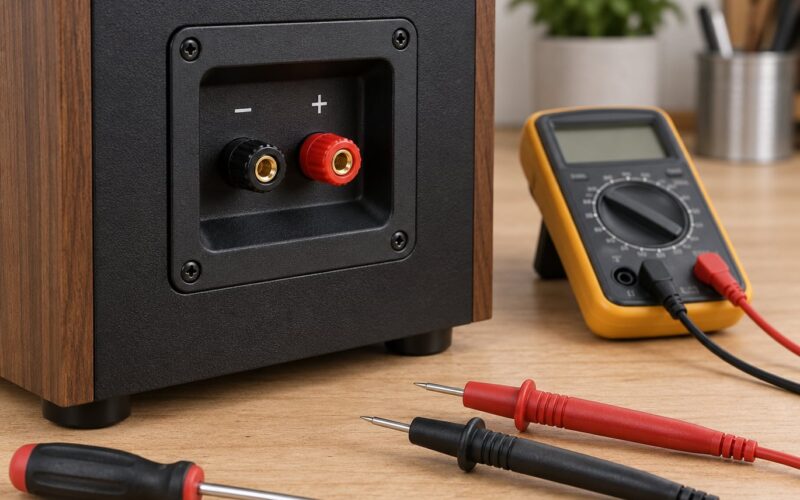
- The manual. Check the impedance or minimum power rating printed on the back panel or in the manual. An amplifier that cannot deliver the current these loads demand will sound thin and may struggle on bass notes.
- The right amplifier or receiver. Match the speaker’s nominal impedance to what the amplifier is comfortable driving. This is the single most common reason new speakers sound disappointing in the first week.
- A music source with material you know. Familiar tracks let you hear changes between sessions instead of guessing at them.
- A way to measure level. A cheap sound level meter app on your phone is fine. Sweetwater measured a guitar speaker run-in at about 105 dB SPL for eight hours using studio gear, which tells you how precise this can get, but a phone app gets you in the right neighbourhood.
- A safe listening spot. Somewhere you can sit at normal distance and leave the system running without fuss.
Step-by-Step
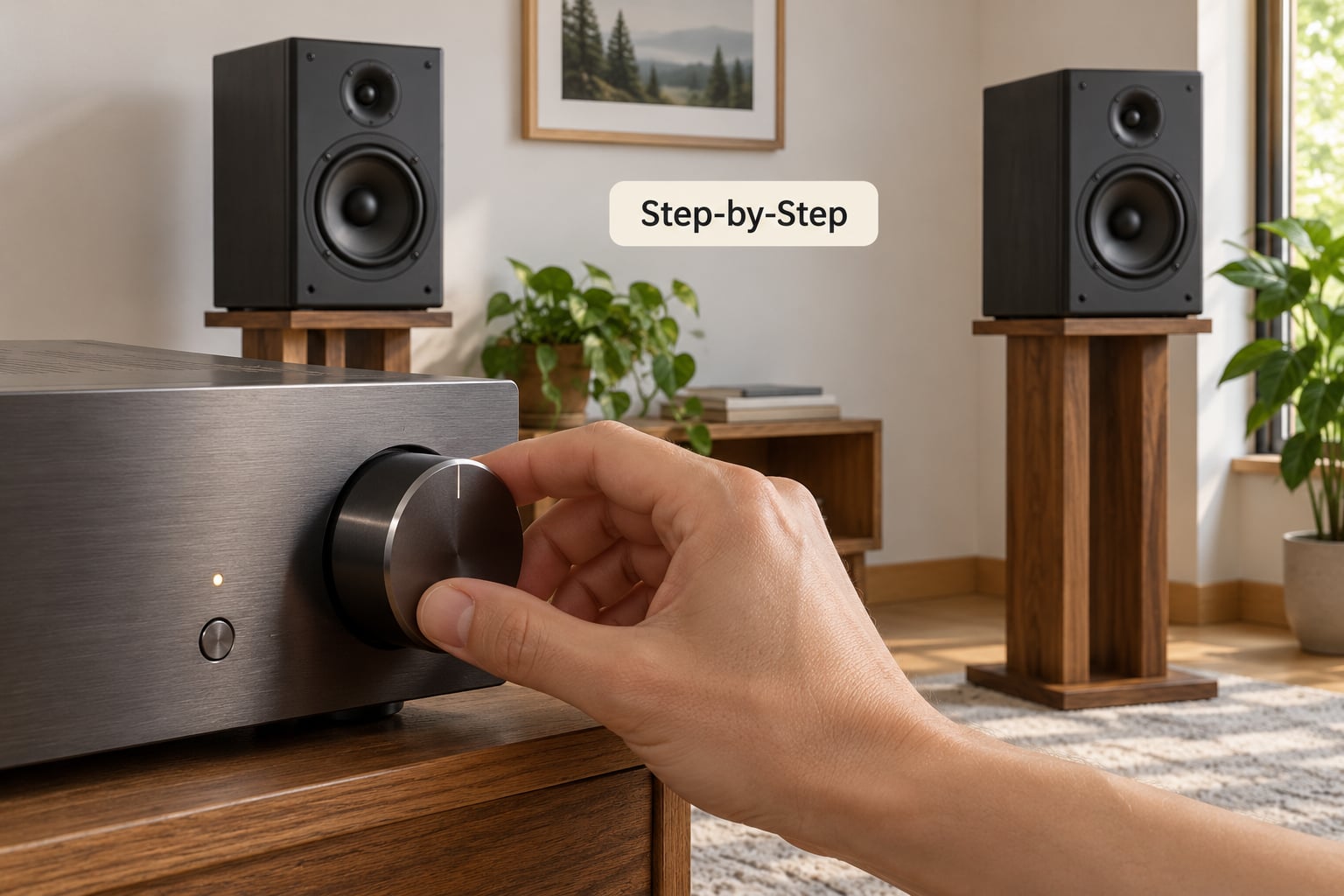
How to Set Up Speakers Safely
Break-in starts with correct placement, because a badly positioned speaker never reaches its intended sound no matter how many hours you give it.
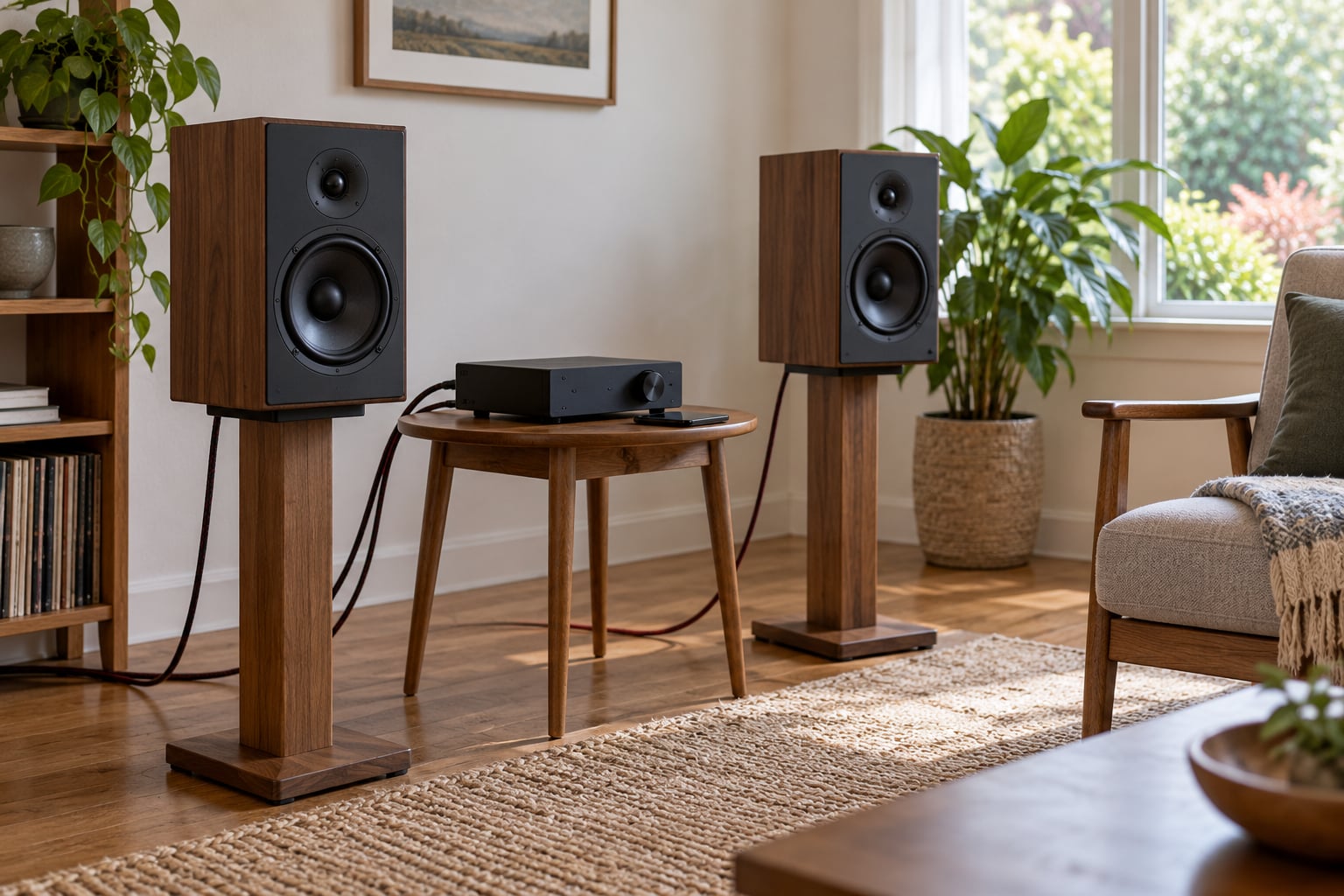
Set the pair on stands, angled toward your seat, with a little air behind each cabinet. Leave the rear vents and ports clear so the amplifier can move air during long sessions.
Check the manual’s placement guidance before you do anything clever with toe-in or wall mounting. Many bookshelf models are designed for a wall behind them, and pushing them out onto open stands changes the bass boundary reinforcement the designer assumed.
Wire both channels the same way round, then play something with a strong centre vocal. If the vocal sits in the middle, polarity is correct. If it drifts to one speaker, flip one channel and listen again.
On the amplifier, start with the volume low before connecting anything. An unfamiliar system can surprise you.
What Volume Should You Use?
Moderate volume, somewhere between a quiet room and a party, is the right level for speaker break-in. Around 70 to 75 percent of your amplifier’s maximum is the ceiling most manufacturers suggest, and that ceiling is not a target.
What actually matters is avoiding clipping. Clipping is what happens when the amplifier runs out of headroom and the waveform flattens at the top. It adds harshness and generates heat, and it is a far more realistic threat to a new speaker than the volume level itself.
Push the volume up until the music starts to sound slightly compressed or harsh at the edges, then back it off until it clears. That spot, minus a few percent, is your working level for the whole break-in period.
Leave enough headroom that normal listening never takes you near it. If you want to turn the volume up during a session, the amp is working too hard, not the speaker.
What Music Should You Play?
Varied music you know well beats any test tone for most people. Switching material is what reveals whether balance, clarity and bass have actually shifted, and a single track tells you almost nothing.
Build a short rotation that covers different demands on the drivers: something with steady low bass to work the surround, a vocal cut to check the midrange, and something with cymbals and strings for the top end. Rock, jazz, classical and an electronic track with a heavy low end will each stress the speaker differently.
Percussive passages and open guitar chords produce quick cone movement, which is exactly what a stiff suspension needs. A three-hour ambient drone barely moves the driver at all.
Pink noise gets a decent reputation for a reason. It spreads energy evenly across the spectrum and it does not get boring after hour two, so owners are more likely to finish the session. Music works just as well for home listening, and most people are happier listening to music than to noise.
Skip the deep bass test tracks and the deliberately clipping rips during break-in. There is no reason to audition the extremes of what your room can do in week one.
How Long Should Speakers Be Broken In?
Treat speaker break-in as gradual rather than as a countdown with a finish line. Manufacturer advice ranges from about an hour to 100 hours, and most speakers feel close to settled far earlier than either number.
| Manufacturer or source | Stated guidance | What it means at home |
|---|---|---|
| Celestion | Around an hour to help the suspension settle | A warm-up, not a full settling period |
| KEF | A few hours to a few days of normal use | Just listen normally for a week |
| Soundcore | 20 to 30 hours | Most listeners reach this in a week or two |
| Klipsch | About 100 hours | Longest recommendation; improvements taper off early |
Here is the schedule I would use. It keeps the drivers moving without turning your living room into a workshop.
- Days 1 and 2: 2 to 3 hours total per day at 60 to 65 percent volume. Low bass and vocals, no late-night sessions.
- Days 3 and 4: 3 to 4 hours per day at 65 to 70 percent. Full rotation, vocals in the centre.
- Days 5 and 6: 4 to 5 hours per day at 70 to 75 percent, still short of clipping.
- Day 7: Normal listening. Compare against your notes from day 1.
You can split sessions. Manufacturer sheets sometimes say consecutively, and touring players who run a cab hard for an hour get through it in one go. There is no measured evidence that hours must be continuous, so three evenings in a week beats three overnight runs you resent.
Judge progress by listening, not by the clock. Bass that sits deeper, a midrange that stops sounding edgey on cymbals, and less of that thin flutter on sustained bass notes are the signs worth looking for.
Common Mistakes
Playing loudly for hours. Break-in needs cone movement, not stress. A loud session on day one is the most common way people hurt a new speaker and then decide break-in was a bad idea.
Changing five settings at once. Moving speakers, changing toe-in, swapping cables and altering the amp’s tone controls in the same session makes it impossible to know what helped. Change one thing and give it a session to prove itself.
Judging from one track. A single album hides problems and invents them. Use the rotation and listen to something you have known for years.
Overheating the cabinet or amp. A closed cabinet in a small room, with an amp underneath it pushing hard, cooks both. Leave clearance above and behind.
Chasing bass with the tone controls. Boosting the low end on a speaker that has not settled yet just moves distortion. Fix the amp’s tone controls flat and let the driver do the work.
Expecting a transformation overnight. The improvement is real but gradual, and a lot of what people call break-in is their ear adjusting to a new room. Both matter, and neither arrives on day one.
When to Stop the Break-In Process
Stop playing and troubleshoot if you notice any of the following. None of these are break-in symptoms.
- Constant hum or buzz. A low hum that stays when the music stops is a ground loop or a cable problem, not a settling driver.
- Intermittent sound. Crackling that comes and goes, or one channel dropping out, points to a loose connection or a fault in the amplifier.
- Distortion that will not clear. Harshness that stays at low volume as well as high is a signal problem. Play a track you know well at a low level and listen carefully.
- A burning smell or unusually hot cabinet. Shut it down immediately. Smell the cable ends for a hot-plug or an underpowered amplifier straining.
- Bass that goes weaker instead of deeper. If a subwoofer or bass driver loses output over hours, the voice coil may be cooking.
- A driver that moves unevenly. Listen for rubbing or catching at low volume. Stop and have it checked.
If a speaker has already run 50 hours and still sounds harsh, the cause is rarely break-in. Check impedance matching, room placement, source quality and any tone controls before you blame the speaker. In the forum discussions around this topic, that same check is what resolves the problem for most owners.
Frequently Asked Questions
How many hours does it take to break in new speakers?
Most home speakers feel close to settled after 20 to 50 hours of moderate-volume use, spread over a week or two. Manufacturer recommendations range from roughly an hour to 100 hours, but the audible change tapers off well before the largest numbers. Judge progress by ear rather than by a counter: deeper bass and a less edgey midrange are the reliable signs.
How loud should I play speakers during break-in?
Stay at moderate volume, roughly 70 to 75 percent of your amplifier’s maximum, and stop well short of clipping. Clipping flattens the waveform, adds harshness and generates heat, which is far more damaging than the volume level itself. Increase gradually over the first week, and leave headroom so everyday listening never pushes you into that ceiling.
Can I break in speakers in multiple sessions?
Yes. Some manuals say hours should be consecutive, mostly a leftover from touring and pro practice where a cabinet is pushed hard for a set. Nothing measured shows that break-in hours have to be continuous. Three short evening sessions produce the same cone movement as one long block, and they are far easier to fit around normal listening.
Is pink noise good for breaking in speakers?
Pink noise is a reasonable choice because it spreads energy evenly across the spectrum and stays tolerable after an hour. Music you know well works just as well for home listening and makes changes easier to judge, because you have a reference for how the track should sound. Whichever you use, vary the material and avoid testing bass extremes in the first week.
Do new speakers need to break in, and does it change them permanently?
Most manufacturers say break-in is real, while some suggest it is largely your ear adjusting. Both effects occur. The physical side is minor: the surround and spider soften slightly with use, mainly in the first hours. The change is not permanent in any damaging sense, and a speaker that sounds wrong after 50 hours usually has a placement, matching or room problem rather than a break-in problem.
How does amplifier matching affect speaker break-in?
An amplifier that struggles with the speaker’s nominal impedance cannot deliver clean low-frequency current, and that shows up as thin, distorted bass that no amount of break-in will fix. Match the impedance on the speaker’s rear panel to what your amplifier is rated for, and keep the amp’s tone controls flat while the speakers settle. Fixing this first saves you weeks of blaming the wrong component.
Conclusion
Start with the part that costs nothing: check the impedance, place the speakers on stands with air behind them, and set both channels the same way round. Then play music you recognise at a volume well short of clipping for an hour or two a day for the first week.
Keep the amp’s tone controls flat, vary what you play, and stop if you hit hum, distortion or heat. If the speakers still sound wrong after 50 hours, the answer is in the room and the matching, not in more hours.