Noise-cancelling headphones work by listening to the noise around you, inverting it, and playing that inverted copy back into your ears so the two sounds largely cancel. Small microphones sample the outside sound, a chip builds a mirror-image signal in real time, and the ear speaker mixes it with your music. The result is a big drop in steady low-pitched rumble and almost no reduction in sharp, high-pitched sounds.
That split between what works and what does not is the single most useful thing to understand before buying a pair, so let’s walk through the whole system: the physics, the hardware, the two competing methods, and what you can change yourself.
Table of Contents
- What Are Noise Canceling Headphones?
- How Noise Canceling Headphones Work
- Active Noise Cancellation: The Main Technology
- The Parts That Make the System Work
- Active vs Passive Noise Isolation
- What Types of Noise Can They Reduce?
- Why Noise Canceling Headphones Can Create a Vacuum Feeling
- What to Look for When Choosing Noise Canceling Headphones
- How to Get the Best Noise Reduction
- Frequently Asked Questions
- Do noise-cancelling headphones work without playing music?
- Can I still hear people talking with noise-cancelling headphones on?
- Are noise-cancelling headphones safe for your ears?
- What are the downsides of using noise-cancelling headphones?
- Why do noise-cancelling headphones give me a pressure feeling or headache?
- How much noise can noise-cancelling headphones cancel, in decibels?
- Conclusion
What Are Noise Canceling Headphones?
Noise-cancelling headphones are headphones that actively measure outside sound and generate an opposing signal to reduce what reaches your ear. They are not the same thing as noise-isolating headphones, which only use thick padding and a physical seal to block sound.
The distinction matters because the two methods attack different problems. A tight seal is very good at taking the edge off a door slam and almost useless against a bus engine two metres away. Electronic cancellation does the opposite. It is at its best on that engine drone and struggles with the door slam.
Where this gets useful day to day: a long-haul cabin at cruising altitude, a train or bus commute, an open-plan office, a noisy kitchen while cooking, or light sleep in a shared flat. For radio listening at a desk, they also let you keep the volume low enough that you still hear the programme clearly rather than turning it up to fight the room.
How Noise Canceling Headphones Work
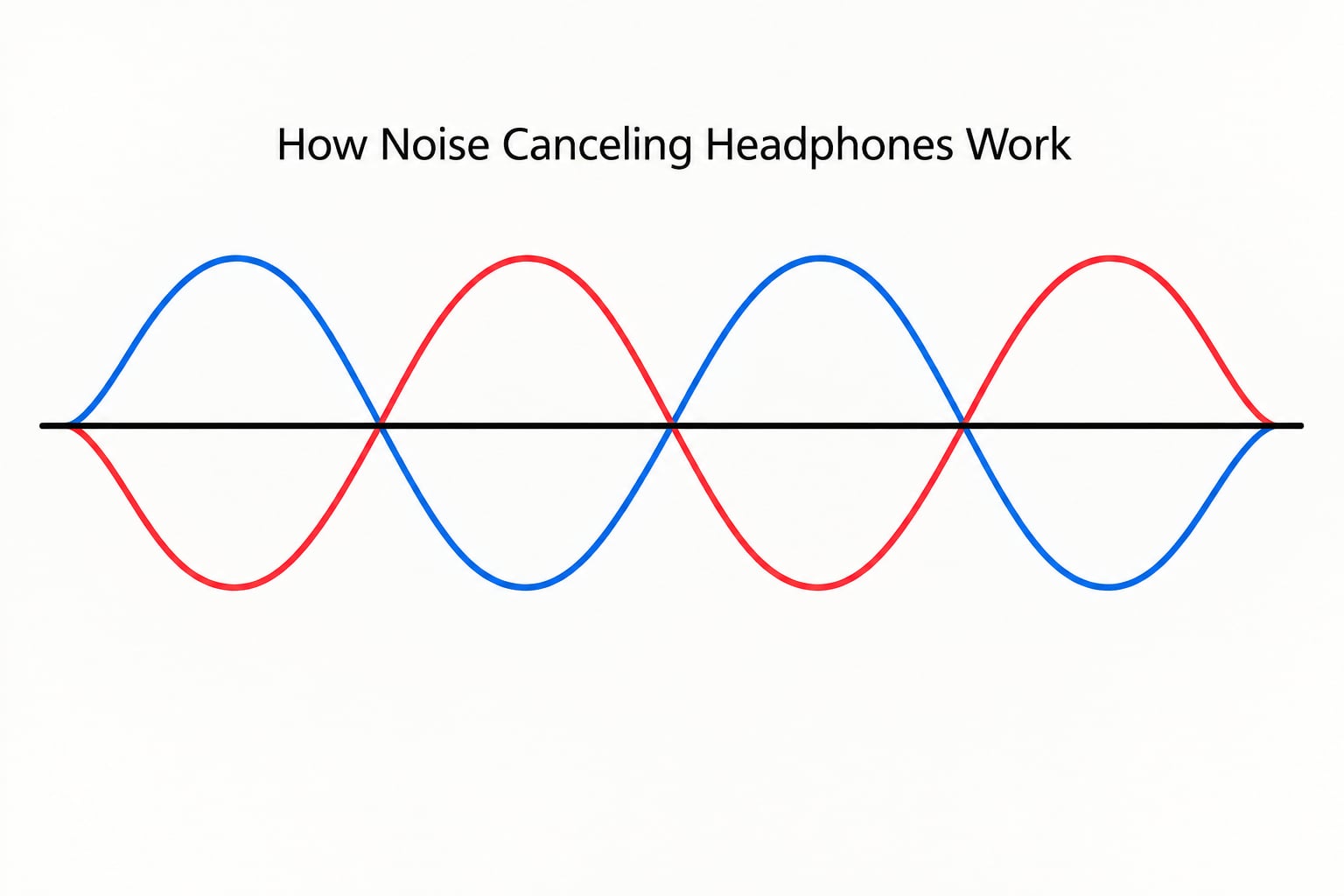
The whole idea rests on phase. When an air molecule moves and pushes its neighbour, that pressure change travels outward as a wave with peaks and troughs. Add a second wave whose peaks land exactly where the first wave’s troughs are, and the two amplitudes subtract each other. Instead of louder sound you get near silence, and that effect is called destructive interference.
So the process, stage by stage:
- The microphones listen. One or more mics on the outside of each ear cup pick up the ambient sound before it reaches you. On most modern pairs there are two or more per side, feeding a chip thousands of times per second.
- The chip inverts the wave. Digital signal processing analyses the incoming signal and generates a copy that is equal in amplitude but flipped by 180 degrees, so peaks become troughs. This mirrored signal is the anti-noise.
- The speaker plays it and the waves meet. The anti-noise is mixed into your music at the ear. Where it overlaps the real noise, destructive interference lowers the level reaching your eardrum.
Two details are easy to miss. The chip has to work far faster than sound changes, because a jet engine note shifts the moment you move your head. And the anti-noise is added to your music, not subtracted from the world, which is why some listeners notice a faint tonal hiss in quiet passages.
Active Noise Cancellation: The Main Technology
Active noise cancellation, usually shortened to ANC, is the electronic half of the system. It needs a power source, a processor and a speaker that is deliberately playing something other than your music. That is why ANC headphones have an on/off switch at all: switching it off kills the electronics but leaves the physical seal doing its passive job.
Feedforward ANC: microphones outside the ear cup
A feedforward mic sits on the outer shell and hears noise before it reaches you. Because it samples the sound on its way in, it can react quickly and handle a wider range of frequencies than a mic sealed inside the cup. Its weakness is that it has no idea what actually arrived at your ear, so if the seal leaks or the fit is off, the anti-noise is generated from the wrong noise.
Feedback ANC: a microphone inside the cup
A feedback mic sits inside the ear cup, close to the driver, and measures the residual sound that survived the first pass. It is measuring the result, not the input, so the system can correct itself continuously. That makes it good at low frequencies, which is where cabin noise lives, but less able to chase fast changes than a feedforward mic.
Hybrid ANC: both at once
Hybrid systems use a mic outside and a mic inside together. The outside mic gives an early reading and the inside mic cleans up the error, which is why hybrid designs tend to hold their cancellation steady when you move your head or shift the glasses that distort your ear-cup seal. It holds its cancellation better than either microphone alone, which makes it the arrangement most flagship pairs use.
What all three share is the preference for steady sound. A constant engine note has a predictable shape, so the processor can stay locked to it. A reversing truck, a barking dog or a sudden announcement does not give the system anything stable to mirror.
The Parts That Make the System Work
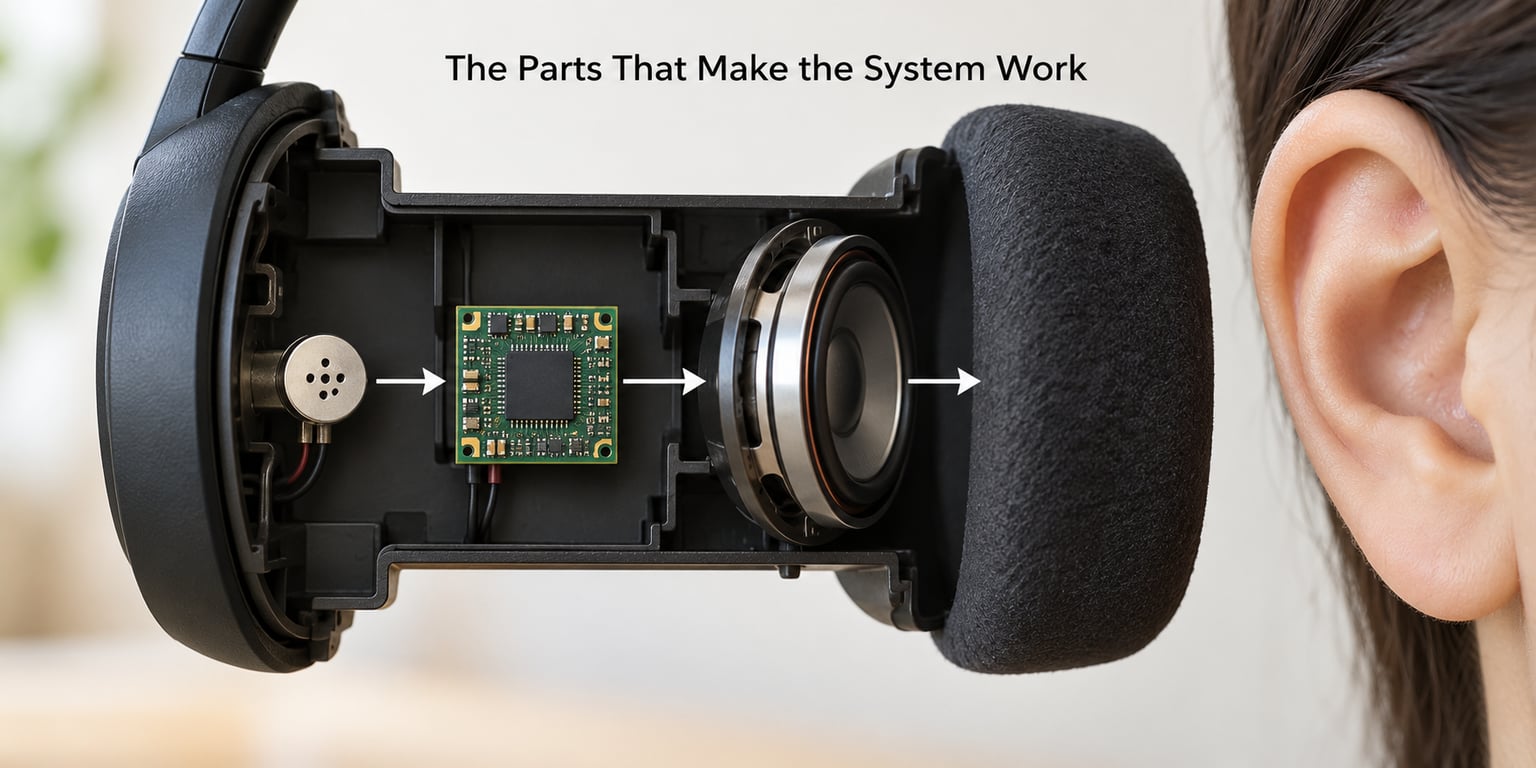
Reading a spec sheet is easier once you know what each component is doing. Here is the signal chain, from the air outside your head to the anti-noise you hear:
| Component | Job in the chain |
|---|---|
| Feedforward microphone | Samples outside noise before it reaches the ear |
| Feedback microphone | Measures residual noise inside the cup and feeds back an error signal |
| Analogue-to-digital converter | Turns the microphone signal into data the chip can work on |
| ANC chipset or DSP | Generates the 180-degree-out-of-phase anti-noise and adjusts it continuously |
| Digital-to-analogue converter and ear speaker | Play the anti-noise mixed with your music |
| Ear cups, cushions and clamping force | Provide the passive seal that stops sound leaking in around the electronics |
| Battery or power source | Runs the microphones, chip and speaker continuously while ANC is on |
Several of these pull in the same direction. A weak battery can make a chip recalculate less often, a blocked microphone port can starve the system of input, and worn ear cushions can wreck the seal that the feedback mic relies on. ANC is a chain, so the quietest-sounding component is not always the one that matters.
Active vs Passive Noise Isolation
Every serious pair of noise-cancelling headphones uses both methods, and comparing them explains most of the differences in price between models.
| Active noise cancellation | Passive noise isolation | |
|---|---|---|
| Mechanism | Microphones, processing and a speaker playing inverted sound | Materials, padding and a physical air seal |
| Power needed | Yes, a battery or mains supply | No |
| Best at | Steady low-frequency noise: engines, vents, hum, rain | High frequencies and transients: voices, horns, bangs, keyboards |
| Weak spot | Sudden or unpredictable sound, and very high pitches | Low-frequency rumble, which travels straight through foam |
| Fit sensitivity | Moderate on hybrid designs | Extreme; the seal is the whole mechanism |
A heavy layer of foam blocks short, sharp, high-frequency sound well because that wavelength is small and gets absorbed in the material. A low rumble has a long wavelength and simply passes through it. Electronics are needed for the rumble, and material science is needed for the hiss, which is why every pair does both.
What Types of Noise Can They Reduce?
Sound is easier to cancel when it is steady, low in pitch and predictable. The processor can only mirror a pattern it can see repeating, and long low-frequency waves are also far easier to phase-match accurately across the cup.
Steady low-frequency noise, where ANC shines
Airplane cabin drone, train engines, air conditioning, a fan in a server cupboard, distant traffic and washing machines. These hold a stable frequency, so the anti-noise stays locked to them for as long as the sound continues. This is the effect that makes a flight feel suddenly, strangely quiet.
Intermittent sound, handled partially
Speech, door closing, someone tapping a pen, a kettle boiling. The system catches the sustained tail of each sound and mutes it, but the initial instant usually leaks through, which is why a conversation can sound oddly hollow, like a voice heard through a wall.
High-pitched and sudden sound, where ANC gives up
Whistles, car horns, dog barks, cutlery, construction noise and a slammed drawer. These have very short wavelengths, and matching phase precisely gets harder as the distance between two microphones gets large relative to the wavelength. Music vocals also sit in a range the chip tends to leave alone, so singers can stay stubbornly audible with the strongest cancellation running.
Here is the honest limit of how noise canceling headphones work. A manufacturer claiming 40 dB of attenuation is describing steady low-frequency conditions in a laboratory, not a chatty café. Treat the number as the best case rather than the everyday one.
Which sounds ANC handles and which ones leak through
| Sound you want gone | How well ANC handles it | What actually does the work |
|---|---|---|
| Airplane cabin drone | Very well | ANC, helped by the ear-cup seal |
| Air conditioning hum | Very well | ANC |
| Distant traffic | Well | ANC, with passive isolation taking the edge off |
| Rain on a window | Partly | Both, depending on how steady it is |
| Conversation nearby | Poorly | Passive isolation, or just turning the volume up |
| Announcements and alarms | Poorly | Transparency mode, deliberately |
| Dog barks, horns, cutlery | Barely at all | Foam and padding |
| Sudden bangs and clatters | Barely at all | Foam and padding |
Wind deserves its own line, because it behaves unlike anything else on that list. Air moving across an external microphone diaphragm creates its own pressure signal, which the chip then dutifully tries to invert. The result is an audible whoosh inside the headphones that has nothing to do with the noise you were hoping to remove. Many pairs now include a wind mode that gates the feedforward microphones down when it detects this, which is worth checking if you cycle outdoors.
Why Noise Canceling Headphones Can Create a Vacuum Feeling
Plenty of listeners describe a pressure sensation or a mild headache the moment ANC switches on, and it is one of the most repeated complaints in headphone forums. The usual explanation is a combination of reduced cabin noise, a tight seal and the way the brain interprets a large, sudden drop in background sound as a physical change in pressure, similar to the ear pop on a flight descending.
On-ear cups make it more noticeable than earbuds, because the sealed volume around the ear is larger. If it bothers you, turning transparency mode on briefly, or taking the headphones off for a minute, breaks the effect. A headband that is simply too tight causes the same feeling for a different reason, and loosening it or swapping the cushion size often fixes that.
The sensation is uncomfortable, not a fault. Nothing is being damaged, and it usually fades within a few minutes of wearing.
What to Look for When Choosing Noise Canceling Headphones
Skip the marketing gloss and check these in order:
- Cancellation strength against your noise. Ask specifically about low-frequency rumble, since that is where the difference between a good and a great pair shows.
- Microphone quality for calls. ANC microphones and call microphones are often separate; check reviews for how the pair behaves on a windy street.
- Comfort over a long session. Cushion depth, clamping force and weight decide whether you can wear them for a four-hour flight or want them off after an hour.
- Battery life with ANC actually switched on. Rated playtime usually assumes ANC off, and a heavily used chip can take a noticeable bite out of it.
- Transparency mode quality. Listen to it before buying. A good one sounds natural, a cheap one sounds like a telephone in another room.
- Codec and multipoint support. Relevant if you switch between a laptop and a phone for radio work or calls.
- Whether you want music or silence. For focus and commuting, cancellation matters most. For critical listening at a desk, a neutral pair with a decent passive seal may serve you better.
How to Get the Best Noise Reduction
Most disappointing ANC is a fit or settings problem, not a hardware problem. A short routine fixes it:
- Get the seal right first. Over-ear cups need the pad sitting flat against the curve of your head, with no glasses arm trapped in the middle. Earbuds depend on the right ear tip size, and foam tips that have gone flat will not seal at all.
- Check the microphone ports. Dust, fluff and pocket debris on the outside mesh cut the input signal, and the chip has nothing accurate to invert. Wipe them gently and keep ANC off while you do.
- Pick the mode for the environment. Max cancellation for steady travel noise, a mid level for an office where you still need to hear a colleague, and transparency at a crossing or a till.
- Update the firmware. Makers tune the filter through app updates as much as through hardware, and an old tuning curve underperforms the same phone.
- Look after the cushions and battery. Replace ear tips when they flatten out and charge before long journeys. A pair of fresh tips on an older pair regularly beats a new pair on old tips.
Frequently Asked Questions
Do noise-cancelling headphones work without playing music?
Yes. The microphones, chip and anti-noise speaker run off the battery regardless of whether audio is playing, so switching ANC on with nothing queued still reduces steady background noise. Many listeners use a pair this way on flights or in offices. Music simply adds masking on top, which covers the sounds ANC cannot touch.
Can I still hear people talking with noise-cancelling headphones on?
Usually yes, and that is expected rather than a fault. Human speech sits mostly in the mid and high frequencies, where wavelengths are short and phase matching gets difficult, and voices change shape constantly, so the processor has little stable pattern to mirror. Sustained vowel sound fades noticeably; consonants often cut straight through.
Are noise-cancelling headphones safe for your ears?
They can be safer than ordinary headphones, because you can listen at a lower volume instead of turning everything up to fight a noisy room. They add no harmful sound of their own. Keep volume moderate, take breaks during all-day wear to let ears dry out, and if you already have tinnitus, speak to a clinician rather than relying on cancellation alone.
What are the downsides of using noise-cancelling headphones?
The common complaints are a pressure or vacuum feeling in the eardrums, a faint tonal hiss in quiet passages when anti-noise is audible without music, reduced battery life, added processing that can slightly alter sound quality, and wind noise being re-amplified by the microphones outdoors. A heavy pair can also get warm after a few hours.
Why do noise-cancelling headphones give me a pressure feeling or headache?
A large sudden drop in background noise, combined with a sealed ear cup, is interpreted by the brain much like a cabin pressure change, which produces that vacuum sensation. Headphone forums fill with people describing it across several brands. It is uncomfortable rather than harmful, and loosening the headband or using transparency mode briefly usually settles it.
How much noise can noise-cancelling headphones cancel, in decibels?
Manufacturer figures usually describe steady low-frequency sound in laboratory conditions, and top-end pairs claim attenuation around 40 dB. A 10 dB drop is roughly half as loud to the ear, which explains why good ANC feels dramatic on an aircraft. In a real street or office you will notice far less, because voices and transients are barely affected.
Conclusion
How noise canceling headphones work comes down to four moving parts: a microphone that hears the noise, a chip that builds an inverted copy of it, a speaker that plays that copy, and a seal that stops sound sneaking in around the hardware. Everything else on the box is refinement.
Before you buy or before you blame a pair that seems weak, check four things in this order. Identify the noise that actually bothers you and whether it is steady or sudden. Test the seal, because no electronics can rescue a leaking pad. Then judge the cancellation against low-frequency rumble rather than voices, and finally check comfort, since the best noise control in the world is worthless if you cannot wear the thing for a two-hour flight.