Room acoustics change the way radio sounds because the room is the last thing the audio passes through before it reaches your ears. Walls, floors, ceilings and furniture reflect, absorb or scatter the sound, so the same station arrives louder, thinner, boomier or clearer in one room than in the next. Your radio does not send a different signal in each room. The room simply re-colours it.
That is why the news sounds crisp on a kitchen worktop and muffled in a carpeted lounge, and why a speaker that sang in a shop demo can sound disappointing at home. The demo room was chosen and treated. Yours was not.
Table of Contents
- What Room Acoustics Change in Radio Sound
- How Reflections, Absorption, and Diffusion Shape Sound
- Why Frequency Response Sounds Different in Different Rooms
- How to Hear the Same Radio Station More Accurately
- Simple Room Treatments That Make a Difference
- Room Acoustics for Streaming, DAB, and FM Listening
- Frequently Asked Questions
- Start With One Small Change
What Room Acoustics Change in Radio Sound
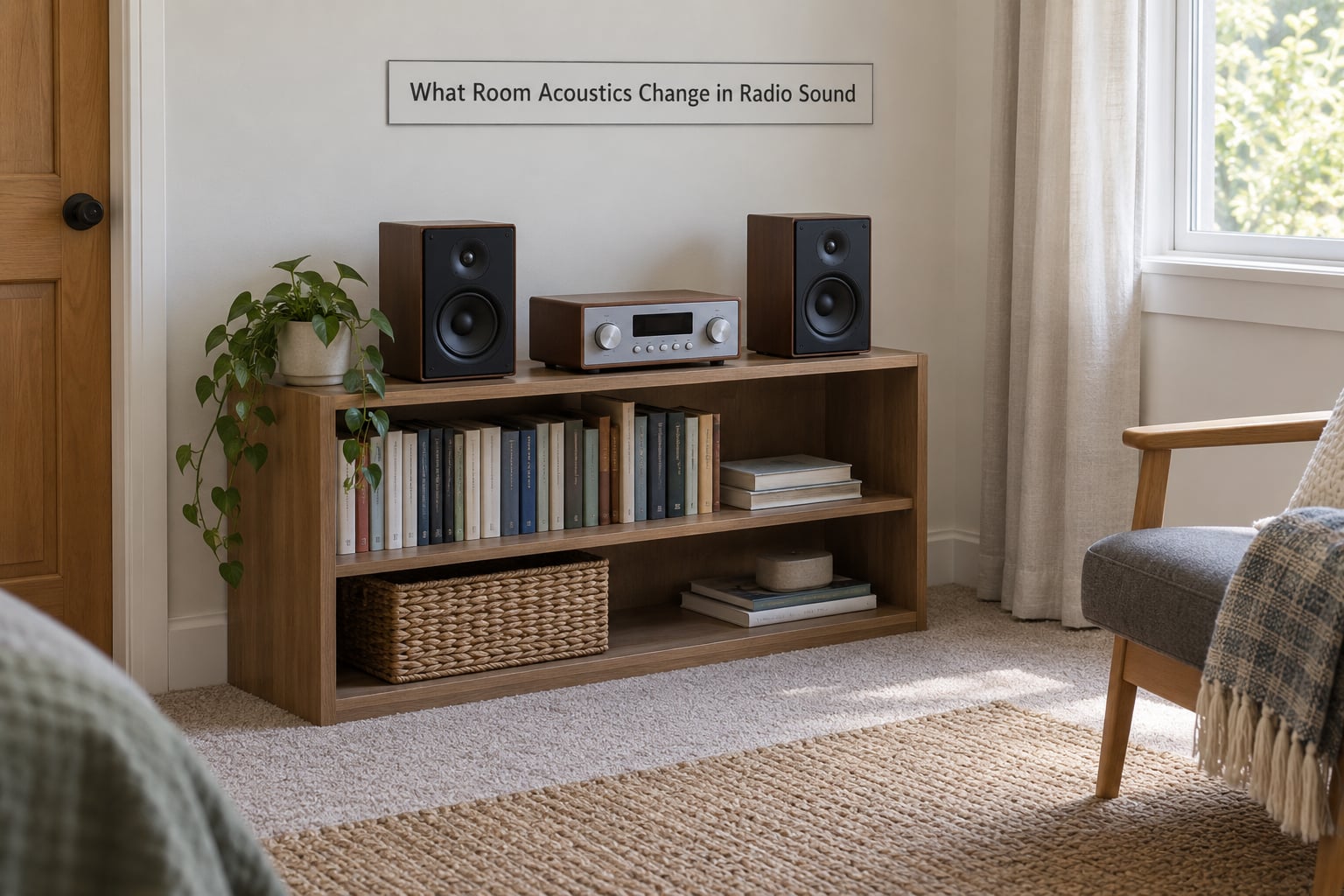
Room acoustics is the way sound behaves once it leaves the speaker: how it reflects off surfaces, how long it takes to decay, and which frequencies the room’s dimensions reinforce or cancel. The signal leaving your radio is identical in every room. What changes is everything the room adds to it before your brain hears it.
Four things move as you move around a home, and listeners notice all of them without being able to name them. Loudness shifts, because a soft-furnished room swallows energy. Clarity changes, because reflections blur the gaps between words and notes. Bass either bulges in the corner or disappears in the middle of the room. And brightness changes, because bare plaster and glass throw treble back at you while carpet and curtains do not.
It is worth separating two words people use interchangeably. Soundproofing or sound isolation is about stopping sound passing through a wall into the next flat. Acoustic treatment is about how sound behaves inside your room. Rugs and curtains do the second job well and the first job not at all.
Why the same station sounds different in every room
Listen to a news bulletin in the kitchen, then carry the same radio to the lounge. The station has not changed, and neither has the speaker, yet the voice will sound noticeably closer and thinner in one room and duller and further away in the other.
Forums like r/audiophile and r/Acoustics are consistent on one point: the room is usually the limiting factor, not the speakers. People ask for advice about upgrading and get told to move the speaker ten centimetres and put a rug down first.
Radio has one extra wrinkle that music does not. Much of what you hear is speech, and speech intelligibility depends on the direct sound arriving cleanly and slightly ahead of the reflected sound. When the two arrive together, words blur.
How Reflections, Absorption, and Diffusion Shape Sound
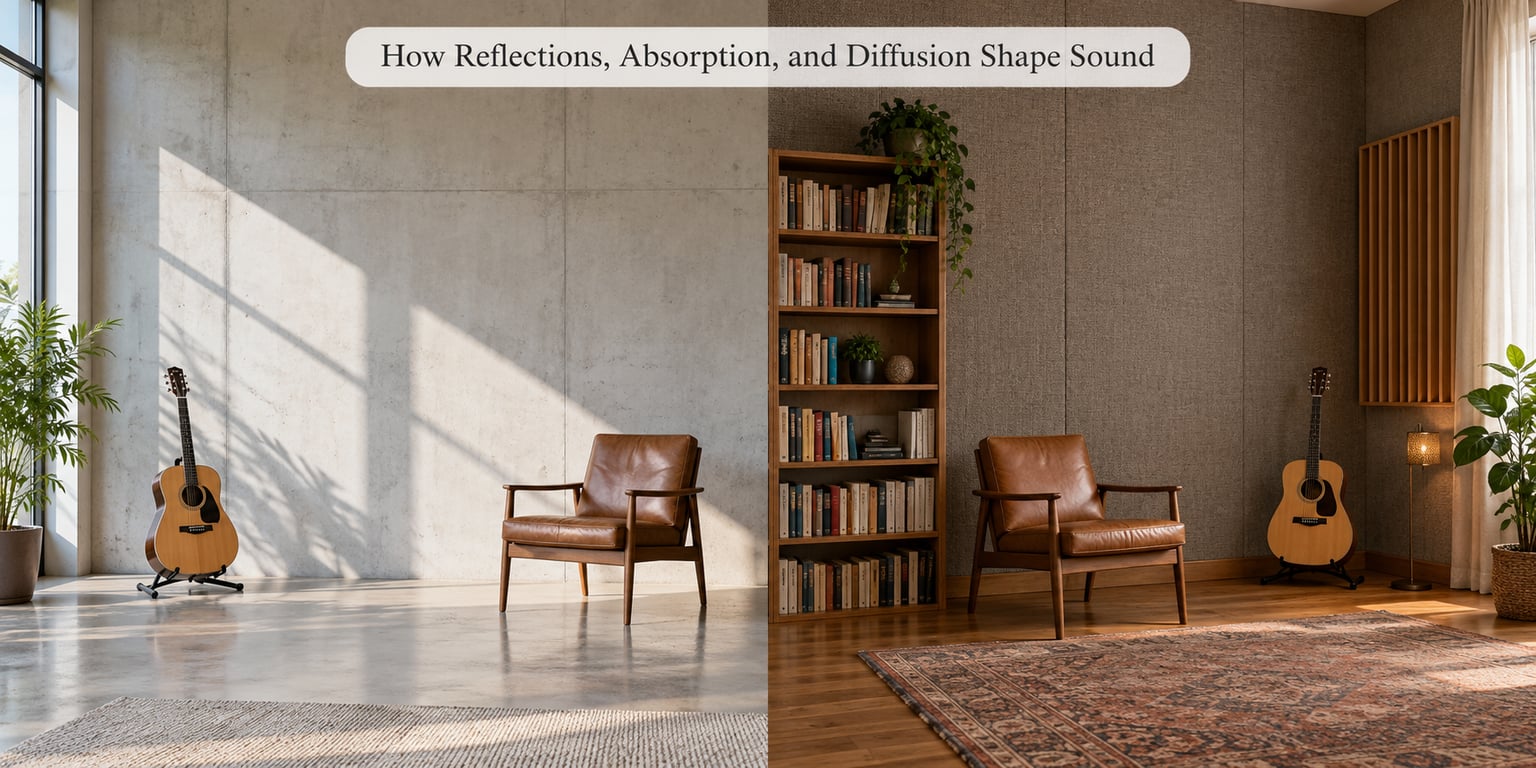
Sound leaves a speaker as a direct sound and bounces off every surface it meets at the same time. Those reflections arrive a few milliseconds later and your ear fuses them into one event, which is why a good room sounds natural and a bad one sounds like the voice is smeared.
There are three things a surface can do with that energy. Hard surfaces reflect it, mostly back at you, which sharpens the sound and can create flutter echo between two parallel hard walls. Soft and porous surfaces absorb it, turning the energy into a little heat and shortening the decay. Diffusion surfaces scatter it in many directions instead of one, which softens a reflection without deadening the room.
Reverberation is simply the sum of all those reflections, and it is measured as reverberation time, or RT60: the number of seconds for a sound to decay by 60 decibels. A carpeted bedroom might sit around 0.4 seconds. A room with tile, glass and bare plaster can run past a second. For speech on radio, shorter is easier, because each word needs to fade before the next one starts.
What each surface in your room actually does
| Surface | Acoustic effect | Where it helps |
|---|---|---|
| Bare plaster wall | Reflects almost everything, strong treble return | The side wall beside a speaker |
| Glass window | Hard reflective surface, loses bass energy | Keep speakers angled away from it |
| Wood floor | Reflective, with some absorption when bare | A rug underneath the listening spot helps more |
| Tile or laminate | Almost pure reflection, brightest of floors | Cover a third of the floor area |
| Thick rug or carpet | Absorbs mid and high frequencies | Between the speaker and your chair |
| Heavy curtain | Absorbs mid and high frequencies well | Along the wall behind the speaker |
| Sofa and upholstery | Broadband absorption, softens decay | Anywhere it already sits |
| Bookshelf | Scatters and absorbs, a cheap diffuser | Behind or beside the speaker |
| Acoustic panel | Targeted absorption, speech range 250 Hz to 4 kHz | First reflection points |
That table is also why office-grade foam panels disappoint many listeners. They work hardest between 250 Hz and 4 kHz, which is speech, and do very little below 100 Hz, which is the bass boom most people are complaining about.
Why Frequency Response Sounds Different in Different Rooms
Frequency response in a room is shaped by the dimensions of the space and by where the speaker and the listener sit inside it. Low frequencies behave like waves you can feel and they wrap around the room, which is why bass is the least predictable part of home listening.
Every room has room modes, frequencies where its exact length, width and height reinforce each other. Some positions get a bass build-up, others sit in a null where the same bass almost disappears. Sitting in a corner is the worst case, because you are hearing the direct sound plus the low-frequency build-up of three surfaces at once.
Hard surfaces also cause boundary interference: when a speaker sits close to a wall, the wall reflection arrives in step with the direct sound at low frequencies and pushes a bump into the response. Move it out from the wall and the bump usually flattens.
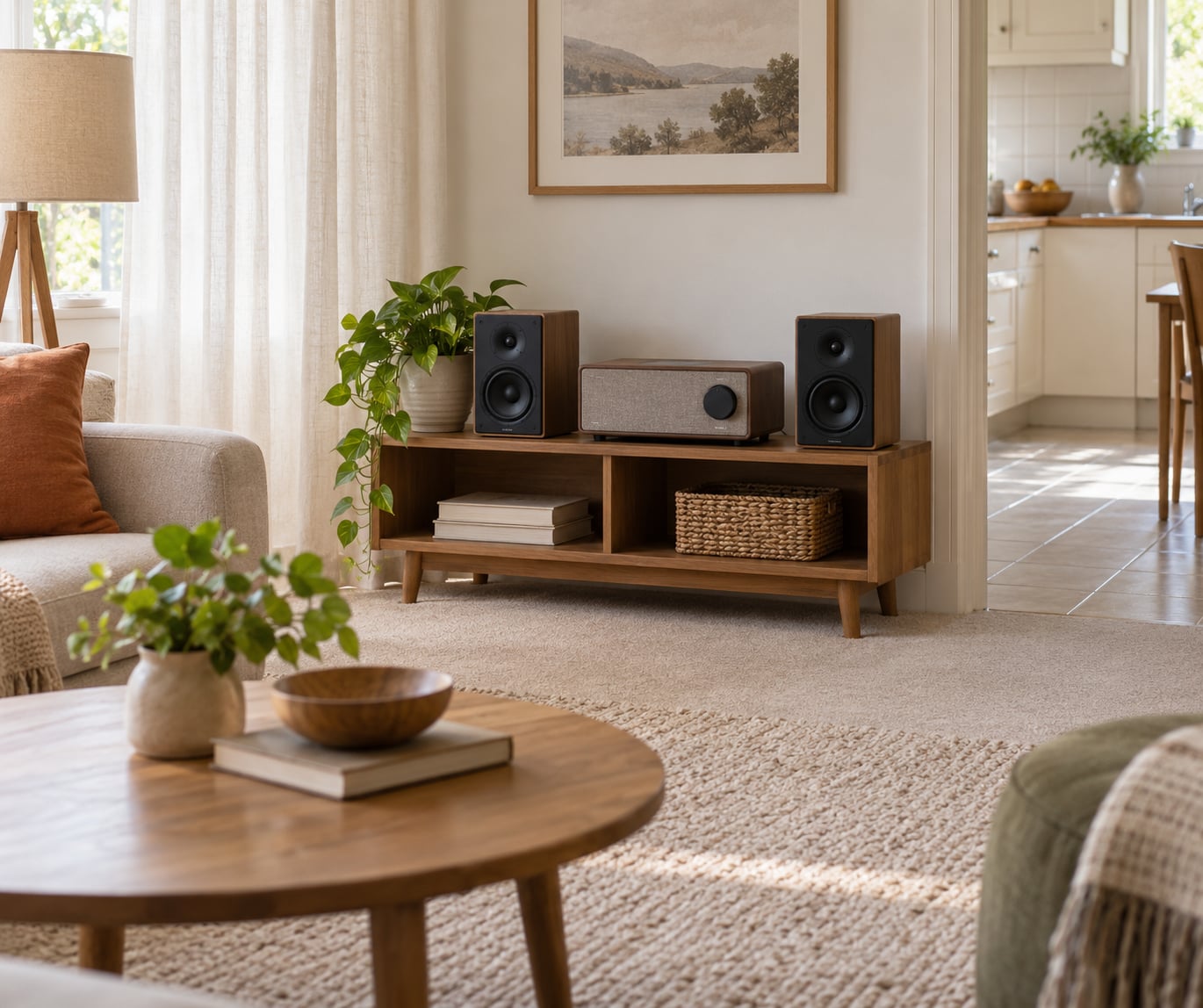
High frequencies behave almost the opposite way. They are absorbed by soft furnishings and reflected by hard ones, so the same radio sounds bright and forward in a kitchen and dull and distant in a bedroom with a thick bedspread and curtains.
Where the same station sounds most different
| Room | What you hear | Cause |
|---|---|---|
| Kitchen | Bright, thin, splashy | Tile, glass and hard cabinet fronts |
| Living room | Full but often echoey | Large volume, mixed surfaces, speaker near a wall |
| Bedroom | Muffled, soft, short on presence | Heavy carpet, bed, curtains |
| Open-plan space | Weak at the far end, strong nearby | Speaker only covers part of the room |
| Car | Consistent, close, slightly boomy | Small sealed volume, near-universal surface treatment |
That last row explains something most people notice without explaining. A car is a terrible recording environment and an excellent listening one, because the small sealed volume and the fabric-covered interior give it an even, predictable decay.
How to Hear the Same Radio Station More Accurately
You can audit your own room in about ten minutes with no equipment beyond a phone. The goal is not a measurement, it is a before-and-after comparison you can hear.
Run it like this:
1. Set the radio to a station you know well, a talk or jazz station rather than heavily compressed chart music, and fix the volume at a moderate level you can hear across the room.
2. Stand or sit in your usual chair and listen to sixty seconds. Then stand in the middle of the room and listen to the same sixty seconds. The difference is the room’s contribution and it is usually bigger than people expect.
3. Clap once, hard, in the middle of the room. A dead, flat clap means the room is absorbing well. A long ringing one means decay time is high and you will hear blurred speech as a result.
4. Move the speaker away from any wall and out of any corner, then repeat step two from the same seat. Get someone else to move it while you listen, since you cannot judge the change from the wrong position.
5. Compare at low volume as well as moderate. This matters more than most advice online suggests. At a low level your ear loses most of its sensitivity to the direct sound and leans on the reverberant tail, so a live room makes quiet listening sound noticeably worse than loud listening.
6. Record thirty seconds on your phone from your chair, then move the speaker and repeat. Comparing the two recordings removes your memory from the argument.
Simple Room Treatments That Make a Difference
Ranked from cheapest and most reversible to most expensive, these are the changes that do the most for the least. People on r/BudgetAudiophile and diyaudio consistently report rugs, curtains and soft furniture delivering the largest improvement per pound spent.
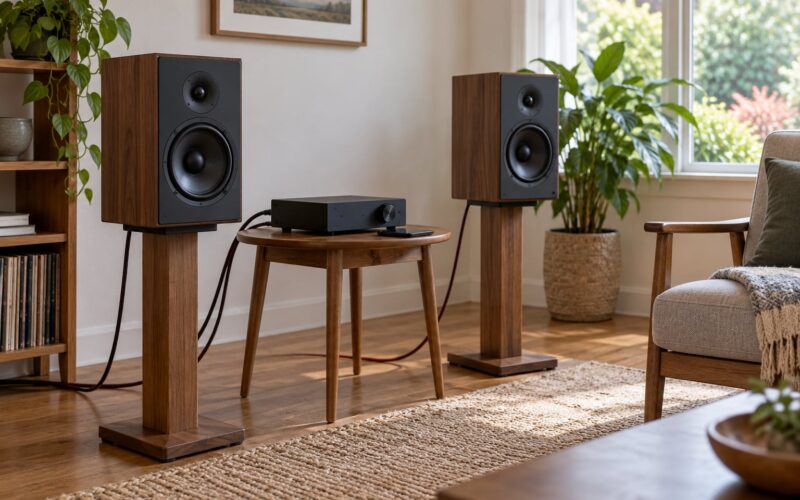
Start with placement. Move the speaker off the wall, out of the corner, and onto a stand or a stiff surface at roughly ear height when you are seated. In a small room, listen closer to the speakers, almost nearfield, and the room’s grip weakens further.
Then add absorption where it belongs: a thick rug between the speaker and your chair, a heavy curtain along the wall behind the speaker, and a bookshelf already in the room doing more acoustic work than you think.
For corners, a rolled-up heavy blanket in the wall-to-ceiling corner or a purpose-made corner bass trap does more for low-frequency build-up than any amount of foam on the flat wall.
Room correction DSP, the tone adjustment built into many receivers and all-in-one speakers, is a different tool. It measures a microphone at your chair and applies filters to flatten tonal balance at that one spot. It cannot remove reflections, shorten decay time or fix a standing wave, so it treats the symptom rather than the room.
If you want to try panels, broadband panels filled with mineral wool and air behind a breathable fabric cover beat thin decorative foam, and a thick rockwool panel is far better than a thin one. Cheap and reversible still wins, though, and in most living rooms soft furnishings will do 80 percent of the work.
Room Acoustics for Streaming, DAB, and FM Listening
Room problems affect streaming, DAB, DAB+ and FM in exactly the same way, because the room sits after the delivery method in the signal chain. What the delivery method changes is what arrives at the room in the first place.
Streamed and Wi-Fi speakers often add their own room correction automatically, which can partly mask a bad room until you change seats. Compact Bluetooth speakers sound surprisingly good in a small room for exactly this reason: they are being used nearfield, close to the listener, where the direct sound dominates.
Broadcast audio is dynamic and usually compressed, which means quiet passages carry a lot of information. A live room smears those quiet passages first, so a news bulletin degrades faster with reverberation than music does.
Used speakers are the other common disappointment. A system that sounded balanced in one room can be bass-heavy in another, because the room modes line up differently. Soundproofing between flats is a separate matter again: it needs mass, sealing and decoupling, and no amount of absorption will stop transmission through a thin wall.
Frequently Asked Questions
How does sound travel through a room?
Sound leaves the speaker as a direct sound and simultaneously bounces off walls, ceiling and floor. Those reflections arrive milliseconds later and your ear fuses them with the direct sound, which is why a live room makes voices sound thinner and blurrier. The split between direct sound and the reverberant field behind it is what listeners hear as clarity.
What is room correction in audio?
Room correction is digital signal processing that plays test tones, measures the result with a microphone at your listening position and applies filters so the tonal balance is flatter there. It is genuinely useful. What it cannot do is remove reflections, shorten decay time or fix a standing wave, so it corrects the symptom rather than the room itself.
How to dampen sound between rooms?
Dampening sound between rooms is a transmission problem, not a room acoustics problem. Add mass to the wall, seal the gaps around sockets and skirting with acoustic sealant, and decouple the new surface from the old one so it does not vibrate as a single panel. Rugs and curtains absorb sound inside a room but barely reduce what reaches the next flat.
What type of wall is most effective at reducing sound transmission?
Dense, heavy, well-sealed masonry on its own decoupled frame performs best. Inside a listening room the property that matters is different: how much energy the surface absorbs at speech and high frequencies. Dense block reflects sound and creates bass build-up, so a listening room needs soft, absorbent materials layered over it.
Does room size affect sound quality?
Yes, and room size sets the frequencies at which problems appear. Small rooms push their room modes up into the range where most music and speech live, so bass build-up and muddy midrange are more common. Large open rooms weaken the direct sound across the space, so the listener simply hears less detail from the speaker.
How do I stop sound echoing in my living room?
First move the speaker off the wall and out of the corner, since parallel hard surfaces cause most audible flutter echo. Then add soft materials on the two surfaces involved: a rug on the floor and a heavy curtain on the wall. Bookshelves and upholstered furniture scatter and absorb too, and panels on the first reflection points work when the cheaper options run out.
Start With One Small Change
Move the radio or speaker away from the corner and off the wall today. It costs nothing, takes two minutes and fixes the single biggest problem most rooms have.
After that, sit in your normal chair, listen at a moderate level, and listen again from the middle of the room. If the difference surprises you, the room is doing more to the sound than the speaker is, and it is worth ten minutes of your evening.
Add soft materials only once you know which problem you have. A rug fixes a bright floor, a heavy curtain fixes a reflective wall behind the speaker, and a corner bass trap fixes low-frequency build-up. Doing all three at once tells you nothing about which one mattered.
In short: how room acoustics change the way radio sounds comes down to reflections, decay time, and the dimensions of the room you are sitting in. Fix the surfaces and the placement before you touch the volume, and the station you already listen to will sound like a different broadcast.