The loudness war is the ongoing trend of increasing the average volume of recorded music, which reduces dynamic range and often introduces audible distortion. What the loudness war did to recorded music is measurable: tracks got louder, the gap between the quietest and loudest moments shrank, and mastering engineers traded real musical decisions for a number on a meter.
That is the honest version. The dishonest version is the one that blames every modern record for sounding bad, or claims your speakers are at fault for something that happened decades ago in someone’s mix bus. Both versions are floating around online, and neither is much use if you just want your music to sound right.
So here is what actually happened, why it happened, what it did to the sound coming out of your speakers, and what you can do about it now that streaming services measure loudness before playback.
Key takeaways
- The loudness war was a mastering decision to raise average level, and it cost dynamic range, detail and depth in exchange.
- Loudness is not the same as volume. Your volume knob sets playback level; the master decides how much of the recording is compressed.
- Clipping and brickwall limiting are what make heavily limited music sound harsh rather than merely loud.
- Radio compresses a second time on the way out, under broadcast standards, so a station stream flattens dynamics even when the master is fine.
- Streaming normalisation has largely ended the arms race on the major platforms, but it does not give back the dynamics that were already removed.
Table of Contents
- What Was the Loudness War?
- Why Did Record Labels Make Music So Loud?
- How Does Loudness Differ From Volume?
- What Changed in the Mastering Process?
- Why Do Songs Sound Fat, Harsh, or Exhausting?
- What Is the Difference Between a Radio Edit and a Streaming Master?
- How Did Streaming and Loudness Normalization Change the Battle?
- What Is the “Loudness War Fix” for Listeners?
- Frequently Asked Questions
- Conclusion
What Was the Loudness War?
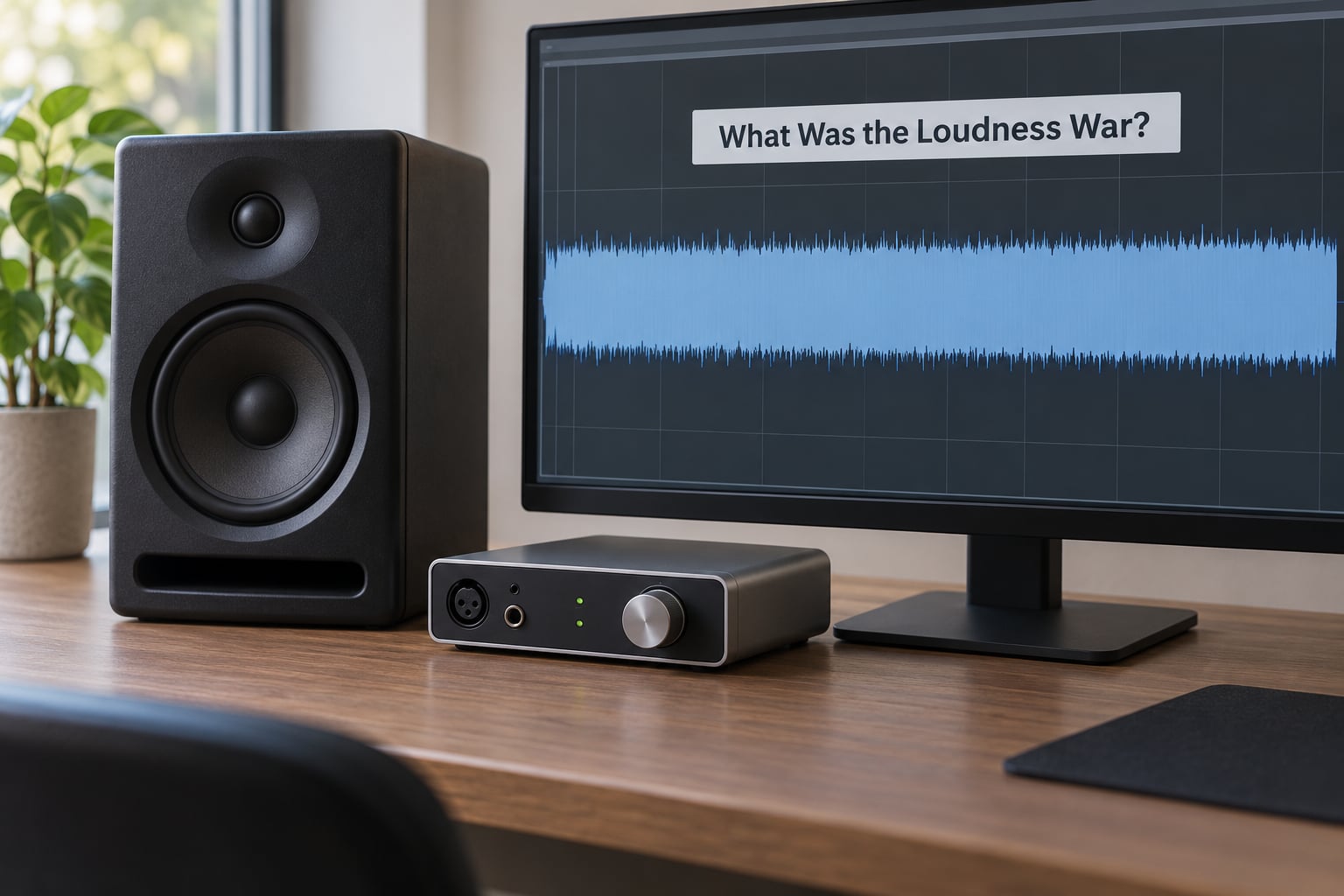
The loudness war is the effort by mastering engineers and their employers to make recorded music sound louder than the last release, achieved by compressing the audio so its average level sits as close as possible to the digital maximum without audibly distorting.
Dynamic range is the gap between the quietest and loudest parts of a track. A record mastered with wide dynamic range breathes: a verse sits low, a chorus lifts, a snare hit has somewhere to go. A record mastered for sheer loudness has that gap squeezed shut, so everything arrives at roughly the same level and the song never rises.
Three tools did the work. Compression reduces the difference between louder and quieter passages. Limiting caps the peaks above a set threshold. Brickwall limiting caps them instantly and very hard, right at the ceiling of the digital format, which is where the damage shows up.
What the loudness war did to recorded music, in plain terms
It did four things, and they are worth separating because they are often blurred together online.
- It raised average level. Track after track landed louder at the same playback setting, so the quiet passage in one song matched the loud chorus of the last.
- It shrank dynamic range. The gap between whisper and shout narrowed, sometimes to a few decibels.
- It flattened compression. Bus compressors held level so steady that mixes lost punch, and several famous records were remixed with less compression as a result.
- It pushed masters to the edge of clipping. When a track is limited right up against the ceiling, the waveform turns into a flat-topped block, and the result is the muffled, fatiguing sound people argue about online.
The term is usually applied to the period from the mid-1990s onward. Long before that, the same instinct was operating, just more slowly and with tape as the ceiling.
What the loudness war was not
It was not a conspiracy, and it was not every loud record ever made. Plenty of genuinely great music is loud, loudness is a creative choice, and genre matters enormously. Some of the flatness people hear in modern production comes from arrangement and mixing style, not from mastering.
It was also not purely one-sided. Mastering engineers pushed back, and the measurement arguments about whether the damage was as bad as claimed have never fully been settled. We will get to that.
Why Did Record Labels Make Music So Loud?
Because a quieter record could lose the argument, and nobody gets fired for a single that is too loud.
The pressure had a long build-up. The 1940s jukebox single was a small format with a real limitation on how much level you could cut onto it, and labels like Motown optimised hard for that ceiling, getting very close to it because that was where the next jump in loudness lived.
Then the compact disc arrived and removed the ceiling. A CD can hold levels no vinyl disc could, and for a while that headroom was treated as spare capacity rather than as an invitation. Records pressed close to zero digital maximum sold as the most advanced product available.
In the 1990s the tools matured. Brickwall limiters with look-ahead became affordable and reliable, which meant an engineer could put a hard ceiling on the output and still keep the peaks clean. That combination changed the economics of the decision. Once you can have both the loudness and a clean peak, the loudness wins by default, because loudness is the visible one.
The comparison argument was the real engine. A mastering engineer would play a new master against the last single from the same label, and if the new one was quieter, the label’s marketing department would hear it immediately. Nobody in the chain wanted to be the person who lost that contest.
Format competition added the rest. Radio wanted a version that could punch through under a transmitter limit, which the broadcast world later codified under standards such as EBU R128. Singles were played next to songs already at the new maximum. Albums were followed by promos that were louder again.
How Does Loudness Differ From Volume?
Volume is what your amp does. Loudness is what the recording already contains. Turning the volume up makes everything louder; it does not change how much of the music is squeezed together.
Three numbers describe the difference, and they are worth learning because they are the whole argument.
- Peak level, in dBFS. The highest point in the waveform, measured against digital full scale. Clipping happens when that point has nowhere left to go.
- Average or integrated level, in LUFS. The perceived loudness of the whole track. This is what streaming services measure.
- Dynamic range. The distance between the loudest and quietest meaningful moments, usually reported as a number like 12 or 5.
Crest factor is a related idea: the gap between the peak and the average. A track with lots of quiet around a few loud moments has high crest factor. As the loudness war progressed, crest factor fell, which is another way of saying the dynamics were squeezed.
A practical example. Play a heavily limited 2005-era master of an album next to a later, quieter reissue of the same record at the same volume setting. The reissue will sound quieter and better. Turn the volume up two or three notches and the reissue sounds bigger, more open, and less tiring, while the loud master simply gets louder without gaining anything. That is the whole trick, and it is why matched-level comparison matters.
What Changed in the Mastering Process?
Mastering used to be about putting a finishing layer on a record that already worked. Across the loudness war years it became the place where a record’s final level was decided, and that decision started to drive decisions earlier in the chain.
Compression moved onto the mix bus as a matter of routine. Bus compression was always used, but pushing it harder became a way to raise average level before mastering ever saw the track. In some cases the mix was later redone with less of it, because the compressed version was so dense that nothing else on the record could sit properly against it.
Limiting got more aggressive and less audible. A brickwall limiter with look-ahead can hold peaks under the ceiling without obvious distortion, which removes the last technical objection to making a record louder. The loudness potential for a track is largely decided at the mix stage, so mastering inherited the problem.
Clipping is the part that separates loud from fatiguing. Turn a track up until the waveform sits against the ceiling and the peaks flatten into a block. The resulting artefacts are not subtle, but at low listening levels they often mask themselves, which is part of why the war ran as long as it did.
Stereo width and reference monitoring added their own quirks. Some mastering engineers widened the image while boosting level, which smears mono compatibility and can make a record sound bloated on a car stereo. Monitoring at very high levels also removed an incentive to be accurate.
The measurement debate: LRA versus PLR versus crest factor
How much damage was done, and how you measure it, is genuinely contested, and pretending otherwise is the fastest way to lose the reader’s trust.
Researchers such as Emmanuel Deruty and Damien Tardieu have argued that loudness range, which reports the distribution of loudness across a track, can understate compression because it looks at typical levels rather than at peaks. Ian Shepherd and Bob Katz have pushed loudness range and crest factor further, developing peak-to-loudness ratio as a way to catch short loud events that do not shift the average much. Others have argued the opposite, that crest factor over-reacts to a single transient.
There is also a genre objection. A dense electronic master and a solo piano master will never produce the same dynamic range figure, and a low number does not automatically mean bad mastering.
The honest position is that the direction of travel is well established and the exact magnitude is not.
Two decisions that made the debate impossible to ignore
When mastering engineer Bob Ludwig took on the Chinese Democracy sessions, the finished master was so compressed that he declined to release it as-is and issued the album in three versions instead: one dynamically intact, one with the extreme limiting intact for anyone who wanted it, and one halfway between. That episode is still the reference point when people argue about whether compressed masters can be tasteful.
Later, an uncompressed version of Metallica’s Death Magnetic circulated widely after appearing with Guitar Hero III, which made the audible difference between a near-clipped master and the same music with its dynamics intact very easy to hear for anyone who had the two files. The community on r/audiophile still treats it as the canonical example, for better and worse, since it is the moment the argument became public rather than academic.
Why Do Songs Sound Fat, Harsh, or Exhausting?
Because heavy compression and limiting remove the information your ears use to judge effort, and push the mix against frequencies where everything competes.
- Fat and thin at once. Cymbals and hi-hats lose their shape and turn into a continuous hiss above the mix, so the record sounds foggy rather than detailed.
- Hard and fatiguing. Wide limiting and aggressive high-frequency EQ push energy into the band your ears tire of first. A 45-minute listen at a high level is where this shows up.
- No depth. Loudness raises the noise floor along with everything else. Reverb tails and room ambience sit closer to the dry sound, and the record loses the sense of space that makes an instrument sound like it is in a room.
- Buried detail. When everything is at the same level, the small stuff that used to sit underneath the kick becomes equally present, which is the opposite of clarity.
None of this means loud music is bad. The pumping you can hear on heavily compressed dance and electronic masters is a deliberate aesthetic that suits the format. The point is narrower: loudness alone does not predict whether a record sounds good, and past a certain level it actively works against the mix.
It is also worth knowing how much of the fatigue is playback rather than mastering. Phones and most televisions apply their own dynamic range compression to hold dialogue steady and protect speakers, which flattens music further and is invisible to the listener. Many people who blame a compressed master are actually hearing their television’s processor.
What Is the Difference Between a Radio Edit and a Streaming Master?
A radio edit has been level-processed a second time, after mastering, to meet a broadcast standard, so it is usually the flattest version of a track you will ever hear.
Europe handles this through EBU R128, which sets a target integrated loudness for broadcast material and relies on a limiter to keep peaks in check. In the United States, ATSC A/85 takes a similar approach for television audio and was extended to radio, while the CALM Act requires commercial services to avoid sudden volume jumps between advertisements and surrounding programming. The practical consequence for a listener is that everything arrives at a similar level, and quiet passages are pulled up towards the loud ones on the way out of the station.
That is why a station stream can sound flatter than the album you own, even when the master is perfectly healthy. The record gets mastered once, then broadcast processing compresses it again. Online radio listeners get the double treatment because the station’s own processing feeds a stream that may then be normalised again by the platform carrying it.
So a comparison between the streaming master and the radio edit is not really a comparison of two masters. It is a comparison of a master and a master that has been through the whole chain twice.
How Did Streaming and Loudness Normalization Change the Battle?
Normalisation has largely settled the arms race on the major platforms, because a quiet master and a loud one come out at nearly the same playback level.
Before this, being louder meant standing out on your listener’s playlist. Now a service measures the loudness of each track and applies gain so that the integrated level sits near its target. A master pushed to the ceiling is simply turned down, which removes the main commercial reward for having pushed it there.
| Service | Approximate normalisation target |
|---|---|
| Spotify | Around -14 LUFS, with a quiet mode setting lower still |
| Apple Music | Around -16 LUFS |
| YouTube | Around -14 LUFS |
| YouTube Music | Louder than most rivals |
| Amazon Music | Around -13 LUFS |
| Tidal | Around -14 LUFS, with a lower setting for classical |
| SoundCloud | Around -14 LUFS |
| Bandcamp | No normalisation applied by default |
Targets shift and the list ages, so treat it as an orientation rather than a specification. The pattern holds regardless of the exact figures: the major platforms normalise, Bandcamp generally does not, and uploads elsewhere are frequently left as delivered.
Here is the part that gets missed. Normalisation is a playback control, not a repair tool. It cannot put back the reverb tail that limiting removed, and it cannot separate a cymbal that has been squashed into the mix. A loud master gets turned down and is still a compressed master, only quieter, which is exactly why some records now sound oddly lifeless on streaming even when their loudness is fine.
The counter-argument deserves a hearing too. Much of what listeners dislike in modern production is a mix style that arrived alongside the loudness war rather than because of it, and the demand for a quieter master only emerged once the war made everyone tired of the sound.
What Is the “Loudness War Fix” for Listeners?
There is no undo button for a master. What you can do is compare versions properly, look for releases that kept their dynamics, and stop blaming your speakers.
Test one: loud master against a quieter reissue
Take an album that was remastered and find the original release. Play both at the same physical volume, not the same numeric setting, by matching them until the loud chorus sounds identical. If the newer version leaves you turning up the volume to hear anything, that is compression you can hear. Common examples of badly handled remaster jobs come up repeatedly on r/audiophile, and the community maintains a public database of dynamic range measurements per release if you want to check a specific album before buying.
Test two: normalisation on against off
Every major streaming app has a loudness or normalisation setting in its playback options. Listen to the same playlist with it on and off. With it on, quiet records come up to meet the loud ones and the dynamic shape of individual songs flattens. With it off, you hear the mastering as delivered. Neither setting is right in the abstract; the switch is useful because it shows you what the platform decided on your behalf.
Test three: headphones at matched level
Fatigue is easier to judge on headphones at a moderate level than on speakers turned up. Put on a heavily limited master and a dynamically intact one, level-matched by ear, and switch between them for a full track. The difference in how long you can listen without switching off is usually more convincing than any description.
Three smaller habits worth changing
- Use playback equalisation sparingly. A bass boost on a mastered track adds level rather than detail, and pushing loudness with EQ is the quickest way to make a record tiring.
- Look for the reissue labels that care. Audiophile programmes such as Mobile Fidelity Sound Lab, Analogue Productions, Blue Note Classic Vinyl and Earache’s full dynamic range series are cut from the master rather than from a loud parent, which is why they sound the way they do.
- Watch your exposure. A mastered track peaking near the digital maximum is not dangerous by itself, because the volume you play it at is what sets the level reaching your ears. Long sessions at high volume are the actual risk, and ordinary advice about keeping music below around 80 dB for extended periods is well supported. If you have to shout over it, turn it down.
Frequently Asked Questions
Does the loudness war still exist?
Not on the major streaming platforms, where normalisation means a loud master is simply turned down. Loudness creep continues on Bandcamp, on user uploads to YouTube, and in mastering houses that still compete on level. Engineers often describe it as won on streaming rather than settled in the studio.
Why has music gotten louder?
Because labels competed on it for decades. Small formats like jukebox singles had a real level ceiling, the compact disc removed that ceiling, and brickwall limiters eventually made high loudness possible without obvious distortion. Once loud records were the visible achievement, quieter releases started to sound like less effort.
Why are older songs quieter?
Older recordings were mastered when there was no format able to reach the digital ceiling, so average levels sat lower with a much wider gap between quiet and loud. If you play one against a compressed modern master at a matched level, the difference is immediate: the older track has dynamics, and the modern one does not.
Should I turn on loudness normalisation?
Turn it on for playlists and background listening, where consistent level matters more than dynamics. Turn it off when you are comparing albums or evaluating a mastering, because it applies gain to match targets and tells you less about what the engineer actually did. Switching between both settings is a useful habit.
What is a good loudness range for mastering?
There is no single figure, because genre sets the expectation. Wide dynamic range is generally the target for acoustic, jazz and orchestral material, while dense electronic and pop masters sit lower by design. The more useful question is whether the quiet parts are still readable and the loud parts still have impact at a comfortable listening level.
Does loud music damage your hearing?
The mastering itself does not; the playback volume does. A track peaking near the digital maximum is simply turned down by your system, so what reaches your ears is a function of the volume you set. Sustained listening at high volume is the genuine risk, and keeping music at a moderate level for long sessions is the practical habit that matters.
Conclusion
What the loudness war did to recorded music is now easy to state and hard to undo: it moved average levels closer to the ceiling, narrowed the gap between the quietest and loudest moments, and made a generation of listeners reach for the volume knob during long sessions. It also produced the measurement debate, the reissue boom, and the norm that mastering engineers now argue about openly rather than hide.
If you do one thing first, compare two versions of the same album at a matched playback level and listen for the dynamics rather than for maximum volume. Your ears will tell you which one was compressed, and once you have heard that, the volume wars on streaming stop being as interesting as the music.